Browsed by
Category: Vintage Treasures

Your Favorite Novellas In One Sentence: Announcing the Winners of Tor.com‘s March Releases!

Your Favorite Novellas In One Sentence: Announcing the Winners of Tor.com‘s March Releases!

The Martian Way Isaac Asimov-smallLast week we invited the readers of Black Gate to submit a one-sentence review of their all-time favorite novellas.

Every qualifying entry was entered into our contest to win one of Tor.com‘s March novella releases: The Devil You Know by K. J. Parker, Forest of Memory by Mary Robinette Kowal, or Pieces of Hate by Tim Lebbon.

We received a huge number of entries, covering a vast number of novellas both famous and obscure — proof once again (as if we needed it) that you folks are the most widely-read fantasy fans on the planet. At the bottom of this article we announce our three winners.

But first, we’ve selected ten of the best entries to share with you here. The very first one we received was from Jeff Rogers, who kicked things off with an old school classic from a science fiction master, Isaac Asimov:

Hard to beat the classics: “The Martian Way” by Asimov stands out for its elevation of rational, evidence-based thought; its portrayal of can-do attitude mixed with engineering know-how; and its foreshadowing of The Expanse in setting!

Nice one, Jeff. I re-read “The Martian Way” just a few months ago, and you’re quite right… it put me in mind of The Expanse immediately.

Next up is Andrew Slater, who went really old school.

Read More Read More

Vintage Treasures: Voice of Our Shadow by Jonathan Carroll

Vintage Treasures: Voice of Our Shadow by Jonathan Carroll

Voice of Our Shadow Jonathan Carroll-small Voice of Our Shadow Jonathan Carroll-back-small

Jonathan Carroll has been nominated for the Hugo, World Fantasy Award, and British Fantasy Awards multiple times. He won the World Fantasy Award for his short story “Friend’s Best Man,” the British Fantasy Award for his novel Outside the Dog Museum (1991), and the Bram Stoker for his collection The Panic Hand (1995).

I read his first novel The Land of Laughs (1980) the year it was released, and was enormously impressed. Carroll is a true original — his fantasy is hard to quantify, but I consider it an effective blend of magic realism and horror. His second novel, Voice of Our Shadow, appeared in hardcover from Viking in 1983, and was reprinted in paperback by Ace the following year. As you can see from the cover above, it was originally marketed as horror, but later printings have treated it more as dark fantasy. In 1992, it was reprinted by Gollancz as Fantasy Masterwork #25, and published in ebook format by Open Road Integrated Media in 2012.

Voice of Our Shadow was published by Ace Books in December 1984. It is 197 pages, priced at $2.75. The cover is by Joe DeVito. It is not hard to find; I bought an unread copy for $1 on eBay earlier this month.

Amazing Stories, March 1964: A Retro-Review

Amazing Stories, March 1964: A Retro-Review

Amazing Stories March 1964-smallHere’s a latish Cele Goldsmith issue… indeed, she became Cele Lalli with the August issue (and her tenure ended with the June 1965 issue). This one has a cover by Emsh for Robert F. Young’s “Arena of Decisions.” Interiors are by George Schelling and Virgil Finlay.

Norman Lobsenz’ Editorial is about SFnal games, referring to Lewis Carroll’s notion of Circular Billiards. In the book review column, The Spectroscope, a new reviewer is introduced: Lester del Rey. The column had missed one issue, with the January issue having been longtime reviewer S. E. Cotts’ last. Curiously, del Rey lasted only one issue, though the Editorial implies a long run was coming. Robert Silverberg took over with the next issue – I don’t know the story behind this. Del Rey did later have long runs at If and Analog doing review columns. In this issue he praises Simak’s Way Station and (with reservations) Dean McLaughlin’s The Fury from Earth, and he is quite negative about Heinlein’s Glory Road.

The letter column features Jeff Rensch (wants to ditch the magazine’s name), Jim Hawkins, Ricky Hautala, Georgia Covington, Michael L. Abraham, and Robert Lewis. Of those I know Hautala’s name – he was a fairly prolific horror novelist in the ‘80s.

Ben Bova contributes the Science article, “The Time of Great Dying,” which discusses the Cretaceous Extinction, summarizing the current theories and adding one of his own (the proliferation of grasses led to the extinction of the dinosaurs). Bova’s summary is sensible and clear, but as with almost all such on this particular event, it can largely be thrown in the dustbin of history. (He does suggest a nearby supernova as a possibility, though.)

The fiction, then:

Sunburst (part one of three), by Phyllis Gotlieb (18500 words)
“Arena of Decisions,” by Robert F. Young (6,800 words)
“Now is Forever,” by Dobbin Thorpe (5,200 words)
“Jam for Christmas,” by Vance Simonds (7,300 words)

Read More Read More

A Tale of Two Covers: Stand on Zanzibar by John Brunner

A Tale of Two Covers: Stand on Zanzibar by John Brunner

Stand on Zanzibar-small Stand on Zanzibar 1976-small

For this installment of A Tale of Two Covers, we look at my favorite book by one of my favorite writers: John Brunner’s Hugo Award-winning Stand on Zanzibar.

Stand on Zanzibar was published in 1969. I read it about a decade later, when I was in my mid-teens, and it pretty much blew my mind. It’s set in the far-distant future of 2010, when the Earth groans under the weight of a staggering seven billion souls, terrorists are the major threat facing America, China is a new economic superpower, erectile dysfunction and depression are treated with pills, and the head of state is President Obomi.

Pretty clear-eyed predictions (over the years, in fact, Brunner has been lauded for his amazing forecasting). But it wasn’t his predictive skills that drew me to the book — it was the brilliant structure. Brunner painted an astonishingly vivid picture of the future of our planet by interspersing his chapters with numerous brief vignettes, news items, book quotes, and snapshots of life all over the world. It was the most believable and compelling rendition of the future I’d ever encountered, and it has stayed with me for decades.

Read More Read More

Vintage Treasures: Three Apocalyptic Anthologies

Vintage Treasures: Three Apocalyptic Anthologies

After the Fall-small Countdown to Midnight-small New Dimensions 1-small

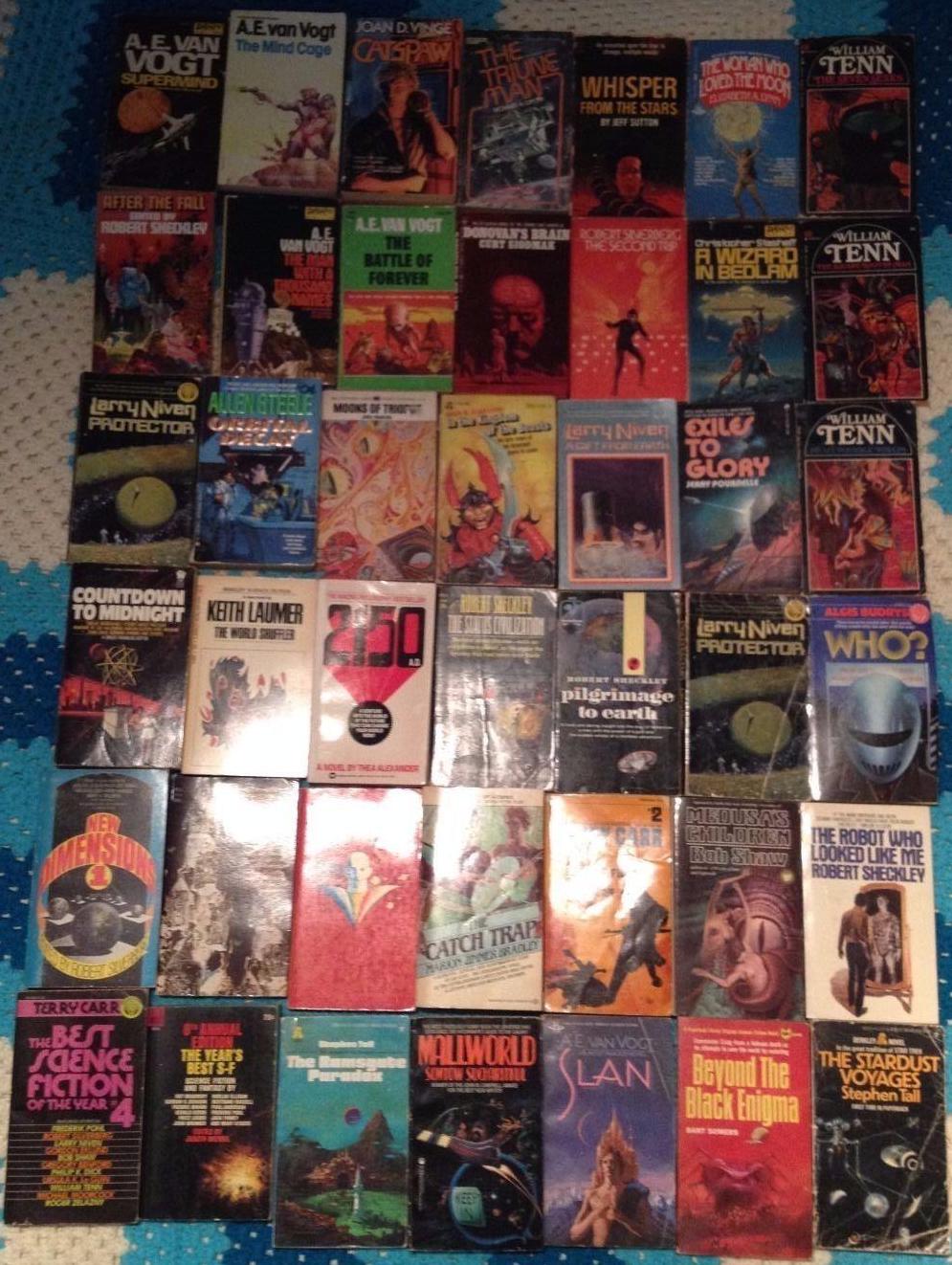
Back in January I bought a nice lot of 42 vintage science fiction paperbacks on eBay. Most were from the 70s and 80s, and most were in pretty good shape. Enough to keep me busy for a month, taking them out of the box one by one and cooing over them.

Most of you are probably too young to remember that far back, when the Cold War was at its height and the specter of nuclear war loomed over everything. In November 1981 Gallup found that 53% of American adults expected a nuclear war within a decade, and after Nicholas Meyer’s apocalyptic TV film The Day After and NBC’s tense mock-documentary Special Bulletin, about terrorists who detonate a nuclear weapon, both aired in the spring of 1983, some polls showed that number rocket briefly above 70%. 70%! These days we can’t even get that many to agree that the President of the United States is Christian.

Not too surprisingly, a lot of science fiction from the era was preoccupied with tales of the apocalypse. The Cold War is long over, but those paperback treasures, with their morbidly imaginative visions of the end of the world and beyond, are still with us. You can find plenty of great anthologies with that theme very cheaply if you look (the ones I haven’t hoarded in my basement, anyway.) Today I want to look at three that I pulled out of my newly acquired collection: Robert Sheckley’s After the Fall (1980), H. Bruce Franklin’s Countdown to Midnight (1984), and Robert Silverberg’s New Dimensions 1.

Read More Read More

Vintage Treasures: The Silistra Quartet by Janet Morris

Vintage Treasures: The Silistra Quartet by Janet Morris

High Couch of Silistra-small The Golden Sword Janet Morris 1981-small

In the last few weeks I’ve touched on a few tales of modern writers who didn’t make it — or at least, fantasy series that never got off the ground, and died after one or two hardcover releases without even a paperback edition. To switch things up a bit, today I thought I’d look at one of the most successful fantasy debuts of all time, a series that became a huge international hit with its first release, launching the career of one of the most prolific fantasy writers of the late 20th Century: Janet Morris’ The Silistra Quartet.

The Silistra Quartet began with Janet’s first novel, High Couch of Silistra, which appeared in paperback from Bantam Books in 1977 with a classic cover by Boris (above left). Although it was packaged as fantasy, High Couch was really science fiction, the far-future tale of the colony planet of Silistra, still recovering from an ancient war that left the planet scarred and much of the population infertile. With a dangerously low birth-rate, it’s not long before the human colonists of Silistra develop a new social order, with a hierarchy based on fertility and sexual prowess.

Read More Read More

Jack Binder and the Early Chicago SF Fan Club

Jack Binder and the Early Chicago SF Fan Club

14 leaflet 1937 spring-small

Back in the mid-1930’s, one of the most active science fiction fan clubs was the Chicago Science Fiction Club, which had among its members such fans as Jack Darrow (among fandom’s most prolific writers of letters of comment to the SF pulps), Earl and Otto Binder (the Eando Binder writing team), Jack Binder (their brother, an artist), Walter Dennis and Paul McDermott (both of who had started the Science Correspondence Club in 1929 and later published The Comet, edited by Ray Palmer and arguably the first SF fanzine), William Dellenback, Allen Kline (brother of author Otis Adelbert Kline) and Howard Funk. The Chicago Club had formed as the Chicago Chapter of the Science Fiction League, the nationwide fan organization created and promoted by Wonder Stories. The Chicago Chapter’s activities were prominent in the pages of Wonder Stories, and in Sam Moskowitz’ words, it was “the outstanding chapter of the time.”

From November 1935 to the Spring of 1937, the Club published a fanzine called The 14 Leaflet. The Spring 1937 issue is available online as a pdf in the fanzine section of fanac.org. The copy that’s online, however, is missing the first interior page of the issue. Following the cover (by William Dellenback; I acquired his original preliminary for it back in 2001 when I bought material from Jack Darrow’s estate) but before page 1, many copies of the issue had another page inserted, which contained 19 very small photos (all taken by Dellenback) of various club members. The photos were all glued to a plain sheet of white paper, with numbers identifying them, with the code, revealing the identities of the folks in the photos, on page 2. However, the copy scanned online was apparently missing this photo page. On page 11 of the issue, the editors noted that 50 copies were being printed with the photo page (most going to the members) and 25 copies were being printed without the photo page.

I’ve looked for the Spring 1937 issue of The 14 Leaflet for many years, but had not had any success finding it. I wanted to see those photos!

Read More Read More

Future Treasures: The Human Chord/The Centaur by Algernon Blackwood

Future Treasures: The Human Chord/The Centaur by Algernon Blackwood

The Human Chord The Centaur Algernon Blackwood-small The Human Chord The Centaur Algernon Blackwood-back-small

I’m embarrassed to admit that I’ve not read much Algernon Blackwood. But I’ve been educated on his substantial contributions to the American horror genre by my fellow Black Gate writers, especially Ryan Harvey and Bill Lengeman. In his 2009 post “The Incredible Adventures of Algernon Blackwood,” Ryan wrote:

Of all the practitioners of the classic “weird tale”…  none entrances me more than Algernon Blackwood. Looking at the stable of the foundational authors of horror — luminaries like Poe, James, le Fanu, Machen, Lovecraft — it is Blackwood who has the strongest effect on me. Of all his lofty company, he is the one who seems to achieve the most numinous “weird” of all.

Blackwood is often referred to as a “ghost story” writer… But true ghosts rarely appear in his fiction. Blackwood liked to dance around the edge of easy classification, and as his work advanced through the 1900s and into the teens, it got even harder to pinpoint. Blackwood’s interest in spiritualism, his love of nature, and his pantheism started to overtake his more standard forays in supernatural terror. His writing turned more toward transcendentalism and away from plot. The most important precursor to this development is his 1911 novel The Centaur, which critic S. T. Joshi describes as Blackwood’s “spiritual autobiography.”

And in his 2015 review of Algernon Blackwood’s The Empty House and Other Ghost Stories, Bill Lengeman clearly agreed.

Read More Read More

New Treasures: A Cure For Cancer by Michael Moorcock

New Treasures: A Cure For Cancer by Michael Moorcock

A Cure for Cancer Moorcock-small A Cure for Cancer Moorcock-back-small

Titan Books has been doing a marvelous service for modern fantasy fans, as they gradually reprint Michael Moorcock’s back catalog — including some of the most fondly remembered fantasy of the 20th Century. They began with his early steampunk trilogy Nomad of the Time Streams (starting with The Warlord of the Air), and continued with the complete Chronicles of Corum. This year they’ve turned their attention to the Cornelius Quartet, starring the hippest adventurer in fantasy, scientist and rock star Jerry Cornelius.

The first volume, The Final Programme (which we gave away three copies of last month) was published on February 2. Volume Two, A Cure For Cancer, arrived earlier this month. A mirror-image of his former self, Jerry Cornelius returns to a parallel London, armed with a vibragun and his infamous charisma and charm, and hot on the trail of the grotesque Bishop Beesley. Click on the cover above for the complete book description (or just to gawk at the trippin’ cover art).

A Cure For Cancer was published by Titan Books on March 1, 2016. It is 340 pages, priced at $9.95 in paperback and $7.99 for the digital version. The cover was designed by Julia Lloyd.

The Problem With Marion Zimmer Bradley: Rich Horton on Falcons of Narabedla/The Dark Intruder

The Problem With Marion Zimmer Bradley: Rich Horton on Falcons of Narabedla/The Dark Intruder

Falcons of Narabedla 1964-small The Dark Intruder 1964-small

In a recent review at his blog Strange at Ecbatan, Rich Horton tackles the thorny subject of Marion Zimmer Bradley, one of the top-selling fantasy writers of the 20th Century (The Mists of Avalon, Darkover) head on.

In 1964… Marion married Walter Breen, a fellow SF fan and a noted numismatist, within a month. Breen was already well known as an advocate of pederasty, and MZB certainly knew of his proclivities, and indeed Breen had been banned from at least one SF convention in that time period. Breen had been convicted of pederasty-related crimes as early as 1954, and continued to have trouble with the law, finally going to jail after another conviction in 1990. MZB managed to dodge serious consequences of her husband’s activities throughout her life, and she died in 1999. In 2014 her daughter, by Breen, Moira Greyland, accused her of sexual abuse, and in retrospect it seems to me that it should have been clear all along that Bradley was at least negligently complicit in her husband’s crimes, certainly aware of them, and now it appears more likely than not that she was a participant herself. (Though I suppose I must add that damning and convincing as the accusations seem, Bradley never did have a chance to defend herself against those that came after her death, though some of her own testimony given during Breen’s legal troubles is chilling enough.) This has understandably had a devastating effect on her reputation — and she was not really a good enough writer to make it likely that her work will long survive the posthumous stain. Jim Hines briefly discusses this, with links to more direct information, in a good blog post here.

With that preamble, he has another look at Bradley’s 1964 Ace Double, the novel Falcons of Narabedla paired with the collection The Dark Intruder.

Read More Read More