Browsed by
Category: Vintage Treasures

Galaxy Science Fiction, April 1953: A Retro-Review

Galaxy Science Fiction, April 1953: A Retro-Review

Galaxy April 1953-small Galaxy April 1953 contents-small

Galaxy’s April, 1953 issue includes a story by fellow Hoosier, Kurt Vonnegut, Jr. I hadn’t read any of his work previously. Gasp! So I was excited to find something of his within Galaxy.

“Made in U.S.A.” by J. T. M’Intosh — Roderick began a divorce trial with his newlywed wife, Alison. The couple had been in love, but when Roderick found out she was an android, he wanted to end the marriage. Though androids are identical to humans in many ways, they lack the ability to produce children. As to why Alison withheld the truth of who she was, it was within the statutes of the law — androids have equal status in society.

Read More Read More

A Helluva Detour: The Mysterious Island

A Helluva Detour: The Mysterious Island

Mysterious Island poster-small

The Mysterious Island (1961)
Based on a novel by Jules Verne
Directed by Cy Endfield

It wasn’t my intention to watch a bunch of adventure movies lately that all dated from the early Sixties. It just worked out that way. As coincidence would have it, the three I watched shared a similar theme — that of being stranded. The Lost World (1960) found a group of adventurers stranded on a high plateau in South America. In Robinson Crusoe on Mars (1964), well, you can figure that one out. In The Mysterious Island (1961), a group of Union soldiers and a Confederate find their balloon swept way off course, all the way from Virginia to a point located somewhere in the South Sea Islands of the Pacific Ocean. Which is a helluva detour, by my reckoning.

Like The Lost World, which was based on a story by Sir Arthur Conan Doyle, The Mysterious Island is an adaption of a work by a well-known author of yesteryear. Jules Verne’s first novel, Five Weeks in a Balloon, was published in 1863 and in the next decade or so he turned out a number of books, including Journey to the Center of the Earth, From the Earth to the Moon, Twenty Thousand Leagues Under the Sea, and Around the World in Eighty Days. He returned to balloon adventures in The Mysterious Island, which was published in 1874. But it was hardly the end of the line for the prolific Verne, who had written his best known novels by this time, but who turned out many more novels before his death in 1905.

Read More Read More

Vintage Treasures: Moons of Triopus by John Rankine

Vintage Treasures: Moons of Triopus by John Rankine

Moons of Triopus-small Moons of Triopus-back-small

One of the reasons I like to buy collections is that they frequently come with books I’m not looking for. Like this copy of John Rankine’s 1969 paperback Moons of Triopus, with its trippy Richard Powers cover.

I didn’t need to tell you I wasn’t looking for this book. No one on Earth is looking for this book. If there’s a forgotten novel in the canon of 20th Century science fiction, it’s John Rankine’s Moons of Triopus. No one is looking for John Rankine, either. He never existed. ISFDB tells me “John Rankine” was a pseudonym for David R. Mason, the British writer who wrote a zillion SF novels between 1966 and 2003. Has anyone out there read Moons of Triopus? Anyone other than Rich Horton, I mean.

Well, it doesn’t matter. The book is in my hands, so it’s my responsibility now. If Black Gate has a purpose, it’s to explore strange new worlds and seek out neglected SF and fantasy books. My duty is clear; I have to give it a try. The description on the back talks about newly found planets, constant danger, colonists, ominous answers, and “the fate of the galaxy!” Doesn’t sound too bad. Wish me luck.

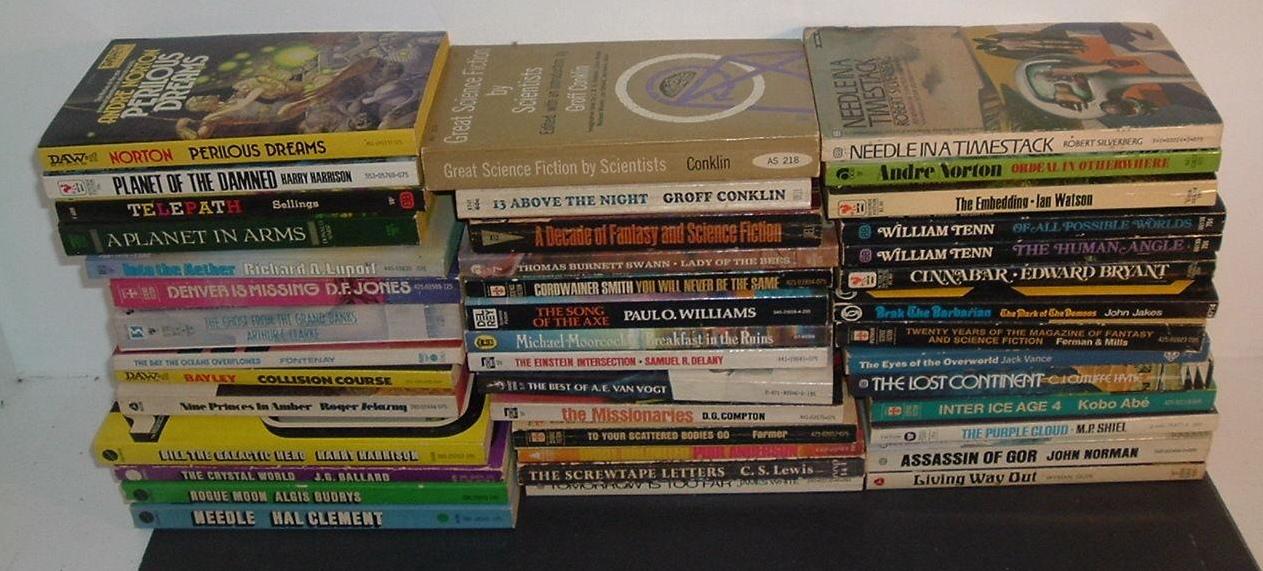
Moons of Triopus was published by Paperback Library in November 1969. It is 157 pages, priced at 60 cents. The cover is by Richard Powers. It was out of print for 44 years, until it was released in digital format by Golden Apple in October 2013. I got my copy as part of a lot of 42 books I bought on eBay for $9.50. Turned out to be a good deal.

Deep Space Scavengers, Pirates, and a Space Witch: Rich Horton on Great Science Fiction Adventures

Deep Space Scavengers, Pirates, and a Space Witch: Rich Horton on Great Science Fiction Adventures

Science Fiction Adventures December 1956 Science Fiction Adventures January 1958-small Science Fiction Adventures June 1958-small

Over at his personal blog Strange at Ecbatan, Rich Horton takes a look at the 1963 anthology Great Science Fiction Adventures, which collects three novellas and a novelette, all from the late-50s magazine Science Fiction Adventures. The stories are:

“The Starcombers” by Edmond Hamilton (December 1956, above left; cover by Emsh)
“Hunt the Space-Witch!” by Robert Silverberg (as Ivar Jorgenson; January 1958, above middle; cover by John Schoenherr)
“The Man from the Big Dark” by John Brunner (June 1958, above right; cover by Emsh)
“The World Otalmi Made” by Harry Harrison (June 1958, above right; cover by Emsh)

Coincidentally, the January 1958 issue also includes the novella “One Against Herculum,” by Jerry Sohl, which was eventually included in Ace Double #D-381 in 1959, paired with Secret of the Lost Race by Andre Norton (which we covered here.)

Not too surprisingly, of the stories in the anthology, Rich prefers the Brunner.

Read More Read More

Vintage Treasures: The Robot Who Looked Like Me by Robert Sheckley

Vintage Treasures: The Robot Who Looked Like Me by Robert Sheckley

The Robot Who Looked Like Me-small The Robot Who Looked Like Me-back-small

Robert Sheckley wrote over two dozen novels before his death in 2005, but he’s best remembered today for his short fiction, gathered in some 20 collections between 1954 and 2014. He has a fine reputation for a sharp wit, idiosyncratic style, and offbeat sense of humor, and that’s kept some of his most famous collections in print for years — including The Robot Who Looked Like Me, originally published in the UK in 1978, reprinted by Bantam in the US in 1982, and still in print over three decades later.

The Robot Who Looked Like Me contains thirteen stories, including the title story, originally published in Cosmopolitan (!) in August 1973. It’s not at all the kind of story I’d expect to find in Cosmopolitan, but maybe things were different in the early 70s. Very, very different.

Read More Read More

Otto Binder on John W. Campbell

Otto Binder on John W. Campbell

John W Campbell-small

John W. Campbell (photo by Astounding cover artist Hubert Rogers)

Back to Otto Binder letters today. This one, from Binder to his friend, Jack Darrow, dated May 23, 1937, was written just before Binder was cut loose from Otis Adelbert Kline’s literary agency, which happened on June 1 of that year. As a result of his job upheaval, Binder spent some time, unsuccessfully, trying to land a gig as an editor (and a few years later interviewed with Ziff-Davis re: the Amazing Stories opening before it was given to Ray Palmer).

The letter is primarily of interest due to its discussion of John W. Campbell, a few months before Campbell would become editor of Astounding. It’s a shame that no more detailed record of the story telling game played at Binder’s house between him, Dr. John Clark, Frank Belknap Long, Campbell and Campbell’s wife exists; it would have been fascinating to sit in on this! Binder is clearly a fan of Campbell’s fiction (later on, when he found it difficult to sell to him at Astounding, he was not nearly as much a fan of his editing).

Read More Read More

Take a Daily Trip Back to the Future with Galactic Journey

Take a Daily Trip Back to the Future with Galactic Journey

Galactic Journey logoRich Horton and Matthew Wuertz have been writing retro-reviews of vintage SF magazines for Black Gate for years, and they have a lot of fans. In fact, it seems to me there’s a steadily growing interest in classic SF, and SF magazines, and a fresh crop of websites popping up to feed that interest. One of the best I’ve found is Gideon Marcus’ Galactic Journey, which reviews SF magazines as they appeared, 55 years ago.

Step through a portal that leads 55 years to the past. 1961: A youthful President named Jack Kennedy promises to reinvigorate America. Formal relations with Communist Cuba have been severed. The first American Mercury flight, piloted by a chimpanzee, anticipates an impending manned mission. Science fiction is a burgeoning field in print and on screen. It is the world of the Galactic Journey.

Jaunt back five and a half decades and dive into the sci-fi and Space Race headlines of the day. See the world through the eyes of a fan with a vintage time frame, but a progressive mindset.

At the Hugo-recommended Galactic Journey (www.galacticjourney.org), you’ll experience the world of day by day, exactly 55 years ago. You’ll stroll down memory lane — or be immersed in a whole new world. Read the in-depth articles on each satellite launch, with behind-the-scenes looks at the people who made them fly. Enjoy the thorough, slightly snarky, and never dull reviews of fiction and films, with links to copies of the reviewed works so you can follow along at home. Live an entirely different time without leaving the comfort of your screen.

Gideon covers F&SF and Analog every month, and the bi-monthly Galaxy and IF in alternating months. He’s looking for reviewers to cover Amazing and Fantastic. The blog has been active since October 2013, starting its coverage in late 1958.

Read More Read More

Vintage Treasures: Machines That Kill, edited by Fred Saberhagen & Martin Harry Greenberg

Vintage Treasures: Machines That Kill, edited by Fred Saberhagen & Martin Harry Greenberg

Machines That Kill-small Machines That Kill-back-small

Today’s Vintage Treasure is a fine example of a recently extinct species: the mass market anthology.

Allow me a moment to mourn the loss of this beautiful and now-vanished creature. In days gone by, mass market anthologies thundered in vast herds across bookstore shelves, terrorizing lesser tomes. A single bookstore ecosystem could support a vast number of anthologies with a spellbinding array of thematic plumage, from horror to romantic fantasy to sword & sorcery and far future SF. In recent years, publishers such as DAW kept a dwindling number of anthologies alive in captivity for breeding purposes, but these efforts generally resulted in weak-blooded specimens about cats and unicorns. Today, the only relatives of the mass market anthology that survive are its larger cousins, the trade paperback and small press hardcover.

But not so long ago this creature strode proudly across the publishing savannah, introducing the curious to new writers, helping readers discover a wide range of different voices they might not otherwise encounter. The one I want to talk about today is the 1984 Ace paperback Machines That Kill, edited by Fred Saberhagen & Martin Harry Greenberg.

Read More Read More

That Movie About the Guy Who’s Stranded on Mars

That Movie About the Guy Who’s Stranded on Mars

Robinson-Crusoe-on-Mars-poster-small

Robinson Crusoe on Mars
Paramount Pictures, 1964
Directed by Byron Haskin

(There will be spoilers.)

So there’s this movie about a guy who finds himself in the rather grim position of being stranded on Mars — all by his lonesome (more or less – but we’ll get to that).

I think you probably thought you knew the one, but it’s actually not that one. Robinson Crusoe on Mars debuted about a half century before that other, more popular, “guy stranded on Mars” movie. I haven’t seen The Martian or read the book, so I can’t compare the two. I’ll confine myself to commenting on the earlier movie.

Read More Read More

The Library of America Publishes Ross Macdonald

The Library of America Publishes Ross Macdonald

Ross Macdonald Four Novels of the 1950s-small Ross Macdonald Three Novels of the Early 1950s-small

The Library of America has been busy as all get-out recently, pumping out archival quality omnibus volumes of Kurt Vonnegut, Elmore Leonard, Raymond Chandler, Dashiell Hammett, Philip K. Dick, H. P. Lovecraft, Ambrose Bierce, David Goodis, and other 20th Century genre authors. The latest beneficiary of all this attention is hardboiled crime fiction writer Kenneth Millar, who published under the name Ross Macdonald.

The first volume, Ross Macdonald: Four Novels of the 1950s, packed in four novels featuring popular private detective Lew Archer:

The Way Some People Die (1951)
The Barbarous Coast (1956)
The Doomsters (1958)
The Galton Case (1959)

Here’s a look at the original paperback editions (click for bigger images).

Read More Read More