Browsed by
Category: Reviews

Steampunk Spotlight: Cherie Priest’s Boneshaker

Steampunk Spotlight: Cherie Priest’s Boneshaker

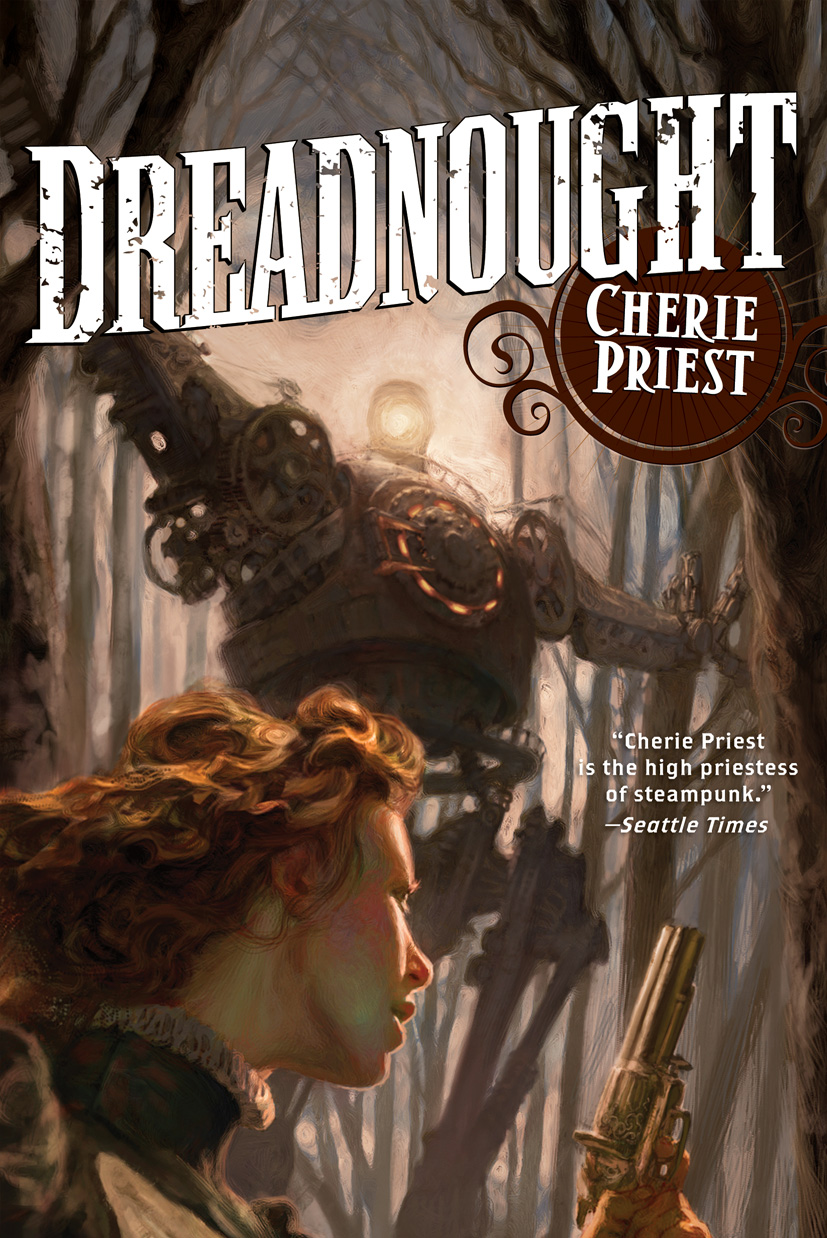
boneshaker3One of the most popular steampunk books of the last few years, Boneshaker (Amazon, B&N) melded some of the most popular genre elements of steampunk and the zombie apocalypse wave of fiction. In this review from Black Gate #15, I commented that the book was a little action-heavy, full of zombie chases that didn’t always translate well on the printed page. I compared it to a George Romero film … and it turns out that someone took that to heart, because it’s being made into a film. I don’t normally go to zombie movies, but I’ll definitely make an exception for this one, which may well be the most visually-stunning zombie film ever.

Boneshaker

Cherie Priest
Tor (416 pp, $15.99, 2009)
Reviewed by Andrew Zimmerman Jones

Steampunk is traditionally set in a Victorian urban environment, with a veneer of gentility that covers a darker underbelly. And steampunk almost always includes airships (or at least flying bicycles)… often with air pirates in tow.

The weird west mythos, on the other hand, represents the frontier. While technology is usually central to steampunk, the weird west is often defined by some sort of monster (frequently zombies), but these elements can cross genres. The 1999 Will Smith film Wild Wild West featured a flying bicycle and a giant robotic spider, firmly placing it in the camp of steampunk by most accounts, but containing many weird west elements.

Boneshaker takes many of these staples, puts them in a blender, and sets to mix. It is set in a modified 1880’s Seattle, which has been walled off because a gas drifting out of the ground turns people into zombies.

Read More Read More

Mark Rigney Reviews Ivy’s Ever After

Mark Rigney Reviews Ivy’s Ever After

ivys-ever-afterIvy’s Ever After
Dawn Lairamore
Holiday House, Inc., (311 pp, $16.95, 2010)
Reviewed by Mark Rigney

There is a land where children go, to fill their minds with castles and kings and queens and rescues and, well, you know. All that stuff. For some, that land comes equipped with polyhedron dice. For seasoned readers ready to dispense with their dice, one can always fall back on Tolkien, Sir Walter Scott, or Le Morte d’Arthur. But what if you happen to be, say, nine years old, and a veteran of second-hand My Pretty Ponies and half-remembered episodes of TV’s greatest fantasia, Sesame Street? The Babysitter’s Club won’t be for you, no, and Swallows and Amazons might be a little dated. Time, then, to sample the gentle charms of Ivy’s Ever After.

Dawn Lairamore has two things on her mind from the get-go. First, she sets out to tell a quite traditional tale set (of course) in a distant, unknown realm where a crisis of succession will soon vault young Princess Ivy into being the only one in the entire kingdom who can save the kingdom entire. Second, she wants to upend the genre just enough to ensure that Ivy actually will be a heroine worthy of a post-Sigourney Weaver world, a heroine who will rely not at all on the hapless men in her life (including her father, the king), and, indeed, not by any male aside from the rather large, winged exception of the dragon set to guard Ivy’s tower.

Read More Read More

Black Static #26

Black Static #26

black-static-26Black Gate contributor Mark Rigney’s story, “The Demon Laplace,” inspires the cover art by Rik Rawling for the December 2011-January 2012 Black Static. A variation of the “be careful what you wish for” trope, Rigney’s protagonist, Alan, is a 27 year-old postal worker whose lackluster love life has him worrying that he’ll never find someone to settle down with or, worse, he’ll settle for whoever might come along.  Then he meets mercurial Michael Wish (ostensibly short for Wyczniewski), a postal colleague of Alan’s who is taking a break from grad studies in statistics.  Michael in Hebrew means “he who is like god” and who better than a god to grant wishes; unless, that is, the god is really a devil.

Further complicating the picture is whether mathematics can actually predict future behavior (if you aren’t familiar with Laplace’s equation, Google can explain it for you).  After a series of what could be clever parlor tricks, an initially dubious Alan comes to invest god-like powers in Michael when the prediction that Alan will marry the next woman he talks to comes true.

The question is does it come true because Michael actually can predict the future or is it because Alan is so thorough convinced of Michael’s prestidigitation that he acts to make it true? Knowing, or at least believing, that someone can foretell future events leads to Alan’s obsession with finding out what he should do next. Problem is, Michael disavows that he was really doing anything more than “messing” with Alan:

“You little jackass. You want what really happened. Fine. When we met, sorting mail? That was a break from grad school–statistics,yes, probability curves — but I was halfway through my thesis, I was bored stiff, and I needed some kind of inspiration. Turns out what I needed was a live. unsuspecting subject. And there you were, a walking tabula rosa, just going with the flow…You fell for everything I said, hook, line and sinker. There. Is that what you came to hear?

4081Problem is, that’s not what Alan came to hear. Which results in tragedy (you are reading a dark horror magazine so why would you expect anything less?) that may, or may not, have been easily foreseen.

In your future I see some interesting reading ahead.

David Soyka Reviews Is Anybody Out There

David Soyka Reviews Is Anybody Out There

is-anybody-out-thereIs Anybody Out There?
Nick Gevers and Marty Halpern, eds.
DAW (312 pp, $7.99, June 2010)
Reviewed by David Soyka

The $64 question of the modern era is not whether God exists. How you answer that depends on intangibles and inferences based more on faith than the scientific method. What is nearly as imponderable is the empirical evidence of a vast universe (and possibly co-existent multi-verses) within which conditions exist (or once existed) that may give rise to life as we know it (putting aside consideration of life as we don’t know it and are incapable of comprehending). Moreover, given the age of the universe, it is further conceivable that there is, somewhere in some galaxy, more advanced civilizations capable of interstellar travel that, by now, should be aware of our existence. Even if we are in an Einsteinean universe in which speed of light travel cannot be exceeded, seeing as how that we are already capable of mapping distant universes, presumably a more advanced civilization would have the technology to find us and make radio contact, just as we have been launching Elvis recordings out beyond the solar system in hopes of doing the same. With no results.

So, where are they? This is the crux of the famous Fermi Paradox, posed by the Nobel physicist who reasoned that given the mathematical probabilities of the existence of alien civilizations, why hasn’t anyone phoned home? Is it truly possible that we are the only intelligent beings in the universe? Or, more depressing, are “intelligent” beings fated to self-destruct, allowing technology to harness their fate instead of the other way around, before becoming capable of interstellar travel?

Read More Read More

Edgar Rice Burroughs’s Mars, Part 2: The Gods of Mars

Edgar Rice Burroughs’s Mars, Part 2: The Gods of Mars

gods-of-mars-1st-editionI played a bit rough with A Princess of Mars last week in my first installment of this eleven part mega-series on the Martian novels of Edgar Rice Burroughs. That book knocked me out when I first read it as a junior high school kid, but it was also the first ERB book I ever picked up. Now that I’ve read most of Burroughs’s canon, the flaws of his first book seem more obvious. For all that is wonderful about A Princess of Mars, it looks like a runt compared to the book I knew was snapping at its heels: The Gods of Mars. Also known as: “Edgar Rice Burroughs gets the knack.”

Our Saga: The adventures of Earthman John Carter, his progeny, and sundry other visitors and natives, on the planet Mars. A dry and slowly dying world, the planet known to its inhabitants as “Barsoom” contains four different human civilizations, one non-human one, a scattering of science among swashbuckling, and a plethora of religions, mystery cities, and strange beasts. The series spans 1912 to 1964 with eleven books: nine novels, a book of linked novellas, and a volume collecting two unrelated novellas.

Today’s Installment: The Gods of Mars (1913)

Previous Installment: A Princess of Mars (1912)

The Backstory

In his original proposal to editor Thomas Newell Metcalf at Munsey’s Magazines regarding a novel of Martian adventure, Edgar Rice Burroughs suggested he could write three books from the concept. But he apparently wasn’t certain about the content of the second and third volumes to follow A Princess of Mars, since it was Metcalf who gave him the idea of where to start the next book. After Metcalf rejected Burroughs’s second novel, The Outlaw of Torn, he urged the author to return to Mars and send John Carter into the Valley of Dor, the mysterious paradise mentioned a number of times in the first book. Burroughs ran with the concept, and finished the novel in the beginning of October 1912.

Read More Read More

Book Review: Jim C. Hines’ The Mermaid’s Madness

Book Review: Jim C. Hines’ The Mermaid’s Madness

themermaidsmadnessThe Mermaid’s Madness

Jim C. Hines
DAW (339 pp, $7.99, 2009)
Reviewed by Andrew Zimmerman Jones

Jim Hines has developed a name for himself by taking traditional fantasy and warping it into a twisted, entertaining, and amusing adult fantasy storyline. His first series, the Jig the Goblin Trilogy (Goblin QuestGoblin Hero, and Goblin War), took traditional roleplaying game fantasy clichés – complete with a dwarf who is obsessed with mapping out the dungeon the protagonists are crawling – and turns it on its ear by making a goblin the hero of the series.

In his Princess Novels, he has taken the three classic princesses of fairy tales – Cinderella, Snow White, and Sleeping Beauty – and turned them into a trio of bad-ass fantasy heroines. (You may insert your own Charlie’s Angels comparison here.)

Snow and Talia (i.e. Sleeping Beauty) are living in exile, serving Queen Beatrice – the mother of Cinderella’s prince charming, Armand – as a sort of secret agent squad. Snow is a sorceress, with an emphasis on mirror-based magic. Talia is basically a weapon expert and all-around combat machine.

Read More Read More

Steampunk Spotlight: Scott Westerfeld’s Leviathan Trilogy

Steampunk Spotlight: Scott Westerfeld’s Leviathan Trilogy

leviathan

Leviathan (Amazon, B&N)
Scott Westerfeld
Simon Pulse (440 pp, $9.99, Oct. 2009)

Behemoth (Amazon, B&N)
Scott Westerfeld
Simon Pulse (5112 pp, $9.99, Oct. 2010)

Goliath (Amazon, B&N)
Scott Westerfeld
Simon Pulse (543 pp, $19.99, Sept. 2011)

Reviewed by Andrew Zimmerman Jones

Scott Westerfeld’s Leviathan trilogy is an epic about an alternate-history version of World War I … and a great example of how steampunk can really work well when it’s firing on all cylinders (both literally and figuratively). In this, the military conflict isn’t just political, but also centers around an ideological difference about technology. The British and Russians have embraced Charles Darwin’s biological insights to breed massive war beasts, while the German alliance put their faith in mechanical (frequently multi-legged) battle machines.

In addition to the global conflict, the major tension in the story centers around two young characters – one from each side of the battle – who are living with their own secrets in the midst of the war. One is a girl disguised as a boy so that she can serve in the British military upon the living zeppelin Leviathan. The other is a prince (and secret heir to the Austrian Empire) on the run from his own people.

On top of all of that, there’s also a romance … even though one of the participants doesn’t realize it for quite some time.

Read More Read More

Charlene Brusso Reviews Conspirator (Foreigner #10)

Charlene Brusso Reviews Conspirator (Foreigner #10)

conspiratorConspirator
C. J. Cherryh
DAW (416pp, $25.95, May 2010)
Reviewed by Charlene Brusso

There is more to communication than mere words. Sure, words have meanings, but they are also, thanks to evolution, tied intimately to the way we think and feel, and the world we live in. Language doesn’t just describe culture or psychology, it is culture and psychology, it’s how we are wired, and assuming that a word can be translated exactly from one culture to another – or, worse yet, from one species to another – is a rookie linguist’s mistake. That is why xenolinguistics is such a challenge. And that is why “first contact” stories are so fascinating – and so difficult to do well.

Nobody does them better than C.J. Cherryh. In novels like Serpent’s Reach and Hunter of Worlds, and series like the Charnur and the Faded Sun books, she has delved deep into the tricky psychological aspects of communication between different, sometimes very alien, species. That challenge to understand lies at the very heart of the Foreigner series, of which Conspirator is the lucky thirteenth volume. Technically, it is the first book of the fourth trilogy in the arc, but don’t be intimidated by that. Cherryh slips in just enough backstory to get you grounded before taking off at full speed into the current situation.

Read More Read More

Matthew David Surridge Reviews Shadow Prowler

Matthew David Surridge Reviews Shadow Prowler

shadowprowler-coverShadow Prowler
Alexey Pehov, translated by Andrew Bromfield
Tor (412 pp, $7.99, mass market edition February 2011)
Reviewed by Matthew David Surridge

Translation enriches a language, bringing in new styles, new influences, new approaches. The phrasing, the way of thinking, native to a given language can often still be found in a text translated into another tongue. Sometimes, even an ordinary story can gain a touch of originality in translation, a kick from unexpected turns of expression.

I don’t know for sure that this is the case with Alexy Pehov’s Shadow Prowler, not speaking Russian myself, but I wouldn’t be much surprised if it were. Pehov has written a fantasy trilogy, with elves and orcs and dwarves and wizards and a quest. Despite a few self-conscious deviations from the norm – elves have fangs, dwarves don’t grow beards – this first book, at least, feels fundamentally like a game of Dungeons & Dragons. The story is even structured around the exploration of an ancient burial ground, Hrad Spein, the Palaces of Bone, filled with traps, magic, and the undead; a quest, naturally, better undertaken by a small party of highly-skilled adventurers rather than a large army.

Read More Read More

Edgar Rice Burroughs’s Mars, Part 1: A Princess of Mars

Edgar Rice Burroughs’s Mars, Part 1: A Princess of Mars

princess-of-mars-a-c-mcclurgThe year 2012 C.E. is the centenary of the Reader Revolution. Two novels published in pulp magazines that year, A Princess of Mars and Tarzan of the Apes, re-shaped popular fiction, helped change the United States into a nation of readers, and created the professional fiction writer. One man wrote both books: Edgar Rice Burroughs.

In celebration of this anniversary, and in anticipation of the upcoming Andrew Stanton film John Carter based on A Princess of Mars, I will tackle all eleven of ERB’s Martian/Barsoom novels in reviews for Black Gate. I also have something special in store for Tarzan of the Apes. This endeavor sounds a touch insane, but come on, but this is the centennial of the series! When else am I going to do it?

Let us turn back the calendar a hundred years to the beginning of all things…

Our Saga: The adventures of Earthman John Carter, his progeny, and sundry other natives and visitors, on the planet Mars. A dry and slowly dying world, the planet known to its inhabitants as “Barsoom” contains four different human civilizations, one non-human one, a scattering of science among swashbuckling, and a plethora of religions, mystery cities, and strange beasts. The series spans 1912 to 1964 with eleven books: nine novels, a book of linked novellas, and a volume collecting two unrelated novellas.

Today’s Installment: A Princess of Mars (1912)

The Backstory

In 1911, Edgar Rice Burroughs was thirty-five years old and selling pencil sharpeners out of an office in Chicago. His post-military service career was so far a series of undistinguished jobs that kept him and his family barely above poverty: an associate in a mining company in Idaho, a railroad policeman in Salt Lake City, a manager of a stenography department, an owner of a stationery store, and a partner in an advertising agency. No position lasted longer than two years.

Read More Read More