Fantasia 2017, Day 11: Finding Forms (The H-Man, Bastard Swordsman, and Gintama)
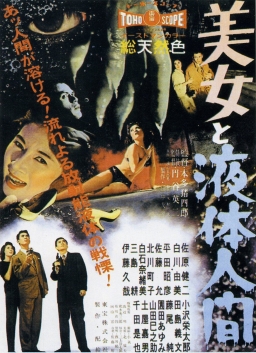 Sunday, July 23, I was down at Fantasia’s De Sève Theatre before noon to see a screening of the 1958 film The H-Man (Bijo To Ekatai-Ningen). I intended to follow that up with another vintage movie, the Shaw Brothers–produced 1983 film Bastard Swordsman (Tian can bian). Finally, I’d wrap up the day with a contemporary movie, the manga adaptation Gintama, which promised a mix of action and comedy. I liked the variety the films seemed to represent, and I was especially curious about The H-Man, which had been directed by Ishiro Honda, director of Godzilla.
It was preceded by a talk about Honda’s life given by Ed Godziszewski, who had co-written (with Steve Ryfle) Ishiro Honda: A Life in Film, from Godzilla to Kurosawa. The book comes out on October 3, with a foreword by Honda fan Martin Scorsese. It was clear that Godziszewski knew his stuff, though he had so much material he ran out of time before the film had to start. Nevertheless, what he had to say was fascinating. Without wanting to replicate Honda’s Wikipedia entry (which is relatively sparse, anyway), I want to mention some of the more interesting points Godziszewski raised.
Godziszewski began by recalling how his book came about, with the assistance of Honda’s family, and how he and Ryfle were able to see Honda’s entire body of work, including films never seen outside of Japan and rarely inside. Honda had done a lot of realist movies, especially in the 50s, that had been lost to the public for a long time and were only now beginning to show up again. Godziszewski talked about the experience of seeing 25 films he’d known nothing about, and how they demonstrated that Honda was a versatile, wide-ranging filmmaker.

 In 2016, the Fantasia International Film Festival created a showcase of short films by women directors:
  On Saturday, June 22, I reached Fantasia’s Hall Theatre before noon to see a screening of the anime Napping Princess (Hirune Hime: Shiranai Watashi no Monogatari), a story about dreams, technology, and the 2020 Olympics. After that, I had a short film showcase to see, then another feature. But before either of those, I planned to pass by the Fantasia Samsung VR 360D Experience, which, as the name implies, gives people the chance to experience VR by watching one of a selection of short films. I’d tried out the technology
  Tuesday, July 18, I set off for Fantasia with another full day before me. I planned to watch three films for which I had three different expectations. First was Animals (Tiere), a German film promising surrealism and artfulness. Then the Chinese big-budget special-effects blockbuster Wu Kong. Finally, and perhaps most intriguingly, House of the Disappeared (Si-gan-wi-ui-jip), a Korean horror movie based on a Venezuelan movie called The House at the End of Time (La casa del fin de los tiempos) which I’d seen three years ago during my first year covering Fantasia; I couldn’t help but wonder how that film would translate across cultures.