Fantasia 2019, Day 19, Part 4: Son of the White Mare
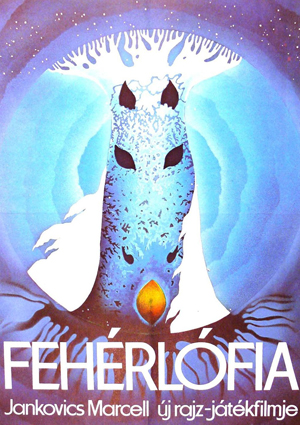 The last of the four movies I had on my schedule for July 29 promised to be interesting on any number of levels. Son of the White Mare (Fehérlófia) is an animated film made in 1981 by Hungarian Marcell Jankovics, directed by him from a script he wrote with László György. It’s based on the work of poet László Arany and folktales of the Magyars and Avars; Jankovics, who has published 15 books on comparative mythology, picked and chose from among the various versions of the tale to create what he wanted — a weird, protean, eye-popping, archetypal light show.
The version presented at Fantasia was a new 4K restoration of the movie. Hundreds of hours went into cleaning and colour-grading the film, with the participation of Jankovics. When the movie originally came out it was not a box-office success, but it has since gained a high (and thoroughly deserved) reputation among animation fans; the restoration’s an important project, and the results are beautiful, doing the colours justice.
The story itself is a fairy-tale: a king and queen are deposed, and the queen in the shape of a white horse gives birth to a boy who grows into a hero by drinking her milk. He sets out to find his brothers and destroy the dragons who overthrew his father’s rule. This entails a long journey into a mysterious underworld, where he must rescue captive princesses, slay the dragons, and return.
Beyond the subject matter, the structure’s a fairy-tale as well. It’s generally cyclical, beginning with a child in a deep dark forest and ending with the restoration of the idyllic state of things before the saga began. The rule of threes is everywhere: three brothers, three princesses, three dragons. It begins with “Once upon a time” and ends with “they lived happily ever after.”
But then the way it’s made is something else again. The animation’s expressionistic, mostly in primary colours without black contour lines, shapes frequently neon-bright and often against dark backgrounds, sometimes strobing from one hue to another. The designs are almost Blakean, mixed with elements of art-nouveau.
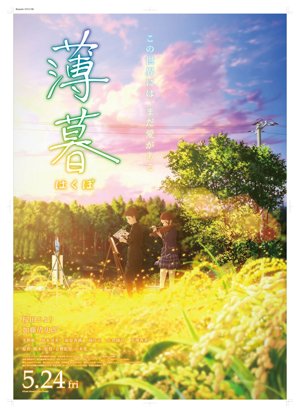 My third screening on July 29 was a double-feature at the De Sève Cinema of two animated movies, a long short and a short feature. “A Japanese Boy Who Draws” (ある日本の絵描き少年) is 20 minutes long. Twilight, which I immediately came to think of as (Not That) Twilight (and in fact some places online translate the title 薄暮, Hakubo, as Project Twilight), is 53 minutes long. They’re both slice-of-life films about young people in Japan making art, but are otherwise very different narratively and visually. Which is to say they have enough in common and enough contrast to make a fine double bill.
 One of the things that most fascinates me about film is the way Frankenstein is at least as important in that medium as it is in prose. Obviously this importance is most visible in genre film, but it’s there one way or another in the mainstream too — consider Gods and Monsters. From at least 1910, when the story was adapted into a then-epic ten-minute movie, through the tremendously important 1931 Boris Karloff version, it’s a story that’s haunted cinema. One way or another the tale or the monster comes up regularly at Fantasia, whether in Guillermo del Toro
 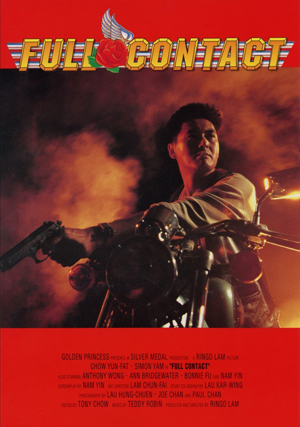 There’s still so much I don’t know about film, so many great movies I haven’t seen. Thankfully, every year Fantasia screens restorations and special presentations of a number of established classics (and semi-classics). I usually don’t have free time in my schedule to watch films I’ve already seen — I had to pass on First Blood to watch
 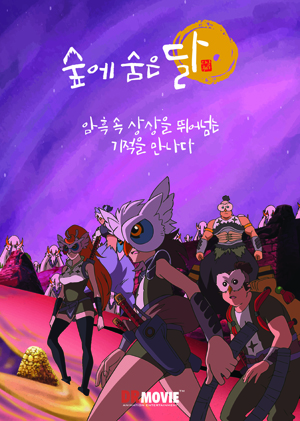 My second film of July 28 screened at the De Sève Cinema. It was an animated film from Korea with a Japanese director, Takahiro Umehara, and it was stunning. Watching early scenes of The Moon in the Hidden Woods (Sup-e Sum-eun Dal, 숲에 숨은 달) I wondered where the movie could go from its opening act — it had already shown us a major city, fights, desert nomads, monsters, a wild variety of costumes and architecture and technologies and designs. Surely, I thought, it would have to slow down. It did; and then built back up again.
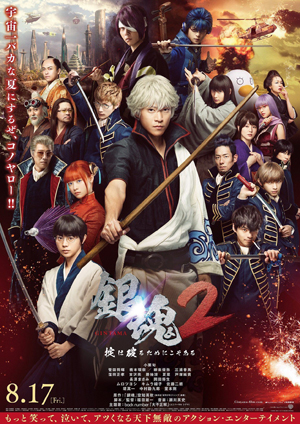 My first movie on July 28 was one of my most-anticipated of the festival. In 2017 I watched
 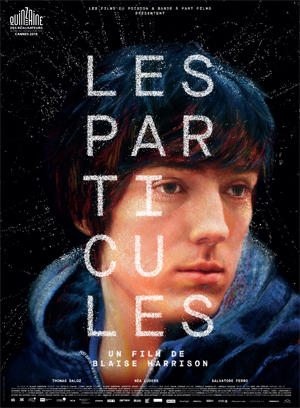 For my last movie of July 27 I crossed the street to the De Sève Cinema to take in the French-Swiss co-production Les Particules (The Particles). It’s the first fiction feature by director Blaise Harrison, who co-wrote the script with Mariette Désert. After a day of particularly frenetic movies, this was good way to end the evening; a subtler, atmospheric, intelligent, and character-based film that thoroughly succeeded at what it was trying to do.
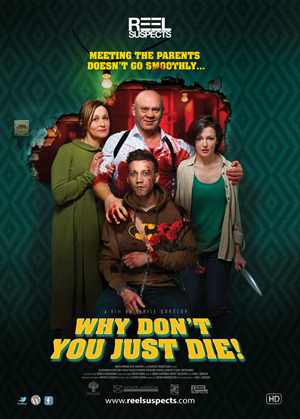 My fourth film of July 27 was once again in the Hall Theatre. It was a Russian film about which I had heard very good things, with one web site calling it among the best action movies of the year so far. You may have heard of Chekhov’s gun; well, Why Don’t You Just Die! (Papa, Sdokhni) gives us Chekhov’s gun, along with Chekhov’s other gun, Chekhov’s claw hammer, Chekhov’s power drill, Chekhov’s CRT TV, and any number of Chekhov’s other odds and ends.