Browsed by
Category: Pulp

Rick Lai and the Secret Histories of Pulp Fiction

Rick Lai and the Secret Histories of Pulp Fiction

shadows01-01sisters01Pulp historian Rick Lai is perhaps best known for his definitive chronologies of Doc Savage and The Shadow published by Altus Press. The comprehensive nature of these works has inspired more than one reader to wish Lai had dedicated his career to producing similar volumes for all other pulp series. While that particular wish may not be possible to accommodate, he has devoted much of his time and energy for the past quarter century authoring speculative articles on works of imaginative fiction. Some of his literary investigations fall within the Wold Newton framework established by Philip Jose Farmer, while others do not. Much like a dedicated theosophist indifferent to sectarianism, Lai seeks the truth regardless of where the path leads.

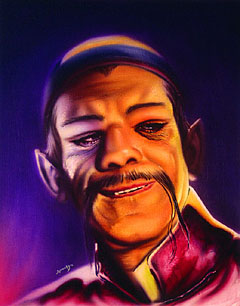
Altus Press subsequently published two volumes collecting all of Rick’s articles under the titles Daring Adventurers and Criminal Masterminds. The former features articles concerning the classic pulp hero, The Avenger; as well as more obscure characters created by Talbot Mundy and Robert E. Howard; and multiple articles concerning such well-loved characters as Peter the Brazen, Raffles, Professor Challenger, Arsene Lupin, and Jules de Grandin. The second volume shifts the focus to the villains readers loved to hate such as Fu Manchu and various Yellow Peril clones including Hanoi Shan and Sumuru; Jules Verne’s seminal super criminals, Captain Nemo and Robur the Conqueror; Guy Boothby’s highly obscure Dr. Nikola; Bulldog Drummond’s arch-nemesis, Carl Peterson; and the most famous criminal mastermind of all, Professor Moriarty from the Sherlock Holmes series by Sir Arthur Conan Doyle.

Read More Read More

Vintage Treasures: Prince of Foxes by Samuel Shellabarger

Vintage Treasures: Prince of Foxes by Samuel Shellabarger

Prince of Foxes-smallIf you’ve been reading my Vintage Treasures posts for any length of time, you’re probably aware I have a weakness for buying small collections. Especially vintage paperback collections.

There are a few ways to find interesting lots on online auctions sites like eBay, but I’ve had the most success recently searching for Bantam Giants, a line which repackaged a lot of popular historical adventure fiction in paperback with terrific covers — and without chopping it up first to fit the smaller format, a common practice in the early days of paperbacks.

Bantam Giants are a great way to learn about new writers (okay, old writers, but new to me), and they’re ridiculously cheap. They sold — by the tens of thousands — on newsstands for 35 cents in the early 1950s. Generally speaking, copies in fine condition are still fairly common, and don’t cost much more than that now.

Last year I talked about discovering the works of Lawrence Schoonover, especially his 13th Century adventure novels The Golden Exile and The Burnished Blade. Tucked into the same collection that contained those volumes was a gorgeous book titled The King’s Cavalier, by someone named Samuel Shellabarger.

My guides through the world of 40s and 50s historical adventures, the Honorable Howard Andrew Jones and John C. Hocking, have been telling me about Shellabarger for years. So I was delighted to find another of his novels in the latest collection of Permabooks and Bantam Giants I acquired last month: Prince of Foxes, a tale of adventure and intrigue in Renaissance Italy.

It follows the exploits of Andrea Orsini, a talented and resourceful peasant who rises through the ranks to become a political agent for the sinister Cesare Borgia. It was filmed in 1949, with Orson Welles as Borgia and Tyrone Power as Orsini.

Read More Read More

Fredric Brown, Stanley G. Weinbaum, and Appendix N: Advanced Readings in D&D

Fredric Brown, Stanley G. Weinbaum, and Appendix N: Advanced Readings in D&D

What Mad Universe-smallTime to get caught up with the tireless Mordicai Knode and Tim Callahan, as they trek towards the finish line of their epic Appendix N re-read over at Tor.com.

This time, they take a look at two names very familiar to Black Gate readers: Fredric Brown and Stanley G. Weinbaum, both of whom we’ve discussed recently, and at considerable length.

In fact, just last week I examined The Best of Fredric Brown, calling it “one of the best short story collections I’ve read in years.” Any collection which included “Arena,” “Puppet Show,” and “The Geezenstacks” has to be considered a classic, and I was looking forward to seeing what our intrepid literary explorers thought of it.

Not much, going by Tim’s analysis:

A spaceman single-handedly battles for the fate of the human race. A god plays war games with knights and bishops. Test tube babies become the new anointed ones. A mountaineer comes face-to-face with a yeti. Earth’s first contact with Mars goes horribly awry.

These are things that happen in the stories, often very short stories, of Fredric Brown. I can see why Gary Gygax liked them.

Unfortunately, their connection to Dungeons & Dragons is vague at best. They seem to fall into a category that, after reading most of these Appendix N recommendations, I can now confidently call Somewhat Clever Things Gary Gygax Enjoyed but are Pretty Tedious to Read Today.

Like the works of L. Sprague de Camp and Fletcher Pratt, the stories by Fredric Brown seem to be the kinds of tales that would delight Gygax with their intellectual playfulness and that might be reason enough for their inclusion on his list of recommended reading, but the cleverness only goes so far, and the stories feel pretty thin otherwise.

Bah. I don’t mean to critique the critic, but I think Tim was asleep at the switch here. Maybe he should have read these magical tales on a long plane-ride to Las Vegas, like I did, instead of hunched over his laptop, thirty minutes before deadline.

Read More Read More

An American Fantasy Master: The Pulp Art of Virgil Finlay

An American Fantasy Master: The Pulp Art of Virgil Finlay

Virgil Finlay cover for Famous Fantastic Mysteries-smallJohn O’Neill graciously offered me a spot in Black Gate’s blogosphere. How nice of him. Silly man, now he has to put up with me.

Most of you probably don’t recognize my name, but I’ve been in the fantasy-sf-comics business for years. I’ve worked at Cinefantastique magazine (and written for it), Mayfair Games, and First Comics. In 1984, I began freelancing and have worked for a number of specialty presses as designer, consultant, guru, you name it.

A few years ago, I decided I wanted more control of the work I was doing, packaged the first US edition of Creature From the Black Lagoon for DreamHaven Books, and co-edited the Worlds of Edgar Rice Burroughs with Mike Resnick for Baen Books. Go buy them both.

So what can you expect from me in the upcoming weeks and months?

Well, I’ll be giving you sneak peeks on things I’m working on, writing retrospectives of great American Fantasists (writers and artists) you should know about, and giving you a lot of information on fantasy films from the silent era to now.

The last bit is because I’m working on a history of fantasy films and occasionally I run across bits that are cool, but just don’t fit into the book. I’ll share them here.

This time, let’s start with a book I’m working on which allows me to talk about that wonderful artist Virgil Finlay.

It’s a 192 page 9 x 12 art book Doug Ellis, Bob Weinberg, and I are putting together, with over 150 black and white Finlay illustrations from Doug’s and Bob’s personal art collections, and a 32 page color section that will include paintings from Glynn Crain’s collection as well.

Read More Read More

Jack Ripcord and the Evolution of Pulp

Jack Ripcord and the Evolution of Pulp

may72013trysnakebiteMost mainstream readers who were familiar with the phrase “pulp fiction” prior to Quentin Tarantino’s critically and commercially acclaimed film associated it with hard-boiled detective fiction. While this association only captured part of the eclectic spectrum of genres represented in pulp magazines in the first half of the last century, it must be noted that the documented evolution of the western gunfighter into the hardboiled detective hero was crucial to the proliferation of twentieth century popular culture.

Dashiell Hammett’s seminal hardboiled thriller Red Harvest could just as easily have been transferred from a mining town to a western setting. This flexibility is what allowed the story to be adapted so effectively decades after the fact by Akira Kurosawa as Yojimbo and by Sergio Leone as A Fistful of Dollars with equally trendsetting results.

Most people today best understand the ethos of pulp fiction from the 1981 blockbuster hit Raiders of the Lost Ark. George Lucas and Steven Spielberg perfectly encapsulated the archetypal pulp hero in the form of Indiana Jones, an original character who revived the cheap thrills and spills of pulp magazines and Saturday matinee serials and transformed them into box office gold.

Read More Read More

Galaxy Science Fiction, June 1951: A Retro-Review

Galaxy Science Fiction, June 1951: A Retro-Review

Galaxy Science Fiction June 1951-smallThe June, 1951 edition of Galaxy Science Fiction featured several longer works: two novelets and the second part of a serial novel. That only left room for one short story.

In his editorial remarks, H. L. Gold writes of his discovery of science fiction and how his love for it helped him realize what he wanted for a career.

Unfortunately, the dream of editing as good a magazine as possible does not include production difficulties. Because buying paper these days is like being mugged on a dark street, GALAXY has been late much too often… Other headaches are distribution, newsstand display, rocketing costs, ruckuses over ads, sweating good stories into better stories, and improving art, which has been the biggest single gripe of readers.

Regardless of the hassles, Gold found a way to keep the magazine going, and the June issue is another strong showing.

“Hunt the Hunter” by Kris Neville — Ri and Mia act as scouts for humanity’s leader, Extrone, helping him to successfully hunt a farn beast. Extrone is an intimidating figure who will risk confrontations with hostile aliens for the chance at killing a farn beast, something so rare in the systems humanity controls. Ri and Mia try to hide their traitorous thoughts as they lead Extrone toward the beasts, hoping to complete their mission quickly before Extrone’s impatience leads to wrath.

I loved Extrone’s character in this story. By far, it overshadows everyone else, but it works. I could picture Jeff Bridges playing the role, if this was a movie, barking out commands and delivering the slow, menacing dialogue.

I read a little about Neville, and it seems he was one who quickly vaulted into several of the big magazines. But he apparently felt that his work extended beyond the accepted boundaries of science fiction at the time. So he withdrew from science fiction and instead wrote texts in the field of epoxy resins. Yes, I’m serious.

Read More Read More

Insanity in Pictures

Insanity in Pictures

culbard-coverThough I can’t be completely certain, I think the first time I encountered the name of H.P. Lovecraft was sometime during the course of 1980, not long after I’d discovered Dungeons & Dragons. The thin blue rulebook contained inside the Basic Set included a single reference to “Cthulhu” as a deity alongside Crom and Zeus (two names I already knew). Back in those days, hobby shops were ground zero for the burgeoning roleplaying hobby. Bearded wargamers, nerdy college kids, heavy metal-loving teens, and fantasy fans of all sorts rubbed shoulders in these peculiar little stores, swapping stories of their characters and campaigns, as well as holding forth on a variety of topics. To a young person such as myself, hobby shops were amazing places filled with amazing people, whose company I sought out as often as I could.

There was a strange camaraderie among the hobby shops’ patrons – or so it seemed to me anyway. We were all a little strange by the standards of the time, taking interest in things that were still many years from mainstream recognition, let alone acceptance. Consequently, the usual distinctions of age didn’t matter much and I regularly found myself chatting with people years older than myself about gaming and fantasy and science fiction. I can’t begin to convey what a big deal this was to me. I was a shy, bookish sort and didn’t make friends easily, yet here I was gabbing with teenagers and university students as if we were old comrades.

That’s when I heard someone mention Cthulhu again and, callow youth that I was, asked just who (or what) Cthulhu was. Little did I know that that innocent question would lead to a lifelong interest in the life and works of H.P. Lovecraft.

Read More Read More

Vintage Treasures: The Best of Fredric Brown

Vintage Treasures: The Best of Fredric Brown

The Best of Fredric Brown-smallWelcome to the 13th installment of my ongoing examination of one of the most influential book series of my youth, Lester Del Rey’s Classics of Science Fiction line. This time, we’re looking at the 1977 release, The Best of Fredric Brown, edited by Robert Bloch (who had his own entry in the series eleven months after this one, which I discussed back in July.)

The Classics of Science Fiction line was my introduction to many of the major SF and fantasy writers of the 20th Century (well, that and The Hugo Winners, which first introduced me to Poul Anderson, Walter C. Miller, Arthur C. Clarke, and others, and of course the various volumes of The Science Fiction Hall of Fame).

All that education didn’t teach me much about Fredric Brown, however. A week ago, I probably could have named only one Fredric Brown short story from memory, “Arena” — which, admittedly, I dearly loved. I first read it in The Science Fiction Hall of Fame, Volume One, where it was selected as one of the finest short stories ever written, but even before that, I knew it as the Star Trek episode of the same name.

You probably think of it as, “Isn’t that the one where Kirk throws styrofoam rocks at the Gorn?”

Yes. Yes it is. And even though it has been much-parodied (including a brilliant video game commercial starring an 80-year old William Shatner and an aged Gorn in a re-match), it’s still one of the finest episodes of the original series.

So before I sat down to assemble my notes for this article, I took my paperback copy of The Best of Fredric Brown with me on a business trip, to a banking show in Las Vegas, and used the opportunity to reacquaint myself with the author. Honestly, I wasn’t expecting all that much. Not every installment in the Classics of Science Fiction could be a winner.

My mistake.

The Best of Fredric Brown is one of the best short story collections I’ve read in years. Brown is frequently compared to O. Henry for his gift for twist endings and the comparison is apt. Even when you’re on the alert, Brown manages to constantly surprise and delight you in a way that very few authors — in the genre or out — can pull off.

Read More Read More

In Defense of Fantasy Heroes

In Defense of Fantasy Heroes

Osprey Bosworth
                 People really did this stuff.

It’s often said that Fantasy abounds with unrealistically heroic heroes and that it overstates the capacity for the individual to shape History.

If that were true, I’m not sure it would be a Bad Thing, as long as victory is properly earned, since you can read the stories as allegory for more mundane real life and since the main function of most speculative fiction is escapism, anyway.

However, I would argue that the Fantasy heroes are in fact realistic, both in their powers and their influence, as long as we bear in mind that the protagonists of Fiction, like Biography, do not have to be statistically representative and that narrative favors the survivors.

For a start, it is very easy to underestimate the disproportionate capacity for violence shared by some individuals.

Studies suggest that something like 95% of pre-modern combatants have a sort of safety catch preventing them from specifically setting out to kill an individual. Something biological seems to translate war into primal dominance displays. We feel happy blazing away in the general direction of the enemy, or shouting and shoving in a phalanx fight — the equivalent of monkeys throwing poo — but not walking up to a person and putting a blade through their face.

Read More Read More

Vintage Treasures: The Pirates of Zan by Murray Leinster

Vintage Treasures: The Pirates of Zan by Murray Leinster

Astounding Science Fiction February 1959-small The Pirates of Zan Ace Double-small The Pirates of Zan Ace Double2-small The Pirates of Zan-small

[Click on any of the images above for bigger versions.]

Murray Leinster is one of my favorite pulp writers. I reprinted one of his earliest tales, “The Fifth-Dimension Catapult,” which first appeared in the January 1931 Astounding Stories of Super-Science, way back in Black Gate 9. Fittingly enough, when I kicked off my investigation of the Classics of Science Fiction line, I started with one of the finest volumes, The Best of Murray Leinster. More recently, I looked at his creepy pulp SF tale “Proxima Centauri” on August 15th.

But none of those is nearly as well known as his classic space fantasy The Pirates of Zan. Because, hello, space pirates. Also, it was blessed with a terrific series of covers over the three decades it was in print. So here we are with another fond look at the work of Murray Leinster.

(While we’re on the topic, why aren’t there more novels of space pirates? The only other ones I can think of are H. Beam Piper’s Space Viking, CJ Cherryh’s Merchanter’s Luck, Piers Anthony’s Bio of a Space Tyrant, and maybe A. Bertram Chandler’s John Grimes novels, at least the ones featuring his recurring adversary Drongo Kane. That’s pretty sad. Seriously, if there are two things that go great together, it’s unexplored space and pirates. Get with it, science fiction.)

The Pirates of Zan was originally serialized (as “The Pirates of Ersatz”) in three parts in Astounding Science Fiction, starting with the February 1959 issue. The famous Kelly Freas cover, featuring a pirate with a slide rule between his teeth, is one of the most beloved Astounding covers of the era. It’s shown at left above.

Don’t ask what a slide rule is, you damn punk kids.

Read More Read More