Walter M. Miller, Jr. was born on January 23, 1923 and died on January 9, 1996. He is best known for his novel The Canticle for Leibowitz, which won the 1961 Hugo Award for Best Novel. He had previously won the first Hugo Award for Best Short Story for “The Darfsteller” in 1955. He wrote numerous short stories and edited the anthology Beyond Armageddon with Martin H. Greenberg, and left a partial manuscript for a sequel to A Canticle for Leibowitz at his death, which was completed by Terry Bisson and published as Saint Leibowitz and the Wild Horse Woman.
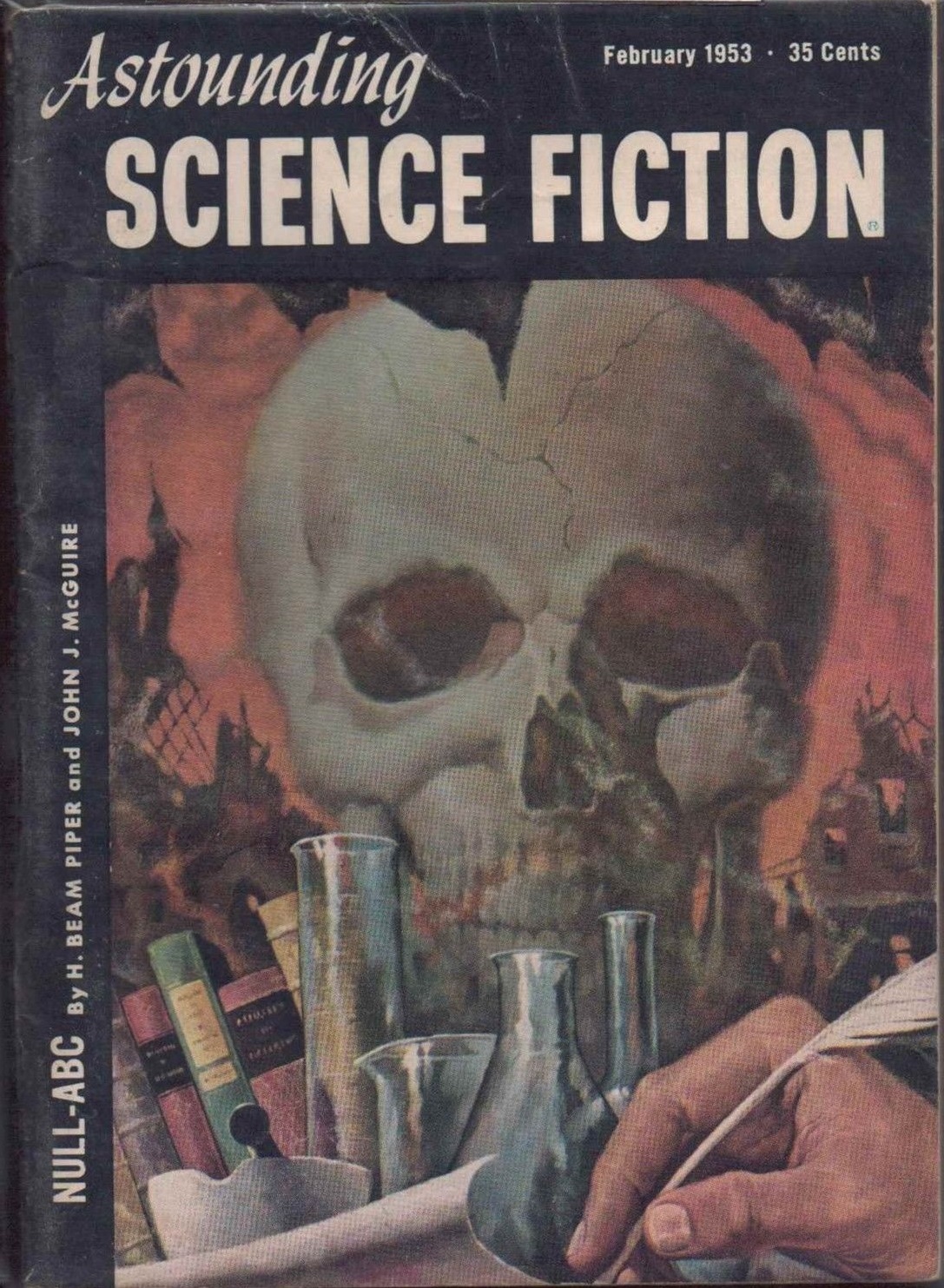
“Crucifixus Etiam” was originally published in the February 1953 issue of Astounding Science Fiction, edited by John W. Campbell, Jr. It has been reprinted numerous times, including under the title “The Sower Does Not Reap” in The Best Science Fiction Stories: Fifth Series, edited by Everett F. Bleiler and T.E. Dikty (although it was published under its original title in the first edition of the book). Miller included the story in his collections The View from the Stars,The Science Fiction Stories of Walter M. Miller, Jr., The Best of Walter M. Miller, Jr., The Darfsteller and Other Stories, and Dark Benediction. It has been translated into Croatian, Dutch, German, and Italian.
“Crucifixus Etiam” tells the story of Manue Nanti, a poor Peruvian who has signed an indenturement contract to work on Mars for five years. Nanti figures that with little to spend the money on while he’s working, he can save up and have a good sized nest egg when he returns to Earth. Shortly after his arrival, however, he realizes that conditions on Mars are not exactly as he had expected.
Katherine MacLean was born on January 22, 1925. Her novella, “The Missing Man” received the Nebula Award in 1971, and in 2003 she was named an Author Emerita by the Science Fiction and Fantasy Writers of America. MacLean was the guest of honor at the first WisCon in 1977, and in 2011 she was named the recipient of the Cordwainer Smith Rediscovery Award. Best known for her short fiction, which has been collected in three volumes, she has also written three novels and has co-written works with Carl West, Tom Condit, and Charles V. De Vet.
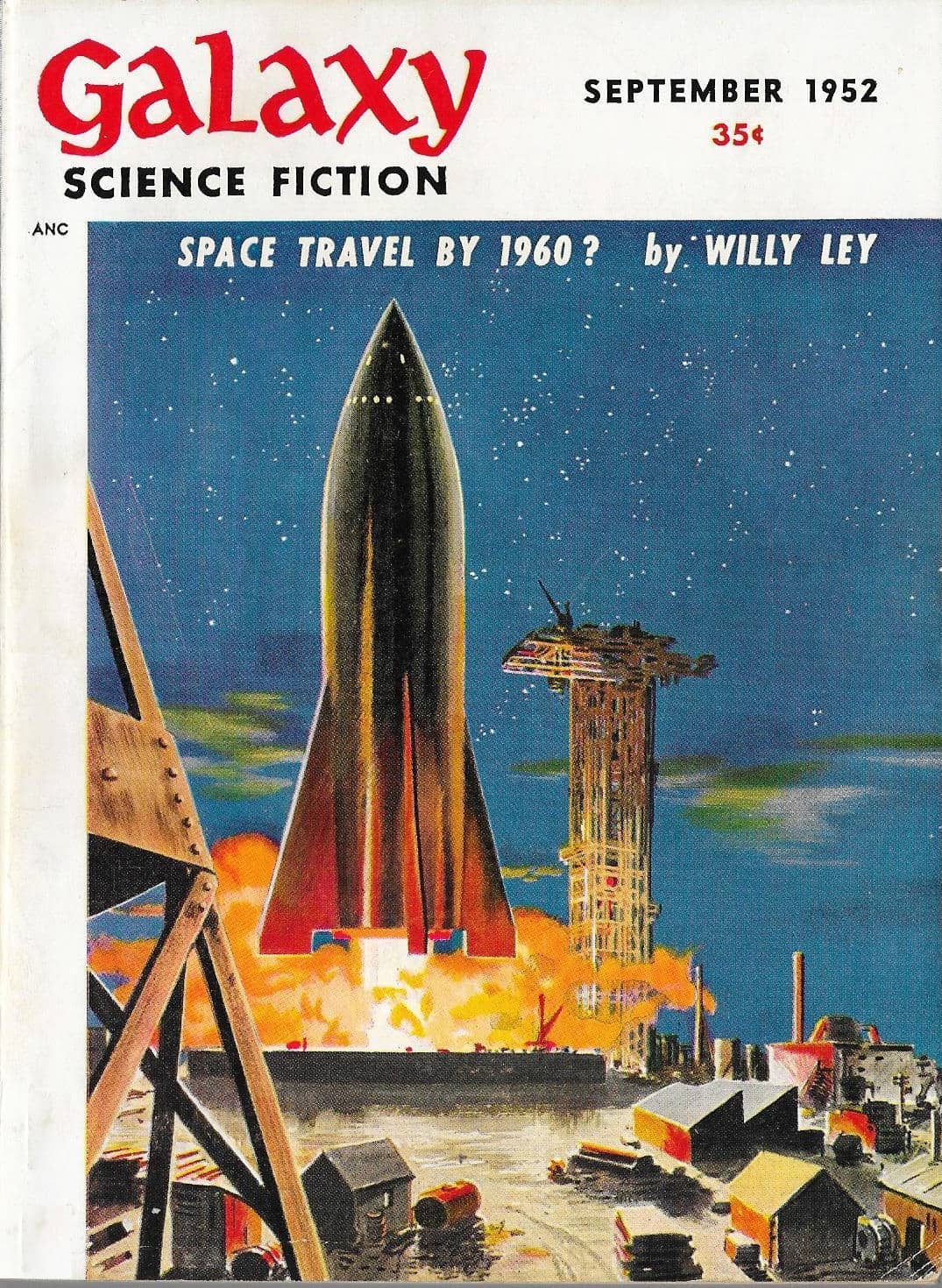
“The Snowball Effect” was first published in Galaxy Science Fiction in the September 1952 issue, edited by Horace L. Gold. It has been reprinted several times, including in MacLean’s collections The Diploids and Science Fiction Collection.
Judith Merril was born Judith Grossman on January 21, 1923 and died on September 12, 1997. She adopted the pseudonym Judith Merril for her writing. Merril received an Aurora Award in 1983 for Lifetime Contributions to the field and a second Aurora Award in 1986 for Lifetime Achievement in Editing. She was the subject of the non-fiction book Better to Have Loved: The Life of Judith Merril, written by her granddaughter, Emily Pohl-Weary, which won the 2003 Hugo Award for Best Related Work.
In addition to her writing career and her activities as an editor, Merril founded the Spaced Out Library in Toronto, now the Merril Collection of Science Fiction. In addition to her own writing, Merril collaborated with C.M. Kornbluth, publishing work under the joint pseudonym Cyril Judd. She was married twice, first to Dan Zissman, and later to science fiction author Frederik Pohl.
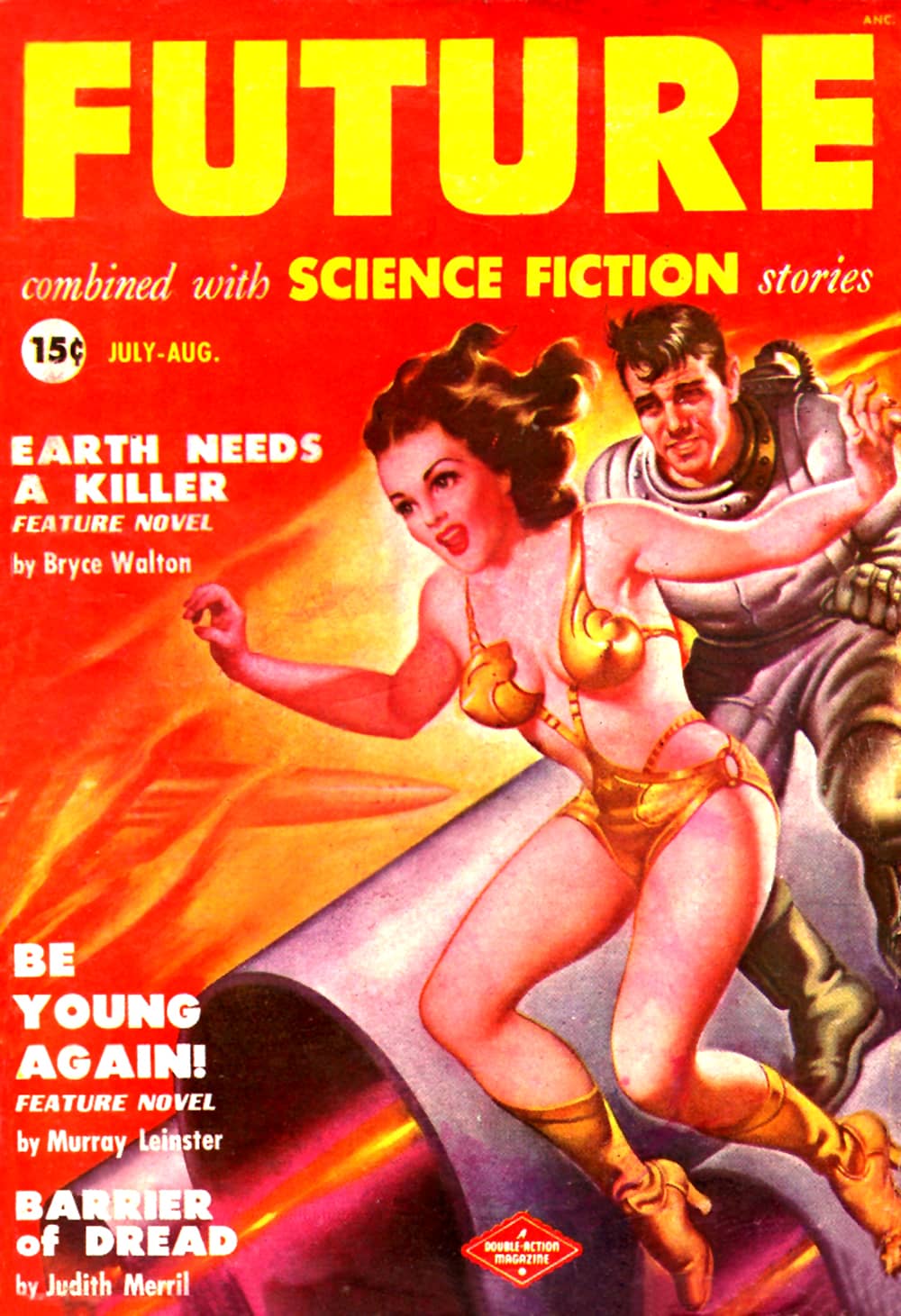
“Barrier of Dread” was originally published in the July-August 1950 issue of Future Combined with Science Fiction Stories and was later picked up by Martin Greenberg for his Gnome Press anthology Journey to Infinity. It also appeared in Selected Science Fiction Magazine issue 5 in 1955. It was next reprinted in Homecalling and Other Stories: The Complete Solo Short SF of Judith Merril, published by NESFA Press.
In “Barrier of Dread,” Merril posits a future which seems to have been popular among mid-twentieth century authors: A galactic-spanning empire in which humans have complete luxury while robots and automata do all the hard work. As Managing Director Dangret is preparing to open up a new galaxy for human colonization, his wife, the artist Sarise makes an offhand comment about the speed with which new galaxies are being opened.
Despite his lofty title, it appears that Dangret has plenty of time on his hands because his niggling concerns at his wife’s comment leads him to lock himself away for several hours watching a history of humanity, which gives Merril a chance to provide the background for this world to her reader.
Among the couple of boxes of fanzines I picked up a few weeks ago was this oddity.
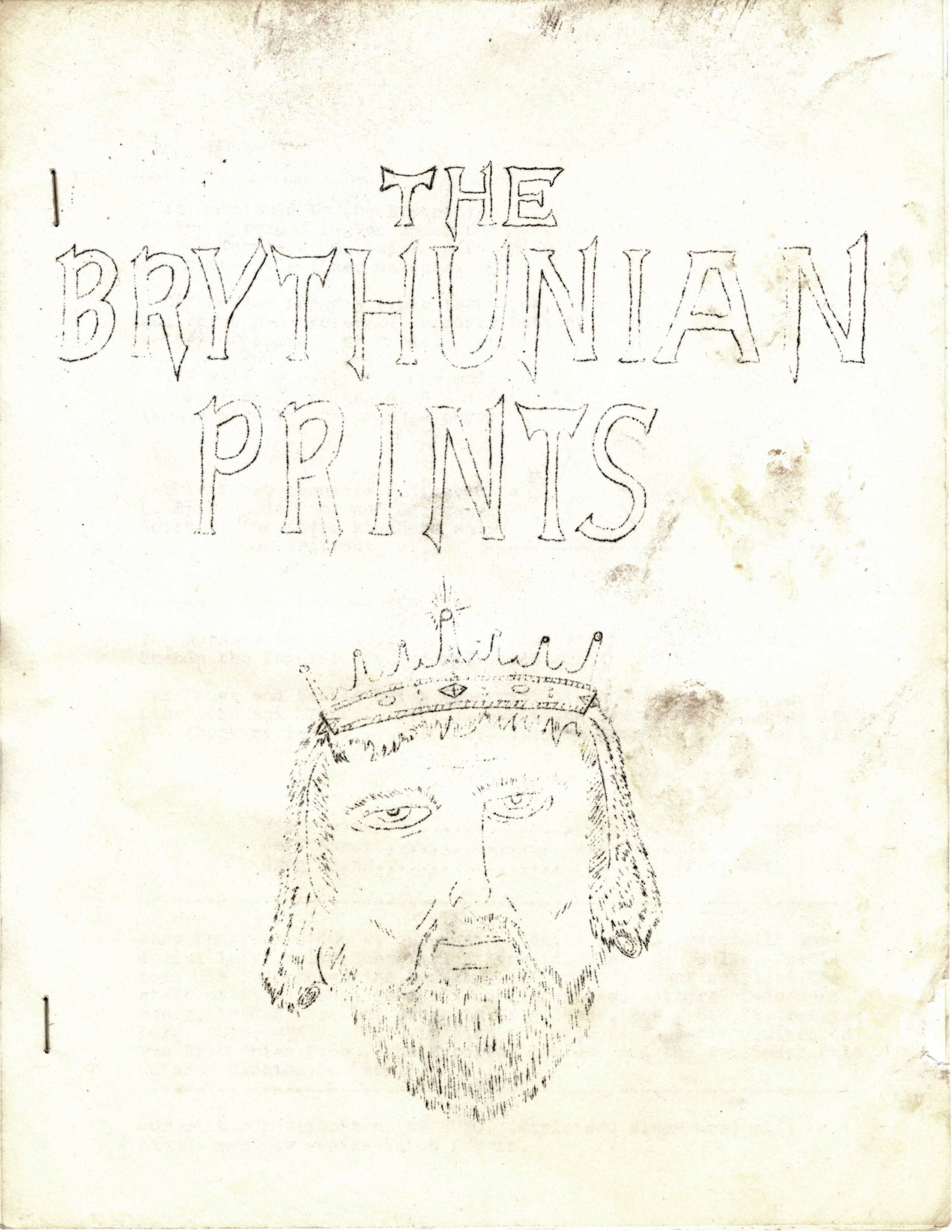
It’s the first (and I suspect only) issue of The Brythunian Prints, dated June 1967. I’ve not been able to find out any information at all on this title. It was a sword and sorcery fanzine, “published by the Brythunian Troop of the Hyborean Legion.”
The editors (Ken Hulme, Jim Feerhmeyer and Greg Shank) dedicate the issue “to L. Sprague de Camp and George Scithers for their kindness and cooperation!” Based on Shank’s editorial, they were apparently students at Toledo University, where they formed an organization called the Northwest Ohio Science Fiction Society.
The fanzine is 16 pages long, five pages of which are a S&S story, “Shandu the Magnificent” by Tom Trotter and Ken Hulme. It’s just as good as you would expect it to be. ?
The most interesting content is two pages of poetry by Lin Carter, under the general heading “War Songs and Battle Cries,” apparently reprinted with Carter’s permission from The Wizard of Lemuria and Thongor of Lemuria. The remaining content is taken up with editorials, limericks by John Boardman (four of which were reprinted from Amra) and a book review of The Fantastic Swordsmen edited by de Camp. The back cover is Tolkien related, as it pictures “Baggins and Trinket” (the Ring).
I’d be curious to know if anyone has any further info on this one.
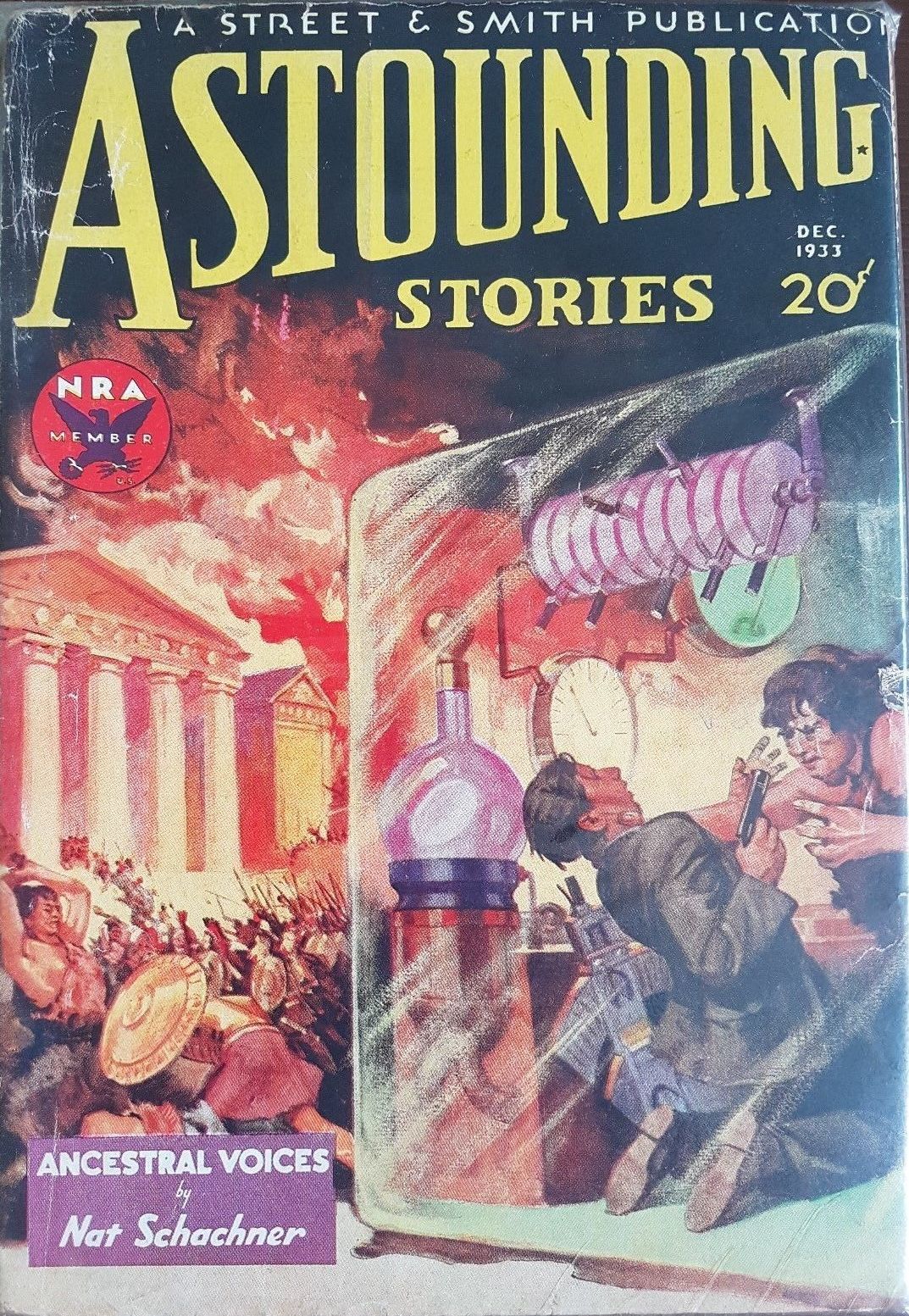
Nat Schachner was born on January 16, 1895 and died on October 2, 1955. Schachner was an attorney who began writing in collaboration with fellow attorney Arthur Zagat. After about a year working together, each man began writing solo, but after publishing science fiction for a decade, Schachner turned his attention towards biographies, focusing on early Americans.
“Ancestral Voices” was a solo effort published by F. Orlin Tremaine in the December 1933 issue of Astounding Stories.It has never been reprinted in English, although a French translation appeared in 1973 and an Italian translation ten years later.
Schachner opens “Ancestral Voices” with a brief look at several people for whom their ancestry helps define who they are in a very basic way, from a Hitlerian dictator of “Mideuropa” (although Hitler is also mentioned) to the crème-de-la-crème of Boston society, to an accountant who is convinced of his superiority over his boss because he is Anglo-Saxon rather than Spanish. Schachner also posits a boxing match between an Aryan champion, Hans Schilling and a Jewish challenger, Max Bernstein, clear stand-ins for Max Schmeling and Max Baer, who fought in the year the story was published.
The main thrust of the story, however, is the arrogant scientist Emmet Pennypacker, who has created a time machine. Denying his assistant any part of the glory, Pennypacker travels backwards in time, without knowing when or where he’ll wind up. To his chagrin, he finds himself in Aquileia during the Hunnic attack of July 18, 452. Unable to return to his own time until the machine is ready to take him there, he winds up rescuing a Roman girl from her Hun rapist.
Although the idea of going back in time and stopping your parent from being born has become cliché, that is the scenario Schachner wrote. However, given the fifteen centuries that separated Pennypacker from his distant forebears, it means he eradicated the common ancestor of about 50,000 people living in the Twentieth Century.
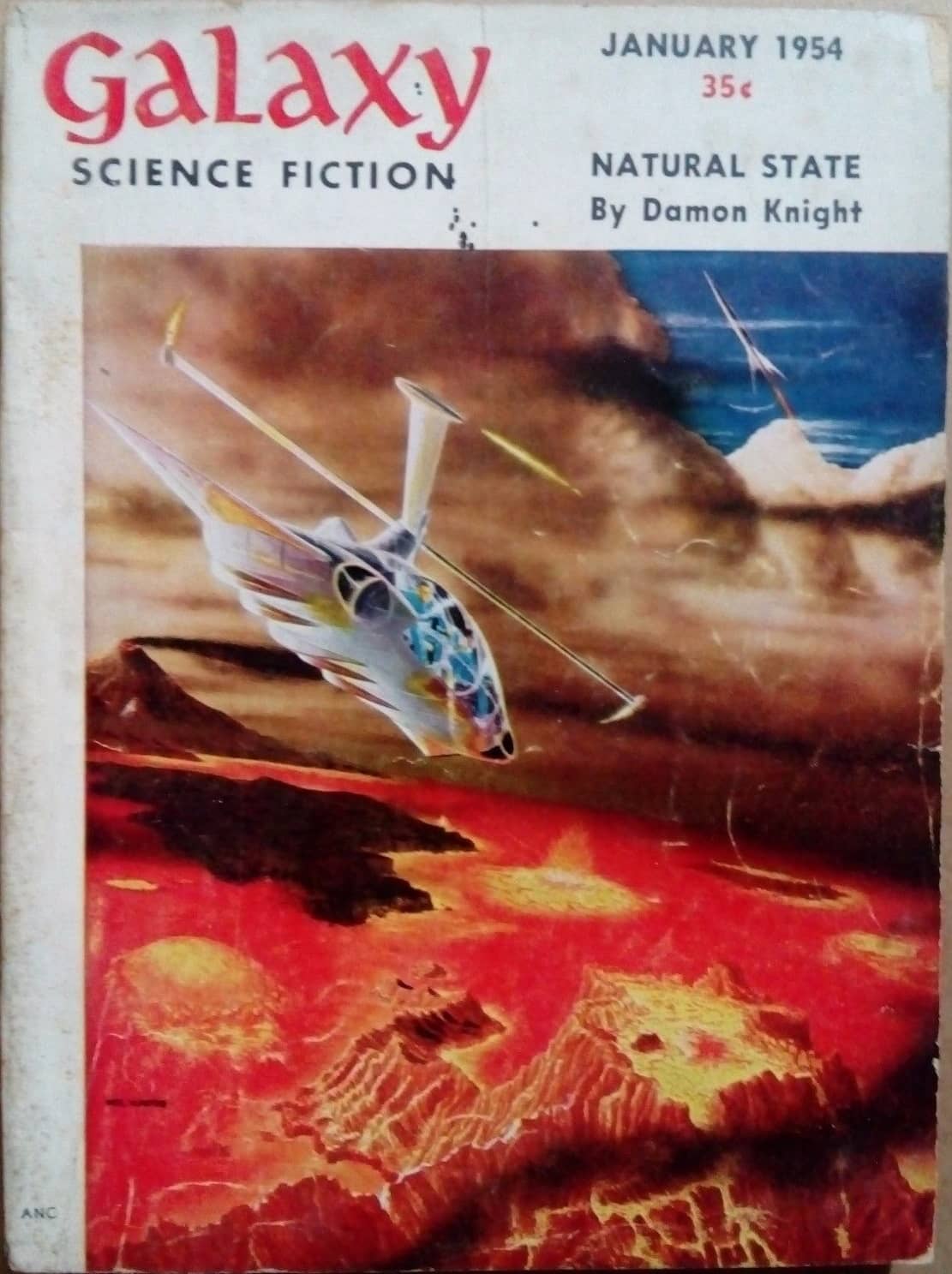
Mel Hunter’s “Flight Over Mercury” is featured on the cover of the January, 1954 issue of Galaxy Science Fiction. It’s much more interesting than the actual surface of Mercury, which looks a lot like our moon.
“Natural State” by Damon Knight — The major cities of the United States operate as industrial nations of their own while the rest of the country becomes agricultural. The cities repeatedly try to subjugate those in the country, but the cities’ technology can’t compete against the genetic engineering of those in the country.
Alvah is sent from New York to open trade with the outsiders — the Muckfeet — in hopes of bringing them into a civilized world and to support the needs of the city. When he meets with the Muckfeet, he finds that they consider him backwards – that those in the cities are the uncultured, uncivilized people. It’s up to a young woman named B.J. to reeducate him, if he’ll listen.
Arthur Byron Cover was born on January 14, 1950. He attended the 1971 Clarion Writers Workshop and made his first sale to Harlan Ellison for inclusion in The Last Dangerous Visions. Cover’s novel, Autumn Angels was nominated for the 1976 Nebula Award. Cover was the owner of Dangerous Visions bookstore in Sherman Oaks, California until the store closed in 2002.
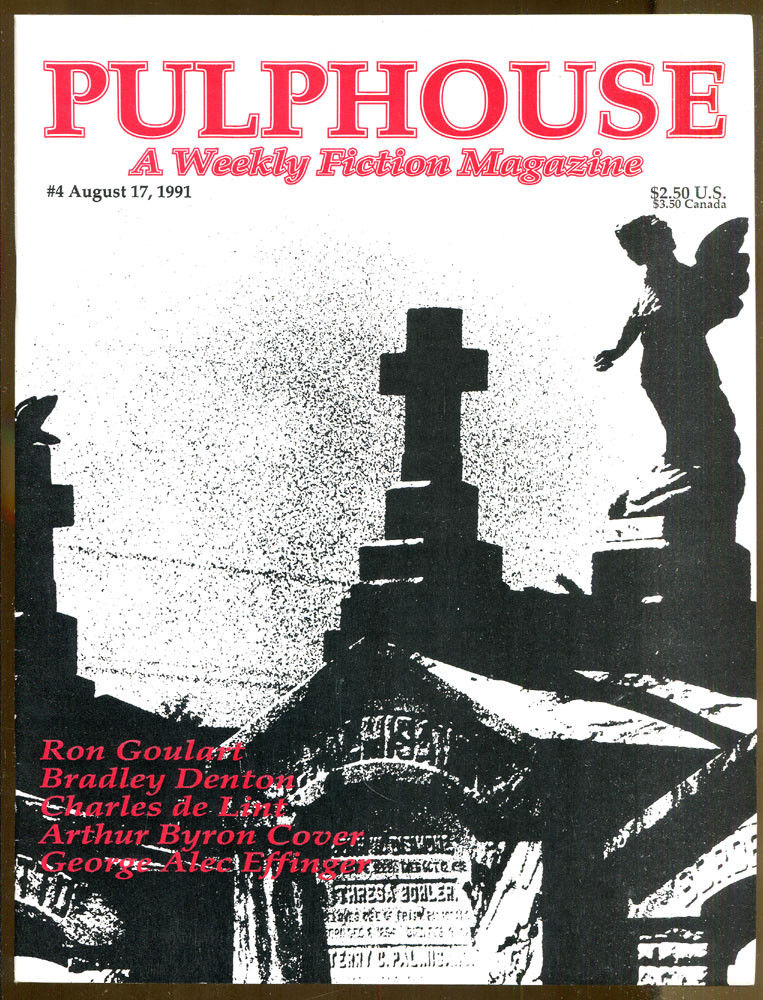
His story “A Murder” was published in the August 17, 1991 issue of Pulphouse Weekly Fiction Magazine and was purchased by Dean Wesley Smith. The story has never been reprinted.
Cover’s “A Murder” is a metafictional and psychological exploration of a brutal murder. He tries to get into the head of both the victim, Stephanie, and the murderer, Bill Prisman. Stephanie is an avid reader of horror novels and stories and when she finds herself being attacked, she is very much aware that it was a complete surprise. There was none of the forewarning or sense of foreboding that she would have expected there to have been in the novels and stories she has read. Prisman’s mind is dark. He has just been released from prison and has a sense of entitlement towards women that he can only fulfill by raping and murdering them.
Cover brings the two of them together and then backs away from the horrible crime be invoking the point of view of the omniscient author. Rather than describing Prisman’s attack, he discusses an alternative to the horror he has set up. This tangent is presented in almost clinical terms and serves to show that certain ideas about criminal behavior, notably reformation, are impractical.
Prisman is the poster child for recidivism, something both he and the law enforcement community know, but their hands are tied by a society and culture which believe that people can change when placed in an environment which actually serves to reinforce their worst tendencies. Once this detour is complete, Cover allows his story to continue to its inexorable ending.
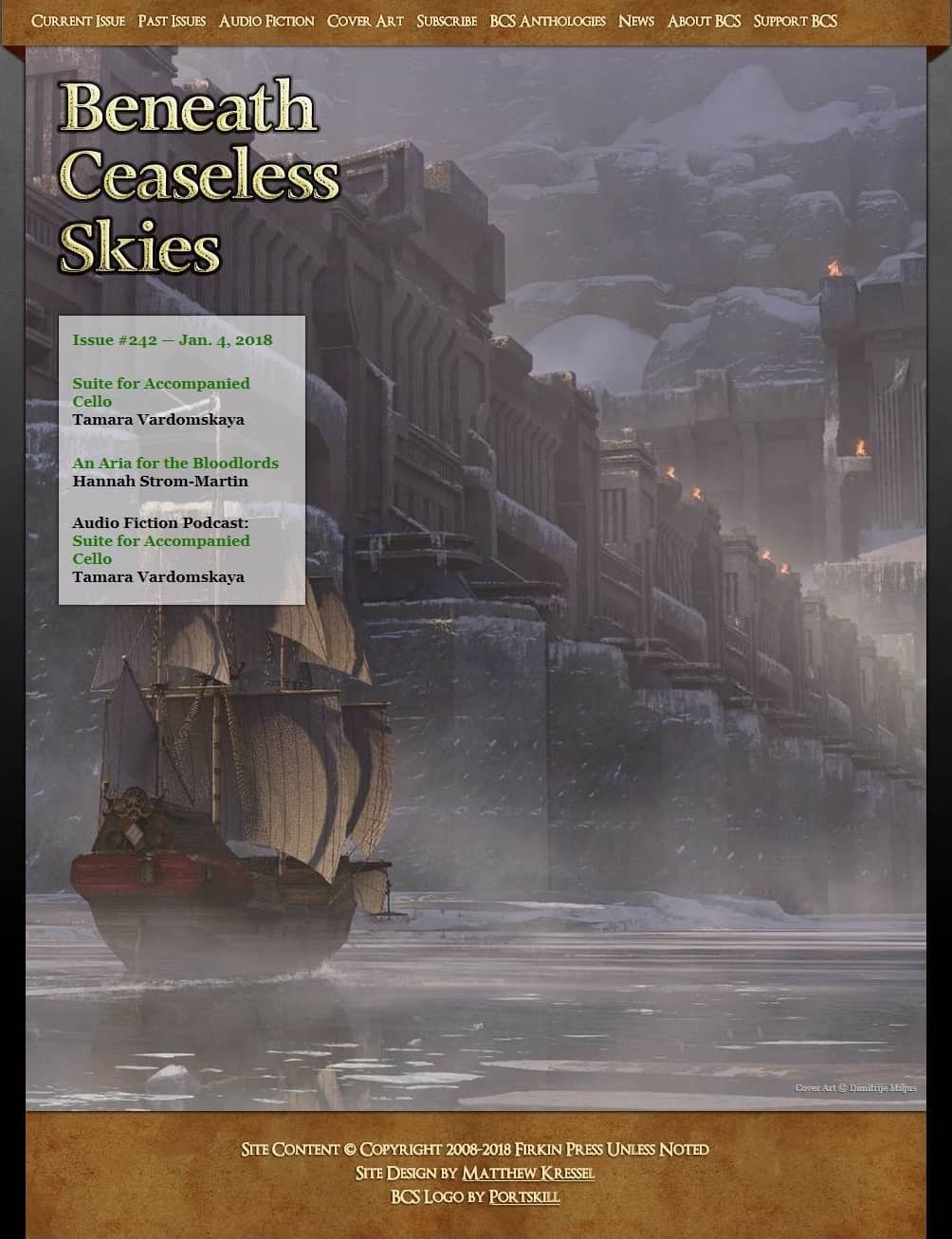
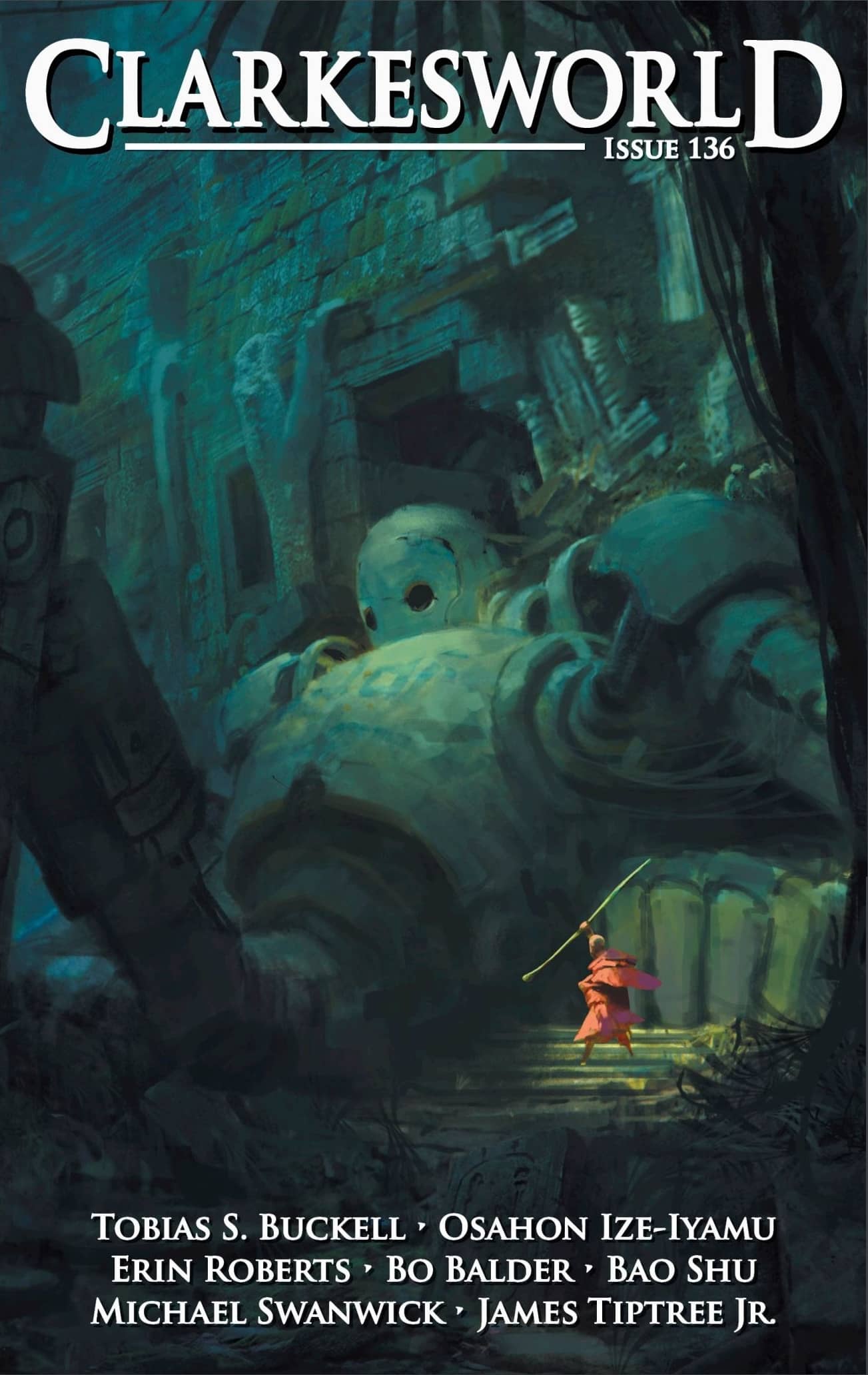
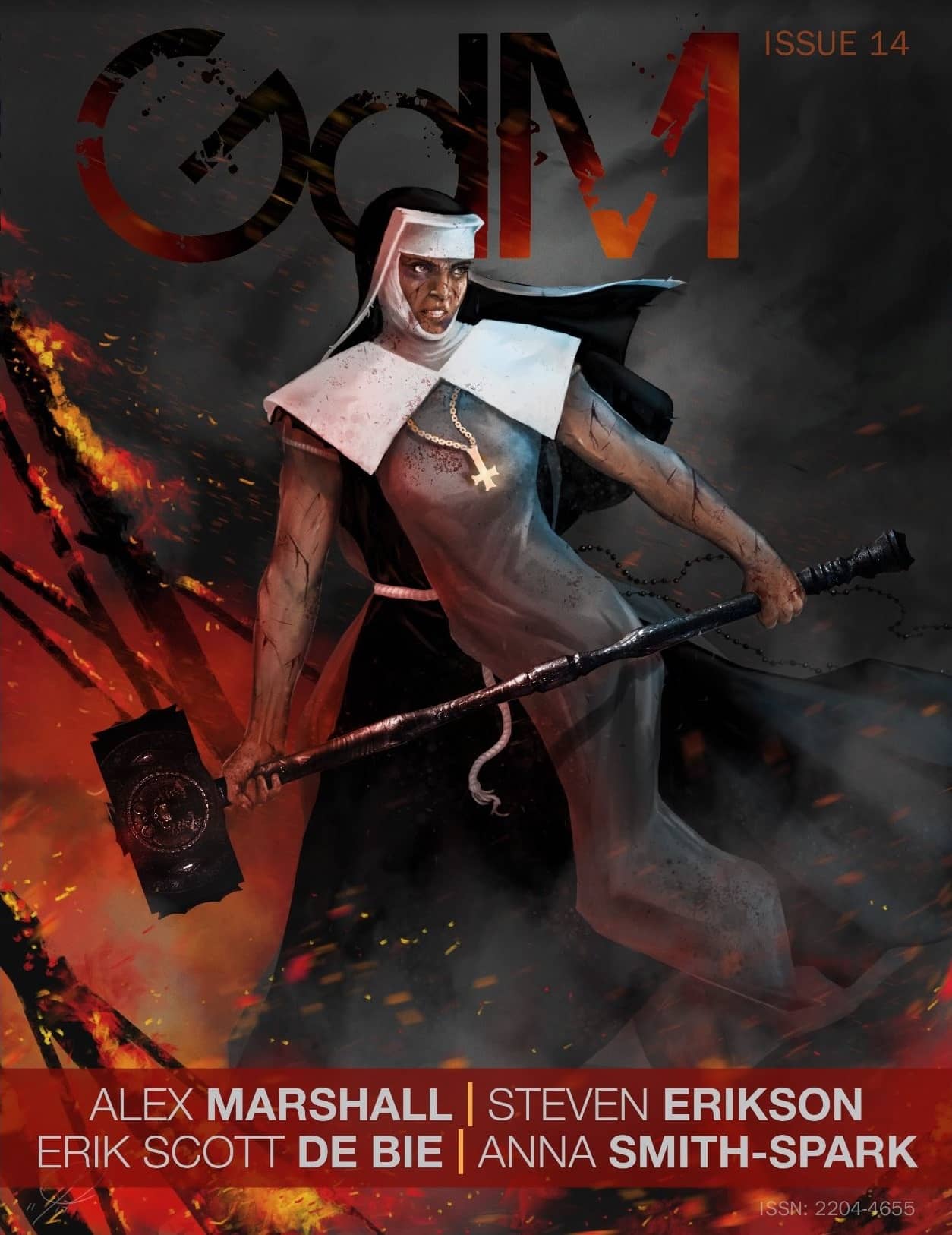
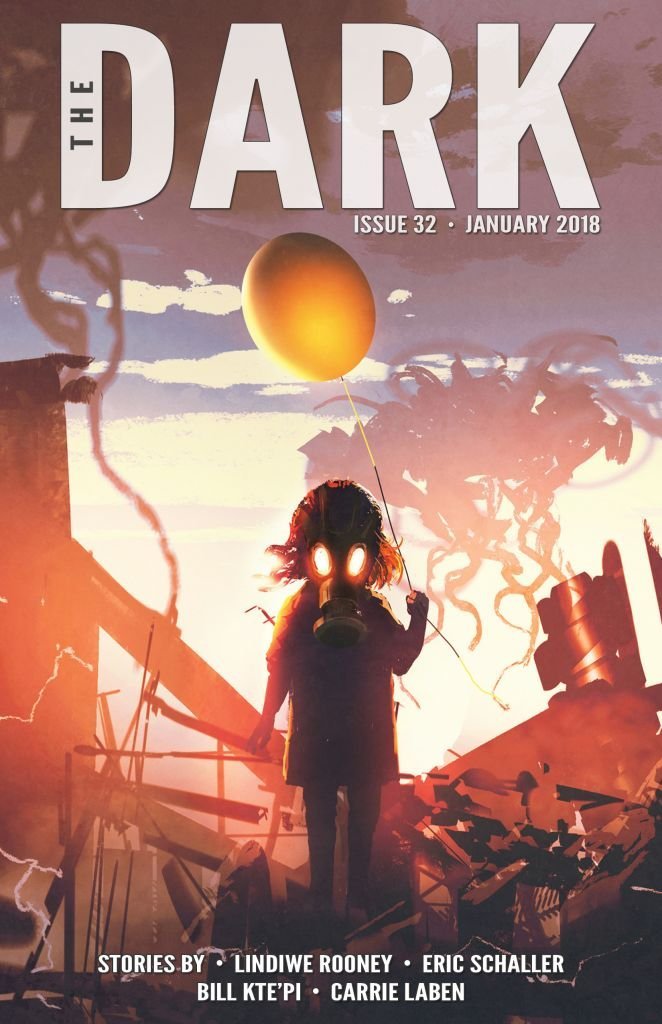
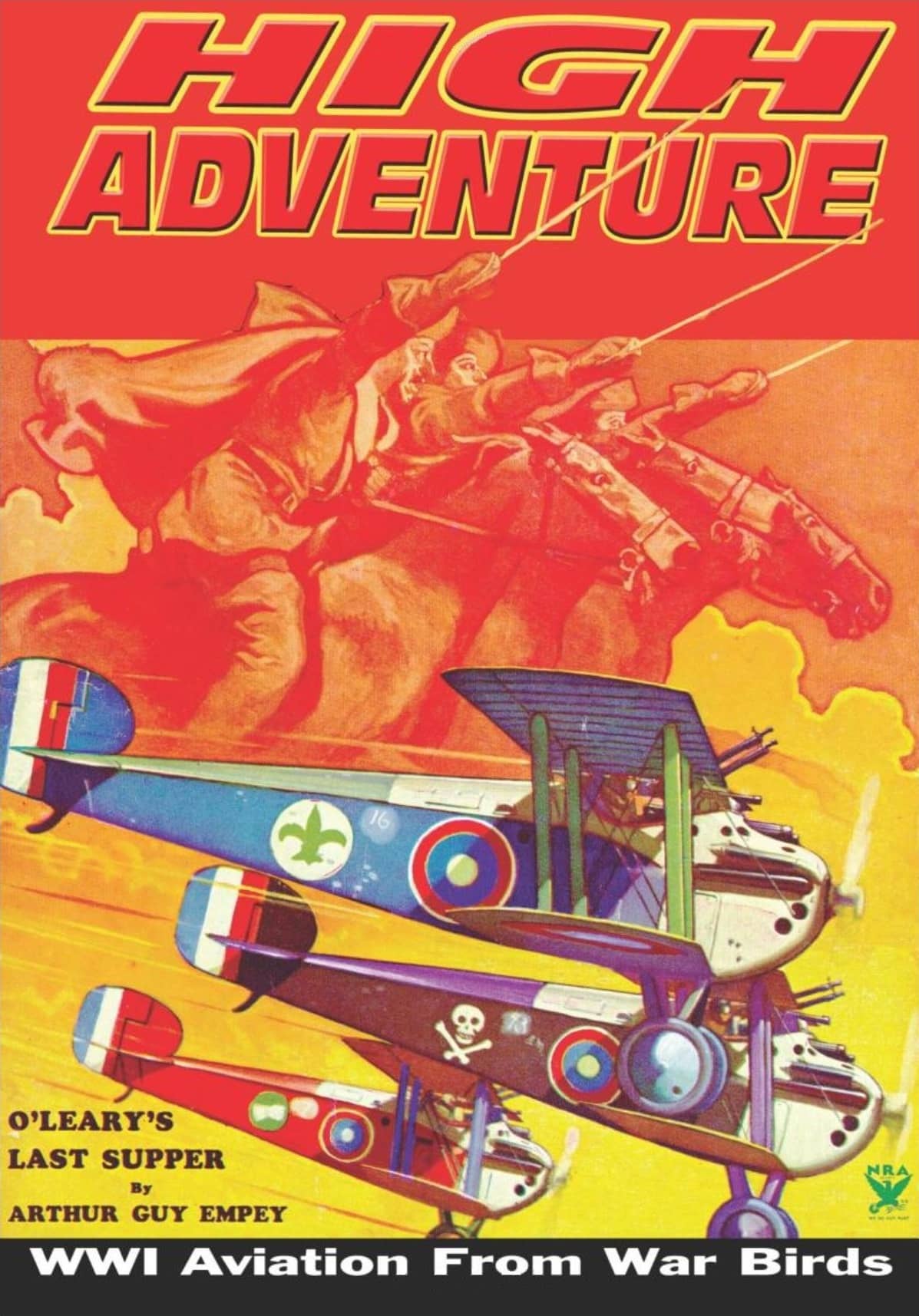
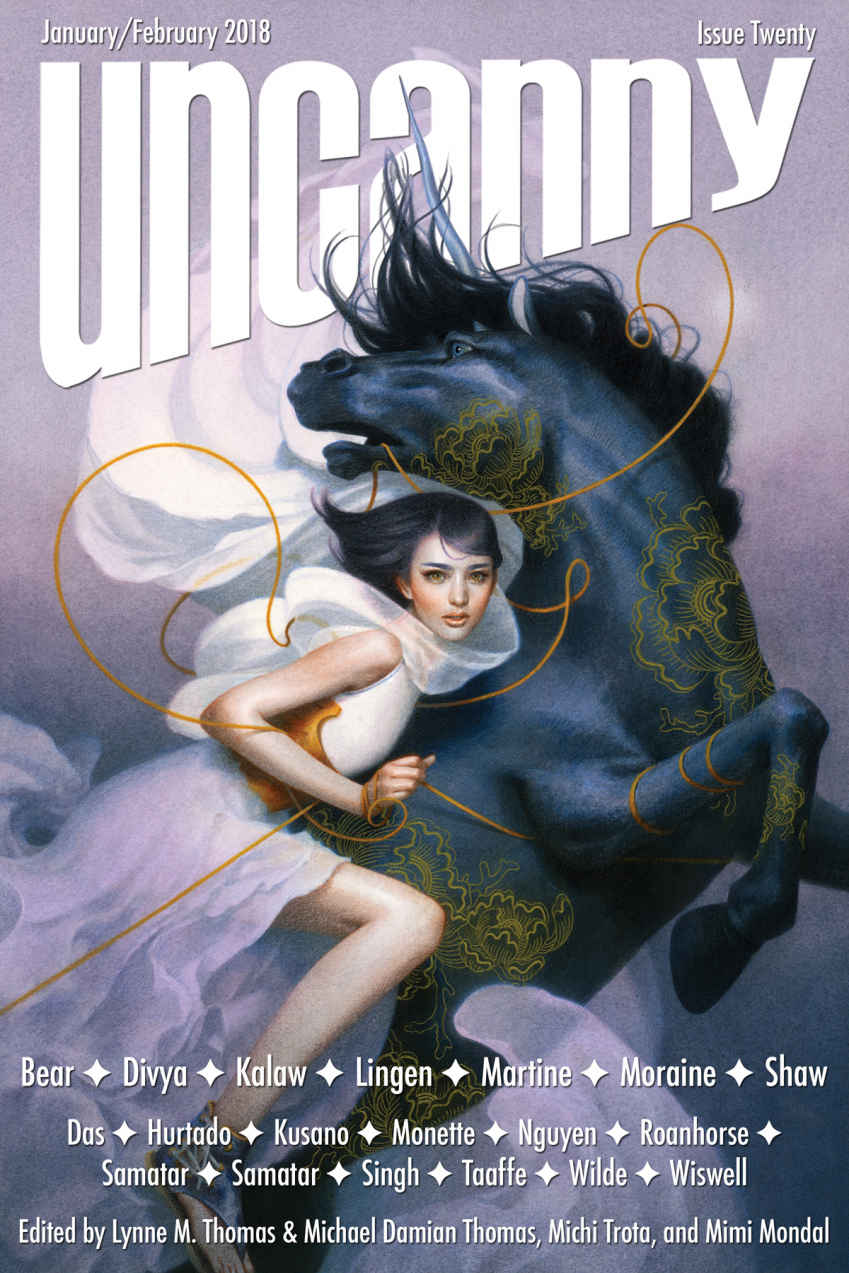
Only two print magazines in the first half of the month, Ellery Queen’s Mystery Magazine and pulp reprint mag High Adventure. Online zines definitely seem to be where the action is. The first magazines of 2018 feature fiction from Tobias S. Buckell, Elizabeth Bear, S.B. Divya, Tamara Vardomskaya, Sunny Moraine, Terence Faherty, Osahon Ize-iyamu, Erin Roberts, Bo Balder, Bao Shu, Arkady Martine, Marissa Lingen, Sunny Moraine, Vivian Shaw, R.K. Kalaw, and many others. Here’s the complete list of magazines that won my attention in early January (links will bring you to magazine websites).
Beneath Ceaseless Skies — the January 4 issue — #242! — has fiction from Tamara Vardomskaya and Hannah Strom-Martin, plus a reprint by A.B. Treadwell Clarkesworld — new stories from Tobias S. Buckell, Osahon Ize-iyamu, Erin Roberts, Bo Balder, and Bao Shu, plus reprints from James Tiptree Jr. and Michael Swanwick Ellery Queen Mystery Magazine — the January/February double issue follows their winter tradition of seasonal suspense and Sherlockian detection, with a new entry in Terence Faherty’s series from the lost manuscripts of Dr. John Watson, “The Noble Bachelor” Nightmare — original fiction from Lori Selke and Vincent Michael Zito, plus reprints by Halli Villegas and Lynda E. Rucker GrimDark Magazine — Alex Marshall is back with his second Crimson Empire novella *Beasts of the Burnished Chain,* plus a story from Anna Smith-Spark, and interviews with Steven Erikson and Erik Scott de Bie The Dark — brand new dark fantasy and horror from Lindiwe Rooney and Bill Kte’pi, plus reprints from Eric Schaller and Carrie Laben High Adventure — three classic tales of air adventure: “War Game” by George Bruce, “O’leary’s Last Supper” by Arthur Guy Empey, and “The Kansas Comet” by William E. Barrett Uncanny — issue #20 contains all-new short fiction by Elizabeth Bear, S.B. Divya, Arkady Martine, Marissa Lingen, Sunny Moraine, Vivian Shaw, and R.K. Kalaw, plus a reprint by Vandana Singh
Click any of the thumbnail images above for bigger images. Our Late December Fantasy Magazine Rack is here.
Jack London was born on January 12, 1876 and died on November 22, 1916. Best known as an adventure author for his novels The Call of the Wild, White Fang, and The Sea Wolf, he also wrote novels which would be considered proto-science fiction, perhaps most notably Before Adam. Active in socialist causes, many of his works supported the rights of workers, including his dystopian novel The Iron Heel, which has appeared as a preliminary nominee on the Prometheus Hall of Fame ballot twice.
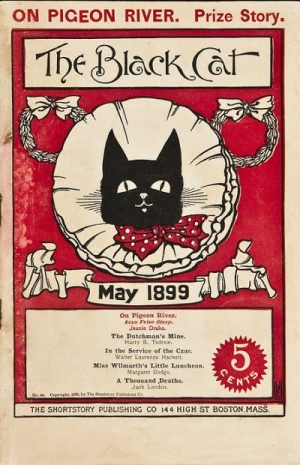
“A Thousand Deaths” was purchased by Herman Umbstaetter and published in the May 1899 issue of Black Cat. The magazine reprinted the story in 1917 and it has been published in several science fiction collections over the years, including a reprint in The Magazine of Fantasy and Science Fiction in 1967 when Ed Ferman was the editor. It has been reprinted in various London collections and science fiction anthologies over the years.
“A Thousand Deaths” is the story of a man who has been disowned by his wealthy parents and forced to make his own way in the world. He has found a niche for himself as a merchant marine, but when the story opens, he is drowning in San Francisco Bay, having decided rather precipitously to leave the ship he had been working on. He passes out in the water and when he awakens, he finds himself revived on a pleasure yacht which happens to belong to his father, who does not recognize him.
His father is interested in finding a way to stave off death and has, in fact, brought the narrator back to life. Without revealing his identity to his father, the two agree that the narrator will allow his father to kill him in various ways and bring him back to life to test his various hypotheses. The father is depicted as a monster, reminiscent of Jules Verne’s Captain Nemo or H.G. Wells’s Doctor Moreau. His two assistants, whose only notable characteristic is that they are black, unfortunately, allow the casual racism of the period in which the story was written to shine through.
The narrator eventually tires of the experimentation, especially when he realizes that his father is doing much more to him than his father has told him. He effects an escape after managing an unlikely scientific breakthrough that allows him to follow in his father’s monstrous footsteps.
The story was clearly written at a time when it was believed that science would eventually be able to solve all of life’s (and death’s) problems, and while it doesn’t have a Frankensteinian “There-were-things-man-was-not-meant-to-know” lesson to it, London definitely makes the implication that technological advances needed to be tempered by man’s humanity.