Browsed by
Category: Magazines

Vintage Treasures: George R.R. Martin’s “Nightflyers”
Vintage Treasures: George R.R. Martin’s “Nightflyers”

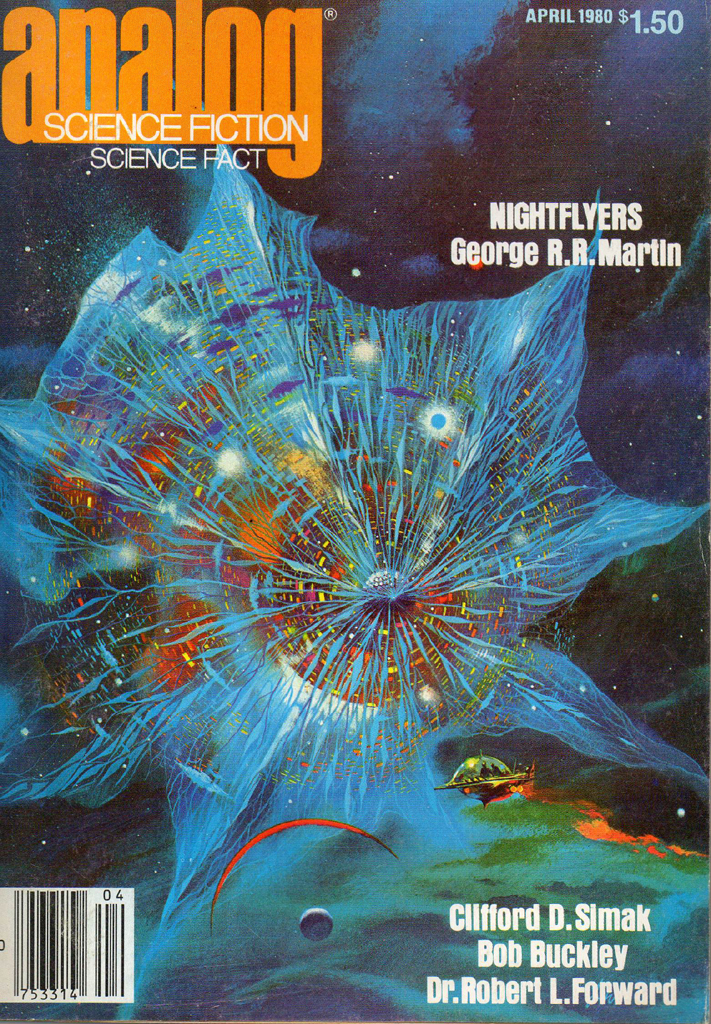
analog-april-1980-smallOver the weekend I put away a collection of 80s magazines I purchased a few months ago. In the process I discovered the April 1980 issue of Analog, which I read as a junior in high school in Ottawa, Canada.

There’s a lot to like about this issue, from the gorgeous cover by Paul Lehr — perhaps my favorite SF artist — to a famous short story by one of my all-time favorite SF writers: “Grotto of the Dancing Deer,” by Clifford D. Simak, which won both the 1980 Nebula Award and 1981 Hugo Award for Best Short Story. Even the ads reflect those things I personally found most exciting and fresh about SF and fantasy at the time: a full page ad from TSR for D&D, “The Ultimate in Adventure Games;” an ad for six microgames from Metagaming (the company that introduced me to role playing games), including the classic Ogre; and a subscription form for Ares, the short-lived SF gaming magazine from SPI.

This issue is an intriguing cultural artifact for other reasons. There’s an editorial from Stanley Schmidt in response to the recent kidnapping of 50 Americans at the US embassy in Iran, both a fascinating snapshot of a critical moment in American history, and a typical science fiction response:

What the Iranian crisis really demonstrates, at least as dramatically as any incident so far, is that if we want real freedom, we must produce our own energy… Technologies which can do this are possible, and we should not willingly settle for less. Readers of this magazine are well acquainted with the role space can play, but many people are not — and we need to get the action under way now.

If you read Analog in the 20th Century, you got used to this. Exploring space was pretty much the answer to everything — the energy crisis, the hole in the ozone, foreign policy crises, and crappy network television programming — and the magazine’s self-congratulatory tone clearly told its readership (including 15-year-old readers in Ottawa) that they were smarter and more informed than everyone else, especially on science and technology, topics far more important than cars, sports, and other things kids our age obsessed about. Analog told its readers they were destined for success. The future was ours.

But the real reason this issue is remembered is its cover story, George R.R. Martin’s novella of horror in deep space, the chilling classic “Nightflyers.”
Read More Read More

Octavia E. Butler’s “Bloodchild”

Octavia E. Butler’s “Bloodchild”

isaac-asimovs-science-fiction-magazine-june-1984I’m still putting away boxes of stuff that’s piled up in my library. Today it’s a collection of science fiction magazines I purchased from Craig Sandford, a guy I met on eBay, a few months ago. Craig kept his magazines in great condition. I had most of them already (don’t tell Alice), but Craig offered me a sweet deal. And realistically, I won’t be content until my basement is so stuffed with games and magazines it’s impossible to move. So this is progress.

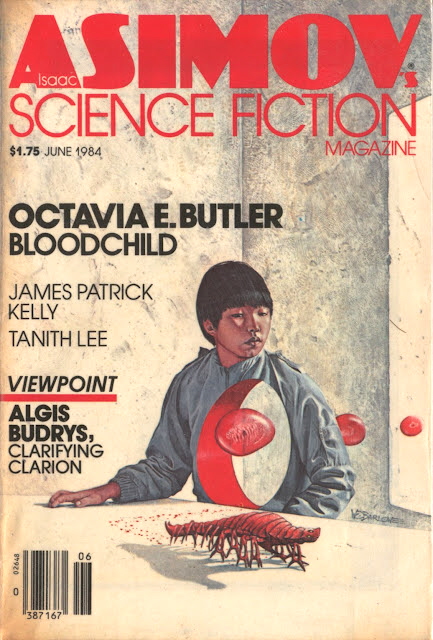
As I slid each magazine into a protective plastic bag, daydreaming of the future age when SF digests from the 1980s are near-priceless cultural artifacts (not far off now), I came across the June 1984 issue of Isaac Asimov’s Science Fiction Magazine, with Wayne Barlowe’s brilliant and chilling cover for Octavia E. Butler’s story “Bloodchild.”

“Bloodchild” is a stunning work of short fiction. It won both the Hugo and Nebula awards for best novelette, and was the title story of her slim 1995 collection, Bloodchild and Other Stories. Although I had magazines and boxes scattered all over the floor, I curled up in my big green chair to re-read it.

Butler has described “Bloodchild” as a tale of male pregnancy, which is apt even if it isn’t very descriptive. The young Gan lives with his family on a Preserve on an alien world, where humans are protected from the dominant species — the huge, powerful and intelligent insect-like Tlic, who lay their eggs in humans and nearly wiped them out when the first human settlers arrived. Gan’s father gave birth to three alien broods before he died, including the noble T’Gatoi, a female Tlic who’s become one of humanity’s strongest protectors. But now it’s time for T’Gatoi to lay her own eggs, and she has chosen Gan as her mate. When Gan witnesses the violent and bloody birth of a clutch of grubs, he realizes for the first time exactly what he’s being groomed for. He’s unsure he can go through with it, but to refuse now will have dangerous ramifications for his family. “I knew birth was bloody and painful, no matter what,” he reasons. And how does T’Gatoi see her mate? Is he just a pet? Or is it possible she feels… something like love?

Barlowe captures the innocence and horror of “Bloochild” perfectly in his cover, which depicts a new-born alien grub leaving a trail of blood as it emerges from the adolescent boy Gan, who watches with a calculating look. Click on the image above for a bigger version.

This is why I love science fiction and fantasy magazines. They’re not just slender collections of stories. They are a refined meeting of fact, art, and fiction, and when that meeting turns into a wild night of necking in the back seat, as it does here, it’s worth telling your friends about. You’re my friends, so I’m telling you. (And as we’ve discussed, kindly don’t mention this to Alice).

I don’t know any place where you can read “Bloodchild” online, but you can get a copy of the June 84 issue of Asimov’s online for only a couple of bucks. Just buy it soon, before the inevitable day 80s SF magazines become priceless. Why not hoard them in your basement, like me? You’ll thank me later.

Vintage Treasures: TSR’s Amazing Science Fiction Anthologies

Vintage Treasures: TSR’s Amazing Science Fiction Anthologies

amazing-the-wonder-yearsD&D publisher TSR generally gets a bad rap for their brief venture into science fiction in the 1980s. Much of their D&D related fiction — especially the Weis and Hickman DragonLance novels, which launched their entire publishing line — is still remembered fondly today. But does anybody remember Martin Caidin’s Buck Rogers novel, or Martin H. Greenberg’s Starfall anthology?

Nope.

Which is a shame. At one point — riding high on the success of the DragonLance books — TSR claimed it was the largest publisher of SF and fantasy titles in the nation, and it sure looked that way whenever I walked into a bookstore. There were literally racks of the stuff: DragonLance books, Forgotten Realms books, Dark Sun novels, Birthright novels, SpellJammer novels, Greyhawk books, Ravenloft novels, Planescape novels… and on and on and on.

If you were a serious genre reader in the late 80s, you gradually trained your eyes to ignore it all as you scanned the shelves for anything new and original.

What many of us never knew — because they were hidden alongside all their gaming fiction — was that TSR published dozens of new and original SF and fantasy novels, unconnected to any of their gaming fiction, including bestselling author Sharyn McCrumb’s famous science fiction pastiche Bimbos of the Death Sun (1987), Paul B. Thompson and Tonya C. Cook’s Red Sands (1988), Ardath Mayhar and Ron Fortier’s Monkey Station (1989), Robin Wayne Bailey’s Nightwatch (1990), and many others.

They also discovered several major authors, publishing Nancy Varian Berberick’s first novel The Jewels of Elvish (1989), Nick Pollotta’s first novel Illegal Aliens (written with Phil Foglio, 1989), and first novels from L. Dean James, Chrys Cymri, K.B. Bogen, and others.

But my favorite books published by TSR during this period weren’t novels at all. They were five anthologies collecting stories from the pulp days of Amazing Stories, edited by Martin H. Greenberg.

Read More Read More

Apex #37 and Interzone #240

Apex #37 and Interzone #240

apexmag0612June’s Apex Magazine features  ”Winter Scheming” by Brit Mandelo, “In the Dark” by Ian Nichols and “Blocked by Geoff Ryman  (who is interviewed by Maggie Slater), as well as Seanan McGuire’s poem, “Wounds.” Ken Wong provides the cover art. Nonfiction by Tansy Rayner Roberts and editor Lynne M. Thomas round out the issue.
Apex is published on the first Tuesday of every month.  While each issue is available free on-line from the magazine’s website, it can also be downloaded to your e-reader from there for $2.99.  Individual issues are also available at  Amazon and Weightless.

467_large2A version for the Nook will also be available in the near future.  Twelve issue (one year) subscription can be ordered at Apex and Weightless for $19.95Kindle subscriptions are available for $1.99 a month.

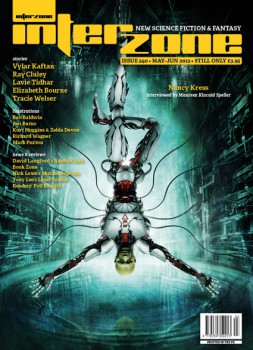
The May–June issue of Interzone has stories by Vylar Kaftan, Ray Cluley, Lavie Tidhar, Elizabeth Bourne and Tracie Welser. Cover art is ‘The Hanged Man’ by Ben Baldwin, the third of his covers commissioned for 2012.

The issue also includes all the usual suspects: “Ansible Link” by David Langford (news and obits); “Mutant Popcorn” by Nick Lowe (film reviews); “Laser Fodder” by Tony Lee (DVD/Blu-ray reviews); along with book reviews by Jim Steel and others, and an interview with Nancy Kress.

Interzone alternates monthly publication with sister dark horror focused Black Static, published by the fine folks at TTA Press.

June Page XX Available — get the latest Pelgrane Press News

June Page XX Available — get the latest Pelgrane Press News

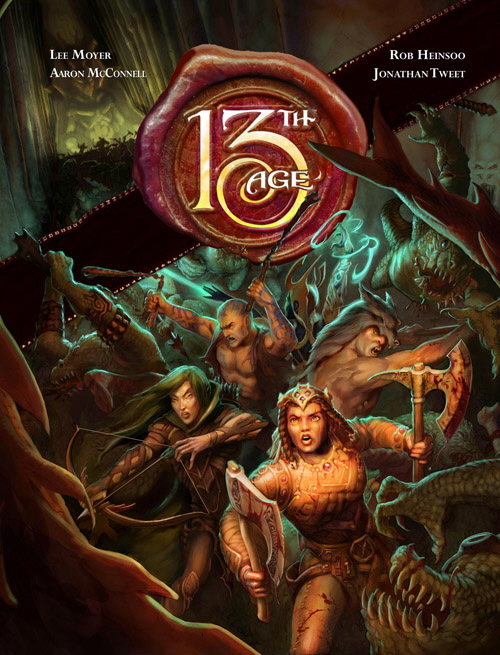
the-13th-ageSimon Rogers, publisher of Pelgrane Press, tells us a bumper-sized issue of their newsletter Page XX is now available.

I’ve been a huge fan of Pelgrane Press since they published the superb The Dying Earth role playing game nearly a decade ago, and began supporting it with one of the best small press gaming magazines ever published, The Excellent Prismatic Spray, which included articles by Gary Gygax, Robin D. Laws, Phil Masters, Steven Long, and many others.

More recently Pelgrane Press has produced Trail of Cthulhu, Mutant City Blues, Night’s Black Agents, and the highly acclaimed science fiction RPG Ashen Stars.

This latest issue of Page XX is packed with updates on three major new releases and lots of news, including the latest on their new fantasy RPG 13th Age by D&D designers Jonathan Tweet and Rob Heinsoo:

And lots more! Check out the latest issue of Page XX here.

Yes, The New Yorker

Yes, The New Yorker

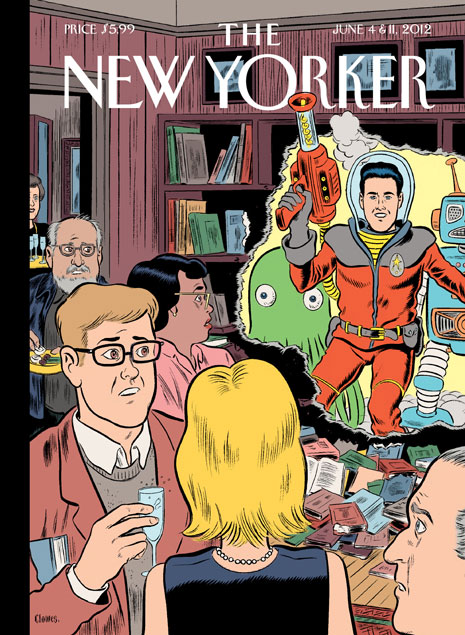
the-new-yorker-science-fiction-issue2This week’s issue of The New Yorker (yes, The New Yorker!) is a science fiction issue, featuring fiction by Jonathan Lethem, Jennifer Egan, and Junot Diaz, among others.

Here’s the complete table of contents.  Now you can have your science fiction fix and feel literary about it at the same time.

Weird Tales Closes to Submissions

Weird Tales Closes to Submissions

weird-tales-359aHoly cats! That was fast. The editors of Weird Tales magazine have announced it is closing to submissions on Tuesday, June 5th.

Now, Black Gate magazine is in no position to throw stones about being closed to submissions. We’ve been closed since roughly the Napoleonic era. But still… didn’t Weird Tales just announce it was open?

Let me check. Yup, it did.

[If you’re too lazy to click on that link, you can just scroll down the page to the announcement four days ago.]

All right, we’re done being snarky. And we will note that the magazine is only closing to fiction submissions — artists and disheveled arcane researchers, your contributions are still valued. [Okay. We’ve still got a little snark left.] Here’s the official announcement:

Heads up that at noon eastern time on Tuesday June 5th we will be closing for fiction submissions. We will still be looking at art and nonfiction proposals.

There’s still time to finish your submission and get it in the mail by Monday morning. Stock up on coffee, turn off the phone, and channel Clark Aston Smith. Fame and Fortune await you.

But act fast.

Weird Tales Reopens to Submissions

Weird Tales Reopens to Submissions

weird-tales-359aAttention all aspiring fantasy writers! (Yeah, I know that’s most of you.) Weird Tales has re-opened to submissions.

Now, I know you never read Submission Guidelines. But before you run off to send editor Marvin Kaye your latest short fiction masterpiece, I urge you to check out the guidelines. There’s lots of news — for example, the pay rate has dropped from 5 cents/word to 3 cents/word — but perhaps most interesting is the announcement that the magazine has shifted to themed issues. Upcoming themes include Elder Gods & Cthulhu (#360), Fairy Tales (#361) and Undead (#362), and if you’ve got a story in the latter two categories, the editors are especially interested:

Please know that each issue of Weird Tales – beginning with issue 360 – will be featuring a theme. This means that HALF of each issue will be devoted to strange and innovative takes on that theme. This also means that HALF of each issue will be devoted to the unclassifiable and eclectic tales that have always been the soul of Weird Tales.

Our current needs are… Stories for our Undead issue (#362). This issue is quite far along, but we seek unusual and radical takes on Zombies, Ghouls, chiang-shih’s, the Lich and other creatures yet undefined. Even vampires, if you have found a new wrinkle. Theme-related poetry is welcome.

We also have a bit of space left in the Fairy Tales issue (#361), so if you have worked on something for us, send away.

Be sure you are submitting an unpublished story or poem.

Because we publish half of the magazine as unthemed content, you may submit any variety of fantasy including science fiction (though we will not use much of the latter). We are currently most interested in stories between 3,000-5,000 words, but longer stories are acceptable. However, it may take quite a while for a long or unthemed story to be published. Short shorts, i. e., flash fiction, are definitely of interest to us.

The complete guidelines are here.

Clarkesworld #68 plus PKD and Gnosticism

Clarkesworld #68 plus PKD and Gnosticism

cw_68_300The May  issue of Clarkesworld is currently online. Featured fiction: “Prayer” by Robert Reed, “Synch Me, Kiss Me, Drop” by Suzanne Church and “All the Things the Moon is Not” by Alexander Lumans.  There are also audio versions of all three stories, read by Kate Baker. Non fiction by Aletha Kontis, Jeremy L.C. Jones and Elizabeth Bear.  The cover art is by Jessada Suthi.

All of this is available online for free. However, nothing is really free. The magazine is supported by “Clarkesworld Citizens” who donate $10 or more. There’s also a Kindle edition.

One personal reaction to Bear’s very funny essay, “Another Word: Dear Speculative Fiction, I’m Glad We Had This Talk”: I agree that Lenny Bruce didn’t get funnier when he got angrier (his drug problems certainly didn’t help), but I found George Carlin to be more interesting the angrier he got. Maybe he wasn’t quite as funny, but his anger certainly resonated with me.  Sometimes having your “face pressed down into a trough of human misery until the bubbles stop” is necessary to remind people that life is not a television sitcom. At least the ones who haven’t already drowned.

Someone else who got less interesting when he started taking himself too seriously (and, once again, the drugs didn’t help) was Philip K. Dick. Simon Critchley examines Dick’s metaphysical worldview as expressed in Exegeiss, a posthumously published series of philosophical 133948681ramblings. While I tend to think all this stuff really is the result of a bad acid trip, Critchley as a professor of philosophy for the most part keeps a straight face. Some of you may laugh out loud not only at the source material, but the attempt at exegesis.
We last covered Clarkesworld with issue #67.

Spring 2012 issue of Subterranean Magazine Now Available

Spring 2012 issue of Subterranean Magazine Now Available

subterranean-magazine-spring-2012I admit I never know when to blog about Subterranean magazine. I really enjoy it, and I used to go to great lengths to acquire the print issues. But now that they’ve converted to an online zine they’re releasing the contents in a rolling format, a new story or article every week.

Do I announce it here when the first article goes up? Or wait until the entire magazine is posted, two months later? By the time a new issue is up, I’ve already forgotten what I did last time. So over the years I’ve finally developed a consistent system: I blog about it whenever I remember.

So here I am to tell you about the Spring 2012 issue. And it’s got a terrific line-up, nearly 70,000 words of fiction, including two big novellas from Jay Lake and Allen Steele:

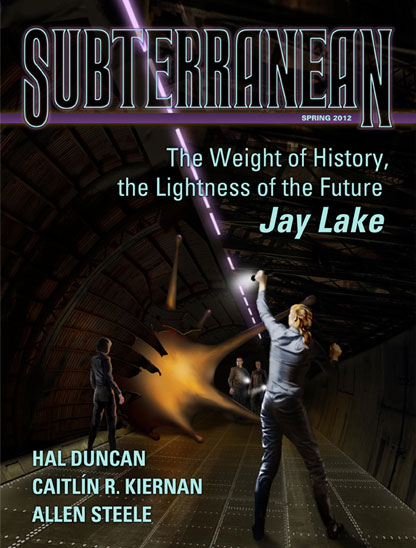
  • “The Weight of History, the Lightness of the Future,” by Jay Lake (24,000 words)
  • “Angel of Europa,” by Allen Steele (19,000 words)
  • “Sic Him, Hellhound, Kill Kill!” by Hal Duncan
  • “Random Thoughts Before a Fatal Crash,” by Caitlin R. Kiernan
  • “Here and There,” by Neal Barrett, Jr.
  • “A Holy War,” by Mike Resnick

Subterranean is edited by William Schafer, and published quarterly. The Spring 2012 issue is completely free and available here.

We last covered Subterranean magazine with their previous issue, Winter 2012.