Exploring Towers of Adventure
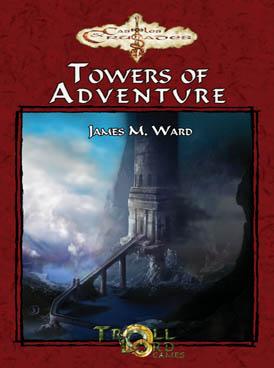 A while back I placed an order with one of my favorite online vendors, FRP Games, whose selection and discounts are both excellent. At the last minute I added an item to my cart that I hadn’t budgeted for: James Ward’s Towers of Adventure, a boxed set for Castles & Crusades from Troll Lord Games.
Not only had I not planned to buy it, I’d never even heard of it until I saw it in FRP’s product newsletter. What can I say, I’m a sucker for marketing copy:
Towers of Adventure offers the Castle Keeper a marvelous set of interchangeable tower levels, rooms, monsters, NPCs, traps and treasures. This box set allows you to make literally millions of exciting towers for your players to explore. Treasures, tower inhabitants, and tower maps are at your fingers and so easy to use you can put together a complex adventure in five minutes or less.
It’s true! This isn’t a typical adventure supplement, with a set of interlinked encounters and rooms carefully described for the game master. In fact, while the box contains designs for 15 wildly different towers — including a Zombie Tower, Vampire Tower, Cloud Giant Tower, and Lonely Wizard’s Tower — I couldn’t find a room description anywhere.
 Some of you might have missed
 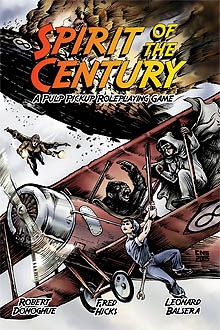 One of the most promising new game systems I reviewed in Black Gate 14 was used for the pulp role-playing game
 One of the things I most enjoy about
  There are a lot of things to commend this book to an experienced gamer. The rules are fairly simple yet cover a lot of ground. I like how the abilities are not really tied into specific stats that are sometimes hard to justify - this system is much more fluid. It also is not conducive to rules lawyering and if there is one thing I hate, it is rules-lawyering, so this is a positive for me. I can see where the OCD crowd who wants a rule for everything could be irritated with it, but I game by the principle that story precedes rules, and this rule set is made for that mindset.
 Risus: The Anything RPG
 If a single positive resulted from the work of that woefully misinformed but correctly acronymed organization BADD (Bothered about Dungeons & Dragons), a group that waged a crusade to stop children from jumping into the Bags of Holding that they learned to construct from an $11.99 hardcover rulebook purchased at a hobby store, it was the computer RPG