Browsed by
Category: Essays

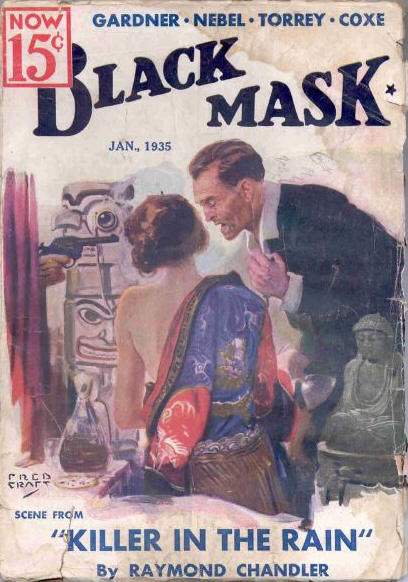
A (Black) Gat in the Hand: Black Mask — January, 1935
A (Black) Gat in the Hand: Black Mask — January, 1935

BlackMask_January1935

“You’re the second guy I’ve met within hours who seems to think a gat in the hand means a world by the tail.” – Phillip Marlowe in Raymond Chandlers’ The Big Sleep

(Gat — Prohibition Era term for a gun. Shortened version of Gatling Gun)

Joseph ‘Cap’ Shaw was still at the helm of Black Mask in January of 1935, when Raymond Chandler’s “Killer in the Rain” scored the cover. But this issue also included stories by Frederick Nebel, Erle Stanley Gardner, George Harmon Coxe and Roger Torrey. All that for fifteen cents!

“Killer in the Rain” featured Carmady. I’m in the camp that feels all of Chandler’s PIs: Carmady, Ted Carmady, Ted Malvern and John Dalmas were all essentially Philip Marlowe with slight differences. Carmady appeared in six stories – all in Black Mask.

The story was heavily cannibalized for Chandler’s first novel, The Big Sleep. Carmen Dravec became Carmen Sternwood, played memorably by Martha Vickers in the HumphreyBogart film. Two other Carmady stories, “The Curtain” and “Finger Man,” were also used. I think that “Killer in the Rain” is a strong story on its own and is definitely worth reading. I’m tinkering with ideas for a separate post on this story.

Frederick Nebel, whose Tough Dick Donahue (subject of an earlier post in the series) would replace The Continental Op when Dashiell Hammett left the pulps, provided Black Mask readers with the twenty-eighth adventure featuring Captain Steve MacBride of the Richmond City Police and newsman Kennedy of the Free Press. MacBride is a tough, by-the-book cop, while Kennedy is a hard-drinking smart aleck reporter. However, both are committed to justice and cleaning up corrupt Richmond City.

Except for one story (“Hell on Wheels” – Dime Detective), the entire series appeared in Black Mask. The collection has been reprinted in a three-volume series from Altus Press.


Read More Read More

Burton in a Skirt, or What Are You Going to Do with Your Life when Game of Thrones Is Over?

Burton in a Skirt, or What Are You Going to Do with Your Life when Game of Thrones Is Over?

(1) Game of Thrones-small

Are you still trying to pull yourself out of the depression death-spiral you entered when you heard that the next season of Game of Thrones won’t appear until 2019? And do you find yourself going through every day in an ostrich-like endeavor to evade the knowledge that the next season of Game of Thrones will be the final season?

What will you do? What will you do?

Well, you could surrender to despair and binge-watch whatever the current iteration of CSI is (CSI Fresno? Arkadelphia? Mu?) until the foul odor of your sweaty, unwashed body drives away everyone you love and cherish.

Or you could do as your fathers’ fathers’… er… fathers (just old are you, kid?) did, yea, even as they wandered in the barren wilderness of the pre-internet, pre-fanboy, pre-CGI age: you could return to the source, the ancient fount from which Game of Thrones derives much of its overheated, multi-hued, melodramatic substance: the historical epics and biblical blockbusters and costume dramas that were Hollywood’s bread and butter from the silent era through the sixties, when the whole madcap caravan broke down by the side of the road, a victim of cultural change and economic vapor lock.

Read More Read More

Two Castles in Slovenia

Two Castles in Slovenia

DSC_0238

Mali Grad

In last week’s post about Zaprice Castle, Slovenia, we looked at a well-preserved Renaissance fortification protecting the important crossroads of Kamnik. Two earlier castles can also be visited in this town, is an easy day trip from the capital Ljubljana.

Mali Grad (“Little Castle”) is an obvious landmark visible from most of Kamnik. It’s situated atop a small hill overlooking the town. All that remains today is a reconstructed tower, a few foundations of walls, and a medieval chapel.

Mali Grad is first mentioned in 1202 but dates to perhaps a generation or two before then.

Read More Read More

Exploring Zaprice Castle, Slovenia

Exploring Zaprice Castle, Slovenia

Zaprice_castle_east

Zaprice Castle from the east. Image courtesy Vojko Kalan.

As a lover of all things medieval, whenever I’m traveling I always sniff out any local castles. Whether it’s a famous castle in England or a crumbling, little-known ruin in the Netherlands, I’m always glad to visit.

Thus I thoroughly enjoyed my trip to Slovenia a few years ago. This compact little country is affordable, easy to travel around in, and has a lovely stretch of the Alps. More importantly, it has heaps of historic buildings, including an estimated 700 castles.

Zaprice Castle is one of Slovenia’s most famous and most visited. It’s located in Kamnik, a small town at the foot of the Alps just 45 minutes from the capital Ljubljana. The castle stands on a hill at the edge of town, making it a clear landmark.

Read More Read More

Black Gate on the list for the 2018 REH Foundation Awards

Black Gate on the list for the 2018 REH Foundation Awards

REHaward_ShanksIf you were to take a poll at Black Gate World Headquarters, asking for the staff’s favorite author, I’d put my money on Robert E. Howard coming in at the top spot. ‘Conan’ appeared in a Black Gate headline over a decade ago (thank you, Charles Rutledge!). Ryan Harvey, John Fultz, Bill Ward, William Patrick Maynard, Brian Murphy, Howard Andrew Jones, Barbra Barrett and more have written about Howard and his works under the Black Gate banner.

And the respect and love of Howard’s work has only increased over the past few years. All with the standard Black Gate quality. For the third year in a row, there is a solid Black Gate presence on the Robert E. Howard Foundation Preliminary Awards List. Our nominees for 2018:

The Cimmerian—Outstanding Achievement, Essay (Online)

(Essays must have made their first public published appearance in the previous calendar year and be substantive scholarly essays on the life and/or work of REH. Short blog posts, speeches, reviews, trip reports, and other minor works do not count.)

BOB BYRNE – “Robert E. Howard Wrote a Police Procedural? With Conan?? Crom!!!”

JAMES McGLOTHLIN – “A Tale of Two Robert E. Howard Biographies”

M. HAROLD PAGE – “Why Isn’t Conan a Mary Sue?”

Read More Read More

Doubling Down, or Just How Bad Are Ace Doubles, Anyway?

Doubling Down, or Just How Bad Are Ace Doubles, Anyway?

The World of Null-A-small Universe Maker-small

Ace Double D-31: The World of Null-A (cover by Stanley Meltzoff)
paired with Universe Maker (cover by Paul Orban)

Just so you know where I stand, let’s get this out of the way right off the bat — I love Ace Doubles (and if you don’t know what an Ace Double is, are you ever in the wrong place. You should immediately go to Slate or HelloGiggles or Shia LaBeouf.com or somewhere, anywhere else or risk irreversible contamination. You’ve been warned.) I’ve loved them ever since the first time I laid eyes on one, in the thrift store that was around the corner from my middle school. The day I pulled the dual volume of A.E. Van Vogt’s The World of Null-A and Universe Maker (D-31) off the dusty shelf, I fell and fell hard; my lunch money never had a chance. I have a lot of reasons for loving these books, some of which have nothing to do with the quality of the writing found between their gaudy covers, and a good thing too, but we’ll get to that. First, though, the looooove.

To begin with, I love them for those aforementioned gaudy covers, and why not? For twenty years, from 1953 to 1973, from D-31 to 93900 (mastering the Doubles numbering system is an arcane science in itself, especially the legendarily convoluted final five-digit series), artists like Ed Emshwiller, Kelly Freas, George Barr, Jack Gaughan, Gray Morrow, Ed Valigursky and many others poured forth a stream of wonderful images that amount to a romp in a candy shop of pulp science fiction props: mutants, ray guns, futuristic metropolises, bug eyed monsters, alien armadas, hostile planets, a-bomb shattered landscapes, femmes in danger, dangerous femmes, space stations, super-submarines, time machines, jut-jawed heroes in bubble-helmeted spacesuits, robots, domed cities… and, of course, spaceships, spaceships, spaceships! What, I ask you, is there not to love about that?

Read More Read More

Greco-Roman Treasures in the Egyptian Museum

Greco-Roman Treasures in the Egyptian Museum

20171211_143050

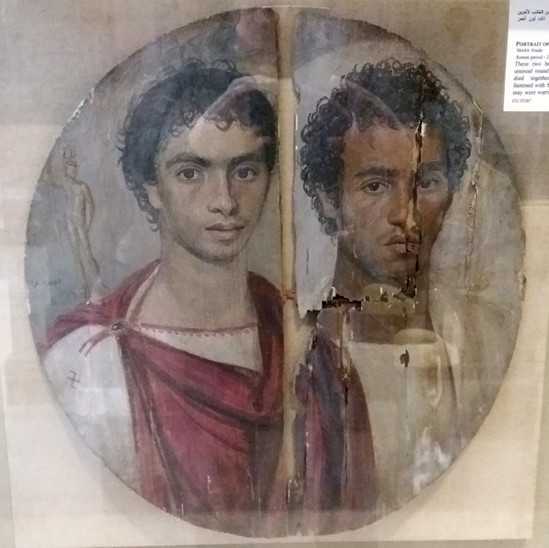
Mummy portrait from the 2nd century AD
of two brothers who appear to have died together

The Egyptian Museum in Cairo is an addictive place. On my two writing retreats in Egypt last year I found myself returning again and again. The collections are so vast, the displays so stunning, that no matter how many times you go you always find something that bowls you over.

Much of the museum is laid out chronologically, from the predynastic era all the way up to the Greco-Roman period (332 BC – 395 AD). This last period of ancient Egypt is often overlooked except for the famous mummy portraits like the one pictured above, lifelike paintings of the deceased. The rest of the art from this time is less compelling. Some of it is overdone, almost cartoonish, but that doesn’t make it any less interesting. Here’s a small sample of what the museum had to offer.

I apologize for the quality of some of these photos. The Egyptian Museum is poorly lit and many of the cases are dirty, making good photography difficult. Hope you enjoy them anyway!

Read More Read More

A Demanding Work that Sings all the Stronger in 2018: The Queen of Air and Darkness by T.H. White

A Demanding Work that Sings all the Stronger in 2018: The Queen of Air and Darkness by T.H. White

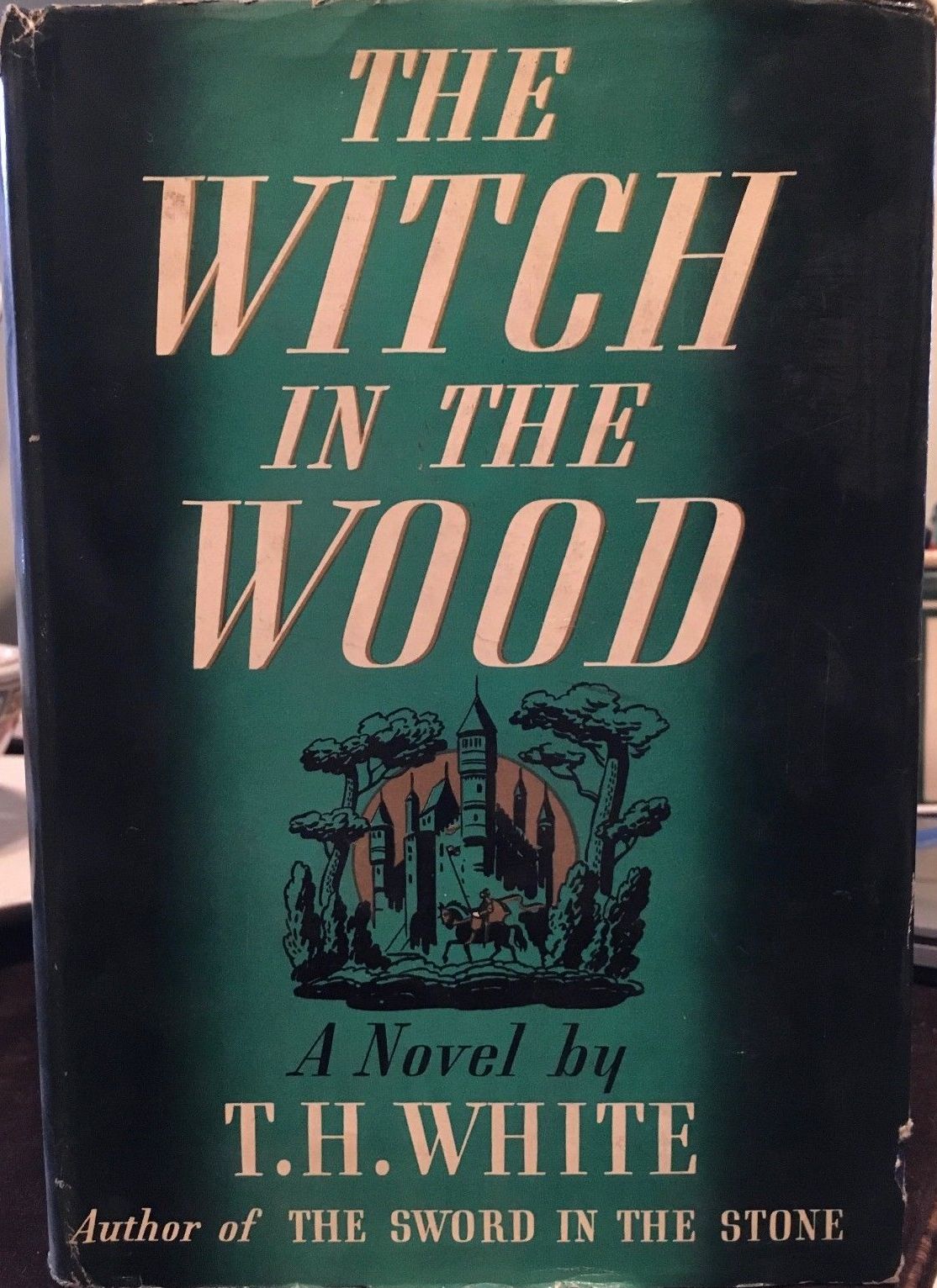
The Witch in the Wood-small The Witch in the Wood-back-small

In my early teens, I discovered and devoured T.H. White’s omnibus quartet of novels, The Once and Future King. The first and most child-like remains the best known: The Sword in the Stone. After this, and unjustly neglected (by Disney and the world in general), come The Queen of Air and Darkness, The Ill-Made Knight, and The Candle In the Wind.

In my later teen years, I concluded that The Once and Future King, taken as a whole, was the single best novel I had ever read. Having reached the ripe old age of fifty, it’s time to re-evaluate. Is White’s work still worth its weight in gold?

Perhaps you recall Book One, in which the young King Arthur, known affectionately as the Wart, meets Merlyn, gambols through a lifetime’s worth of transformational adventures, and draws a certain sword from a stone. Hysterically funny, dreamy and given to long flights of fancy about hawks and birds, The Once and Future King still works genuine magic, even when its digressions and mood swings threaten to topple the whole everything-plus-the-kitchen-sink mess into a stew of narrative anarchy.

In short, it’s a full meal and then some, and I, along with fantasy lovers the world over, adore it still. (Ursula K. LeGuin, R.I.P., lent her opinion to one edition’s jacket copy, saying, “I have laughed at White’s great Arthurian novel and cried over it and loved it all my life.”) Yet, many seem unaware that the cycle, tracing Thomas Mallory’s Le Morte d’Arthur, continues.

Book Two began life as The Witch in the Wood, and arrived in print in 1939, just as the world fell off a precipice it hadn’t seen coming, and descended into a darkness from which it is still fighting to recover. Revised and expanded, The Witch in the Wood became The Queen of Air and Darkness, and no book better upholds the argument for valuing a work as the sum of its discordant parts.

Read More Read More

Exploring the Tomb of Idu at Giza

Exploring the Tomb of Idu at Giza

20170228_132149

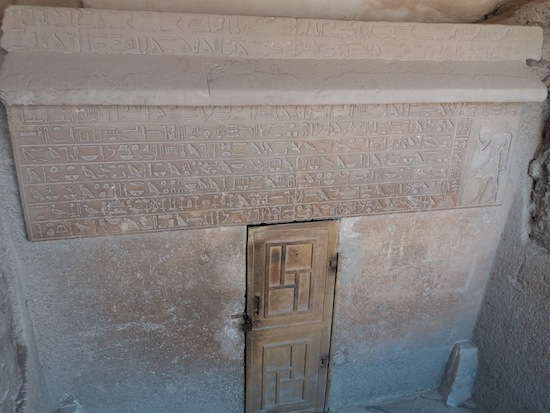
The rather unobtrusive entrance to the tomb. Like most
mastabas, its superstructure has disappeared over time.

Put on your pith helmets, Black Gate readers, because today we’re going into an ancient Egyptian tomb!

This tomb, on the Giza plateau, was built for Idu, an inspector of priests of the pharaohs Khufu and Khafre and overseer of scribes. Idu made sure the rites and rituals in honor of the departed pharaohs were done properly, and that the priests had all the equipment they needed. Idu lived in the VI Dynasty, probably during the reign of Pepi I (2332-2283 BC), a couple of hundred years after the death of these two important pharaohs. The most prominent Egyptian pharaohs had cults that lasted centuries.

Read More Read More

Results of a Writing Retreat in Cairo

Results of a Writing Retreat in Cairo

20170228_115246-EFFECTS

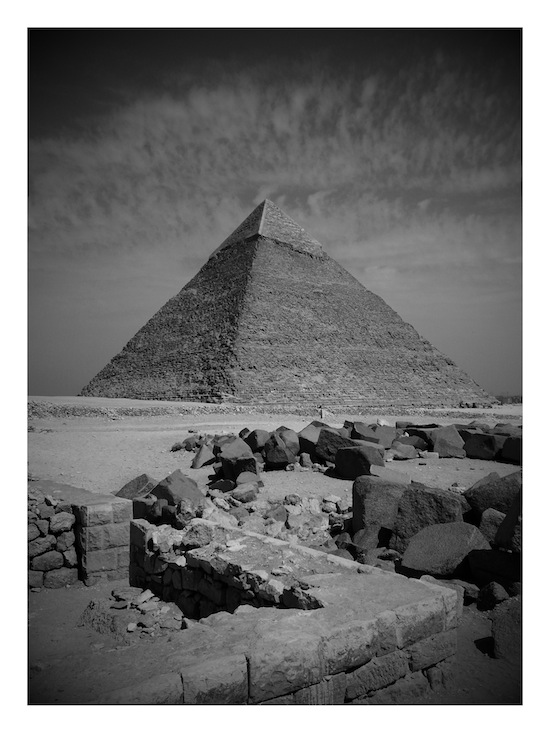
Obligatory pyramid shot

Hello, Black Gaters! I’m back after a month’s silence, and my silence on here usually means I’m drunk I’ve gone off somewhere. This time I spent three weeks in Cairo on my second writing retreat of the year.

During my previous Cairo retreat back in February, I started The Case of the Purloined Pyramid, the first in my neo-pulp detective series The Masked Man of Cairo. It’s set in Cairo in 1919, with the hero trying to solve a murder while the city is convulsed with its first major independence demonstrations. That book recently won the Kindle Scout program and is being published by Kindle Press on January 9. This time around I worked on the next in the series, The Case of the Shifting Sarcophagus.

So what does a wandering writer do when he goes to Cairo to write a novel? Try desperately hard not to let his research take too much time away from his writing!

Read More Read More