Browsed by
Category: Essays

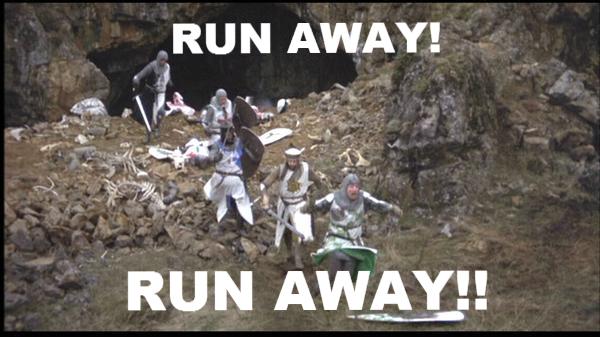
The Art Of Retreat, a.k.a. “Run Away, Run Away!”
The Art Of Retreat, a.k.a. “Run Away, Run Away!”

Run MemeOver the last thirty-five years, I’ve enjoyed gaming (mostly D&D and its ilk) with something like ten different role-playing groups. Other than the blindingly obvious traits that all such gatherings share, such as a love of good company or having a pulse, the most salient characteristic exhibited by each band of gamers was a stunning inability to retreat in the face of bad situations or superior foes.

I find this mind-boggling. Fascinating, too.

Let me provide a couple of classic examples. Once upon a time, my friends Nick and Suzanne, playing a barbarian and a cleric, respectively, “went on ahead” of the rest of the group, which is to say, the rest of us couldn’t make it that week. They came upon a lonely cave inhabited by creatures we later came to call graylocks. I don’t recall the source or where the referee culled them, but that doesn’t matter: they were mean and tough. Think ogres with spells.

Nick and Suzanne pressed the fight, even though they were outnumbered; they pressed the fight even though their opponents were winning; they pressed the fight even when it was hopeless. In short, they behaved as if they could not possibly lose. It took hours of painstaking work over the ensuing weeks to rescue them.

Read More Read More

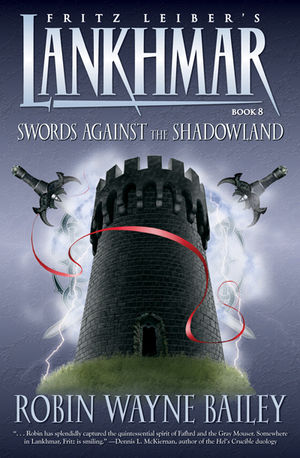
Dual Structures in Fritz Leiber’s Fafhrd and the Gray Mouser Stories and Robin Wayne Bailey’s Swords against the Shadowland

Dual Structures in Fritz Leiber’s Fafhrd and the Gray Mouser Stories and Robin Wayne Bailey’s Swords against the Shadowland

BaileyShadowlandRecently I completed my reading of all of Fritz Leiber’s Fafhrd and the Gray Mouser stories. After I had put down the second or fourth collection (this depends on how you approach the editions from White Wolf, which collected the books doubly in single volumes, and these are the publications with which I began my survey), I made some faintly denigrating comment on Goodreads (if I remember it correctly), something about the quality of these stories being like flies caught in amber. This was a metaphor for Leiber’s soupy, languid, highly embellished prose style.

But a year or so later, as I got to the end of The Knight and Knave of Swords and then the termination of Swords and Ice Magic, I found that I had really begun enjoying these stories. I had even begun to admire the writing style. So I bought, without question, Robin Wayne Bailey’s Swords against the Shadowland out of interest to see who possibly could be so foolish as to try to meet Leiber on his own brilliant terms.

Before I get to a review of Leiber and then, specifically, to Bailey, I want to detail the kind of place I come from. As I become a regular contributor to Black Gate, I realize that there are quite a number of books that I really should have read while I was growing up. Now, I’ve read a lot of fantasy. That will be apparent. But sometimes I pick up a new volume, open the cover, begin reading, and ask myself, “Why didn’t I read this twenty-five years ago?” One of the answers might be because of my intense snobbishness, a youthful shortcoming that I slightly touched on last entry. Another reason is because, at the beginning of eleventh grade, I artificially arrested the sheer volume of my high fantasy reading by consciously “growing up” and turning my back on the genre in preference for established “literary” pursuits. But also, as I cast my memory back through the years, I’m coming to believe that I didn’t read a lot of these works then because a lot of these weren’t all that visible.

Read More Read More

My Love/Hate Romance With Peter Jackson’s The Hobbit

My Love/Hate Romance With Peter Jackson’s The Hobbit

GandalfLet me state for the record that I am a fan of the film adaptation of The Lord Of the Rings. Jack Nicholson can complain all he likes about “too many endings,” but that celluloid trilogy managed the impossible: it successfully imbued a made-up world not only with turmoil and action but with genuine emotional gravitas. The Lord Of the Rings (2001 – 2003), against all odds, mattered.

Having just seen the third of The Hobbit installments (2012 – 2014), I fear I cannot say the same for these sequel-prequels. I want to. At certain moments, I’m convinced. At others?

Yes, the task of adapting a book to the screen is arduous, full of perils, and the fact that Jackson’s scriptwriting team of Fran Walsh, Philippa Boyens and (for these films) Guillermo del Toro have had any success at all is remarkable. Tolkien, let’s face it, was not an efficient story-teller. Given characters like Tom Bombadil, it would not be unfair to crown him as King Of All Digressions.

So let’s take it as a given that adaptation involves violence toward the source material. Additions will be made, and subtractions, too. So be it. The goal, typically, is to preserve the spirit of the original.

Read More Read More

My Overly Conscious Love for Pathfinder

My Overly Conscious Love for Pathfinder

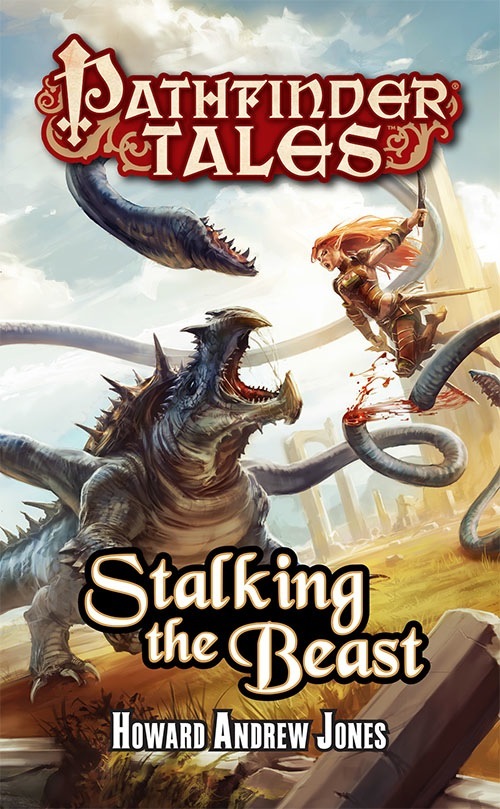
Pathfinder Tales Stalking the BeastLately I’ve been reading a fair amount of Pathfinder novels. Partly this is because I want to play Pathfinder and have no one with whom to play it, because all of my adult friends who are so inclined live too far away, and my children and I just aren’t in the same frame of mind. (Roleplaying with a fourteen-year-old and a twelve-year-old is challenging, simply because logic, for all involved, works a little differently. For this audience, a straightforward dungeon crawl, like Fantasy Flight’s Descent, is a more viable option, but, with that, you don’t get enough freedom for story creation and character generation.)

Another reason I have been reading Pathfinder novels is because my oldest son has started reading them. If I read them as well, we can inhabit a shared text (and perhaps, in time, a satisfying Pathfinder gaming session).

And yet another reason why I have been reading Pathfinder novels is because they’re good.

This was announced not too long ago, at least in reference to Howard Andrew Jones’s Stalking the Beast, when Nick Ozment realized that that novel was “better than it needed to be.” I’ve read some Pathfinder novels by other writers as well, and I will say that most of them are quite good.

Nick made clear why he found Jones’s second novel for the franchise so good, but what do I mean when I say that, in general, I like the series? I will say that they are highly satisfying Sword and Sorcery novels. They are entertaining. They are escapist. They have cool things in them. And, above all, they are quite familiar. They are based on the 3.5 (or 3.75) edition of Dungeons & Dragons, after all.

Read More Read More

The Barbarism of Bullfighting and Archaic Diction in L. Sprague de Camp’s “The Rug and the Bull”

The Barbarism of Bullfighting and Archaic Diction in L. Sprague de Camp’s “The Rug and the Bull”

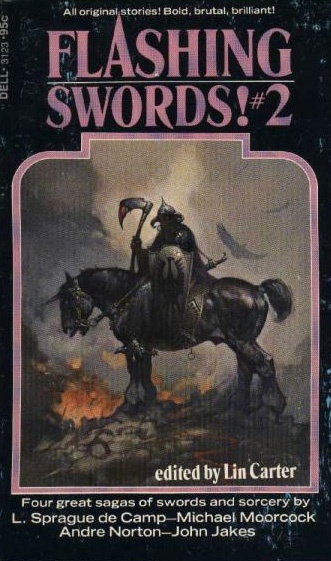
1974 Paperback edition. Cover art by Frank Frazetta.

One of the many freedoms of Sword and Sorcery, it seems to me, is that it enables the adoption of a world that allows the writer to comment on just about anything on which one would want. One of Robert E. Howard’s purposes in the construction of his own Hyboria was to create a conglomerate of cultures, no matter how anachronistic their juxtapositions, so that his hero Conan might have any kind of adventure that Howard might think up. Whereas for previous tales, Howard perhaps had to construct different heroes for different historical epochs (Bran Mak Morn for the Celtic Picts, Solomon Kane for the sixteenth century, Kull for Atlantis), in the Hyborian Age Conan might be a thief, a soldier, a pirate, and ultimately a king, his adventures all the while providing Howard with powerful commentary on “civilization.”

So, too, writers after Howard have utilized this purpose. Dave Sim, through his creation of Cerebus the Aardvark, begins by commenting on the Sword and Sorcery genre itself (as well as the mainstream comic books of Sim’s time) and then goes on to explore High Society, Church & State, marriage – and this last, in Jaka’s Story, is as far as my reading has taken me, but I understand that Sim is so far reaching in his exploration of topics that in a much later volume he even explores the life and works of Ernest Hemingway through Cerebus taking on the position of Hemingway’s personal secretary!

Terry Pratchett uses the Sword and Sorcery milieu to ingenious satirical effect, cribbing directly (I believe) from Fritz Leiber in order to forecast to his readers, in the very first pages of the very first Discworld novel, just what tone and material his readers may expect. Pratchett’s initial perspective characters, soon abandoned, are Bravd and the Weasel (Fafhrd and the Gray Mouser, obviously). I quote the following description in order to give an example of Pratchett’s satirical treatment of Sword and Sorcery and to underscore, specifically, Pratchett’s debt to Leiber. For more humor, one might want to pick up this book and enjoy the way that these characters talk to each other – it’s impressively Leiberesque.

Read More Read More

A Look At The Year Gone By – 2014

A Look At The Year Gone By – 2014

oie_624347x4h9YP6xBy my count, I published forty-two articles here at Black Gate during 2014. I reviewed thirty-two novels and over forty short stories.

While most of the books were older ones [e.g. The Eternal Champion (1962) and Year of the Unicorn (1965)], I did manage to sneak a few newer ones into the mix, as you’ll read below. The short stories, all from presently publishing magazines, reinforced my belief that there’s a continuing renaissance in swords & sorcery. There are talented authors toiling away despite the lack of commerical interest. I hope I convinced other S&S fans to investigate these books and stories and learn for yourselves how much good heroic fantasy is out there waiting for you.

As I’ve written in the past, one of my initial reasons for blogging about S&S was to get myself to read many of the books I had missed or neglected over the years. I managed to accomplish a lot of that this year.

Two-thirds of the books I read were brand new to me. Among the older ones were Darrell Schweitzer’s strange and intoxicating Echoes of the Goddess and Adrian Cole’s phantasmagorical Oblivion Hand. I’m very happy I finally read Keith Taylor’s great Celtic S&S book, Bard, as well as Teresa Edgerton’s The Queen’s Necklace. The best contemporary books I read were the densely constructed The Constant Tower by Carole McDonnell, and sword & soul founder Charles R. Saunder’s brand new Abengoni: First Calling.

Read More Read More

Adventure On Film: Richard Lester’s The Three Musketeers

Adventure On Film: Richard Lester’s The Three Musketeers

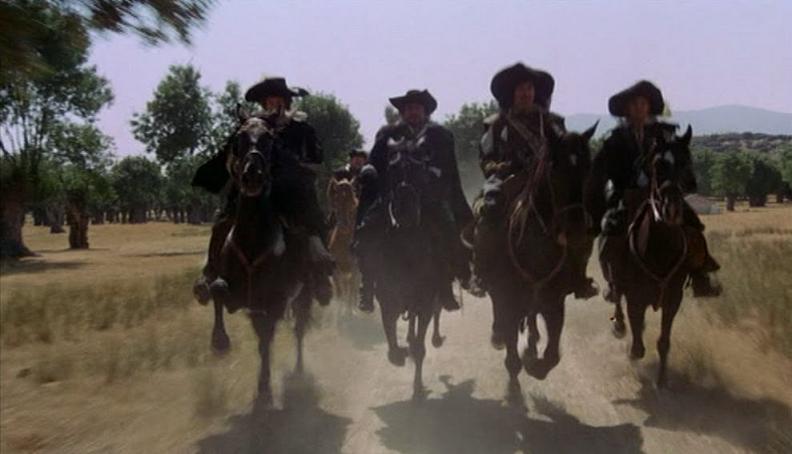
three rideI can hear the protests already: “Don’t you mean Alexander Dumas’s The Three Musketeers?” Well, yes. In a way. But I refer here to the film, not the novel. This 1973 outing is one of perhaps eight full-length film adaptations of this grand French chestnut, and, as directed by Richard Lester, it’s essential viewing for all fans of action, swordplay, and pace.

Indeed, to cut and slash the weighty novel down to a manageable length, no small violence has been done to the text, and the film practically tumbles over itself trying to keep up with its own story-telling requirements. Lester fills each rowdy frame with visions of period France; in his crowd scenes, there’s so much going on that the film bears an immediate second viewing, just to keep up with the busy visuals.

Best of all, of course, are the fabulous, kinetic, and often hilarious sword fights. Athos, Porthos, and Aramis may be musketeers, but there’s hardly a discharge of powder and shot to be found; these heroes (dandies and drunks, really) live by the sword, full stop.

Read More Read More

Frodo Baggins, Lady Galadriel, and the Games of the Mighty

Frodo Baggins, Lady Galadriel, and the Games of the Mighty

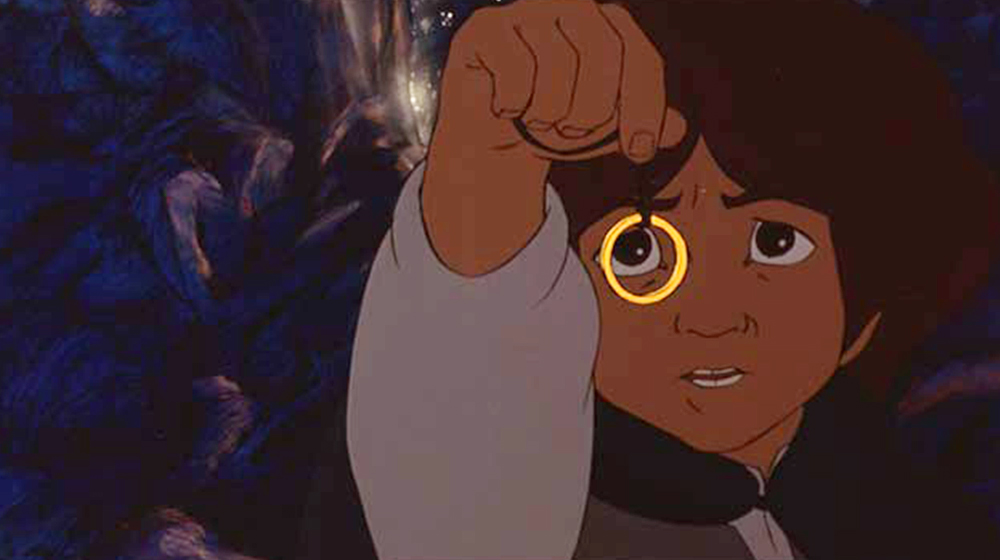
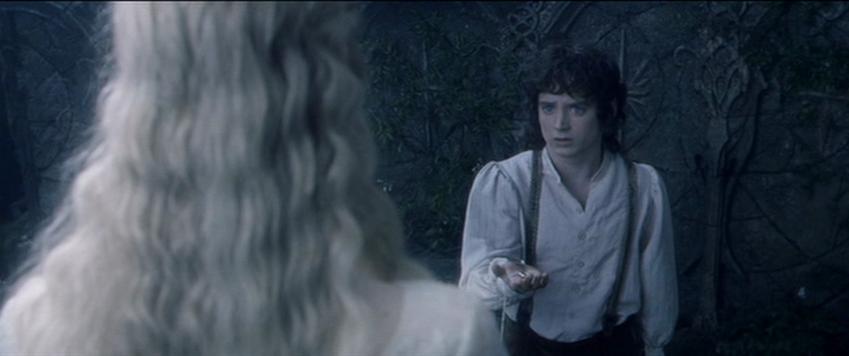
A classic image. Iconic. Frodo Baggins, Hobbit of the Shire, offering the ring of power to Galadriel, Elven Queen of Lothlórien.

Ralph Bakshi version:

Frodo and the Ring-small

Peter Jackson version:

Frodo and the Ring 2-small

Yet, as is often the case in JRR Tolkien’s writings, things are not quite what they appear. Allow me to bullet point the bites Mr. Baggins has had to take out of the crap sandwich served up to him by fate up to this point.

Read More Read More

AD&D Figurines: Youth In a Box?

AD&D Figurines: Youth In a Box?

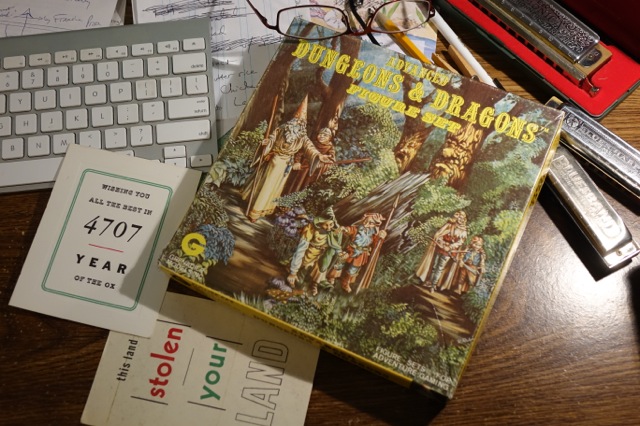
DSC04791A few weeks back, a friend (quite unexpectedly) handed me the boxed set of AD&D miniatures pictured at right. I say “unexpectedly” because so far as I know, this friend had no idea that I ever played D&D. Nor were the figures intended for me; the note she enclosed made it clear the box was for my fourteen-year-old son, “just in case.”

My son was marginally interested, but not seriously so. I, however, was kind of downright sorta hypnotized.

Confession: I never gravitated to miniatures. My twin objections were, first, that the figures never, ever looked the way I pictured either my characters or those of my fellow gamers, and second, they were small enough that painting them to my own exacting standards was next to impossible.

I had Testor’s model paint, of course (most boys I knew in the late seventies and early eighties did), so accessing a mouth-watering color palette wasn’t the issue.

Application, however: yipes!

Read More Read More

Eleven Shades Of Evil

Eleven Shades Of Evil

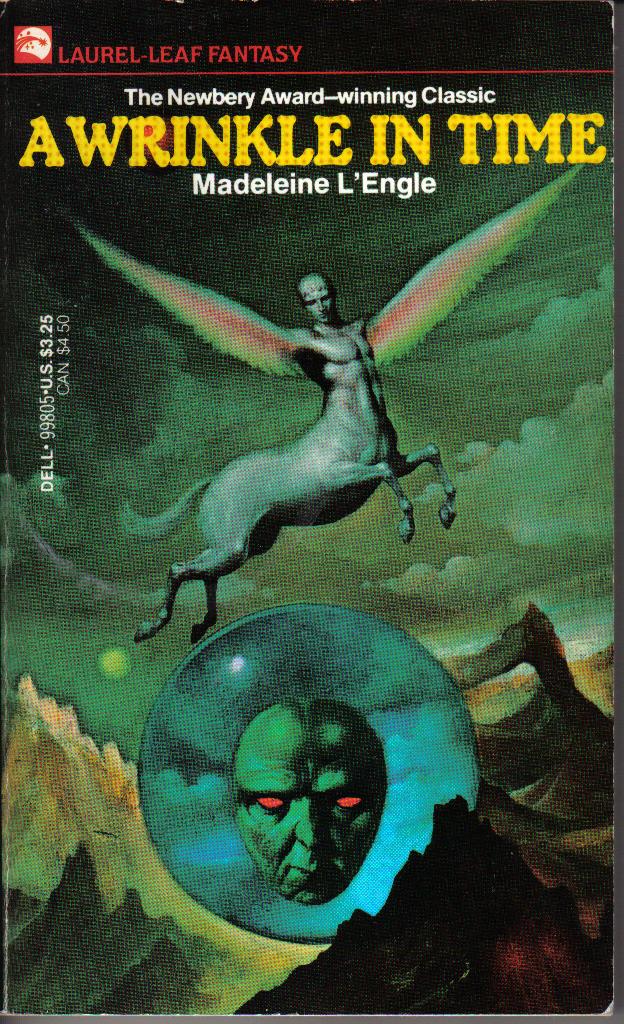
Just in time for the holidays (not to mention the headlines), I bring you EVIL. The ultimate fantastical topic.Wrinkle in Time

Now, just so we’re clear from the get-go, I’m against it. Against evil, that is. As are we all, surely. But, once I’ve got my writer’s hat on (or, for that matter, my reader’s hat), evil becomes indispensable. I not only love it, I’ve just gotta have it. For writers, evil belongs in the same all-purpose toolbox as conjunctions, theme, and essential miscellany like the average blooming season of Agapanthus africanus.

Categories first. When it comes to speculative fiction, and its offspring in film, television, and the ‘net, I submit that evil comes in the following basic flavors, and in the following entirely arbitrary order:

1) Abiding
2) Petty
3) World-conquering
4) Internal
5) Atavistic
6) Alien
7) Humorous
8) Inscrutable
9) Insane
10) Passive and
11) Institutional

Let’s take these one at a time (because taking two at a time would try the patience of a saint).

Read More Read More