Browsed by
Category: Editor’s Blog

The blog posts of Black Gate Managing Editor Howard Andrew Jones and Editor John O’Neill

Vintage Treasures: The Best of Edmond Hamilton

Vintage Treasures: The Best of Edmond Hamilton

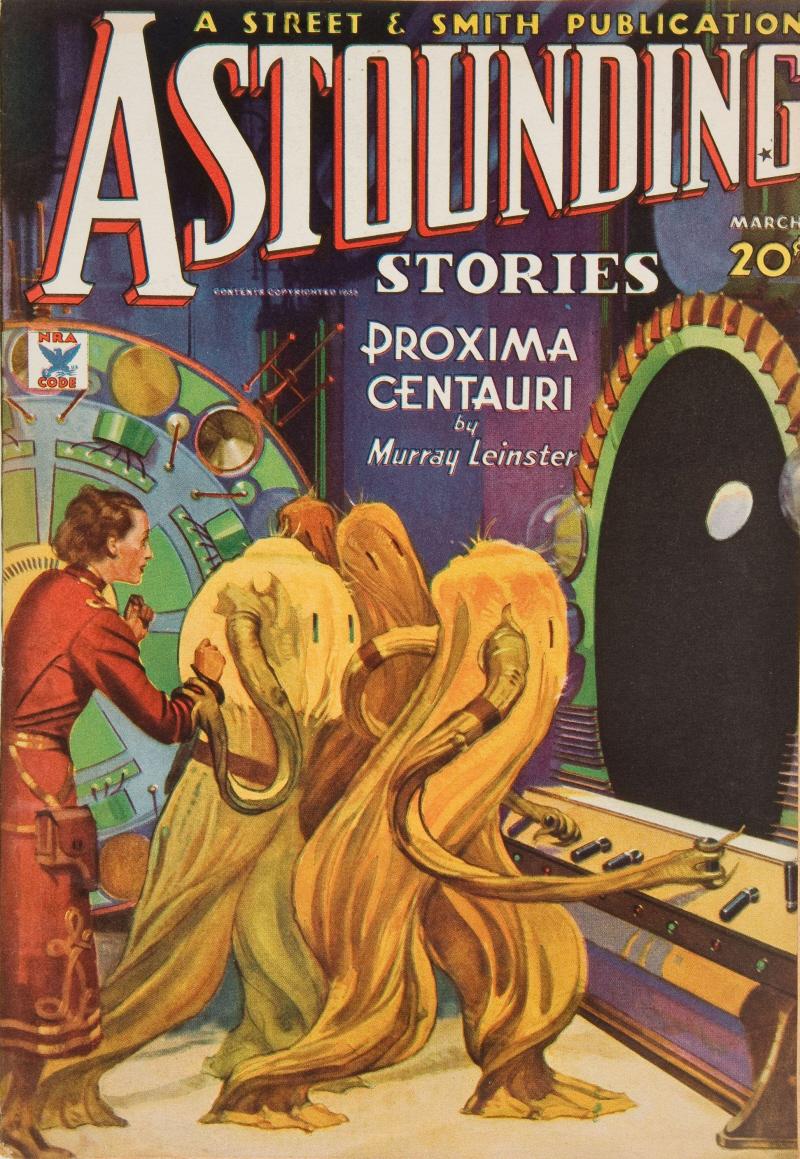
The Best Of Edmond Hamilton-smallEdmond Hamilton is my favorite pulp writer and he has been since I read the chilling short story “The Man Who Evolved” in Before the Golden Age. (Read the complete story online at The Nostalgia League.)

That’s a long time, especially considering how many pulp tales I’ve read in the intervening years. But Hamilton had a lengthy and productive career — he was one of the few writers to survive both the coming of Campbell, who ushered in the Golden Age of Science Fiction, and the death of pulps more than a decade later.

Hamilton’s first published story, “The Monster-God of Mamurth,” appeared in the August 1926 issue of Weird Tales. It was a fully realized tale of eldritch horror, following the exploits of a group of explorers who discover a legendary lost city in the desert and the sinister spider-things who inhabit it still.

When we began including reprints in the print version of Black Gate, “The Monster-God of Mamurth” was the second one we chose, and it appeared in BG 2, with all-original art by Allen Koszowski (see one of the magnificently creepy illos he did for us here).

Hamilton quickly became one of Weird Tales‘ most popular and prolific writers, appearing alongside H. P. Lovecraft and Robert E. Howard. All told he sold 79 stories to Farnsworth Wright and the magazine’s later editors between 1926 and 1948; only Seabury Quinn and August Derleth appeared more often in the magazine’s pages.

According to his ISFDB page, Hamilton wrote exactly 200 short stories for the magazines between 1926 and his death in 1977. He appeared in virtually all the science fiction and fantasy pulps, including Air Wonder Stories, Wonder Stories, Thrilling WonderSuper Science Stories, Amazing Stories, Fantastic Science Fiction, and many others.

Read More Read More

Revisit Pavis: Gateway to Adventure

Revisit Pavis: Gateway to Adventure

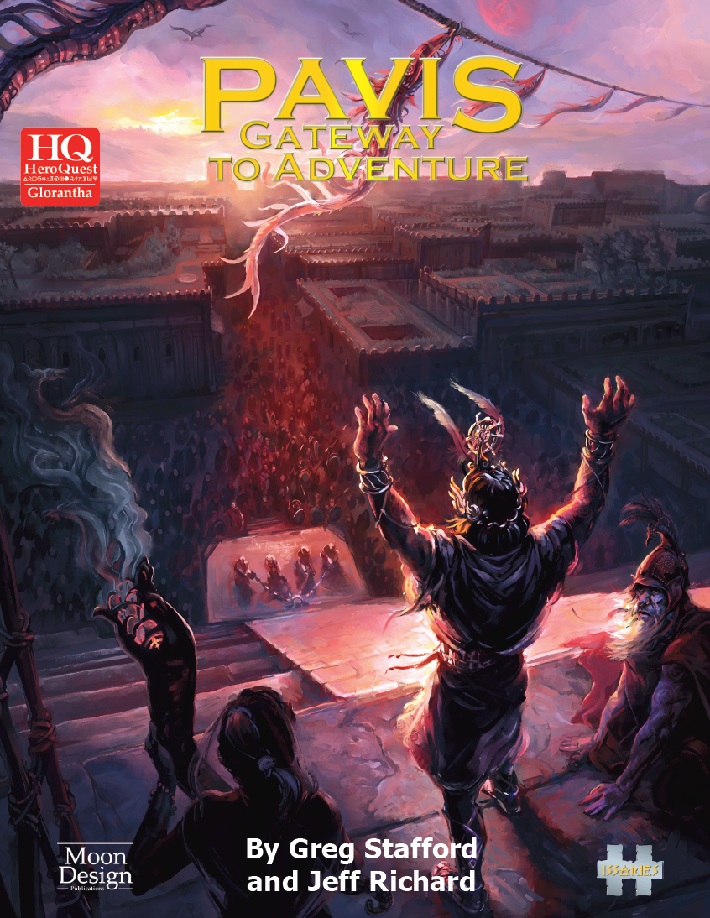
Pavis Gateway to Adventure-smallLast April, Sarah Newton wrote a marvelous two-part review of Moon Design’s Pavis: Gateway to Adventure, the third (and easily the most massive) edition of a fantasy setting I first enjoyed 30 years ago.

Getting my hands on one proved to be more challenging than I expected, however. Apparently, the first printing sold out quickly and I had to wait until it was reprinted. Finally, more than a year after Sarah’s enticing review appeared here at Black Gate, I was able to sit down with my own copy.

Why was I so intrigued? Partly it was memories of that marvelous first edition, a gorgeous boxed set from Chaosium. Pavis was one of the most ambitious RPG adventure supplements ever made when it appeared in 1983: a completely realized bronze age city, packed with historical detail, strange cultures and cults, maps, thieves, profiteers, and adventurers.

Most important of all, however, Pavis was a launching point for adventure in Big Rubble, its sister publication, a ruined city overrun by trolls, snakes — and much worse things. The subtitle of the new edition is “Gateway to Adventure,” and that’s a wholly accurate description.

The new edition combines both Pavis and Big Rubble under a single cover, adding a host of new material on top of an already well-realized setting.

The result is a terrific product, with more tightly-woven encounters and plot threads and everything you need to kick off a grand adventure.

Read More Read More

Unleash your inner Conan with Barbarian Kings

Unleash your inner Conan with Barbarian Kings

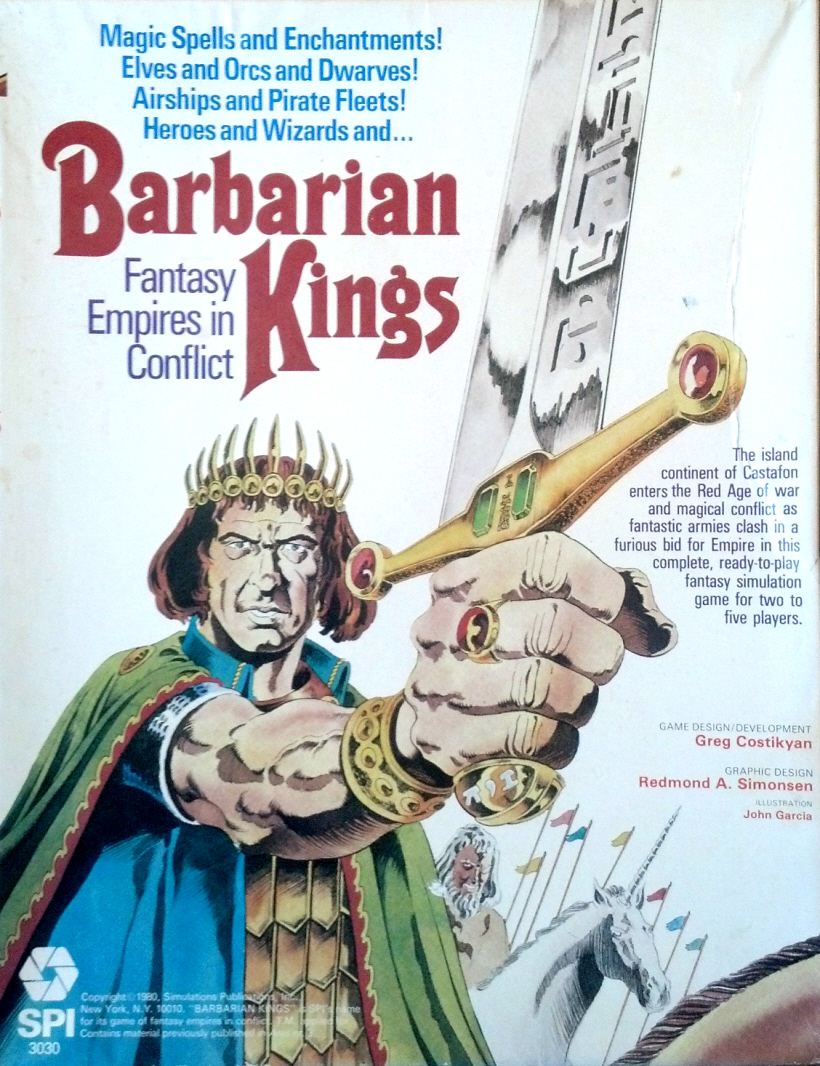
Barbarian Kings SPI-smallMagic Spells and Enchantments! Elves and Orcs and Dwarves! Airships and Pirate Fleets! Heroes and Wizards and… Barbarian Kings.

That’s the cover copy on the boxed version of Barbarian Kings, one of the most fascinating games from my childhood, a game clearly inspired in equal measure by Robert E. Howard and J.R.R. Tolkien. Except for the airships, which I think maybe was an attempt to throw in a little Edgar Rice Burroughs and John Carter of Mars.

My fascination didn’t stem from any virtue of the game design. In fact, I never even had the chance to play it when it was first released in 1980. But it loomed large in my imagination.

Barbarian Kings was originally published in Ares #3. I’ve mentioned Ares before — it was the short-lived (and today, highly collectible) magazine published by SPI that included a science fiction or fantasy board game in every issue.

And what games they were. Star Trader, simulating high-stakes interstellar trade, commerce, and piracy; The High Crusade, inspired by Poul Anderson’s classic novel of a medieval conquest of the galaxy; Nightmare House, which featured intrepid explorers venturing into a haunted house; Voyage of the B.S.M. Pandora, a solitaire game of interstellar exploration on savage worlds; The Omega War, simulating a post-apocalyptic battle on a war-scarred North America in 2419. And nearly a dozen others.

And in issue #3, it was Barbarian Kings, a simple but compelling game of fantasy empires in conflict for 2-5 players. The Jack Kirby-inspired art on the cover communicated just about everything you needed to know (click on the image at right for a bigger version). This was a game of empire building in a world of dwarves, orcs, and magic, just like any of a hundred fantasy novels crowding the shelves in the 70s. It was a compact theatre of the imagination that could drop you smack dab into your favorite fantasy setting and let you run rampant with an army at your back. And airships. Let’s not forget the airships.

Read More Read More

Out With the Old, In With the New: New Versus Vintage Treasures

Out With the Old, In With the New: New Versus Vintage Treasures

secret-history4At the end of every month, I write up a brief report for Team Black Gate, the loose confederation of geniuses, experts, and oddballs who volunteer to blog here. Without these folks, you’d be looking at a whole lot of white space on the Black Gate website every morning as you sipped your coffee.

I usually take a few minutes to look over the traffic stats as I’m preparing the report. It’s interesting stuff. (Some day, for example, I’ll tell you about some of the more bizarre Internet searches that bring people to our shores… believe me, you have no idea).

There’s always a few things to ponder, though. And that’s exactly what I did last night, as the rest of my family got tired of waiting and started watching Thor without me. This time, what I pondered was the disparity in readership numbers between our New Treasures articles, and Vintage Treasures.

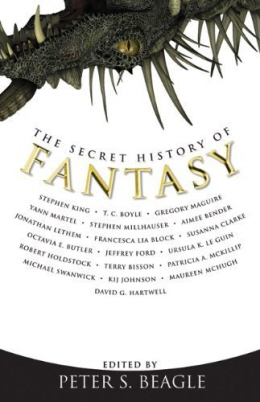
I first started writing New Treasures posts in October 2010, as a way to showcase the most intriguing new fantasy crossing my desk every week that I wasn’t able to cover with a full review. The first one was Tachyon Publications’ The Secret History of Fantasy, and so far I’ve written 262, or about 1-2 per week. In March 2011, I started doing the same with vintage titles (which I loosely define as anything 20+ years old), initially just as an excuse to write about James Van Hise’s marvelous Science Fiction in the Golden Age. As of this week, I’ve done 164 Vintage Treasure articles, or slightly more than one per week.

Long enough to build up an audience, in other words. I understand that the same folks who enjoy reading New Treasures may not always be interested in Vintage Treasures, and vice versa; but I certainly enjoy discovering both promising new authors and exciting older titles, and I expect I’m not the only one. So I’ve always assumed that as the audience for one grew, so would the other.

That hasn’t happened — at all. In fact, if the traffic stats for blackgate.com are to be believed, New Treasures has become the most popular feature on the blog, while Vintage Treasures are read by slightly fewer people than our legal disclaimers. Here’s a snapshot of the number of times those respective links were clicked anywhere on our pages in the month of June.

New Treasures 10,807
Vintage Treasures 174

Read More Read More

Tabletop Gaming On The Rise

Tabletop Gaming On The Rise

Tabletop RPGs-smallThere’s an interesting article in the Times Free Press this week that examines the growing evidence that tabletop role playing is experiencing a significant resurgence.

Written by Casey Phillips, the article, “After 40 years, popularity of tabletop gaming rises despite high-tech competition,” mixes industry stats with anecdotal evidence gathered from the Chattanooga area.

D&D and other role-playing games increasingly are becoming a mainstream activity. In a 2000 survey, Wizards of the Coast — the current owners of the D&D universe of products — estimated that 5.5 million people in the U.S. regularly play tabletop roleplaying games…

With the recent growth of nerd culture through blockbuster comic book films and the growth of the video game industry, role-playing has been embraced more positively by pop culture, serving as a plot device in TV shows such as Futurama, Freaks and Geeks, Community and The Big Bang Theory

In a 2004 essay about his introduction to D&D as a seventh grader, talk show host Stephen Colbert writes, “I… was instantly hooked. It allowed me to enter the world of the books I was reading. I put more effort into that game than I ever did into my school work.” In 2011, he also issued an on-air shout-out to “any half-elf thieves who are joining us tonight.”

I’m not sure I believe that 5.5 million people stat from Wizards of the Coast — unless maybe they define “regularly plays tabletop roleplaying games” as “daydreamed about being Legolas one time.” But I definitely concur that D&D has become tightly identified with the rise of nerd culture, and that has played a very real part in popularizing it and other role playing games. I witnessed that first hand, when my daughter asked to play after her friends watched the “Advanced Dungeons and Dragons” episode of Community.

Read the complete article here.

The Top 50 Black Gate Posts in June

The Top 50 Black Gate Posts in June

beneath-ceaseless-skies-logoAccording to our badly-overheated traffic meter, you folks visited the Black Gate blog in record numbers last month (and you left a mess in the visitors lounge, too. Seriously, what’s with all the Taco Bell wrappers?)

Still, we’re glad to see you. I was pleased to note that our most popular article in June was Fletcher Vredenburgh’s look at our distinguished competition, Heroic Fantasy Quarterly and Beneath Ceaseless Skies, and his assessment of the best new Sword and Sorcery of the last twelve months. Close behind was Scott Taylor’s newest Top 10 list, “The Top 10 Role Playing Games of All Time,” and Patty Templeton’s interview with uber-editor and 21st Century Renaissance Man, John Joseph Adams.

Rounding out the top five were Douglas Draa’s review of Michael Shea’s horror classic The Color Out Of Time, and our coverage of Jean Rabe’s resignation as editor of the SFWA Bulletin.

The Top 50 Black Gate posts in June were:

  1. The Best New Sword and Sorcery of the Last Twelve Months
  2. Art of the Genre: The Top 10 Role Playing Games of All Time
  3. An Interview with John Joseph Adams
  4. Vintage Treasures: The Color Out of Time by Michael Shea
  5. Jean Rabe Resigns as SFWA Bulletin Editor Amidst Controversy
  6. Art of the Genre: Kickstarter – It Really Shouldn’t Be About the Stuff
  7. Robert E Howard and Appendix N: Advanced Readings in D&D
  8. Maureen F McHugh’s China Mountain Zhang
  9. Pathfinder RPG: Fey Revisited
  10. Did I Do that? or We’ve Had the Sword, Where’s the Sorcery?


  11. Read More Read More

The Secret Supplement: Greyhawk, Gygax, and Outdoor Survival

The Secret Supplement: Greyhawk, Gygax, and Outdoor Survival

Outdoor Survival-smallA while ago, my 13-year-old daughter Taylor told me her friend Will had seen the famous “Advanced Dungeons and Dragons” episode of Community and wanted to learn how to play.

“Sure,” I said. “Tell him to come over on Saturday and I’ll put together a quick adventure for both of you.” My 15-year-old son Drew joined in, creating a fighter, and even Tim, my 17-year old, got in on the action, rolling up a 1st level magic user.

That was over six months ago. What began as a simple session, involving a bunch of farm kids rescuing a dwarven thief named Jasper from marauding gobins, has evolved into an epic campaign, a desperate adventure to stop an army of hobgobins and orcs from completing a railroad that will bring war to their frontier home.

It’s the most fun I’ve had role playing in decades.

I introduced my kids to D&D years ago, but we played only intermittently, and the campaign — such as it was — never really built up steam. The addition of a fourth player, from outside the family, has brought with it a regular Saturday morning schedule, and the result is a much heightened level of interest from everyone involved.

Things are happening faster, they’re leveling up quicker, and they spend the days between sessions talking excitedly, planning, and trying to puzzle out how all the clues they’ve uncovered fit together to reveal the sinister plan behind events.

It’s brought a change in how I dungeon master, too. When I was DM for a group my own age, from roughly 1980 to 2000, there was a certain level of performance anxiety. Every session had to be bigger and better, each adventure more ambitious and epic than the last. I couldn’t just create a fun, two-hour subterranean module… I had to bring an entire underworld civilization to life, with a believable backstory and vast cast of heroes and villains.

Read More Read More

The Doom That Came to Kickstarter

The Doom That Came to Kickstarter

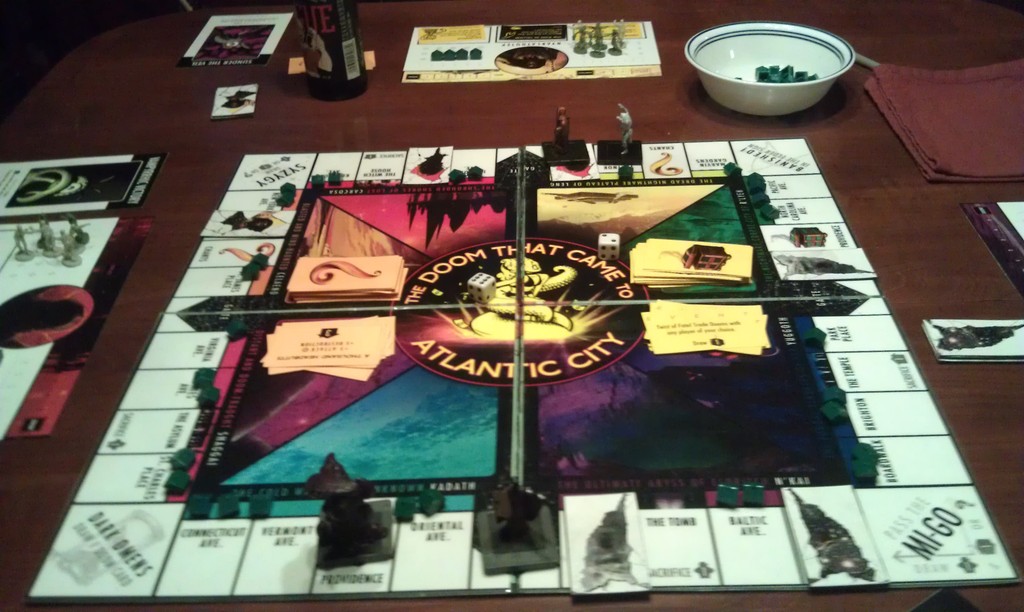
The Doom That Came to Atlantic City-smallReports are coming in that Erik Chevalier, the man behind one of the most high-profile Kickstarter game successes of 2012, The Doom That Came To Atlantic City, has admitted that he will never produce the game.

The Doom That Came To Atlantic City, created by Eberron designer Keith Baker and artist Lee Moyer, was a Monopoly-style game with a distinct Cthulhu flair. Described as “A light hearted Lovecraftian game of urban destruction,” the game invited players to take the roles of Great Old Ones in a race to be the first to destroy the world. The Kickstarter campaign launched May 7, 2012 with a $35,000 goal; by the time it closed on June 6, 2012 it had raised an astounding $122,874.

However, over the past 13 months, Chevalier has been releasing increasingly bleak progress reports, culminating in this post Tuesday:

This is not an easy update to write. The short version: The project is over, the game is canceled…

From the beginning the intention was to launch a new board game company with the Kickstarted funds, with The Doom that Came to Atlantic City as only our first of hopefully many projects… Since then rifts have formed and every error compounded the growing frustration, causing only more issues. After paying to form the company, for the miniature statues, moving back to Portland, getting software licenses and hiring artists to do things like rule book design and art conforming the money was approaching a point of no return. We had to print at that point or never. Unfortunately that wasn’t in the cards…

Predictably, the feedback from backers has been scathing.

Read More Read More

“We Thought We Were Immortal”: Robert Bloch on J. Francis McComas, Eric Frank Russell, and Leigh Brackett

“We Thought We Were Immortal”: Robert Bloch on J. Francis McComas, Eric Frank Russell, and Leigh Brackett

Starlog Science Fiction Yearbook-smallLast week, as part of my ongoing look at Lester Del Rey’s Best of… paperbacks from the 1970s, I wrote a brief piece on The Best of Robert Bloch. In the Comments section, Tangent editor and uber-fan Dave Truesdale offered up this fascinating tidbit:

Back in 1978 David Gerrold and I edited the Starlog SF Yearbook… For the section titled In Memoriam I wrote Robert Bloch and asked if he would do the honors (Kerry O’Quinn, Starlog publisher had given me a budget and so I was of course paying authors). Bob agreed and turned in well over a thousand words on three people who had passed away in 1978: J. Francis “Mick” McComas, co-founder of F&SF; Eric Frank Russell, and Leigh Brackett. It was a marvelous piece, bookended with how the field had begun so small when everybody knew everybody else and it was a big deal when someone died — and today (1978) when hardly anyone noted the passing of folks like Hugo Gernsback or Raymond Palmer…

After Bob got the check for his piece, he wrote back to express his thanks and that Mrs. Bloch would no doubt enjoy spending it on several bags of groceries.

After thinking on it a bit more, Dave got in touch with Robert Bloch’s daughter, Sally (Bloch) Francy, to ask for permission to reprint the piece. Here’s part of her reply:

I’m sure Dad would be very pleased, and I hope he and Rich Matheson are chatting about it as I ‘speak.’ I babysat for Matheson’s kids and rode horseback with their oldest daughter, Tina… Rich’s passing, though not a surprise, given his age and health issues, was still a shock. He and Harlan Ellison are the two people I knew from when I was a teenager, and to whom I still feel strong emotional ties to my father. They are the last of his generation of the people I knew. I miss my dad every day, still!

Thanks to Dave’s efforts, the complete text of her letter and her father’s 1978 piece are reprinted on the Tangent Online website.

Vintage Treasures: The Comic Times

Vintage Treasures: The Comic Times

The Comic Times 4-smallJust check out that 1980 Charles Vess cover at right. Isn’t it neat? I sure thought so, when I accidentally stumbled across it on eBay.

It is now mine. Mine mine mine. Because, Charles Vess. Also, poor impulse control.

Strange thing happened when it arrived, though. I thought I was buying an early issue of The Comics Journal. As soon as I unpacked it — and stopped cooing over the Charles Vess cover — I noticed that it was not an issue of The Comics Journal. It was something called The Comic Times.

I’m embarrassed to admit that I never heard of The Comic Times. Had to look it up and everything.

I’m embarrassed because the early 80s was when I was pretty much completely immersed in the comics scene. I was buying and reading comics by the truckload, from Arthur’s Place in downtown Ottawa. Frank Miller’s Ronin, Cerberus, Love and Rockets, Alan Moore’s Swamp Thing, Keith Giffen’s Legion of Super Heroes, Howard Chaykin’s American Flagg, Pacific Comics… I didn’t need something called The Comic Times. I was living The Comic Times.

I’m sure enjoying reading it now, though. It’s a fun and informative little zine, and I bet I would have gotten a lot out of it back in 1980. Near as I can figure out, it only lasted six issues. It was edited by Dennis Cieri and Mark Gasper, and published out of New York. Like The Comics Journal, it was printed on newsprint and looks like it was typeset with a Smith Corona.

Read More Read More