Browsed by
Category: Books

Vintage Treasures: The Barbarians Anthology Series
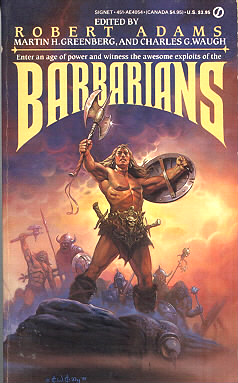
Vintage Treasures: The Barbarians Anthology Series

barbariansThere’s been some good discussion of Sword & Sorcery on the BG blog of late, from Brian Murphy’s excellent list of “A Half-Dozen Swords And Sorcery Short Stories Worth Your Summer Reading Time, and Howard Andrew Jones’s skillful examination of the writing technique of the genre’s patriarch, “Under the Hood with Robert E. Howard,” to Joe Bonadonna’s warm reminiscence of the very best S&S of his youth, “How I Met Your Cimmerian (and other Barbarian Swordsmen).”

I thought I was pretty well educated in Sword & Sorcery; but it’s the sign of a rich and vibrant genre that it can still surprise you after decades of collecting.

That’s exactly what happened when I found the artifact at left, buried deep in a paperback science fiction collection I recently purchased.

Barbarians was a major S&S retrospective anthology published by Signet in 1986. It was edited by Robert Adams, Martin H. Greenberg, and Charles Waugh, and contained stories by Fritz Leiber, Fred Saberhagen, Andre Norton, Karl Edward Wagner, and many more. It’s a thick paperback original with 13 short stories.

And no, I’d never seen a copy before — or its sequel. Here’s the back cover copy:

From a beautiful huntress with glittering eyes and a killing kiss to mighty Conan’s struggle in a deadly place beyond magic… from a distant planet fated to do battle with the forgotten past to primeval swordsmen pledged to protect a besieged land — here are tales of titanic strength and unearthly courage, of savage warriors facing incredible challenges in the far-flung realms of the imagination.

Sounds pretty good. Not entirely sure how this one escaped me for all these years, but I’m glad I’ve stumbled across it now.
Read More Read More

Three Hobbit Films for the LOTR Fans = Trouble

Three Hobbit Films for the LOTR Fans = Trouble

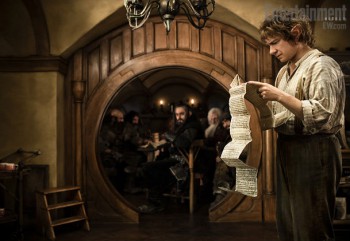
ew-hobbit-bilboFans of Peter Jackson’s The Lord of the Rings should be thrilled that The Hobbit, originally planned as two feature films, is now slated for three.  More Tolkien on screen is a good thing, right?
Surely yes, if what we are getting is indeed more Tolkien. But Jackson’s “bridge” film is not going to be more Tolkien, but more Jackson. And that is not necessarily an encouraging thought.

Due to contractual issues with the Tolkien estate — Jackson is unable to use material from The Silmarillion, The History of Middle-Earth, or Unfinished Tales — this “bridge” film will come from the appendices of The Lord of the Rings. Jackson wrote on his Facebook page:

“We know how much of the story of Bilbo Baggins, the Wizard Gandalf, the Dwarves of Erebor, the rise of the Necromancer, and the Battle of Dol Guldur will remain untold if we do not take this chance. The richness of the story of The Hobbit, as well as some of the related material in the appendices of The Lord of the Rings, allows us to tell the full story of the adventures of Bilbo Baggins and the part he played in the sometimes dangerous, but at all times exciting, history of Middle-earth.”

The appendices are certainly a mine of information, but the stories they tell are scattered, patchy in places, and not written as straightforward narrative. To bridge the events of The Hobbit to The Lord of the Rings in a film that neatly connects a series of disparate dots, Jackson must fill in gaps, construct dialogue from scratch, and so on. And that could spell trouble.

Read More Read More

New Treasures: Laird Barron’s The Croning

New Treasures: Laird Barron’s The Croning

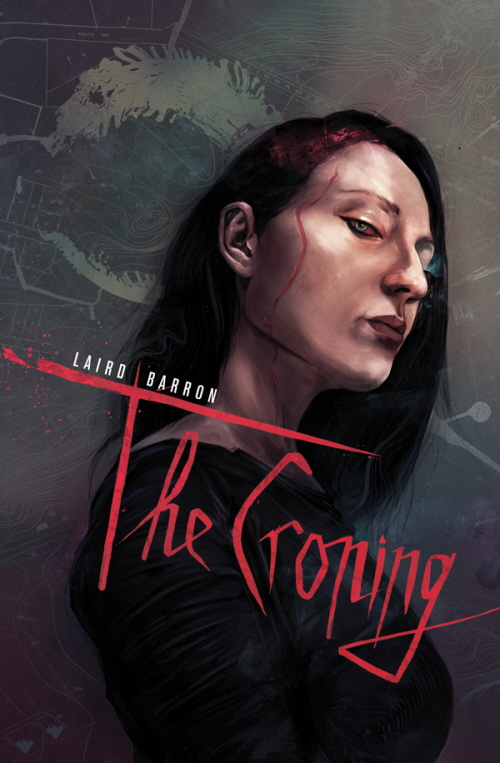
croningHoward and I first met the talented Laird Barron at the World Fantasy Convention in Austin, Texas in 2006. At the time he’d published only a handful of short stories in The Magazine of Fantasy & Science Fiction, SCI FICTION and a few other markets — but what great stories they were, including”Hallucigenia,” “The Imago Sequence,” and “Shiva, Open Your Eye.”

Laird turned out to be a fascinating and entertaining guy. Seriously, next time you’re at a convention, hang with this guy. He has a pure, unabashed love of Lovecraft, pulp and crime fiction, and westerns, and his fiction combines these elements in marvelous new ways. And if you get a chance, ask him to explain his famous comment that the Bible is “the greatest horror story ever told.”

Laird’s first collection was The Imago Sequence & Other Stories, released in trade paperback by Night Shade Books in 2007; it was followed by Occultation in 2010 (also from Night Shade). He won the 2007 and 2010 Shirley Jackson Award for his collections, and has been nominated for numerous other awards, including the Crawford, Sturgeon, International Horror Guild, World Fantasy, Bram Stoker and Locus Awards. These two books helped cement his reputation, and transform him from a rising young star to one of the most respected dark fantasy and horror writers working today.

His long-awaited first novel, The Croning, arrived in May, and true to form it combines cosmic horror and noir fiction in Barron’s signature style:

Strange things exist on the periphery of our existence, haunting us from the darkness looming beyond our firelight. Black magic, weird cults and worse things loom in the shadows. The Children of Old Leech have been with us from time immemorial. And they love us. Donald Miller, geologist and academic, has walked along the edge of a chasm for most of his nearly eighty years, leading a charmed life between endearing absent-mindedness and sanity-shattering realization. Now, all things must converge. Donald will discover the dark secrets along the edges, unearthing savage truths about his wife Michelle, their adult twins, and all he knows and trusts. For Donald is about to stumble on the secret…of The Croning.

The Croning is 245 pages; it is available in hardcover (for $24.99) and digital ($8.99) format from Night Shade Books.

Edgar Rice Burroughs’s Mars, Part 8: Swords of Mars

Edgar Rice Burroughs’s Mars, Part 8: Swords of Mars

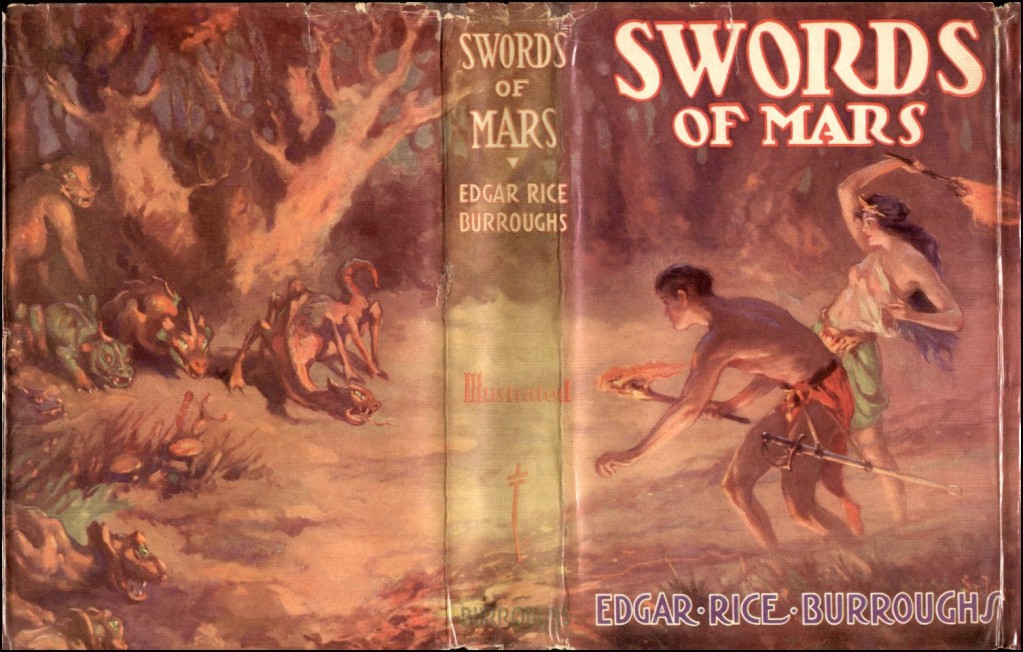
j-allen-st-john-swords-of-mars-1st-edition“But my memories of that great tragedy are not all sad. There was high adventure, there was noble fighting; and in the end there was — but perhaps you would like to hear about it.”
Guess who’s back? John Carter, who for the twenty years of real time since The Warlord of Mars has only served the role of a cameo character, is once again the hero and narrator of a Martian novel. And for the first time, he goes off-planet — although only as far as one of Mars’ two miniature moons.

Our Saga: The adventures of Earthman John Carter, his progeny, and sundry other natives and visitors, on the planet Mars, known to its inhabitants as Barsoom. A dry and slowly dying world, Barsoom contains four different human civilizations; one non-human one; a scattering of science among swashbuckling; and a plethora of religions, mystery cities, and strange beasts. The series spans 1912 to 1964 with nine novels, one volume of linked novellas, and two unrelated novellas.

Today’s Installment: Swords of Mars (1934–35)

Previous Installments: A Princess of Mars (1912), The Gods of Mars (1913), The Warlord of Mars (1913–14), Thuvia, Maid of Mars (1916), The Chessmen of Mars (1922), The Master Mind of Mars (1927), A Fighting Man of Mars (1930)

The Backstory

Why did Edgar Rice Burroughs return to John Carter as the hero after exploring other protagonists for so long? My guess: the Great Depression. The Tarzan merchandising empire was just taking off with the huge success of the first Johnny Weissmuller film, Tarzan the Ape Man, but Burroughs received only a flat $75,000 payment for the first two films while MGM raked in millions from them. Concurrently, Burroughs’s independent investment adventures outside of writing were failing. Even with the apparent outward success from Tarzan, times looked uncertain. Adding to the stress, Burroughs’s marriage was collapsing and he and his wife Emma were living separately by the end of 1934. ERB made serious efforts to expand his other franchises (this was the time in which he wrote the first two Venus novels, Pirates of Venus and Lost on Venus), and getting back to John Carter must have felt reassuring, mentally and financially. And indeed, the “Return of John Carter” novel Swords of Mars sold immediately. Burroughs wrote the book rapidly during November and December of 1933, and it appeared serially a year later in the top-tier pulp adventure magazine Blue Book.

Read More Read More

The Return of Brak the Barbarian

The Return of Brak the Barbarian

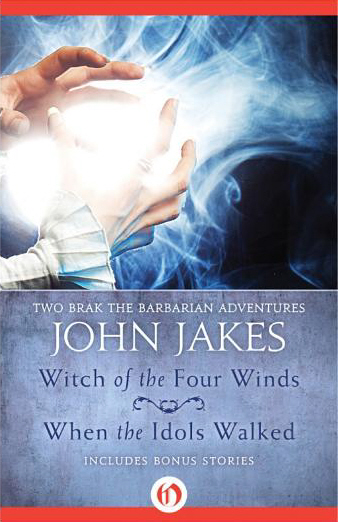
witch-of-the-four-winds2E-book publisher Open Road Media has announced the publication of two omnibus editions of John Jakes’ fondly-remembered Sword & Sorcery hero Brak the Barbarian.

Witch of the Four Winds and Brak the Barbarian will be available in digital format at Barnes & Noble and Amazon.com on July 31 for $4.99 each (before discounting).

Brak the Barbarian first appeared in Fantastic magazine in the short story “The Devils in the Walls” (1963). Over the next few years, Jakes produced over a dozen short stories and novellas featuring Brak, that he gradually collected and expanded into five books, published between 1968 and 1980.

Brak the Barbarian contains the 1968 short story collection Brak the Barbarian and the novel Mark of the Demons (1969), plus additional Brak stories and an illustrated biography of Jakes with rare images from the author’s personal collection.

Witch of the Four Winds contains two more early novels: Witch of the Four Winds — originally published under that title in Fantastic magazine in 1963, and then revised and expanded in novel format as Brak the Barbarian Versus the Sorceress (1969) — and When the Idols Walked (Fantastic 1964, expanded and released under the same title in 1978), plus more bonus stories and an illustrated biography.

Jakes’ Brak the Barbarian stories were strongly influenced by Robert E. Howard’s Conan. In the YouTube video Open Road created to promote the launch of the digital editions, Jakes says:

I was directly influenced by Robert Howard, by the fact that there weren’t enough Conan stories to go around… I wanted to create a character much like Conan, put him in similar circumstances, and have a good time writing them.

For science fiction fans, Open Road has also collected two early SF novels by Jakes in a third omnibus collection: On Wheels (1973) and Six-Gun Planet (1970). It’s also available July 31.

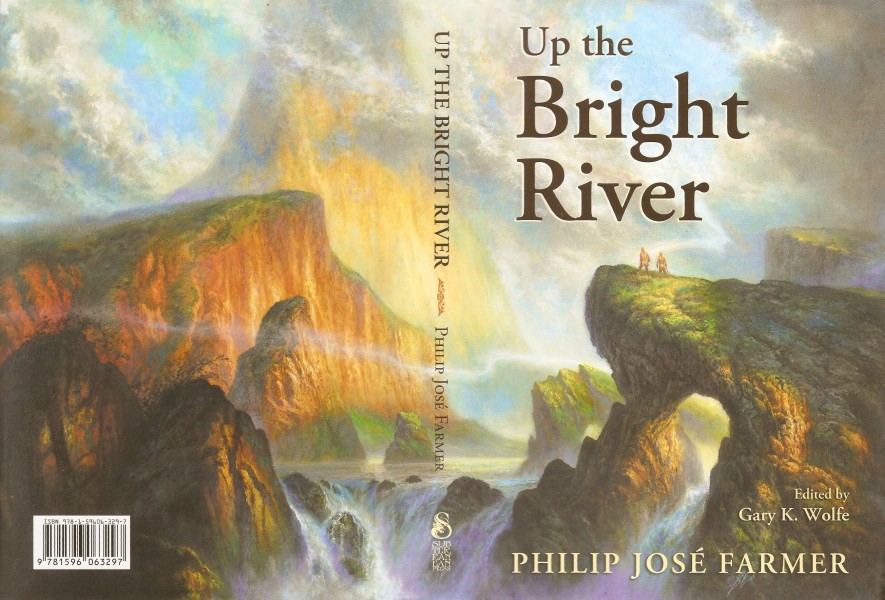
New Treasures: Philip Jose Farmer’s Up the Bright River, edited by Gary K. Wolfe

New Treasures: Philip Jose Farmer’s Up the Bright River, edited by Gary K. Wolfe

up-the-bright-river2

There’s no truth to the vicious rumor that I select candidates for my New Treasures column based solely on awesome cover art.

I also have to be able to get my hands on a copy. That’s two criteria, which I figure gives me a balanced approach.

Which brings us to today’s special guest, Up the Bright River by Philip Jose Farmer, a short story collection edited by Gary K. Wolfe. And its awesome wraparound cover, courtesy of Bob Eggleton (click for even awesomer high-res version).

Read More Read More

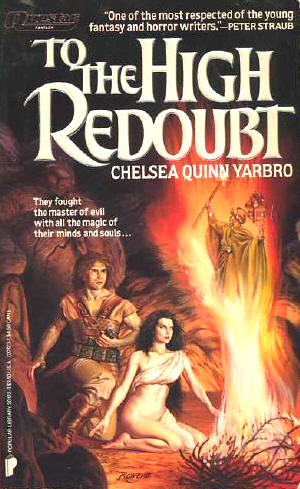
Vintage Treasures: Chelsea Quinn Yarbro’s To the High Redoubt

Vintage Treasures: Chelsea Quinn Yarbro’s To the High Redoubt

to-the-high-redoubt2When I think of Chelsea Quinn Yarbro, it’s usually in the context of her hugely successful Count Saint-Germain novels, the tales of gentleman vampire Saint-Germain and his adventures down through the centuries, beginning with Hôtel Transylvania (1978).  Yarbro’s 26 novels featuring Saint-Germain have covered a lot of historical ground, from the reign of emperor Heliogabalus in 3rd century Rome (Roman Dusk) to his escape from Genghis Khan in Tibet and India (Path of the Eclipse), 6th Century China (Dark of the Sun), and the rise of the Nazi party in Germany (Tempting Fate). The most recent, Commedia della Morte (March 2012), finds our dark protagonist in France during the Reign of Terror of the French Revolution.

But Yarbro has had a very successful career as a noted fantasist quite apart from her Saint-Germain books, with some 65 novels to her credit, including Time of the Fourth Horseman (1977) and A Baroque Fable (1986). Two of her earliest novels, The Palace (1979) and Ariosto (1980), were nominated for the World Fantasy Award, and in 2003 she was named a Grand Master at the World Horror Convention. In 2005 the International Horror Guild named her a “Living Legend,” and in 2009 she was presented with a Bram Stoker Lifetime Achievement Award by the Horror Writers’ Association.

Truthfully, I wouldn’t know any of this if I hadn’t stumbled on some of her paperbacks among a few of the collections I recently purchased, and become intrigued enough to give Yarbro another look. Perhaps the most promising is To the High Redoubt, a 1985 paperback that has received little attention (it’s not even listed on her otherwise comprehensive Wikipedia page) but immediately caught my eye. Here’s the typically dramatic 80s back cover copy:

The Bundhi — Lord of Darkness, stealer of souls. This master of evil had destroyed all who fought against him, all but the beautiful Surata, last surviving adept in tantric alchemy. From Surata he had taken family, vision, and freedom, selling her into slavery in a distant land. But even the Bundhi could not comprehend how deep Surata’s power flowed, even he could not foresee that destiny would bring Surata her champion, Arkady, soldier of fortune.

United by a growing trust, and their astral crusade against the deadly forces of the Bundhi, Surata and Arkady rode forth to challenge their enemy in the very heart of his empire, racing against both time and terror.

To the High Redoubt was published by Questar in 1985, with a cover by the fabulous Rowena Morill. It is 370 pages of promising 80s fantasy. I’ll let you know if it’s any good.

Read More Read More

New Treasures: 21st Century Dead

New Treasures: 21st Century Dead

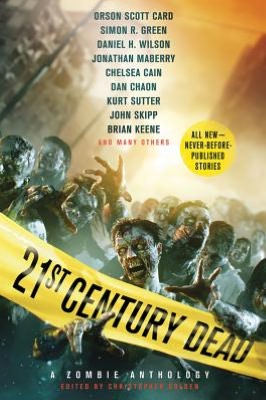
21st-century-deadAh, Zombies. We still love ’em. I know this is a trend that will soon begin to peak and die off (if it hasn’t already), but until then I’m enjoying all the attention to one of my favorite undead.

Christopher Golden’s 2010 anthology The New Dead was one of the more successful recent zombie books. With stories by some of the top fantasy writers in the field, including Joe R. Lansdale, Joe Hill, Kelley Armstrong, Tad Williams, John Connolly, Aimee Bender, Jonathan Maberry, and many others, it demonstrated the zombie story could still be fresh and exciting, even in the era of The Walking Dead and innumerable sequels/re-makes of Night of the Living Dead.

The New Dead was nominated for a Bram Stoker Award for Best Anthology, a rare honor. Now Golden returns with a second volume of all-original zombie stories, and the cast of writers he’s assembled is just as impressive as the first.

21st Century Dead includes “Tic Boom: A Slice of Love,” the first published fiction by Sons of Anarchy creator Kurt Sutter; “Parasite,” a short story set in the world of Daniel H. Wilson’s popular novel Robopocalypse; and short fiction from Orson Scott Card, Mark Morris, Simon R. Green, Jonathan Maberry, Duane Swiercyznski, Caitlin Kittredge, Brian Keene, Amber Benson, John Skipp and Cody Goodfellow, and many more.

21st Century Dead is 339 pages in trade paperback. It is published by St. Martin’s Press. It is $15.99 in print and $9.99 for the digital edition. It was released on July 17, 2012.

New Treasures: Jeff Strand’s A Bad Day for Voodoo

New Treasures: Jeff Strand’s A Bad Day for Voodoo

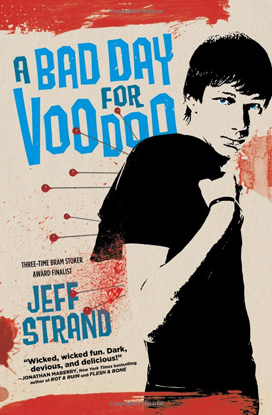
a-bad-day-for-voodooHorror and comedy don’t usually mix. But when they do, the results can be spectacular. Ghostbusters, Young Frankenstein, An American Werewolf in London, Buffy the Vampire Slayer, Tremors, Army of Darkness, Scream, Shawn of the Dead… you see my point.

Three-time Bram Stoker Award finalist Jeff Strand has walked this road before. His Andrew Mayhem novels, including Single White Psychopath Seeks Same and Casket For Sale (Only Used Once) have built his reputation as a master of the modern gothic comedy. His first YA novel is A Bad Day for Voodoo, and the jacket copy grabbed my attention immediately.

When your best friend is just a tiny bit psychotic, you should never actually believe him when he says, “Trust me. This is gonna be awesome.”

Of course, you probably wouldn’t believe a voodoo doll could work either. Or that it could cause someone’s leg to blow clean off with one quick prick. But I’ve seen it. It can happen.

And when there’s suddenly a doll of YOU floating around out there — a doll that could be snatched by a Rottweiler and torn to shreds, or a gang of thugs ready to torch it, or any random family of cannibals (really, do you need the danger here spelled out for you?) — well, you know that’s just gonna be a really bad day …

No word on whether this is the first installment of a new series (when asked, Strand replies “I don’t know. I depends on whether at the end all of the characters get killed.”) But the book is already getting a lot of attention. Jonathan Maberry, the New York Times bestselling author of Rot & Ruin, weighed in with:

Jeff Strand is the funniest writer in the game, and A Bad Day for Voodoo is wicked, wicked fun. Dark, devious and delicious.

I think this book is what I need this week. A Bad Day for Voodoo is 251 pages from Sourcebooks Fire. It is $8.99 in trade paperback and digital format. It was released on June 5, 2012.

Vintage Treasures: The Giant Anthology of Science Fiction, edited by Margulies and Friend

Vintage Treasures: The Giant Anthology of Science Fiction, edited by Margulies and Friend

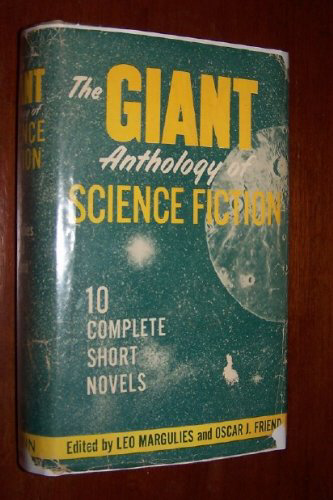
the-giant-anthology-of-science-fiction2Those four boxes of books I purchased from the Martin H. Greenberg collection have been the gift that keeps on giving. In the third box I found about 30 hardcover anthologies, dating from the 40s to the 70s, including The Giant Anthology of Science Fiction: 10 Complete Short Novels, edited by Leo Margulies and Oscar J. Friend.

This book is a treasure trove of vintage novellas from the Golden Age of SF and fantasy. Despite the “Science Fiction” in the title, a great many of the delights on offer are fantasy, as the term was used pretty much interchangeably with science fiction at the time. Just check out this table of contents, with original dates of publication:

  • “Enchantress of Venus,” Leigh Brackett (1949)
  • “Gateway to Darkness,” Fredric Brown (1949)
  • “The Girl in the Golden Atom,” Ray Cummings (1919)
  • “Forgotten World,” Edmond Hamilton (1946)
  • “By His Bootstraps,” Robert A. Heinlein (1941)
  • “Sword of Tomorrow,” Henry Kuttner (1945)
  • “Things Pass By,” Murray Leinster (1945)
  • “Rogue Ship,” A. E. van Vogt (1950)
  • “Island in the Sky,” Manly Wade Wellman (1941)
  • “The Sun Maker,” Jack Williamson (1940)

Read More Read More