Browsed by
Category: Books

Much of a Muchness: Phyllis Eisenstein’s Born to Exile
Much of a Muchness: Phyllis Eisenstein’s Born to Exile

fabian-born_to_exile
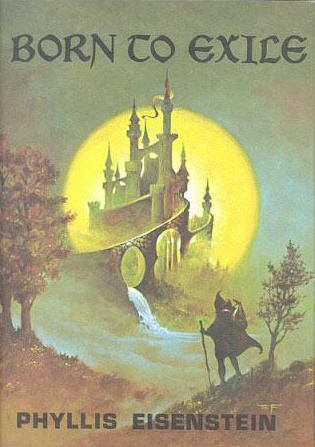
First edition of Eisenstein’s Born to Exile
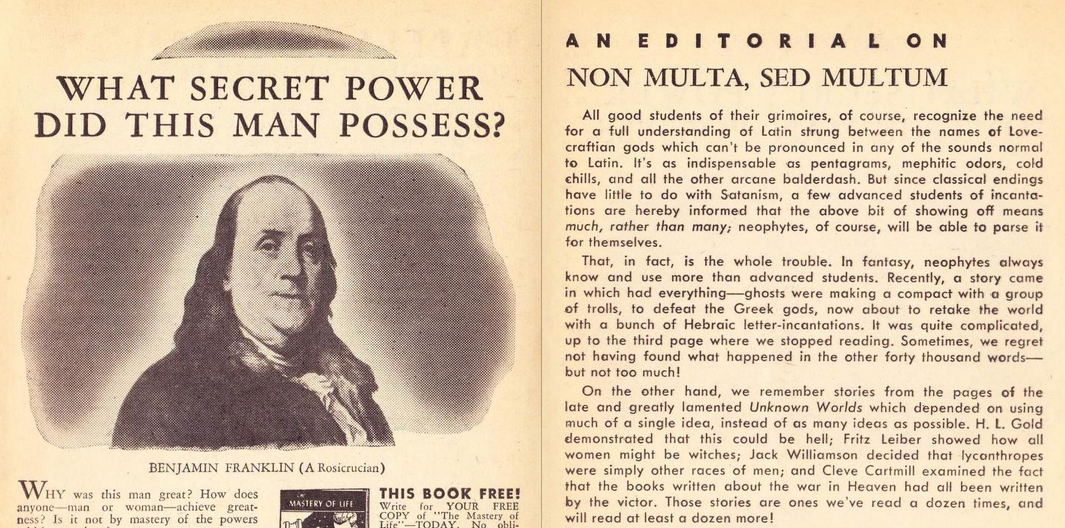
Fantasy Fiction, editorial, detail
Why was the editor of Fantasy Fiction getting stories full of mystical strangeness? We cannot tell.

Recently I was reading an editorial in Fantasy Fictionan old magazine from near the end of the pulp era. This is the kind of thing I’m apt to do, especially when I should be getting some work done, but in this case I was hooked by the title, which was one of Latin’s greatest hits about reading: NON MULTA, SED MULTUM (“not many things, but much of a thing”).

The message of the editorial was that the editor was seeing too many stories that overdid the number of fantastic elements: “Recently a story came in which had everything — ghosts were making a compact with a group of trolls to defeat the Greek gods, now about to retake the world with a bunch of Hebraic letter incantations.”

The editor felt this was bad and stopped reading on the third page. I say it sounds awesome and the editor should have been banished to the outer darkness where there shall be wailing and gnashing of teeth. But I’m of the opposite school of fantasy — the “more cowbell” school, you might call it (to allude to another classic). Some people will try to tell you that less is more, but “more cowbell” people insist that only more is more: more miracles, more fireballs, more talking squids in space.

The truth is that neither school is right or wrong; it’s just a question of what works in a given story. The advantage of the non multa, sed multum approach is that it allows the writer to explore the ramifications of a fantastic concept, and maybe work in a character or two, not to mention a more carefully detailed world.
Read More Read More

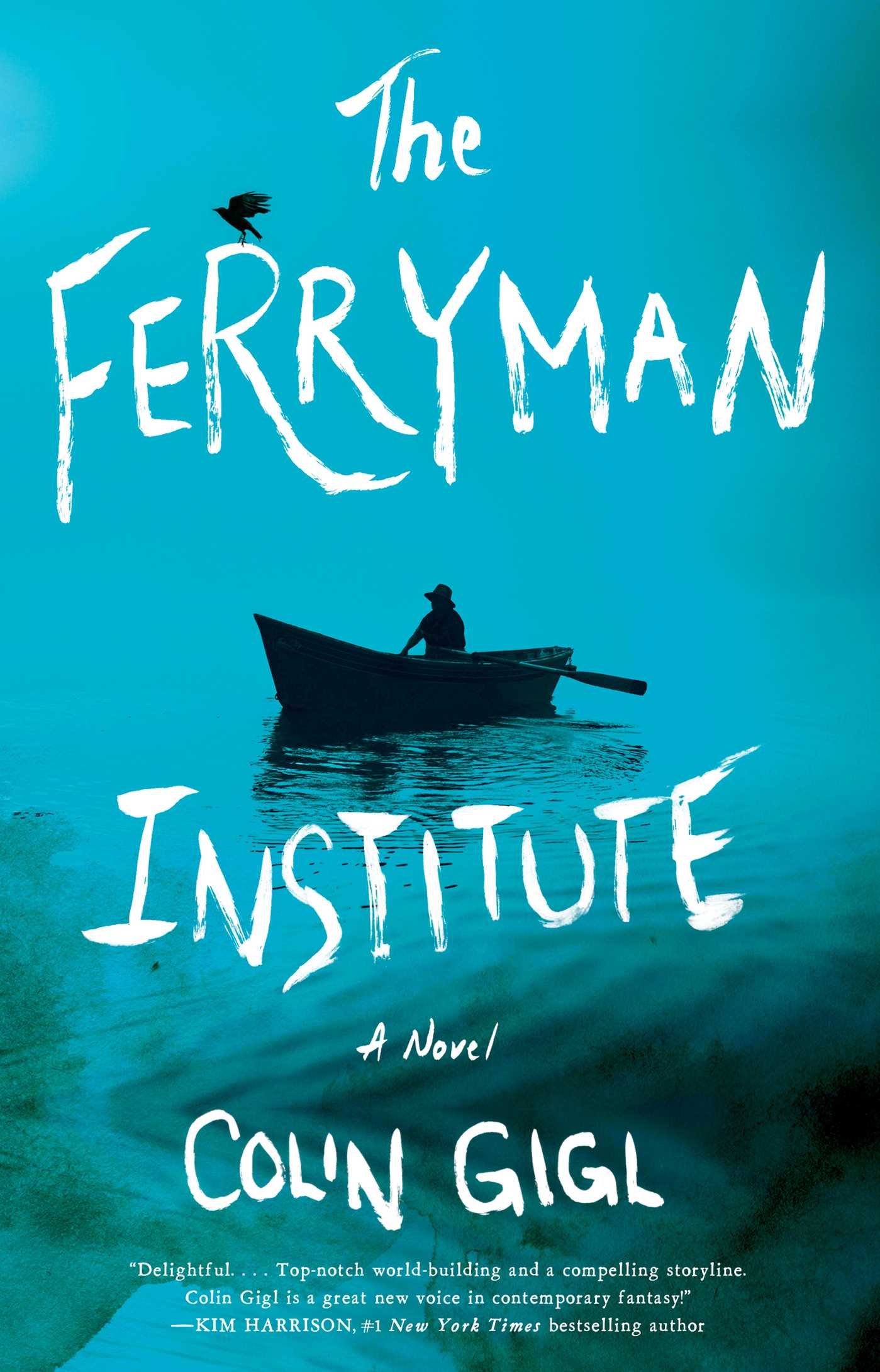
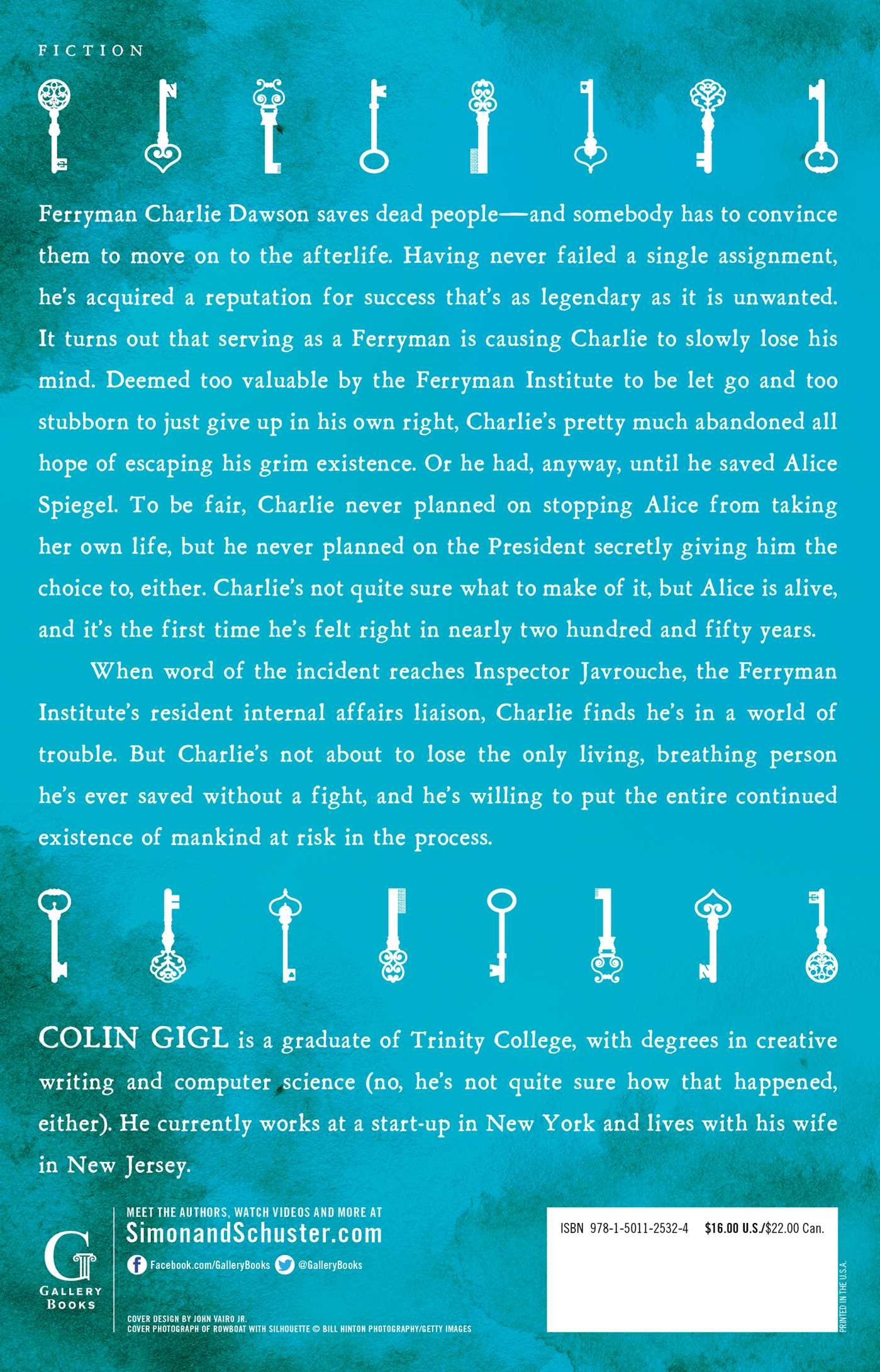
Future Treasures: The Ferryman Institute by Colin Gigl

Future Treasures: The Ferryman Institute by Colin Gigl

the-ferryman-institute-small the-ferryman-institute-back-small

Here’s another debut fantasy with an original and intriguing premise: ferryman Charlie Dawson, condemned to transport souls to the underworld for all eternity, finds his existence unraveling after he prevents a young woman from committing suicide. And his life — such as it is — rapidly gets very complicated. In her review, Jaclyn Fulwood at Shelf Awareness writes,

Since the moment of his near-death more than two centuries ago, Charlie has been in the employ of the shadowy Ferryman Institute, guiding newly deceased souls through the departure process. When a Ferryman fails to convince a spirit to cross over, it becomes a vengeful ghost; Charlie Dawson, star of the Institute’s stable, never fails… In an age when the Institute competes with comparable organizations like the Sisters of Valhalla, Charlie is simply too good to let go. Supported by his refined mentor Cartwright, but stalked by internal affairs liaison Inspector Javrouche (the only person who actively despises him), Charlie limps through his malaise until he receives a special assignment from the president of the Institute — to see to the soul of one Alice Spiegel, a soon-to-be suicide — and is surprised with options: “Be a Ferryman or save the girl. Your choice.”

Gigl pays homage to Greco-Roman mythology while poking fun at corporate structure, but this fast-paced fantasy has its serious side, taking the real-life problem of getting stuck in a dead-end job to a more mystical but still weighty extreme. Gigl seems to realize his concept treads familiar ground; readers will find easy laughs here, but more introspection than in novels with similar premises.

The Ferryman Institute will be published by Gallery Books on September 27, 2016. It is 432 pages, priced at $16 in trade paperback and $7.99 for the digital edition. Click the images above for bigger versions, or read an excerpt at the Simon & Schuster website.

When a Trilogy Becomes a Sextuplet

When a Trilogy Becomes a Sextuplet

Michael J. Sullivan
Michael J. Sullivan

After the launch of his newest book a few weeks ago I asked writer Michael J. Sullivan if he could spare some time to talk about his writing process. In addition to being talented, Michael also happens to be one of the humblest and kindest writers it’s been my pleasure to meet. It’s my pleasure to turn the blog over to him.

I recently released Age of Myth, the first novel in my new series. It’s the one with the big tree on the cover. Since people ignore advice, and nearly everyone actually does judge books by their covers, it’s a good thing for me that trees appear to be popular (no pun on poplar intended… okay maybe it was).

My first series The Riyria Revelations is six books long. This new series was supposed to be a trilogy. You’ll note I used the word supposed in that sentence. When I write a novel it almost always tops off around the 100,000-130,000 word mark (around 375-450 pages). I don’t plan it that way — just happens. It’s the length I need to tell a self-contained tale. Apparently I also have a set number when it comes to how many books it takes to write a series. You guessed it, my trilogy grew to six books long (okay, you had help from the post’s title). No, the publisher didn’t make me expand it, and Peter Jackson had nothing to do with it. The story takes place during a great war, but the story stopped before all the conflicts were over. I had a suspicion readers weren’t going to like that. I didn’t either. Quitting before the war was 100% resolved felt unfinished.

Read More Read More

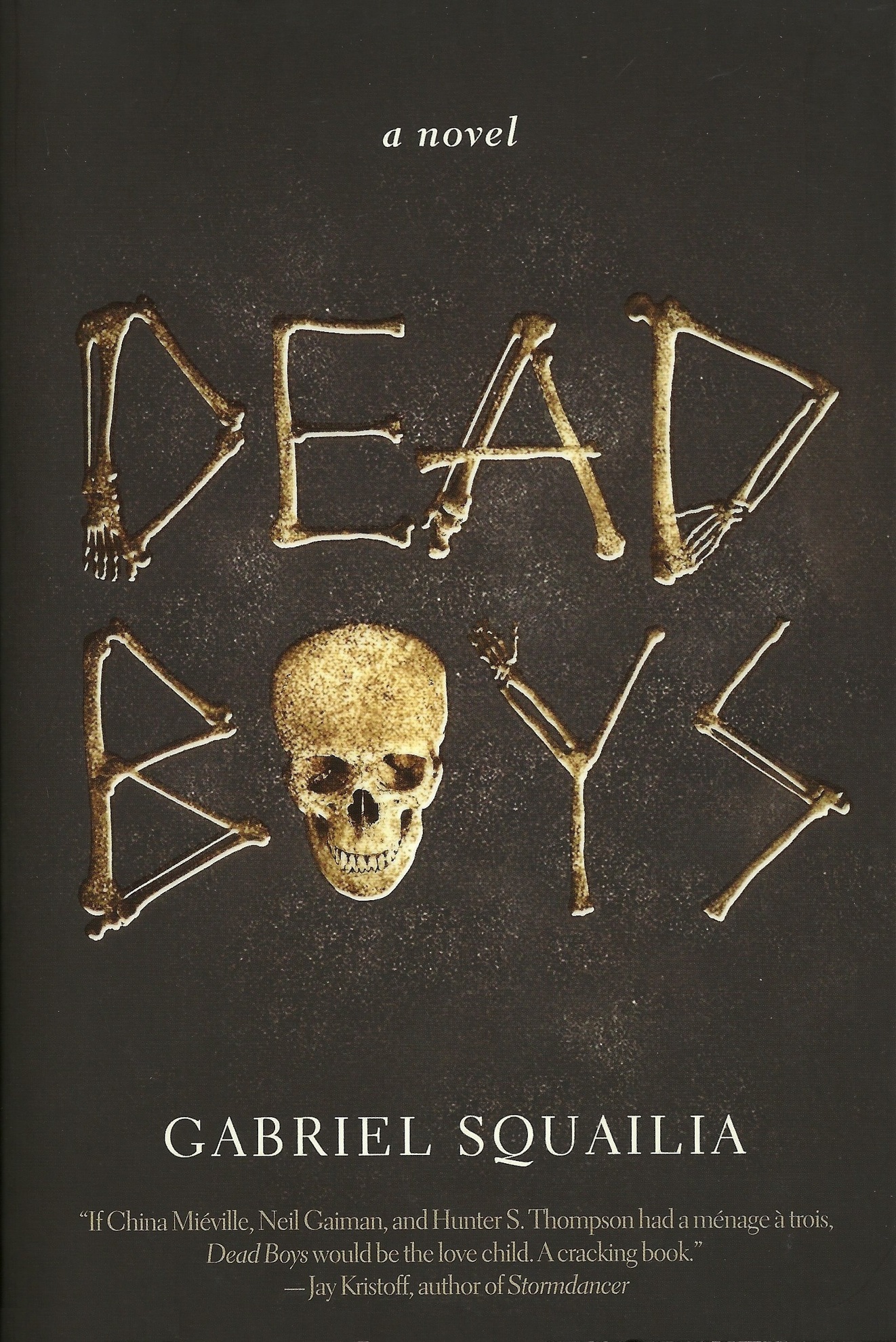
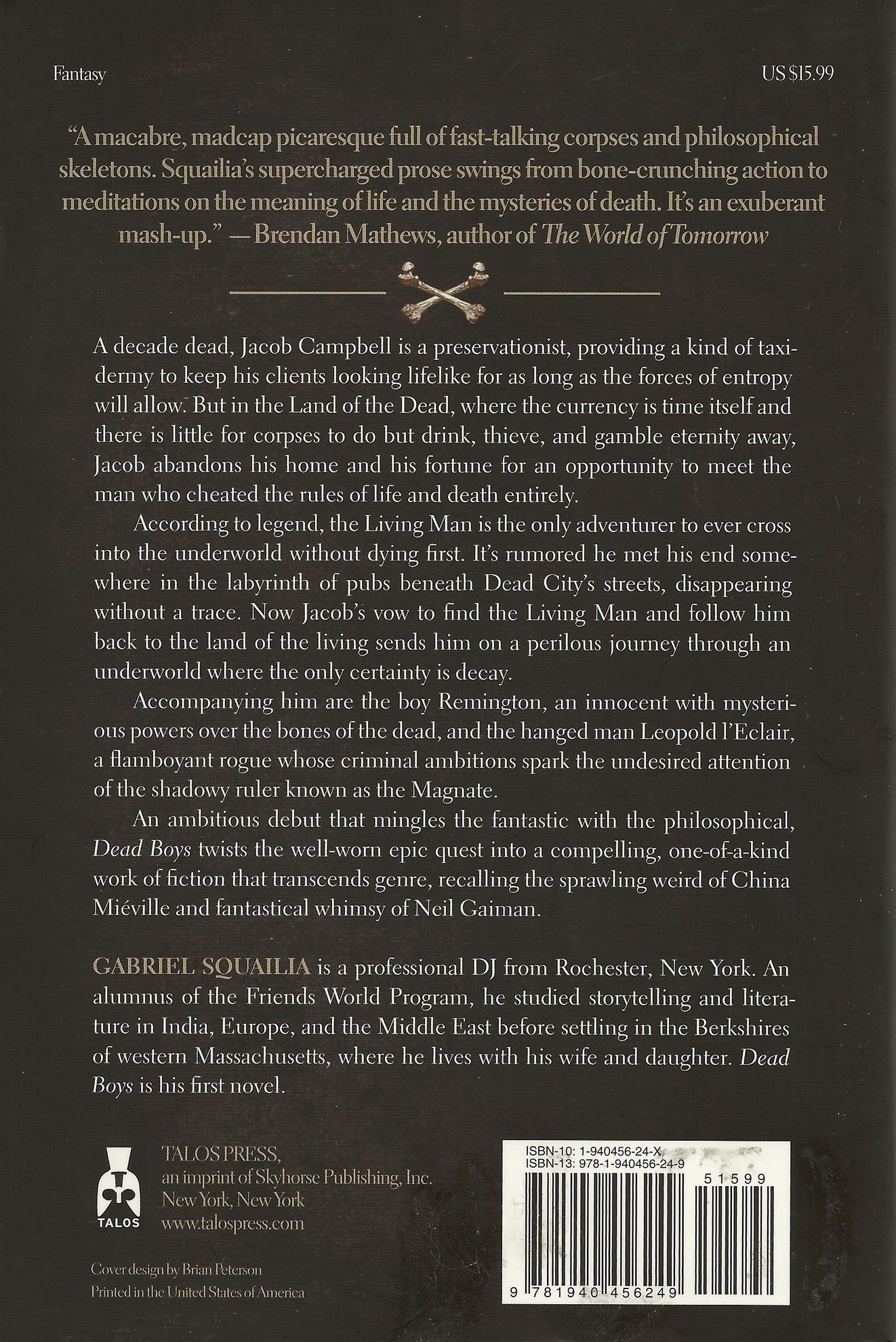
New Treasures: Dead Boys by Gabriel Squailia

New Treasures: Dead Boys by Gabriel Squailia

dead-boys-small dead-boys-back-small

Sometimes I want to settle down with a straightforward adventure fantasy novel. And sometimes… sometimes I want something a bit more off the wall. Something like Gabriel Squailia’s debut novel Dead Boys, in which Jacob Campbell sets off across the Land of the Dead, accompanied by a boy with strange powers over bones, and the hanged man Leopold l’Eclair, searching for the Living Man, the only adventurer to cross the underworld while still alive.

Author Brendan Mathews calls it “A macabre, madcap picaresque full of fast-talking corpses and philosophical skeletons,” and Publishers Weekly praises it for its “Exquisite worldbuilding alongside a mix of humor and philosophy… This underworld is a fascinating city.” Sounds like just the thing I’m in the mood for.

Dead Boys was published by Talos on March 10, 2015. It is 278 pages, priced at $15.99 in trade paperback, and $9.99 for the digital edition. The cover was designed by Brian Peterson. Click the images above for bigger versions.

Exploring the Leonaur Science Fiction and Fantasy Catalog

Exploring the Leonaur Science Fiction and Fantasy Catalog

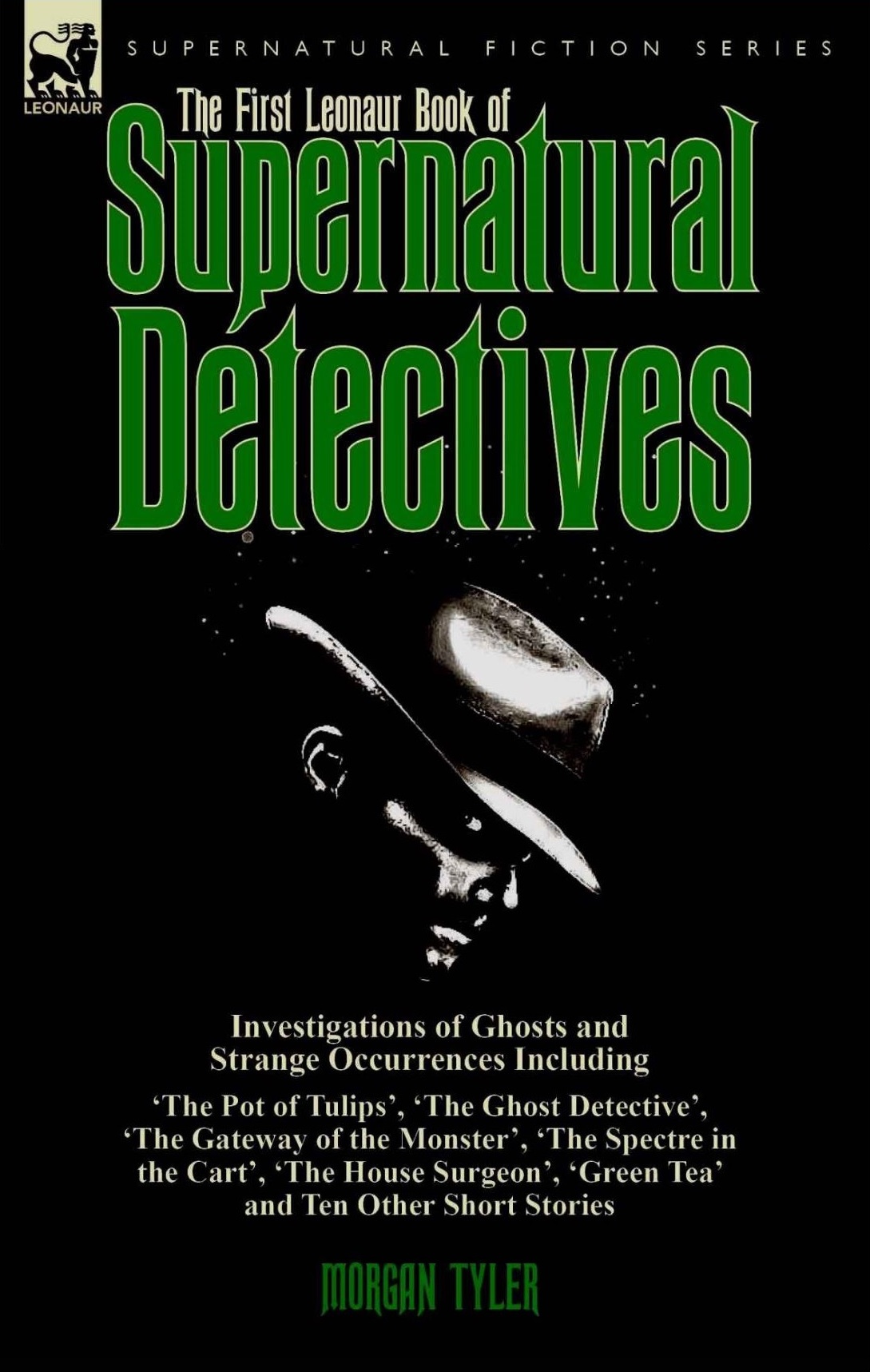
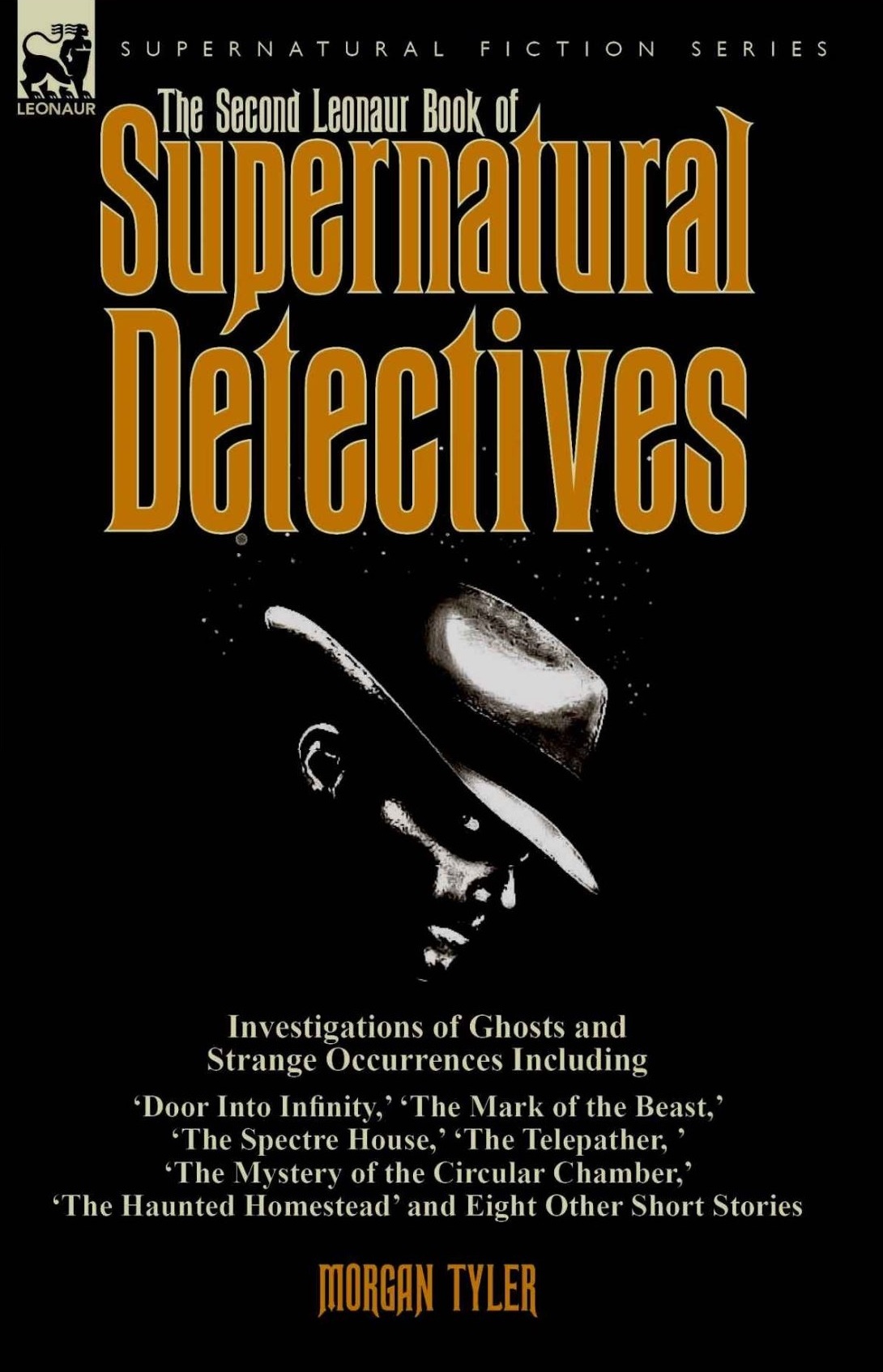
the-first-leonaur-book-of-supernatural-detectives-small the-second-leonaur-book-of-supernatural-detectives-small

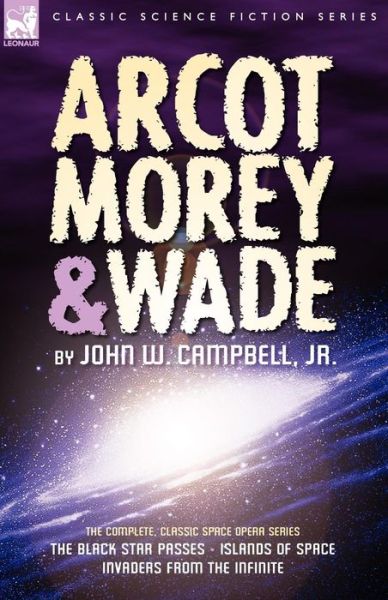
I first discovered Leonaur Books when I went looking for in-print editions of Stanley G. Weinbaum, the pulp author who died in 1935. Leonaur has virtually his entire science fiction output in print in four handsome and affordable paperbacks. How cool is that? Shortly thereafter, I found Leonaur has a back catalog with enormous appeal to pulp fans, including the complete Arcot, Morey & Wade space opera stories of John W. Campbell, Jr, Guy Boothby’s Dr. Nikola tales, and collections by Homer Eon Flint, Arthur Conan Doyle, Robert E. Howard, Arthur Sellings, Rudyard Kipling, Jack London, and many others.

These guys are clearly serious about vintage fantasy and SF. But they don’t just do single-author collections. Over the past few years they’ve also assembled some top-notch original anthologies as part of their extensive Supernatural Fiction Series, like the two volume Leonaur Book of Supernatural Detectives, edited by Morgan Tyler, which contains “The Door Into Infinity” by Edmond Hamilton, a Carnacki tale by William Hope Hodgson, and stories by Joseph Sheridan Le Fanu, Richard Marsh, Gordon McCreagh, Enoch F. Gerrish, and two dozen more.

Read More Read More

You Say Acolyte, I Say Assassin

You Say Acolyte, I Say Assassin

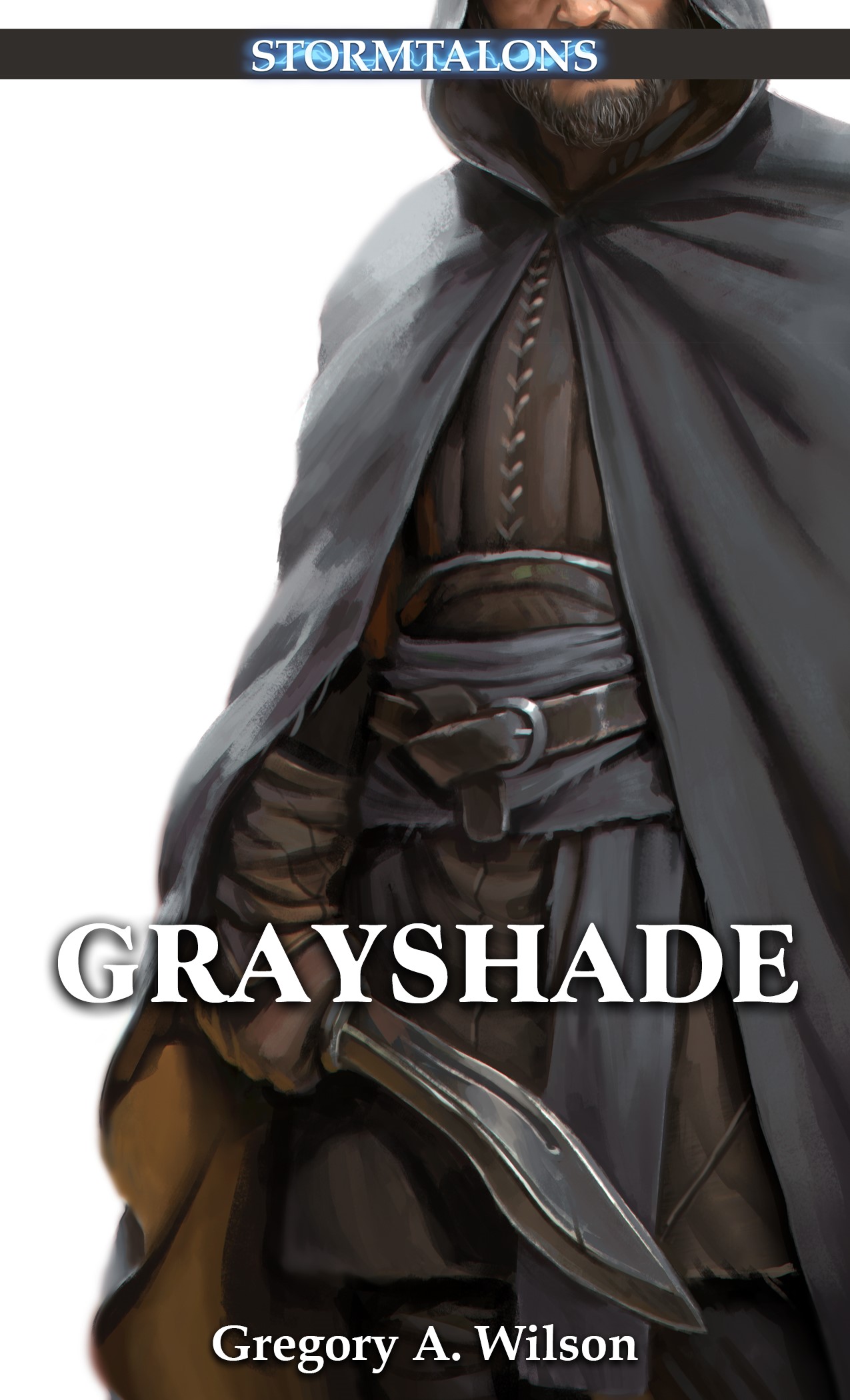
grayshade-smallStormtalons 02: Grayshade
by Gregory A. Wilson
The Ed Greenwood Group ($9.99 CAN digital, released September 30; $49.99 CAN hardcover, January 1, 2017)
Website

Servants of Argoth maintain balance in the world by meting out justice; sometimes, that justice can only be obtained through death. That’s where the Acolytes — some call them assassins — come in. Grayshade and his brethren receive assignments from Father Jant, the head of the order, who is guided by Argoth’s will.

When Grayshade receives an assignment to kill Lady Ashenza, a member of the government of Cohrelle, he accepts it as a matter of course. Being a power broker in the local government isn’t why she’s been marked for a hit, however. She’s also rumored to be a part of the Vraevre, a religious sect that in recent weeks has begun to assassinate Cohrelle political figures. In order to restore balance, she must die, and Grayshade is sent to do his duty.

However, when he enters her room, Lady Ashenza tells Grayshade that she isn’t a threat to him or his order; no, the real threat is the Order of Argoth itself. While this gives Grayshade pause, he does complete his mission. During his exit, he spots another Acolyte near the Ashenza home, and he soon realizes the evening’s events are more complicated than they appear. Before long he questions everything he’s ever been taught, and soon realizes he can only trust himself.

Grayshade by Gregory A. Wilson has everything I love in a fantasy novel: a fully-realized setting, complex characters with hidden motivations, political intrigue, and a touch of humor. As I read, I felt the clay-tiled rooftops beneath my feet and smelled the stench of garbage in alleyways. By the end of the first few chapters, Cohrelle felt very much like a real city with a life of its own.

Read More Read More

The Religion by Tim Willocks

The Religion by Tim Willocks

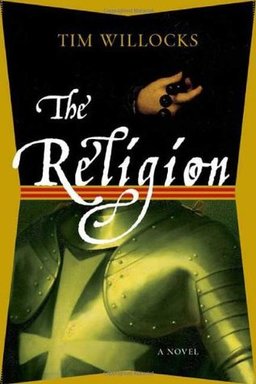
oie_1331351pip0pgfdOne of sword & sorcery’s primary inspirations is historical adventure, like that of writers Harold Lamb and Talbot Mundy. That noble genre continues today in Tim Willocks’ insanely violent The Religion: Vol 1 of the Tannhauser Trilogy (2006), for one, set in the cauldron of the Great Siege of Malta. Into it, Willocks introduces the rogue Mattias Tannhauser, son of a Saxon blacksmith from Transylvania. At the age of 12, Mattias’ mother and sister are killed by Ottoman militia and he is taken captive. Every five years, the Turks would take Christian boys, convert them, and raise them up to be ferocious, elite soldiers, known as the Janissaries.

For thirteen years, Tannhauser served as a true and loyal soldier of the sultan, but eventually he leaves and returns to the West. A dozen of so years later, Tannhauser and a pair of friends, English soldier Bors of Carlisle and Sabato Svi, Jewish trader, have established themselves as important arms and opium dealers in Messina, Sicily.

Now, as the Ottoman tide is ready to break on Malta, Jean de Valette, Grand Master of the Knights of St. John, lures Tannhauser to Malta. The great powers, Spain and France, embroiled in their own internal problems, have lent only token aid to the island’s defense. De Valette wants every resource he can lay his hands on, and what better than Tannhauser’s intimate knowledge of the Turks he once served with?

In the 16th century, the centuries long struggle between Christendom and the Moslem world seemed to be coming to a conclusion. In the century following the fall of Constantinople to the Ottoman Turks in 1453, the Christian West seemed headed for ultimate defeat. Under the brilliant Suleiman the Magnificent, the Knights of St. John, one of the last remaining military orders, had been driven out of the Eastern Mediterranean when Rhodes was captured in 1522. The knights, also known by their nickname the Religion, had been established in in 1099 to escort pilgrims to the Holy Land.

Read More Read More

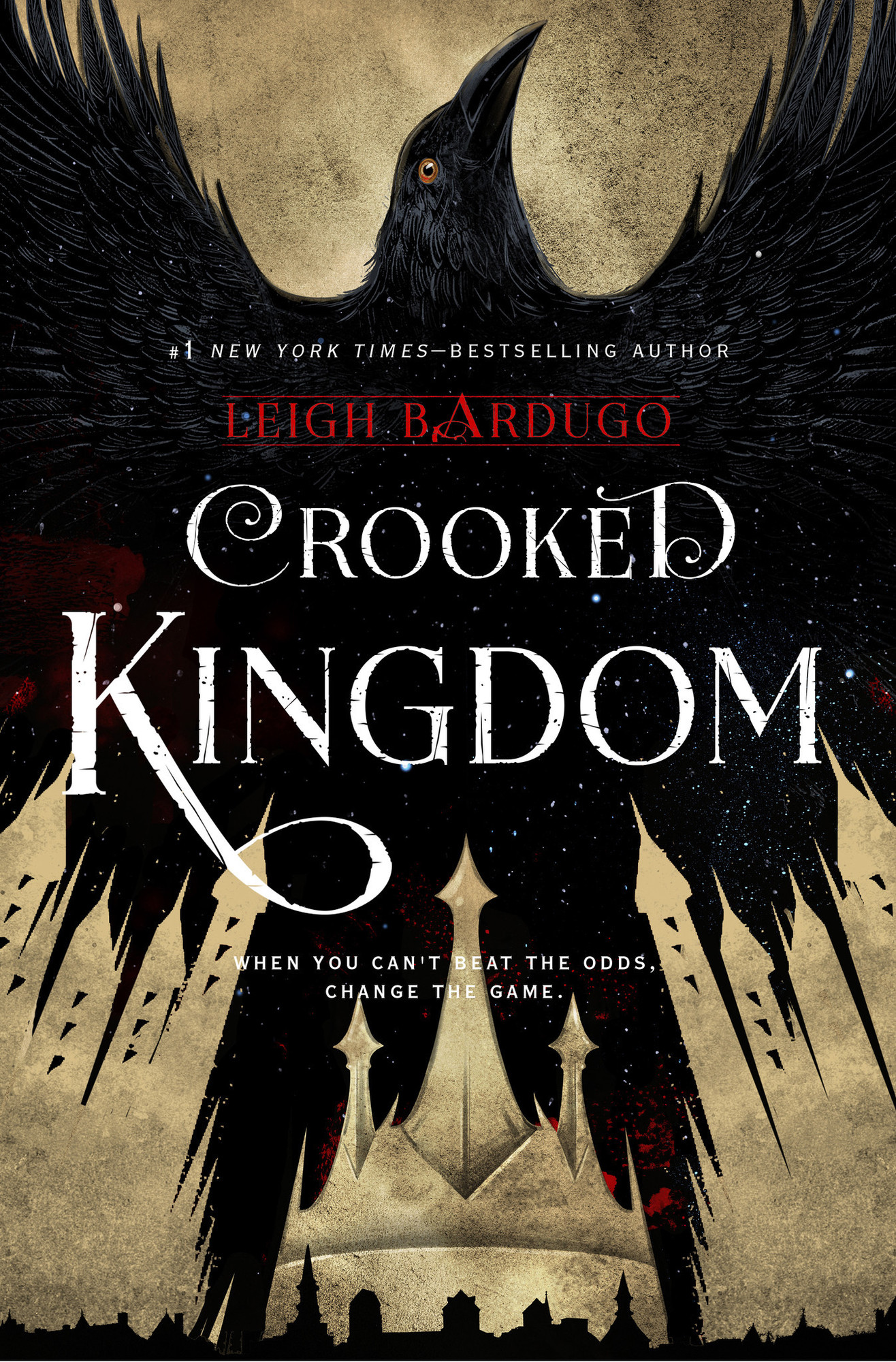
Future Treasures: Crooked Kingdom, the Sequel to Six of Crows by Leigh Bardugo

Future Treasures: Crooked Kingdom, the Sequel to Six of Crows by Leigh Bardugo

six-of-crows-small crooked-kingdom-small

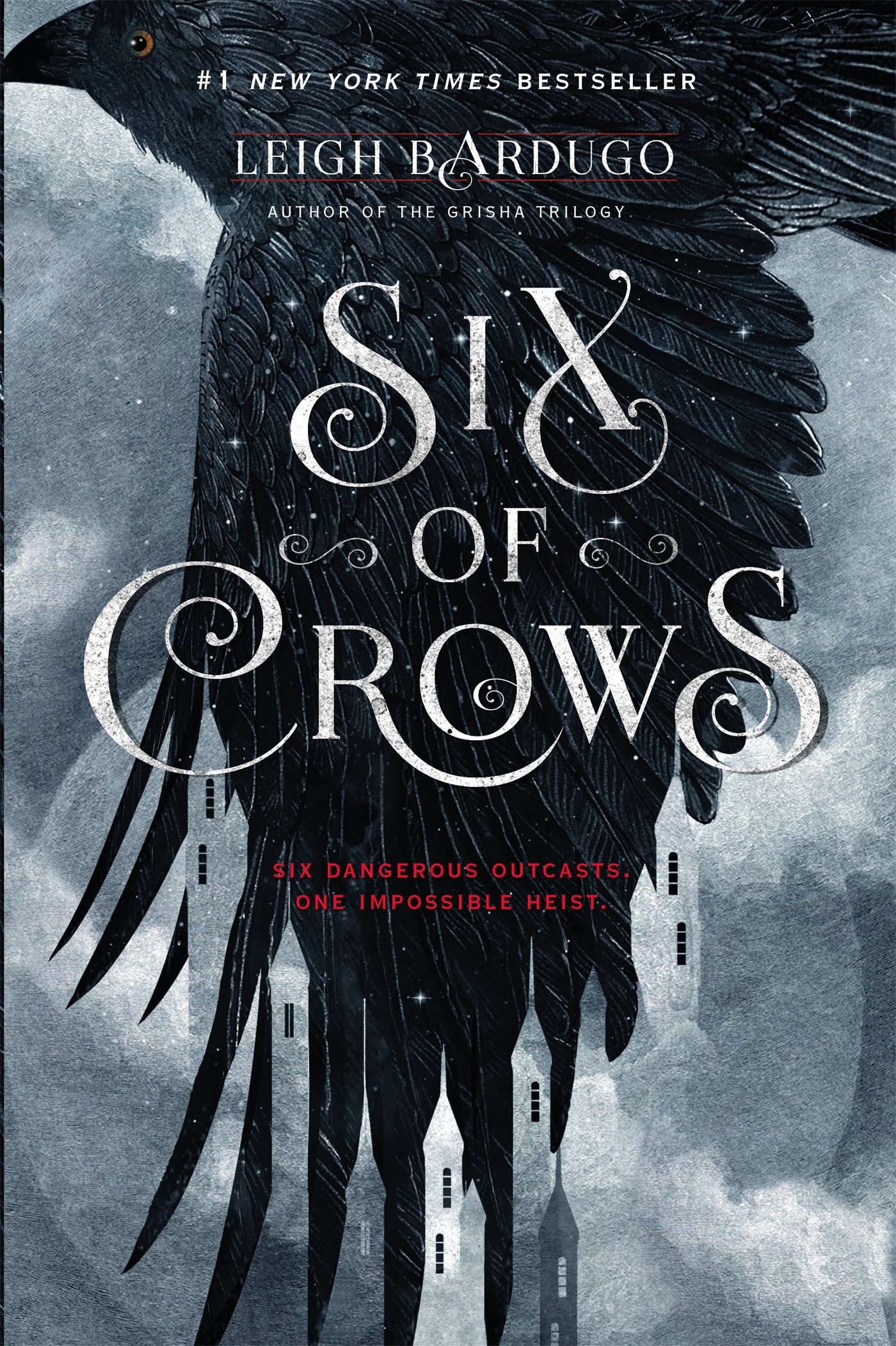
Leigh Bardugo’s Six of Crows, published in hardcover last September by Henry Holt and Co, became a #1 New York Times bestseller. Which hardly seems fair, since she already had a bestselling young adult series in The Grisha Trilogy (Shadow and Bone, Siege and Storm, and Ruin and Rising), but some people just hog all the attention, I guess.

Six of Crows is a caper novel set in the same world as The Grisha Trilogy, in which criminal prodigy Kaz Brekker dreams of a brazen heist in the bustling hub of Ketterdam, and manages to assemble a talented team of geniuses and misfits to pull it off. Author Holly Black called it “A twisty and elegantly crafted masterpiece,” and the Los Angeles Times says it’s “Harry Potter meets Game of Thrones… with a caper twist.” How can you resist a description like that?

The sequel, Crooked Kingdom, arrives in hardcover at the end of the month, and sees Kaz Brekker and his crew thrown right back into the thick of things. Here’s the description.

Read More Read More

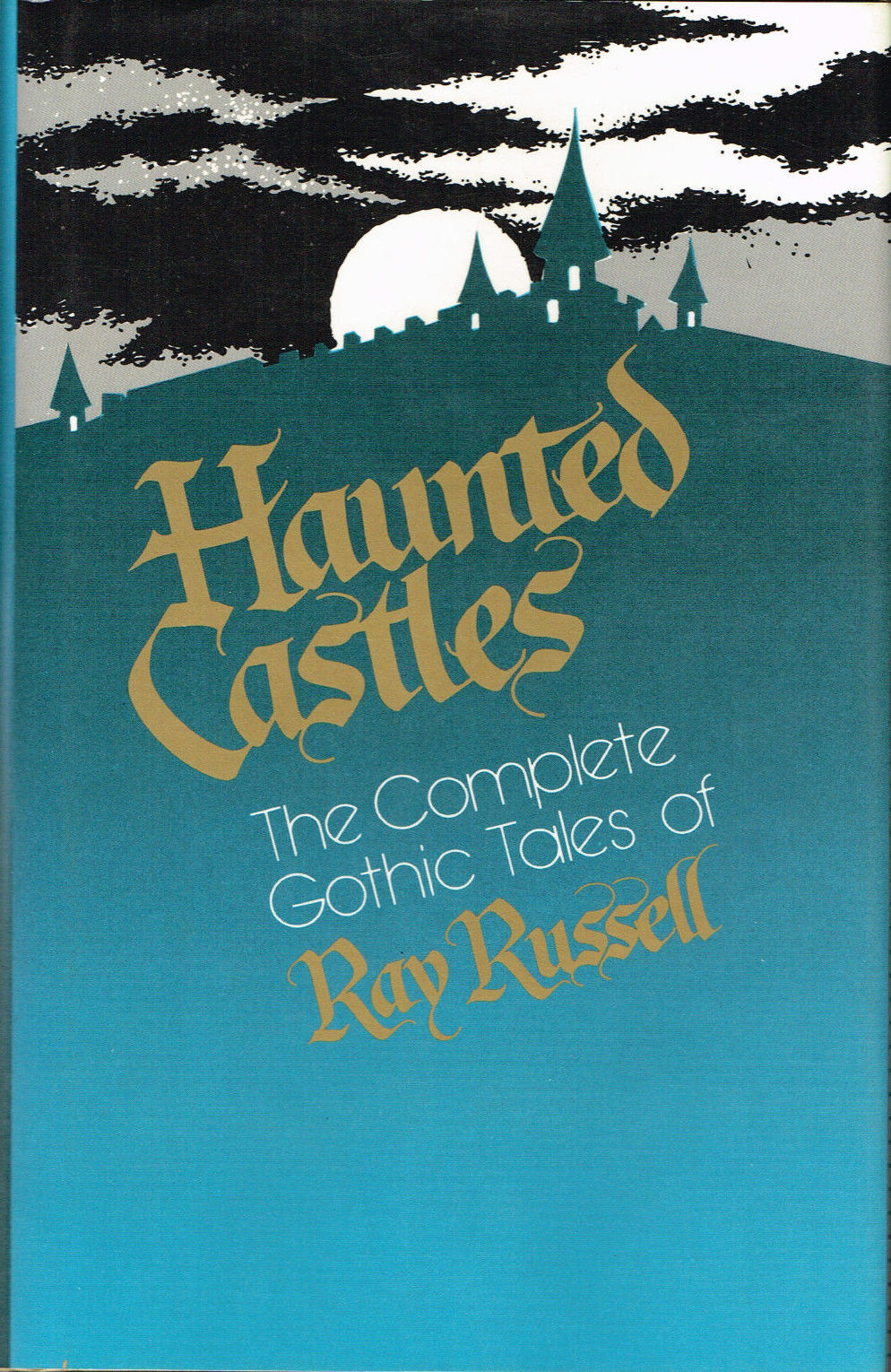
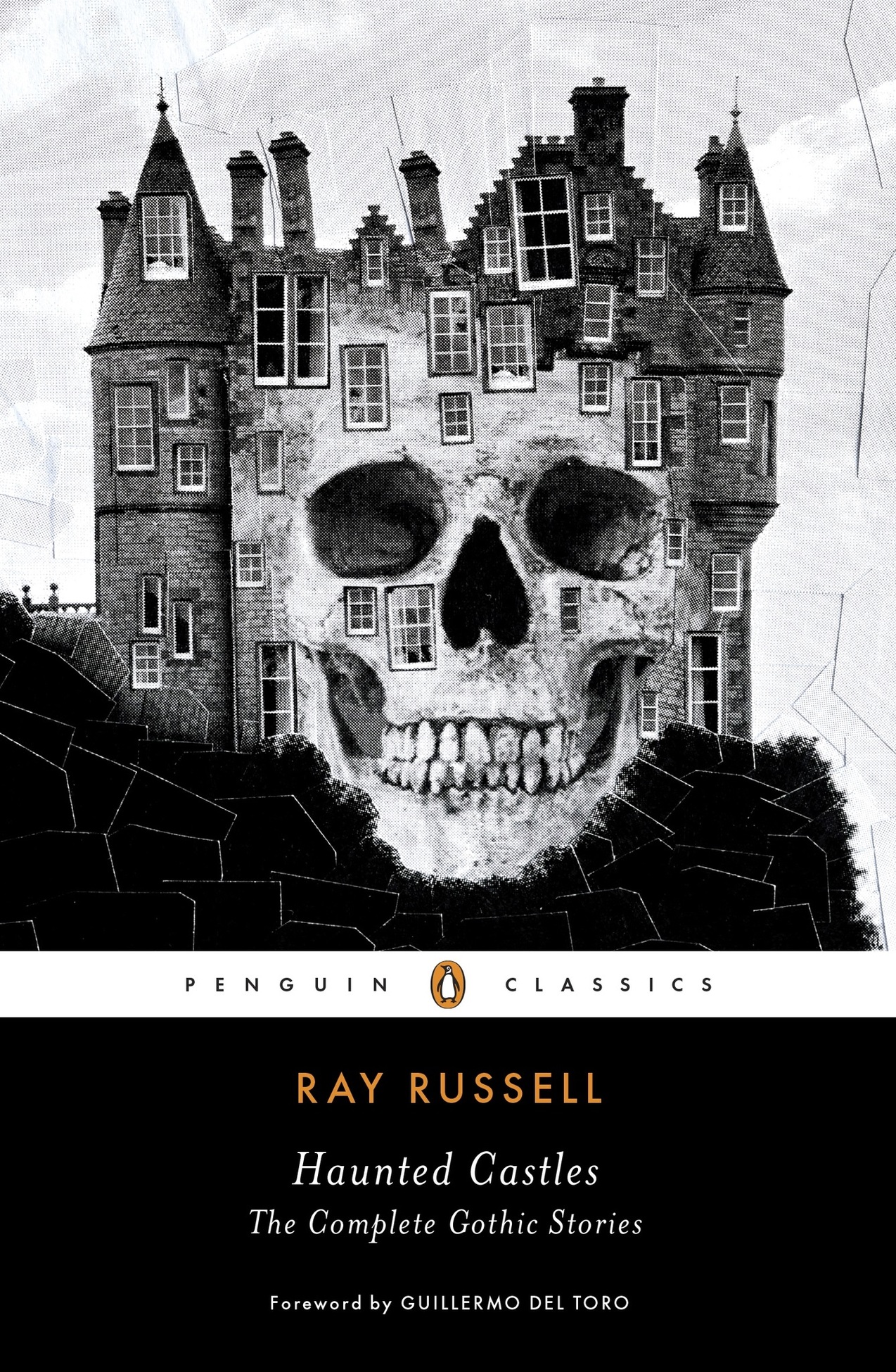
Gypsies, Monsters, and Very Spooky Real Estate: Haunted Castles: The Complete Gothic Stories by Ray Russell

Gypsies, Monsters, and Very Spooky Real Estate: Haunted Castles: The Complete Gothic Stories by Ray Russell

haunted-castles-the-complete-gothic-stories-1985-small haunted-castles-the-complete-gothic-stories-small

Ray Russell received the World Fantasy Lifetime Achievement Award in 1991 and the Bram Stoker Lifetime Achievement Award in 1992. His novels included The Case Against Satan (1962), Incubus (1976), and Absolute Power (1992), and he published a half dozen horror collections in his lifetime, including Unholy Trinity (1967), Prince of Darkness (1971), and The Book of Hell (1980).

Stephen King called his novelette “Sardonicus,” his best known work, “perhaps the finest example of the modern Gothic ever written.” It was collected, with the follow up tales “Sanguinarius” and “Sagittarius,” in Haunted Castles: The Complete Gothic Stories, published in hardcover in 1985 by Maclay & Associates, with a cover by Stanley Mossman (above left). Penguin Classics released it in a new hardcover edition in 2013 with a new foreword by Guillermo del Toro, and the book will be released in paperback for the first time at the end of this month, with a deliciously creepy new cover (above right).

Here’s the description.

Read More Read More

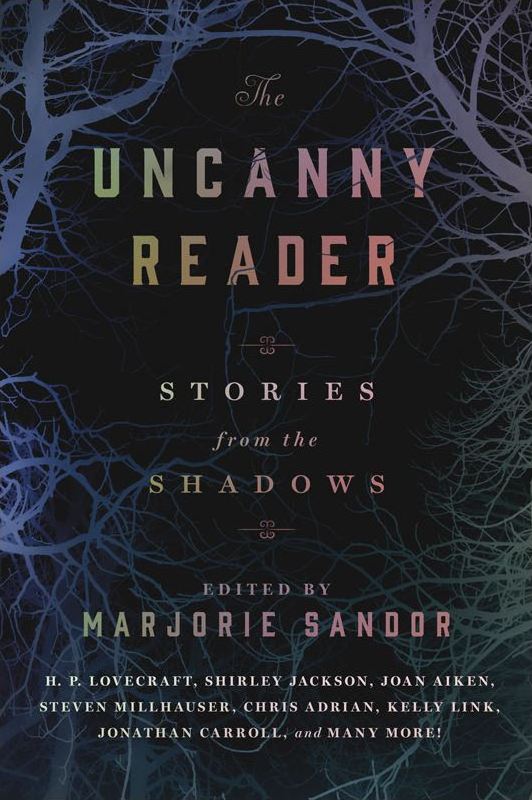
New Treasures: The Uncanny Reader: Stories from the Shadows edited by Marjorie Sandor

New Treasures: The Uncanny Reader: Stories from the Shadows edited by Marjorie Sandor

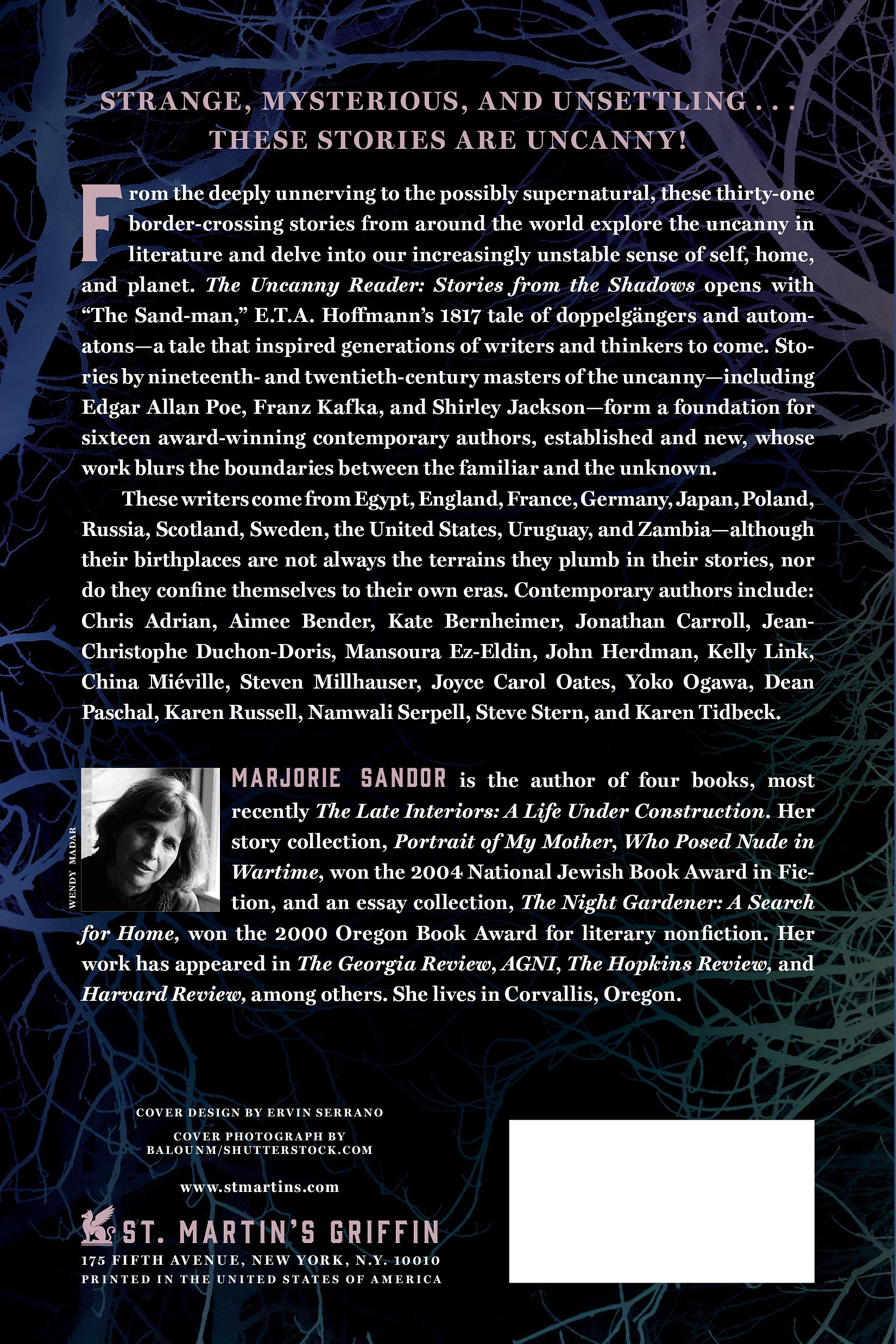
the-uncanny-reader-stories-from-the-shadows-small the-uncanny-reader-stories-from-the-shadows-back-small

I jotted a quick note on Marjorie Sandor’s The Uncanny Reader: Stories from the Shadows last spring. I finally bought a copy last week, and settled down with it this weekend.

As horror anthologies go, it has an even broader scope than I expected. Last year I described it as “a generous new collection of classic and new horror fiction from the four corners of the globe,” and that’s true, more or less. There’s stories by E. T. A. Hoffmann (Germany), Edgar Allan Poe (USA), Ambrose Bierce (USA), Guy de Maupassant (France), Anton Chekhov (Russia), Franz Kafka (Czech Republic), H. P. Lovecraft (The Outer Void), and others.

But in its 555 pages are also more contemporary tales by Kelly Link, Jonathan Carroll, Joan Aiken, Steven Millhauser, and many others. In her lengthy Los Angeles Review of Books review, Rachel Pastan writes:

Though containing fewer than three dozen pieces, The Uncanny Reader feels remarkably generous and comprehensive… [Sandor writes], “Every writer in this collection strips away the armor of familiar, overused language… they make us see and hear anew.” It is this conceit that makes room under one sprawling mansard roof for a horror story like Poe’s “Berenice,” in which a crazed lover disinters his beloved in order to rip her teeth out of her head… a surrealist story like Bruno Schultz’s “The Birds,” in which the narrator’s father turns the family home into an incubator for exotic eggs… and a fantastical story like Karen Russell’s “Haunting Olivia” in which two brothers use a pair of magic pink underwater goggles to hunt for their dead sister’s ghost…

Other standouts: Shirley Jackson’s energetic and urban “Paranoia”; Chris Adrian’s surprising suicide-on-Nantucket story, “The Black Square”; and Kelly Link’s haunted and haunting tale of domestic life, “Stone Animals,” [in which] a family moves out of an apartment in New York City and into a big house in the country… The unexpected and poignantly human way in which this house turns out to be haunted is one of Link’s great achievements.

Here’s the complete table of contents.

Read More Read More