Browsed by
Category: Blog Entry

Goth Chick News: Close Encounters – The Week We Made Contact
Goth Chick News: Close Encounters – The Week We Made Contact

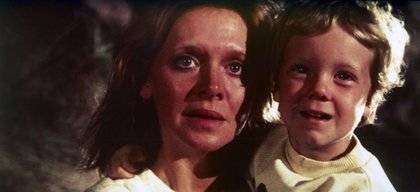
ce3k1Back in May I told you all about cyber-stalking little Barry Guiler, that adorable little tot from the movie Close Encounters of the Third Kind (now apparently referred to as CE3K by you unbelievably cool kids).

I also let you know that though at the time I had turned up a fat lot of nothing in my attempt to contact Barry, who is Cary Guffey in real life, something told me I was eventually going to meet with success. I mean, what little I had read about Cary seemed to point to him being a nice normal guy, which by default meant he was likely the opposite of that other child actor I tried to interview who by all on-line accounts is a bit of a tool.

So for three weeks I busied myself rearranging my voodoo dolls and abusing my new crop of interns, all the while hoping for pay dirt in the form of an email from Cary. So I would be spared from looking like a hopeless poser who spends a lot of time writing about great interviews, without ever closing escrow.

Well, today I am here to tell you that though I may indeed be a grade-A cyber stalker, I am definitely NOT a poser.

Cary Guffey did get in touch and he is indeed a nice guy; actually a really nice guy with a great sense of humor. And since none of you believed I’d end up interviewing him and therefore didn’t send in any insightful and provocative questions, I was forced to make up my own.
Read More Read More

Original Fiction: “THE WEIRD OF IRONSPELL” by John R. Fultz

Original Fiction: “THE WEIRD OF IRONSPELL” by John R. Fultz

mountain4
http://sheikman.blogspot.com

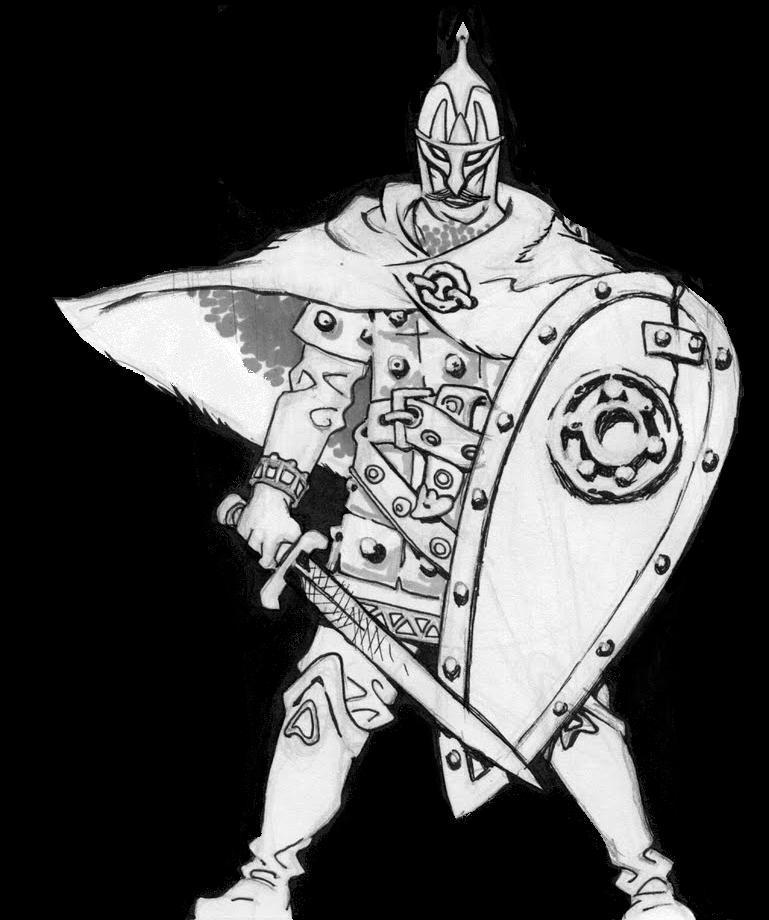
“The Weird of Ironspell” by John R. Fultz

Illustrations by Alex Sheikman


7. On the Mountain of Sorrows


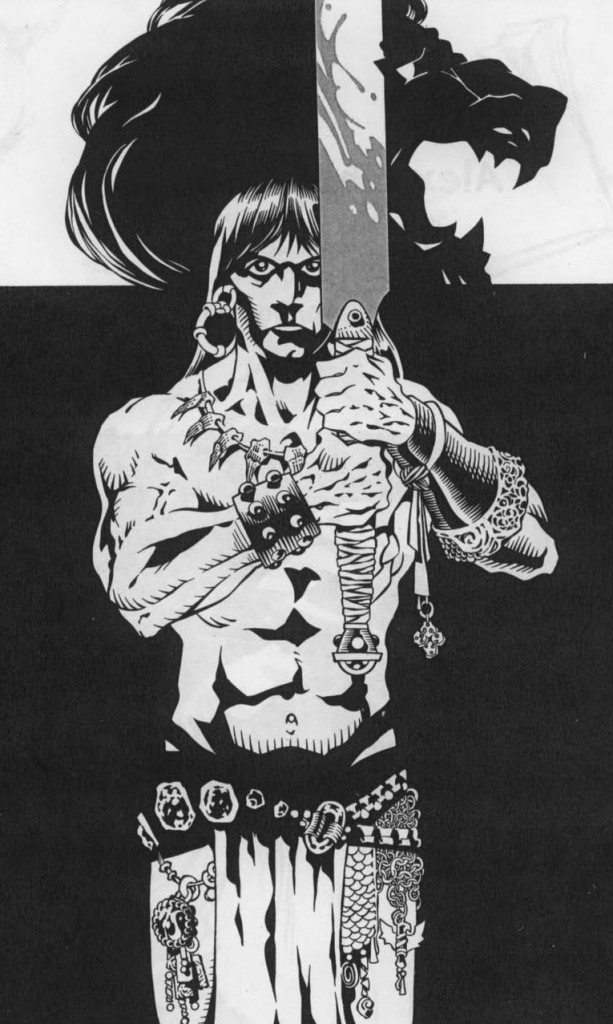
Lightning raged about the peak. Ironspell pulled himself toward the sky, finding handholds in precarious places. Storm clouds cast ominous shadows upon him. Peals of thunder rolled across his back like boulders. It had taken the better part of a year to reach the Mountain of Sorrows, and neither gods, demons, or nature itself would keep him from reaching the summit.

A voice in the back of his mind whispered unheeded warnings:

How do you know your son will truly be here? This is another trap Azazar has set for you. Your son is dead. You’ll find his animated corpse walking rotten and full of hate… 

He screamed his rage into the storm, drowning the voice of caution. He must scale this mountain; he could do no less for his own flesh and blood. If Tyneus were dead, at least he would finally know. And if he lived…

Ironspell had crossed the length of Dylestus, the dead kingdom where ghosts, wights, and ghouls prowled the remnants of shattered cities. The depraved descendants of the ruined realm had quickly captured him and Tumnal. They dragged the duo into a subterranean realm to feed a swarm of ravenous young. But the seekers escaped into an underworld of blind, crawling monsters and passed through a fungoid city of grotesques.

Read More Read More

Frederick Faust, Bound for SF and The Smoking Land

Frederick Faust, Bound for SF and The Smoking Land

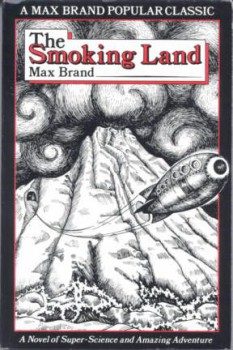
smoking-landThe Smoking Land
Frederick Faust writing as George Challis (Argosy, 1937)

I’m returning to the subject of Frederick Faust for the third time this year. But I have a specific, Black Gate-centered justification for it: I wish to unearth his single novel of science fiction, a piece of Lost World and Weird Science strangeness called The Smoking Land.

Faust, under Max Brand and his eighteen other pseudonyms, made his reputation with Westerns, but he did write in almost every genre that appeared in the story magazines of the time. He penned historical adventures, detective tales, mainstream short stories for the “slicks,” and espionage yarns. In 1937, he authored his one true science-fiction work, the novel The Smoking Land, which appeared serially under the pseudonym George Challis in the old warhorse of the pulp world, Argosy, starting in the May 29 issue.

(In fact, this Saturday evening I stood face-to-face with one of the actual issues of Argosy in which the novel was serialized, housed in the pulp collection at Author Services in Hollywood. Actual surviving issues of the self-destructive pulps are rare finds, and they need special protection to survive. And hey look! One of the Argosy installments of The Smoking Land shares space with the Cornell Woolrich story “Clever, These Americans”! . . . Okay, so maybe only I care.)

Read More Read More

Al Williamson, March 21, 1931 – June 13, 2010

Al Williamson, March 21, 1931 – June 13, 2010

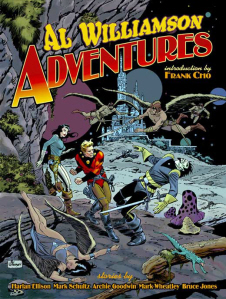
al-williamson2Al Williamson, one of the finest science fiction artists of all time, died yesterday in New York City.
Williamson began his career assisting Tarzan cartoonist Burne Hogarth in 1948. His first professional credit was a three-page crime story, “The Last Three Dimes,” in Wonder Comics #20 (Oct, 1948), co-penciled with Frank Frazetta. In 1952 Williamson began working for E.C.Comics, joining the legendary Wally Wood, Frazetta, and Roy Krenkel on Weird Science, Weird Fantasy, and Incredible Science Fiction, illustrating stories by Harlan Ellison and Ray Bradbury, among others.

By 1966 he was drawing Flash Gordon for King Features, which garnered him an award from the National Cartoonist Society. In 1967 he took the reins on another Alex Raymond creation, Secret Agent Corrigan, which he drew for over a decade. Art historians note that Williamson used his own face as the model for secret agent Phil Corrigan, which made him easy to recognize at conventions.

In the 1980s Williamson began his famed Star Wars comic adaptations, starting with The Empire Strikes Back for Marvel. Williamson was reportedly George Lucas’ first choice for the Star Wars newspaper strip, as Lucas was a fan of his EC Comics and Flash Gordon, and Williamson drew the daily and Sunday feature until 1983. He did additional work throughout the decade for Pacific Comics (Alien Worlds), Marvel (including Blade Runner and Epic Illustrated), and DC (Superman #400).

Since 1998 half a dozen retrospectives of his work have been published, including Al Williamson Adventures, The Al Williamson Sketchbook, The Al Williamson Reader, Vol. 1, and Al Williamson: Hidden Lands. Most of these had tiny print runs, and I had trouble tracking several of them down a few years ago.  If you want copies, I suggest acting quickly.

Science Fiction site io9 has a gallery of some of the best work of this incredible artist, and comics writer and artist Jimmy Palmiotti has written a eulogy here.

Summer Reading

Summer Reading

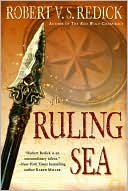
62540212Right now, I’m about a quarter of the way into Robert V.S. Redick’s The Ruling Sea, the sequel (second of a planned four book sequence) to The Red Wolf Conspiracy.  I’m reading this in part for an SF Site review, where I previously took a look at the first volume. My interest in Redick stemmed from seeing him at the 2009 Virginia Festival of the Book, held annually in my home base of Charlottesville.  To quote myself,
I was struck by how intense Redick was, how much he cared about his characters and the world he created and how eager he was to share it (and how he struggled to cover as much as he could within the constraints of his allotted time). He didn’t strike me as a “Tolkien by the numbers” kind of guy. So I was mainly intrigued by his personality to read his book.

BlackGate fans should probably put it on their summer reading lists, even if they aren’t reviewing it. Things  I’m looking forward to reading this summer that I’m not reviewing include:

  • The Magicians by Lev Grossman
  • Horns by Joe Hill
  • Angelology by Danielle Trussoni
  • Bright Dark Madonna by Elizabeth Cunningham
  • The Many Deaths of the Firefly Brothers by Thomas Mullen

Of course, that’s just the tip of my tottering to-be-read pile.  But I’m optimistic that I’ll manage to make a dent in it.

Goth Chick News: I Went To See an Acupuncturist and When I Got Home My Voodoo Doll Was Dead

Goth Chick News: I Went To See an Acupuncturist and When I Got Home My Voodoo Doll Was Dead

voodoo1I have a friend who collects Star Wars paraphernalia. He travels around the country a few times a year attending mammoth SciFi conventions and comic trade shows, in the frenzied remainder of the hunting and gathering instinct that evolution allowed us to keep. The dedicated room in his house where this amazing assortment of merchandise is displayed has its own security system, in place at the request of the insurance company that covers it with a policy of biblical proportion. His Facebook page is a plethora of friends and fans who admire his every acquisition, seeking to purchase or swap rare treasures with their original packaging intact.
By contrast, I collect Voodoo dolls, for which the conventions are largely unpublicized and which no one seems interesting in trading.

The idea of creating and then affecting an inanimate representation of a living thing is thousands of years old. The Egyptians buried their dead kings with dozens of tiny statues of servants which would come to life to serve their masters in the next world, and ancient Romans crafted small likeness of friends and enemies to use in prayers to their many deities. In China, small dolls were artfully sculpted and honored as family ancestors.

In fact, you’d be hard pressed to find a civilization that did not have some sort of similar lore. The act of creation is infused with irresistible mystic qualities; once we make it, we can nurture it or destroy it. That is our god-like choice.

So you can clearly see why this is way more fun than collecting Star Wars figures.

Read More Read More

Original Fiction: “THE WEIRD OF IRONSPELL” by John R. Fultz

Original Fiction: “THE WEIRD OF IRONSPELL” by John R. Fultz

ironspell-6
http://sheikman.blogspot.com

“The Weird of Ironspell” by John R. Fultz

Illustrations by Alex Sheikman 

6. The Tomb of Azazar


The crypt lay on an uncharted isle off the wild coast of southern Mydrithia.

A triple-sailed war galleon dropped anchor in the narrow cove, but only five men came to shore. If there had been any living sentinels watching from the jungle depths, they would have counted only two of the group as human men. The other three were strangelings: two tall Amurions bearing longbows and a gaudily garbed gnome. They stood on the wet sands and surveyed the wilderness that smothered the slopes of a dormant volcano. There was no sign of civilization old or new in this ancient haunt of green shadows.

Ironspell ran a hand through his shaggy black beard and stared into the jungle, looking for invisible signs. Tumnal pulled the rowboat inland and hid it between two jutting boulders.

This desolate chunk of earth bore the stink of long-buried sorcery, of that Ironspell was sure. But it was a reek that had fooled him before.

“Are you sure this is the place?” asked the gnome, dusting sand off his vermillion robes with a gnarled hand. “Looks nothing more than a place for a good shipwreck.”

Ironspell spat upon the brown sand. “It’s here. Somewhere…”

Read More Read More

Looking Back on the first Sword and Sorceress

Looking Back on the first Sword and Sorceress

sword-and-sorceress-iSword and Sorceress I

Edited by Marion Zimmer Bradley (DAW, 1984)

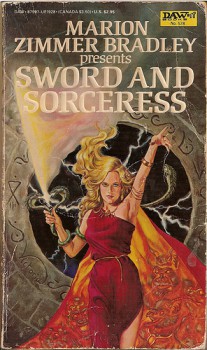
The late author and editor Marion Zimmer Bradley probably could not have dared to guess in 1984 that her anthology series, Sword and Sorceress, would turn into a yearly and best-selling institution of fantasy short stories that would extend past her death. That the first volume in the series bears a Roman numeral shows that she did believe the anthology would see at least two volumes; that it now reaches into the mid-twenties (with the twenty-fifth due this year) shows just how much sword-and-sorcery has embraced inclusiveness during the last three decades. Strong female heroines are now a key part of the genre, completing what C. L. Moore started with her amazing — especially for the time — Jirel of Joiry stories of the 1930s. Bradley invokes Moore a few times in her introduction, and the book is dedicated to both Moore and Jirel.

Over a quarter of a century after publication, the first Sword and Sorceress holds up quite well, while still showing some of the growing pains of sword-and-sorcery in the 1980s. Reading through it makes it clear that the sword-and-sorcery revival still had a distance to go in 1984. About three quarters of the stories Sword and Sorceress I are good-to-excellent, but like all anthologies it has rough patches, some shaky editorial picks, and a few pieces that don’t hit at all. As the series had just started, Bradley did not have a large pool of submissions to pick from. Later volumes would improve the mix as the number of works submitted increased, but this is the start, and therefore worth reading for its historical importance, saggy spots and all.

Read More Read More

Thinking of Heroes

Thinking of Heroes

butch_o_hare-280I’ve been pondering the need for heroes in fiction again this week, and I thought it a good time to revisit a post I’d made on the Black Gate Livejournal page a few years ago. I imagine a lot of you haven’t read it; if you have, I apologize for the repeat.

During the school year my little girl brings home reading practice sheets every week. Each day we’re to time her reading the fluency sheet for a minute, three times, the idea being that it will improve her reading. She does get better at reading each time through, naturally, but she also gets pretty bored – I suppose I would, too, if I had to read the same thing over and over three times a day. But she’s also bored because the stories as a whole haven’t been very interesting. Except for one.

She brought home the story of Butch O’Hare. I’d never given much thought to whom O’Hare airport was named after. I suppose I assumed it was named after a politician. None of these fluency stories can be read completely in a minute—she was only about a third of the way through when the minute timer dinged. My son, her older brother, was so interested that he looked up from his own homework and said “actually, that’s pretty interesting.” I agreed, and asked her to keep reading, and she was intrigued enough herself that she kept going without complaint.

Stories about heroes fascinate my family, and, I believe, humanity as a whole. I think that we’ve become so cynical that we sneer a little when we hear stories of heroics and imagine that it can’t really be true, or we wonder if the hero secretly beats his wife. We are programmed to think that we REALLY need to read stories of ordinary people or cowardly people or despicable people and that stories of heroes are for children. We’re savvy enough now not to believe everything we hear or read, because, God knows, we’ve been fooled plenty of times.

But we still need heroes. And Butch O’Hare was one.

Read More Read More

Ryan Harvey Wins Big

Ryan Harvey Wins Big

ryan-harveyIt gives me great pleasure to announce what some of you may have already heard — the talented Ryan Harvey, author and Black Gate blogger extraordinaire, has placed third in the International Writers of the Future contest for the First Quarter of 2010.

Judged by a panel of experts made up of well-known speculative fiction writers like Orson Scott Card, Anne McCaffrey, Eric Flint (to name just a few!)  the Writers of the Future contest was established 27 years ago by L. Ron Hubbard “to discover and provide talented new and aspiring writers of science fiction and fantasy a chance to have their work seen and acknowledged.”

I can think of few writers as deserving of notice as Ryan, who’s been tirelessly drafting brilliant essays and reviews not only at  Black Gate, but for his own blog and the defunct swordandsorcery.org web site and other places besides.

What many of you may not know is that Ryan is also a talented fiction writer. The winning story is from his Ahn-Tarqa short fiction cycle which — if you haven’t already experienced it — will be featured in two upcoming stories in Black Gate.

I hope you’ll join with us in wishing Ryan congratulations!