Browsed by
Category: Blog Entry

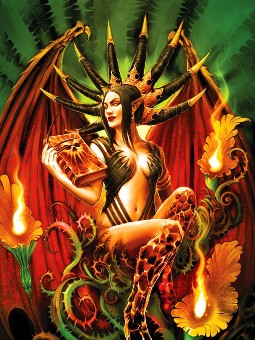
Art Evolution 2011: Eva Widermann

Art Evolution 2011: Eva Widermann

book-of-the-damned-255

Art Evolution 2011 moves forward with the inclusion of a more modern artist, and I’m happy to report the second European talent of the year!

I have to say that I was/am a huge fan of Wizards of the Coast’s D&D 3rd Edition. I’ll not bore you with the details of why, or tell you it’s better than any other edition of the now venerable game, but I will contend that upon its release the art department spared no expense in bringing in new talent and vibrancy to the appearance of the game.

True, if any of you know the history, Hasbro bought the company in the early 2000s and promptly destroyed the final bastion of shared gaming artistry when they fired all their in-house artists from ‘the pit’, but I’ll contend for the sake of argument that not all bad things came from doing so.

By this, I’m saying that not using a set amount of salaried artists opened the flood gates for a whole world of new talent eager to make their mark on the game and the industry as a whole.

Read More Read More

Realms of Fantasy August 2011

Realms of Fantasy August 2011

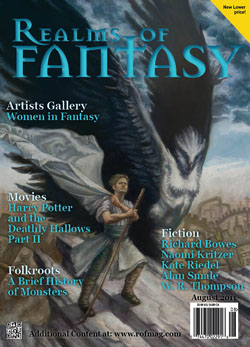
august-2011-cover-250x347The August Realms of Fantasy is its 101st issue, the significance of which editor Douglas Cohen makes some sage observations. Fiction includes “The Progress of Solstice and Chance” by Richard Bowes, “Isabella’s Garden” by Naomi Krtizer, “Collateral Damage” by Katie Riedel, “Snake in the Grass” by W.R. Thompson and “Leap of Faith” by Alan Smale.  Here’s the complete Table of Contents.
You can subscribe to either print or digital editions.

Blogging Alex Raymond’s Flash Gordon, Part Nine – “The Tusk Men of Mongo”

Blogging Alex Raymond’s Flash Gordon, Part Nine – “The Tusk Men of Mongo”

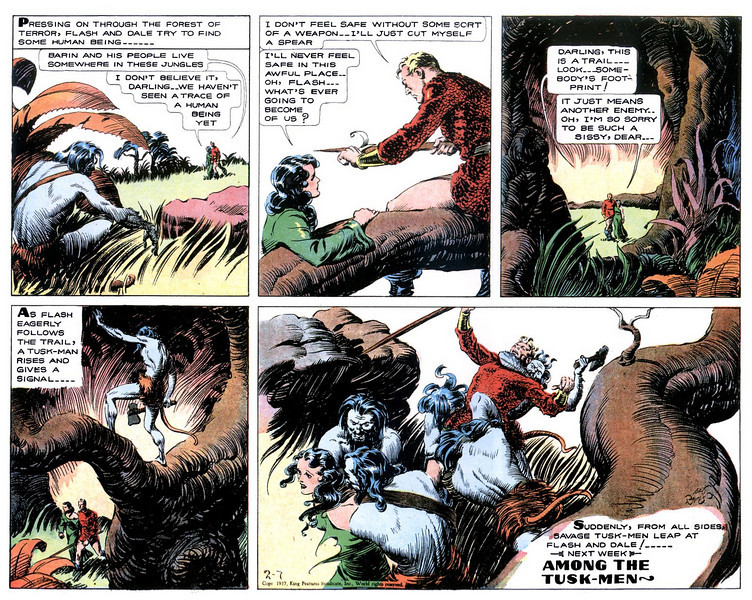
tusk-men-12flash“The Tusk Men of Mongo” was the ninth installment of Alex Raymond’s Flash Gordon Sunday comic strip serial for King Features Syndicate. Originally printed between February 7 and April 18, 1937, “The Tusk Men of Mongo” picks up the storyline where the eighth installment, “The Forest Kingdom of Mongo” left off with Flash and Dale unknowingly venturing into Tusk Men territory. The Tusk Men are a Neanderthal-like race of blue-skinned men with prehensile tails. They live in tribes and have fashioned crude tools such as axes. One of their scouts spies Flash and Dale and despite Flash carrying a makeshift spear, they are quickly overwhelmed by five of the Tusk Men.

Flash and Dale are bound and led many miles away to a vast network of caves where the Tusk Men dwell. There, we learn that the Tusk Men can speak a simple form of English as well as their own bestial language, and that they are cannibals who have captured Flash and Dale to devour them. The tribe is ruled by One-Tusk who claims Dale for his mate. Dale pleads for Flash’s life is to be spared to no avail. Just as he is about to be pitched into the flames, Flash breaks free of his bonds and fights against his captors. The Tusk Men greatly outnumber him and the Earth man is quickly recaptured. Death appears unavoidable.

Read More Read More

Goth Chick News: 13 Questions for the Creators of the New Super Hero Comic Legacies End

Goth Chick News: 13 Questions for the Creators of the New Super Hero Comic Legacies End

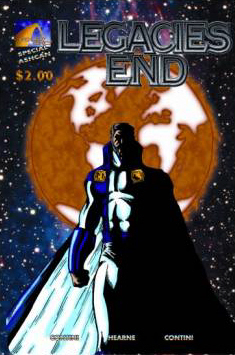
legacies-endAs discussed last week I had the distinct pleasure of covering the Chicago Comic-Con for Black Gate earlier this month. About 20% of the enormous convention center is dedicated to comic artists and creators, set up in an area called “Artist’s Alley.” There you could see a bewildering array of amazing illustrations from the Japanese anime style to traditional pen and ink, and meet the creative minds behind both popular super heroes (last year I got to meet Gary Friedrich, creator of Ghost Rider) as well as emerging new talent.

It was there I found my friend and film actor Jason Contini (star of Shadowland) along with his partners, brother Nathan Contini, Justin Mitchiner and Nicholas Hearne promoting their new comic series Legacies End.

The gents were kind enough to give me an early look and I must say, even though I’m a bit of a super hero traditionalist (Wonder Woman for example), I absolutely loved this very modern day approach. Think X-men and Watchman meet Kick Ass and you wouldn’t be far off.

Clearly, I had to know more.

An Interview With Jason Contini, Nathan Contini, Justin Mitchiner and Nicholas Hearne

Conducted and transcribed by Sue Granquist, August 2011

GC: How did you get into creating comics? Was it to meet girls?

NICHOLAS: Why else would a red blooded American man create a comic book but to meet girls?!  Geek chicks are the best!!! (GC: so what are you implying, Nicholas??)

JASON: Well, I think that’s the main reason to do anything, right? Girls!! No, I think for us, it was more that we were all super comic book fans for nearly most of our lives. And we’ve all talked about doing a comic book of our own for years.

Read More Read More

EXPERTISE: The Role of the Expert in Fantastic Fiction

EXPERTISE: The Role of the Expert in Fantastic Fiction

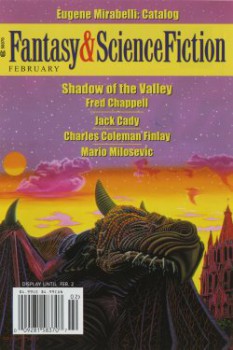
cov0902lg-2502As I began the second story in the latest issue of Black Gate, I was forcefully (but not forcibly) reminded of a review I wrote some years ago for Tangent Online. The review covered a 2009 edition of Fantasy & Science Fiction, the salient section being a paragraph I’d penned in response to Fred Chappell’s “Shadow of the Valley”:
As with heist movies and Tom Clancy thrillers, “Shadow of the Valley” thrives on the appeal of the expert, in this case Falco. He’s a man’s man, the icon of so many Westerns, the sort who can accurately predict the motives and movements of others, then exploit them to a tee. He has no emotional connections of any kind (indeed, women and children are notably absent from the story), and would likely deny needing any such thing. For experts, need is weakness. Think of Moorcock’s Von Bek, Fleming’s 007. We love these all-knowing cynics at least in part because they are so patently broken. Like them, Falco is the sort of tough-guy to whom readers cotton easily; his smarts and his world-weariness are butter for the bread of our reading experience. And so the story’s success stands or falls on Falco’s confident, wary shoulders; we follow the turns of this short story-cum-novelette to the degree that we bet for or against Falco’s success. Will he and his outlaw band reach the prized plants before Mutano, and will he get them back to semi-safe civilization before misfortune overtakes him? The pages turn readily in search of the answers.

Read More Read More

Edgar Rice Burroughs’s Venus, Part 1: Pirates of Venus

Edgar Rice Burroughs’s Venus, Part 1: Pirates of Venus

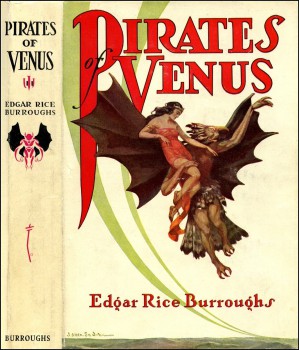
pirates-of-venus-first-edition-coverNext year brings the hundredth anniversary of Edgar Rice Burroughs’s first two published novels: A Princess of Mars and Tarzan of the Apes, as well as a big-budget film version of A Princess of Mars from Disney. (The film is saddled with the unfortunately bland title of John Carter. Fear of a Red Planet?) The effect these novels had on popular cultural was immense: they created a whole medium, they altered the nature of reading for pleasure. Pulp magazines existed before Edgar Rice Burroughs had the idea he could write better than the tripe found in the publications where he was working to place ads; but it was the success of first Under the Moons of Mars (the serial title for A Princess of Mars) and then Tarzan of the Apes in 1912 that made the pulps into the artillery of the Reader Revolution. The pulps turned the U.S. into a nation of readers, and ERB fired the first two shots in the revolution.
Then, twenty years into the revolution, he fired off the few rounds of his “Venus” series.

I have planned some festivities for the upcoming centenary of the Burroughs Upheaval. One is an ambitious project I have wanted to try on Black Gate for the last two years. But as a prologue to my 2012 ERB projects here in 2011, I’ve chosen to present a look at Burroughs’s least popular series, the last one he started before his death.

These posts will have a different structure from my usual free-form analysis style. Inspired by columns I’ve seen on the movie review sites I frequent (particularly “Franchise Me” on CHUD.com), I’ve laid out a template for tackling each of the five installments of the Edgar Rice Burroughs “Venus Saga.” An experiment? Or an admission that trying to go academic on this series feels like the wrong approach? I’m not sure myself, but here it goes….

Read More Read More

IT’S ONLY PULP: A Fair and Balanced Review of CONAN THE BARBARIAN (2011)

IT’S ONLY PULP: A Fair and Balanced Review of CONAN THE BARBARIAN (2011)

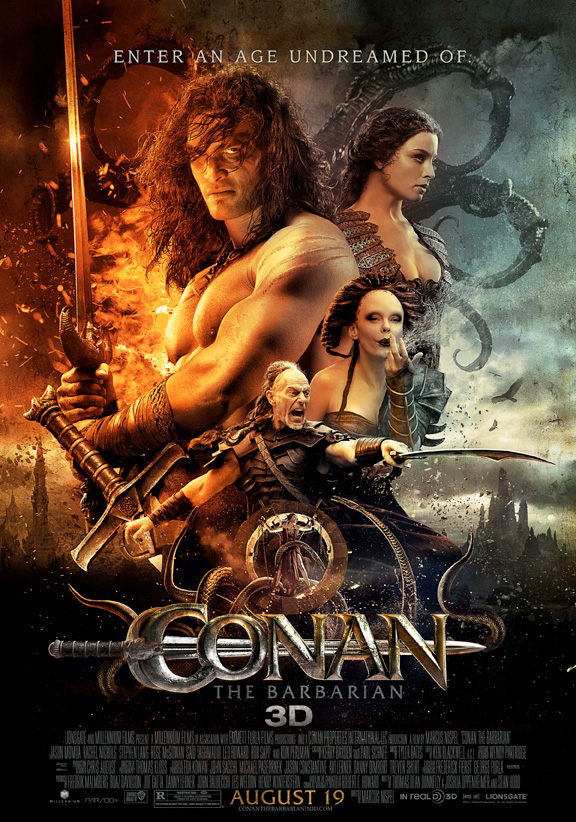
conan2Friends, Bloggers, Conan Fans, lend me your ears! I come not to defend the new CONAN movie, but to present an informal overview that examines what works and what doesn’t work. To begin, I’ve seen a lot better movies … and I’ve seen a LOT worse movies.

First, let’s consider the source: Robert E. Howard is a largely respected fantasy author by today’s standards. However, that was not the case in the 20s and 30s when he was publishing his lurid pulp adventure stories in WEIRD TALES and similar pulp magazines of the time. In Howard’s day, pulp fiction was considered “trash,” and it was treated accordingly. Sex and violence were common ingredients in a good pulp tale, and Howard’s work is definitely full of both. However, what was considered obscene in the Pulp Era seems rather tame compared to the graphic sex and violence we see in today’s media. You can look at this in two ways: Either we as a society have gotten less uptight about certain subjects, or we have become a more depraved society. It’s all a matter of perspective. And as many philosphers will tell you, perspective is reality.

The new CONAN THE BARBARIAN film isn’t exactly a remake, but it does borrow its revenge motif from the original (and superior) John Milius CONAN film from 1982. That was NOT a Howard plot point. The Conan of Howard’s tales is not pursuing vengeance for his slain father, his slain mother, or his slain village. However, he would certainly have not been above bringing bloody and thunderous vengeance to anybody who wronged him. It simply was not his driving ambition, as it is in the movies.

Before I talk about the movie’s failings, let me first say what works about it: The visuals. Marcus Nispel’s CONAN THE BARBARIAN is a visual triumph. The Hyborian Age has never looked so wondrous, splendid, and believable on screen. From the virgin wilderness and Cimmerian villages to the decadent, sprawling cities, the vast monastaries, and the ancient citadels with skull-shaped caves, the movie simply looks fantastic. The costuming too is spot-on and suitably grimy, evocative, and well-designed. Same goes for the props: swords, spears, armor, ships, etc.

It all LOOKS fantastic. But looks aren’t everything…

Read More Read More

Elf Opera in Tang China

Elf Opera in Tang China

Matthew Surridge’s fascinating post on specificity in setting got the various gears, levers, in pistons in my head working.  I’m currently writing this in a cloud of steam gushing out both ears, and hopefully I’ll be able to finish before the gnomes who power the mechanisms of my consciousness go on strike.

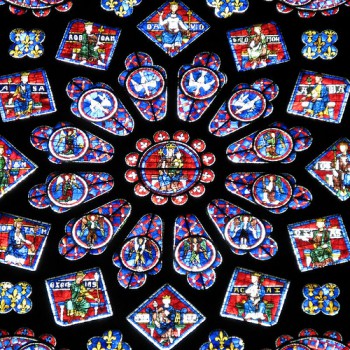
The short version: Matthew, I agree completely.  There is a certain charm to what I think of as the typical D&D setting, in which castles are built out of clichés mortared together with anachronisms, and the world is a playground of exotic sights for the mismatched band of adventurers to wander among and slay monsters in.  It’s a lot of fun in a game–and sometimes fun in a D&D novel–but it lacks the kind of verisimilitude that makes a story really engrossing.chartes-cathedral

I tend to think that the richness of real-world Medieval civilization is masked by a series of misconceptions and broad generalizations, beginning with the tendency to see them as one long Dark Age spanning from the Fall of Rome to the Protestant Reformation.  But the so-called Dark Ages were home to the kingdoms of Charlemagne and Alfred, the flourishing of Irish and Italian monasticism, and the first sparks of the most vibrant intellectual life the world had yet seen.  Likewise, the High Middle Ages were an age of soaring cathedrals, vibrant art and music, and universities that studied everything from Roman law to medicine.

At the same time, the European Middle Ages were anything but homogenous.  The time period covers over a thousand years, which contain literally hundreds of distinct peoples and cultures.  The Vikings who besieged Paris later became the Normans who conquered England and ruled Sicily.  The balance between monarchs, emperor, and papacy was constantly shifting, sometimes responding to new threats or influences, as when the Mongols crashed against the armies of the Holy Roman Emperor.

Read More Read More

Interzone #235 July-August

Interzone #235 July-August

351The new Interzone features “Insha’ Allah” by Matthew Cook, “For Love’s Delerium Haunts the Fractured Mind” by Mercurio D. Rivera, “The Walrus and the Icebreaker” by Jon Wallace, “Eleven Minutes” by Gareth L. Powell and “Of Dawn” by Al Robertson.  There’s also an interview with Lisa Goldstein and the usual assortment of book and video reviews. as well as David Langford’s “Ansible Link” column.

The publishers are reintroducing lifetime subscriptions. What you’re buying, in essence, is a 10-year subscription at the current rate.  If you think you’re going to live for at least another decade, and you think the magazine will also be around for as long, and this could be a bargain for whatever time you and the magazine have after that. If that weren’t enough, you can also opt for joint lifetime sub that gets you sister publication Black Static for a slightly reduced rate than the individual rates.  Sign your life away here.

Blogging Alex Raymond’s Flash Gordon, Part Eight – “The Forest Kingdom of Mongo”

Blogging Alex Raymond’s Flash Gordon, Part Eight – “The Forest Kingdom of Mongo”

blbforestkingdom61ykafrq1zl_sl500_aa300_“The Forest Kingdom of Mongo” was the eighth installment of Alex Raymond’s Flash Gordon Sunday comic strip serial for King Features Syndicate. Originally printed between October 25, 1936 and January 31, 1937, “The Forest Kingdom of Mongo” picks up the storyline where the seventh installment, “The Undersea Kingdom of Mongo” left off with Flash, Dale, and Zarkov winging their way to Prince Barin’s kingdom when they are ambushed by Ming’s air fleet. Their rocket ship is shot down and crash lands in an unknown forest near Mount Karakas. Ming orders Lu Chao, the commander of the air fleet to recover Flash’s body while Flash, an injured Zarkov, and an unconscious Dale stagger off into the forests.

Flash and Zarkov seek shelter in a nearby cave where Dale recovers consciousness. Lu Chao and his fleet arrive at the scene of the crash to discover the stolen rocket ship has been consumed by flames. Taking no chances that Flash might have survived, Lu Chao orders his men to set fire to the forest before they depart leaving the trio cut off by flames at every turn.

Read More Read More