Browsed by
Category: Blog Entry

Fairy Tale Television, Part 2: NBC’s Grimm Pilot

Fairy Tale Television, Part 2: NBC’s Grimm Pilot

grimmAs I mentioned last week, there are two major series starting this fall that are based on fairy tales coming to our world. The second of those series is NBC’s Grimm, which comes across as an attempt to wed fairy tales to a police procedural, sort of like Supernatural merged with Criminal Minds.

The result is a particularly brutal program, leaning strongly toward the horror end of the spectrum. I’m not sure if something this dark will really make it as a success on NBC. Supernatural is a cult success, which is fine for the sort of ratings that the CW is aiming for, but NBC would consider the same ratings level a failure.

The concept: Nick Burckhardt is a police detective who begins to see strange visions, only to learn that it’s because he is descended from a family line of Grimms – those with the power to see supernatural creatures for what they really are. It’s his destiny to hunt down these creatures.

Read More Read More

Still Not Ready for Prime Time

Still Not Ready for Prime Time

6276241335_53830189a1_o1Well, just as everyone is remarking on how the new conversant iPhone is making science fiction true to life, one pretty big part of the science fiction imagination remains just that; while the 21st century has not only arrived, we’re a decade into it, but we won’t be taking any sight seeing trips to Mars in the near future.  Even a suborbital cruise will have to wait until 2013. The overly ambitiously and to-date technically impossibly named Virgin Galactic, a space tourism company founded by British billionaire and all-around let’s do something fun and make some money at it guy Sir Richard Branson, has announced that commercial flights have been delayed for another two years.  But don’t start buying any tickets, as this is something like the fourth time the schedule has been bumped forward since flights were supposed to begin back in 2008.

If you did want to get in on the ground floor, so to speak, tickets cost $200,000, with a deposit of$20,000 required.  Not sure if that includes complimentary drinks.

A Halloween Treat: The New Death and Others by James Hutchings

A Halloween Treat: The New Death and Others by James Hutchings

240px-robert_e_howard_suitnnew-death3The New Death and Others is James Hutchings’ newly-published collection of gothic poetry and short fiction. The title found its way to me through my appreciation of Robert E. Howard’s “The Mirrors of Tuzun Thune” for it is one of four fantasy stories that the author adapts in verse form. I admit to being skeptical that the quality would not come even close to doing justice to the works that provided inspiration. When I read Hutchings’ poem, I found myself recalling Tolkien’s use of poetry throughout The Hobbit and The Lord of the Rings. Here was a similar approach that uses the beauty of words sparingly to convey complex stories or histories in minimalist form. Hutchings’ work immediately captured my imaginations and left me hungry to sample more of his work.

I humbly admit to struggling with technology. Many are the times I require my kids’ assistance to navigate through the DVD’s remote in order to access special features or skip chapters or fast forward properly. The idea of owning an eBook is something that appeals to me as much as owning an iPod or iPhone. That said Amazon has made it hard for me to resist the technology with their free PC for Kindle download. As a reviewer, there are an increasing number of publishers who prefer to send their works as an eBook. The freeware allows readers to enjoy numerous free classics as well as sample other works for literally a fraction of their printed cost and without having to buy an expensive Kindle or Nook. All of this is actually relevant since Mr. Hutchings’ excellent offering is available at Amazon as an eBook or direct from Smashwords’ website for download. Quite honestly, I cannot think of a more perfect Halloween gift than this collection of poems. One could easily see the book becoming a seasonal tradition.

Read More Read More

Art of the Genre: Why do they all want our women?

Art of the Genre: Why do they all want our women?

Maybe they want her because she's got huge... tracts of land!

I’m a fan of Dragon Magazine, or at least I was back in the 80s. That’s not to say that the now fully online version doesn’t have its good points, but when it comes to what I remember fondly from my youth, Dragon certainly ranks up there with the greats.

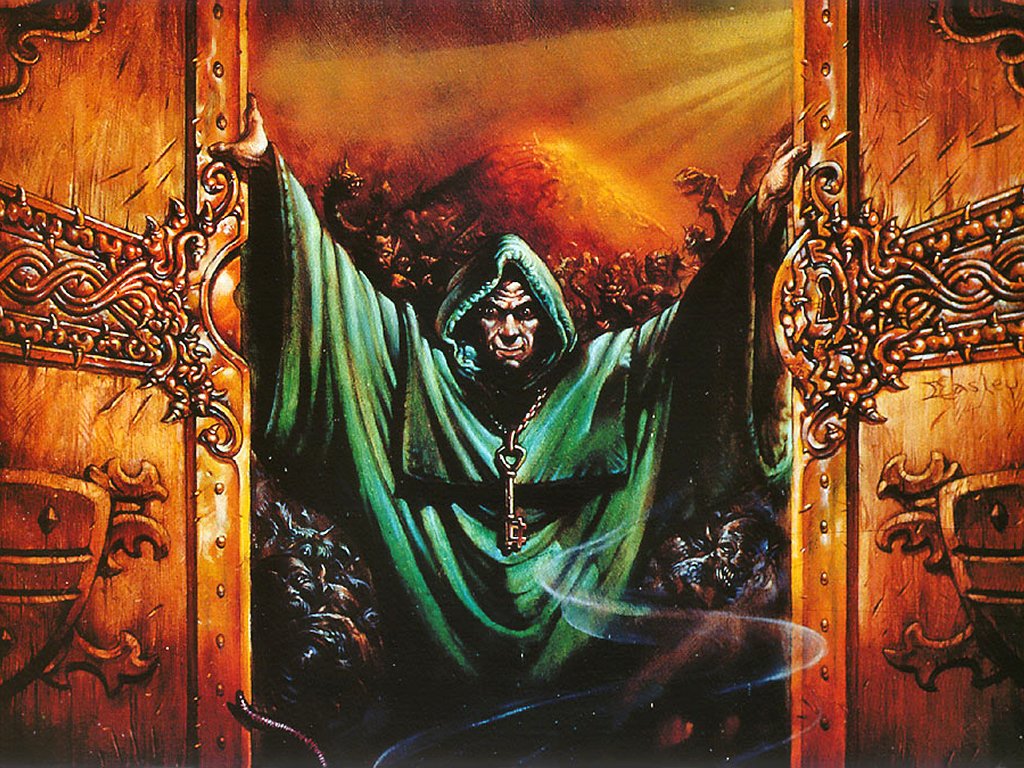
One of the most memorable things about the magazine were the advertisements, almost all for games that I couldn’t readily find in a gaming store. I loved looking at these and dreaming of owning games like Aftermath, Talisman, or my personal favorite Bug-Eyed Monsters: They Want Our Women.

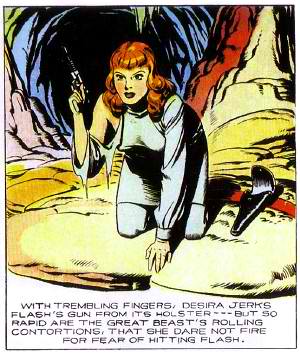
As a child of the late 70s and early 80s I missed the creature feature glory days of the 50s and 60s, so this game was my first real indoctrination to the world of female exploitation by powers beyond the scope of simple men.

This campy style of art was so over the top, so ludicrous, that I was drawn to it like a moth to flame. I’m certain marketing departments knew this as they’d been advising great artists to show such evocative scenes on movie posters and pulp magazines for a half century before I came into the picture.

No matter my desire, both for the game and the women represented, I didn’t acquire Bug-Eyed Monsters: They Want Our Women until 2002, but by that point I’d passed the simple acceptance of the awesomeness of it all and started to question the why…

Read More Read More

Here’s That Other Thing … The One From Another World

Here’s That Other Thing … The One From Another World

thing-from-another-world-51The Thing from Another World (1951)

Directed by Christian Nyby and (uncredited) Howard Hawks. Starring Margaret Sheridan, Kenneth Tobey, Robert Cornthwaite, Douglas Spencer, James Young, Dewey Martin, Robert Nichols, William Self, James Arness.

John W. Campbell’s novella “Who Goes There?” has now produced three film adaptations: two classics and a footnote. After recovering from reviewing the footnote, it occurred to me that The Thing 2011 has two positives I failed to mention: it makes viewers appreciate how great John Carpenter’s 1982 version is, and how great Howard Hawks’s 1951 version is.

More than enough ink and bandwidth has covered The Thing ’82, and as much as I adore that movie, I have nothing new to contribute to the discussion of it beyond the comparisons I made in last week’s review. (Edit: Unless I choose to survey John Carpenter’s career.) However, the 1951 film, The Thing from Another World, hasn’t gotten nearly the attention it deserves in the current collective bashing of the new movie. If I’m going to point out how poor The Thing ’11 is, it’s only fair that I smash it with the Howard Hawks film as well. Why should John Carpenter have all the fun?

The Thing from Another World is a great film in its own way. When John Carpenter set out to re-make it, he made the intelligent decision not to duplicate its style and instead return to the source material and create something new. The result was two Things that can stand side-by-side, each adding to the other.

Read More Read More

Fairy Tale Television, Part 1: ABC’s Once Upon a Time Pilot

Fairy Tale Television, Part 1: ABC’s Once Upon a Time Pilot

onceuponpromoThere are two series starting this season which are trying to leverage the world of classic fairy tales to gain ratings on major networks. Though existing fantasy series, like Supernatural, Sanctuary, and Warehouse 13, do often touch on the idea of fairy tales (or mythical creatures, at the very least), a series fully embedded in the classic fairy tales is something I don’t think we’ve really seen before.

The first show, which premiered on Sunday night, was ABC’s Once Upon a Time. In this story, the characters from the classic fairy tales are trapped in our modern world, in Storybrooke main, without even the memory of their lost identities. The story centers around an outsider, Emma Swann, who comes into the town … only to discover that she’s not as much of an outsider as she thought.

The next one, Grimm – which premiers this upcoming Friday – takes a different tactic. In it, the main character is part of a line of monster hunters who have the innate ability to see fairy tale monsters for what they truly are.

It remains to be seen which of these series will have staying power.

Read More Read More

Supernatural Spotlight – Episode 7.5 “Shut Up, Dr. Phil”

Supernatural Spotlight – Episode 7.5 “Shut Up, Dr. Phil”

Buffy: The Vampire Slayer icons Charisma Carpenter and James Marsters face off in Supernatural.

When a woman gets cooked by her salon hair helmet, Sam and Dean figure that it’s one in a series of pair of suspicious deaths (along with a guy who boiled to death in a hot tub). They investigate, learning that the woman who died was beloved in the community. Dean finds a strange coin at the scene of the death, which he suspects may be some sort of hex talisman.

Next a man gets murdered in a port-a-toilet by a levitating nail gun. As the Chinese say, may you live in interesting times.

Of course, the boys do still have a Leviathan on their tail, so I guess their times are interesting enough.

Read More Read More

Asimov on 21st Century Advertising

Asimov on 21st Century Advertising

imagesBack in 1977, science-fiction writer Isaac Asimov wrote a piece for Advertising Age predicting, among other things, that consumers would opt to receive ads personalized to their interests as well as the role of “persuasion techniques developed by advertology (sic)” to promote social change. While Asimov got the general idea right, he was wrong on the delivery channel for target marketing (he thought it would be television, having no notion of the Internet) and the evolution of political advertising (he thought it would be for the purpose of “battling ignorance and folly” as opposed to most political messages today that’d rather promote ignorance and folly).

Asimov was from a generation of SF writers who saw their avocation in part as to predict the future as a positive, better place to live. In the same article, Asimov conjectured that by 2000, “Energy will once more be relatively plentiful, and it will be used more wisely, we hope, by a world that has been taught by the events of these recent decades to cooperate for survival.” Good luck with that.

I was thinking about this after reading “Novelists Predict Future With Eerie Accuracy” by John Scwartz in The New York Times Sunday Review. He notes the range of predictions that have come to pass, ranging from Jules Verne staging moon launches from Florida to Arthur C. Clarke’s anticipation of satellite communications to Internet virtual realities envisioned by William Gibson and Bruce Sterling, two of the founding fathers of the cyberpunk movement in the 1980s. But he fails to distinguish between those like Asimov who hoped they were right in promoting a future enhanced by technological development and those whose extrapolations of global corporate and media trends led to more decidedly dystopic premonitions.

193176591Alas, it seems as if the optimists who envisioned the twenty-first century as some sort of glittering technological utopia might have gotten some of the details right, but the award for getting right the overall picture of media and marketing malevolence goes to the more pessimistic cyberpunks. As the opening line of the archetypical cyberpunk novel — Gibson’s Neuromancer describes it:

The sky above the port was the color of television, tuned to a dead channel.

Gibson delineates a world in which industry, technology, and mass media dominate human existence, but not in good ways that Asimov thought it might turn out. Certainly not one in which we’ve all decided to cooperate for our mutual survival.

Game Review: Innistrad from Magic the Gathering

Game Review: Innistrad from Magic the Gathering

innistrad-werewolf

Magic The Gathering has recently released another set, this one featuring the dark plane of Innistrad. The end word of title in itself, Strad, should tell you all you need to know to get started here.

The Vampire Strad, as most older gamers will remember, was the famous vampire found in the classic TSR module I6 Ravenloft. That particular gaming supplement was so popular that it spun off its own boxed set and gothic fantasy dimension in the early 90s.

I’ve always been a fan of I6 for a couple of reasons. A: The cover might be the best work Clyde Caldwell ever did for TSR, and that’s saying something. And B: It featured the first TSR 3D map which detailed Strad’s castle.

Now I recently picked up a copy of this module, took it to Milwaukee, and had Caldwell sign it as Wayne Reynold’s birthday gift because the cover inspired Wayne to become an artist. That in itself should be enough to put it into TSR’s artistic top 10, but as the concept of Strad and his new domain began to grow, the creative think tank at TSR began to fail in how to deliver it.

Read More Read More

Behind the Mask: Dr. Phibes Rises Again from Script to Screen

Behind the Mask: Dr. Phibes Rises Again from Script to Screen

doc-phibestumblr_lfvzefdggz1qc1sduo1_500Dr. Phibes Rises Again (1972) brought back Vincent Price and director Robert Fuest for a second go-round with AIP’s favorite madman. Phibes’ original screenwriters William Goldstein and James Whiton penned the first draft of the sequel entitled The Bride of Dr. Phibes. While the resulting film retained significant elements from this work, AIP chose to hand the writing chores over to Robert Blees with director Robert Fuest making final revisions on the produced script. Whiton and Goldstein’s sequel script would resurface several times over the years for AIP as a possible third film re-titled Phibes Resurrectus and later for AIP’s successor, New World Pictures for a revival titled Phibes Resurrected. Between these attempts, Goldstein came very close to getting a television series, The Sinister Dr. Phibes off the ground with comic book legend Jack Kirby providing the designs for the network presentation. A survey of the development of the sequel makes the film’s international title, Frustration seem all too apt.

The October 1971 draft of The Bride of Dr. Phibes makes it evident that Goldstein and Whiton (like many screenwriters before and since) were cheated of a story credit for the sequel since much of the resulting film’s structure is derived from their unproduced script. Phibes’ carefully-planned resurrection and his scheme for reanimating his late wife are exactly as one finds in the finished film. Additionally, the central characters of Emil Salveus and his mistress Daphne Burlingame are virtually identical to the film’s central characters, Jonathan Biederbeck and Diana Trowbridge. Goldstein and Whiton focus the sequel on a the Institute for Psychic Phenomenon which houses a Satanic cult led by the now adult Lem Vesalius seeking vengeance against Phibes nine years after the events of the first film. The Scotland Yard stalwarts, Trout, Schenley, and Crow return to good effect. Although Crow’s role seems better suited to his direct report, Waverley who is missing here. There’s a gripping sequence set at Wembley Arena that is remakably similar to a scene in one of the early Fantomas novels where the detectives think they’ve nabbed Phibes only to discover it is one of his automatons. It is easy to see why this excellent script would not die and resurfaced several times under variant titles over the ensuing decade.

Read More Read More