The April-May Black Staticfeatures new horror fiction from Carole Johnstone (”The Pest House”), Jon Ingold (”Cracks”), Priya Sharma (”The Ballad of Boomtown”), Joel Lane (”The Messenger”) and Daniel Kaysen (”Pale Limbs”).
Nonfiction by the usual suspects, Peter Tennant, Christopher Fowler, Tony Lee, and Mike Driscoll. The editor is Andy Cox.
Black Static alternates monthly publication with sister SF and fantasy focused Interzone.
I’m sure I’ve mentioned TSR’s Oriental Adventures on more than one occasion from my soap box of a blog. This book is the only 1E D&D book I have with water damage because the day I bought it I was so enthralled that I thought I could take a bath while reading it [bad idea].
Anyway, from that moment forward I was deathly intrigued by the Orient, be it Kara-Tur in the Forgotten Realms, the T’ung in my home brew world, the non-magic stage of feudal Japan in Bushido, or of course the realms of Rokugan in Legend of the Five Rings.
Three weeks ago, as my six-year old son broke apart a flex pole tent system and began using it as a weapon, I had the pleasure of showing him firsthand what a three piece staff looked like in the Oriental Adventures book, making it also a fine teaching tool as well as a gaming supplement.
Therefore, you can well imagine my unchecked delight to find that Paizo was not only producing two source books for their Pathfinder system concerning the Orient in Golarion, but also a full Adventure Path that dealt with the region.
In this article I’m going to talk a bit about three outstanding products newly released in the past six months from Paizo concerning their Dragon Empires setting. …
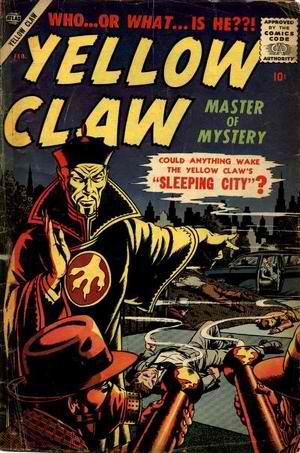
Sax Rohmer’s The Yellow Claw was originally serialized in five installments in Lippincott’s from February through June 1915. The serial was subsequently published in book form later that same year by Methuen Press in the UK and McBride & Nast in the US. The novel chooses to divide the story into four sections. This week, we examine the fourth and final part.
Rohmer really delivers with the final section of the novel with the development of the Eurasian femme fatale, Mahara who was previously referred to only under the mysterious moniker of Our Lady of the Poppies. Mahara becomes a flesh and blood character fiercely jealous to think that her lover, Gianopolis has been thinking of leaving her for another. The object of his affections is Helen Cumberley, Henry Leroux’s neighbor who despises Gianapolis as much as she pines for the unhappy thriller writer. Such a tangled web of unrequited love is uncommon for Rohmer, but it added to the novel’s appeal in its day and is surely one of the reasons that Stoll chose it as the first of his works to bring to the silver screen.
The narrative then switches to Gaston Max in the observation chamber of the opium den. The famous French detective feigns smoking opium, but only exhales through the pipe. Faking a drug-induced stupor, Max waits while Ho-Pin enters the room to check on him and is then startled to discover that upon his exit, Mahara has entered. Rohmer relished creating memorable femme fatales and Mahara seems to have been his first notable accomplishment with such a character. The Eurasian temptress passionately kisses the supposedly unconscious Max while lying upon him and cooing to him how she is going to enter his dreams. The image of a man forced to feign unconsciousness while a seductive female grinds into him is certainly powerful and far from the norm for fiction in 1915.
Once upon a midnight dreary, while I pondered, weak and weary,
Over many a quaint and curious volume of forgotten lore,
While I nodded, nearly napping, suddenly there came a tapping,
As of some one gently rapping, rapping at my chamber door.
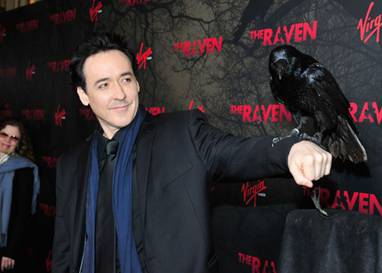
You’ve got to go a long way to adequately capture the creepiness that is the poetry of Edger Allen Poe.
And Hollywood has tried… a lot.
There have been 44 films to date dealing directly with Poe material, not to mention all the films with Poe “inspired” material, from the first Batman movie in 1966 to Saw V in 2008.
It started in 1909 when D.W. Griffith created the first Poe bio-pic in the form of a six-minute, one-reeler entitled Edgar Allen Poe commemorating the 50th anniversary of Poe’s passing. Even with all the wonders the turn of the century brought, including moving pictures, Edgar Allen Poe stood out as a mystery.
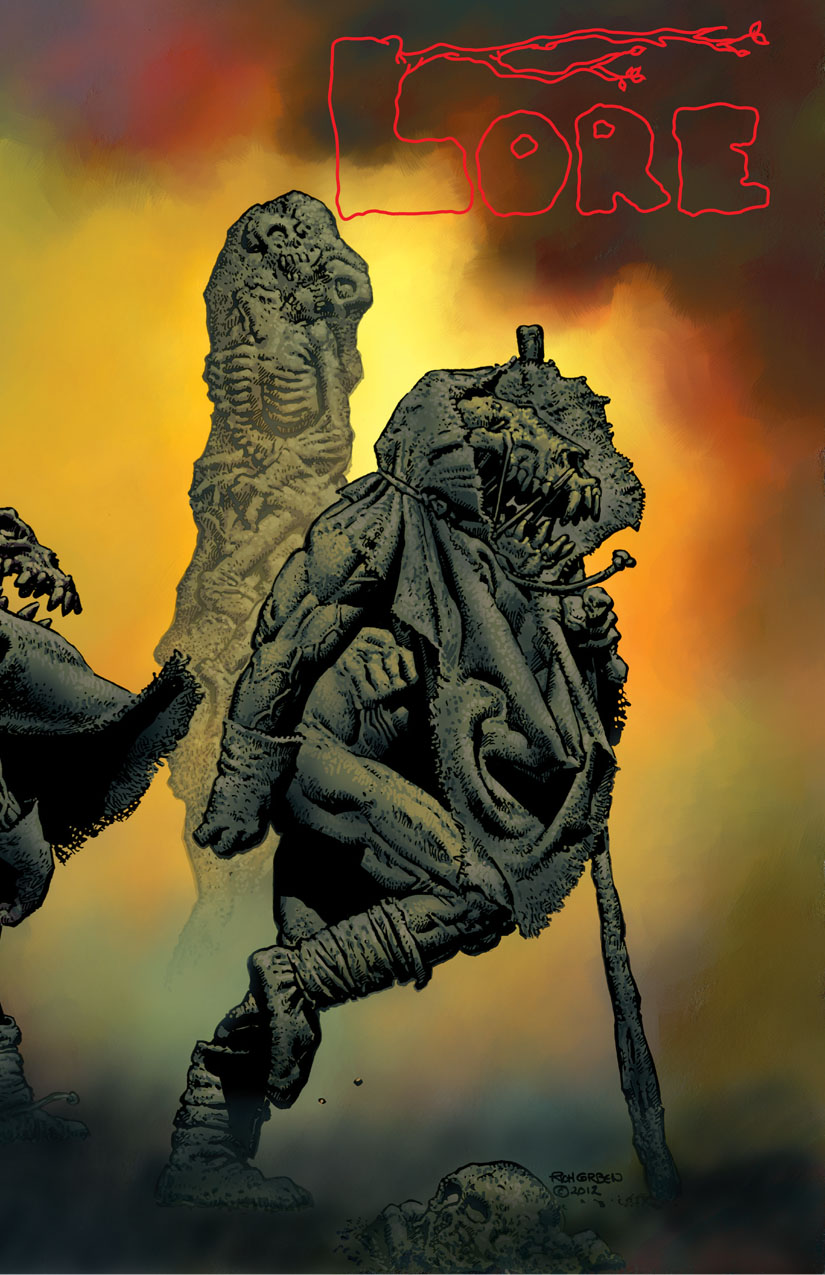
Richard Corben provides a stunning cover for the issue of LORE #2.1, which features a long-lost tale of Seelura by the late, great Brian McNaughton (among other great stories).
LORE is back!
You can’t keep a good mag down. [Insert your own zombie joke here] Back in the 90s LORE was one of the coolest independently-produced horror mags to see the light of day, showcasing stellar talents like Harlan Ellison, Richard Corben, Brian Lumley, and the late, great Brian McNaughton, to name only a few.
Recently LORE dug itself out of its own musty tomb and returned in an improved “2.0” version. I spoke with the mag’s co-founder Rod Heather about where LORE came from, where it’s going, and the resurrection of McNaughton’s THRONE OF BONES setting, Seelura.
More on this and other vital topics follow in the interview:
FULTZ: For those not familiar with the first incarnation of LORE, can you give us a quick snapshot of the mag’s unique history?
We began to put LORE together in 1994, and released our first issue in June, 1995. Back then, we really had no idea about the market … at all. We had never even heard the term “small press.” We have always been avid readers of horror, science fiction and fantasy, and it seemed like it might be fun to publish a magazine of horror stories. And, it was.
Though co-publisher Sean O’Leary and I have written stories of our own in the past, we didn’t want to include any of our own stories in LORE. To us, it’s tacky when someone publishes his or her own work in a collection or magazine for which they, themselves, have selected the stories. We wanted LORE to consist of wholly original short stories discovered and captured in the wild, as it were.
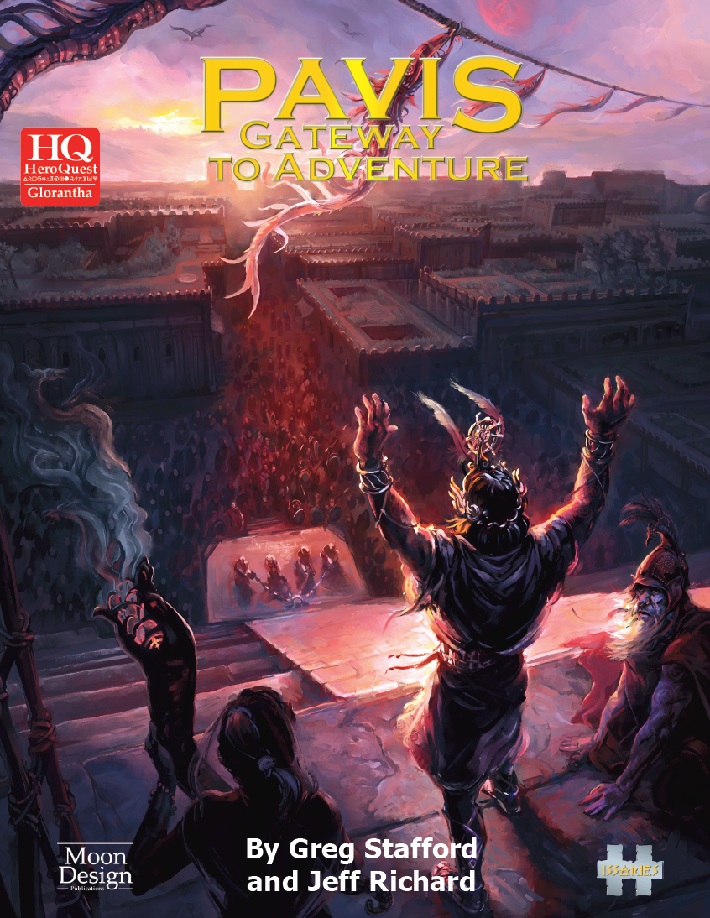
Wow. This is a big book. I mean, seriously big. It’s 420 pages of letter-sized softback, absolutely crammed with information about one of the most famous cities in fantasy roleplaying – Pavis, City of Thieves, Gateway to Adventure.
Let me be frank: I’m a fan. I have been ever since Pavis first saw the light of day back in 1983. And, since this freshly published brand new supplement for the HeroQuest fantasy roleplaying game hit my mailbox last week, I’ve become a fan all over again.
This week and next, I’m going to review Pavis – Gateway to Adventure, and try to give some idea of why it’s such a special book. This week, I’ll consider the history of the city of Pavis as a roleplaying game product, and give a high-level overview of what the new supplement contains; next week, I’ll look into the book in much more detail, and provide a chapter-by-chapter breakdown.
So what is Pavis, and why should you care? Well, if you’re a fan of the ancient fantasy world of Glorantha, the invention of RPG and fiction writer (and sometime shaman) Greg Stafford, then you’ll know all about Pavis already. But if you’re not – then prepare yourselves for a treat. Because whether you’re a roleplayer, or a fan of fantasy fiction with a love of well-crafted worlds, meticulous cultural detail, and awesome fantasy cities, Pavis – Gateway to Adventure might just be for you.
Summer is almost here, and the time is almost right, for dancing in the streets. Or sitting your butt down in a movie theater to watch a big green thing in purple pants beat up aliens.
As I more and more become “The Black Gate Movie Guy,” I’ve grown aware of my responsibilities regarding upcoming films of interest to our readership. This summer I promise to post reviews of all the major genre releases, which means that, yes, you will get to hear my thoughts on Snow White and Huntsman. Because you didn’t demand it.
This is also a transparent bid to get officially recognized as a movie critic so that I will be invited to press screenings here in Los Angeles and thus be able to post up reviews of films in the days before they are released.
Looking over the summer roster (posted below — yes, all shall be reviewed), aside from a few groans of anticipatory pain, there are five films that really have my geek adrenal glands turned up to the danger zone. Here are the films I hope will make summer worthwhile.
This past week’s issue of Strange Horizons features a story by Andrea Kneeland. “Beneath Impossible Circumstances”:
Analise wants to have a baby. A real baby. I tell her that if we had a baby together, it would be a real baby. It would be a real baby and it would have parts from both of us, and it would be a real person made from both of our genes, and that I want parts of myself in a child just as much as she wants parts of herself in a child. When I tell her these things, she turns on the faucet or runs the vacuum or opens the refrigerator door wide and sticks her head in like she’s looking for something so she can pretend not to hear me and I can pretend not to see how damp and salted her reddening cheeks are, and on days like these, when I tell her things like these, the bed sheets between us stay cool and dry and I remind myself of the virtue of silence and I bite my lip to draw blood so that in the morning, when I move my mouth, the pain will remind me not to say a thing.
Other features include poetry by Virginia M, Mohlere, commentary by Adam Roberts on the 2012 Arthur C. Clarke shortlist and a review of Lev Grossman’s The Magician King by Bill Mingin.
This Kickstarter was 70% complete by the closing of the campaign and yet we still are going down to the wire on deadline.
Ok, could Kickstarter be any more popular than it is right now? I’m thinking no… I mean, if we were looking at a bell curve, beginning in 2009 with Kickstarter’s launch, the top of the bell should be right here, right now.
As I was moving through Facebook yesterday, a place where until November 2011 I’d never heard or seen a mention of Kickstarter, I counted 9 different threads among sites I frequent either pushing a new Kickstarter or asking questions about the platform.
It’s kind of crazy, and yet when the gravy train is running, anyone out there would be a fool not to jump on board, or so all the property flippers from 2006 would like you to believe.
Still, I digress, as this post is about something other than the proliferation of the platform.
This fine Saturday, one in which I incredibly DON’T have a Kickstarter to peddle, I’m going to talk a bit about getting ready for a Kickstarter.
As I mentioned in my last post on the subject, a video is now an even greater key to a Kickstarter’s success, and the days of one-on-one testimonials are dying faster than the people of Portland in the TV show Grimm.
But before I reiterate my discussion on videos from two weeks ago, I really want to take you into the world of Kickstarters, fulfillment, and what it takes to not only get one going, but also how to wrap it up and get it out the door after all the ‘crazy’ ends. This process will take a couple of weeks, so bear with me, but it still begins today with the question I got earlier this week.
The year was 1958. I was six years-old. Life was a waking dream filled with magic, mystery, and wonder. It was a year that would have a lasting effect on me.
It was the year I first encountered the cinematic “ancestors” of the warriors and heroes I would go on to discover ten or so years later in the paperback pages of Lancer, Ballantine, Avon, Signet, Paperback Library, Pyramid, and other publishers who had taken up the banner of sword and sorcery, and heroic fantasy.
Of course, I had already become a fan of Disney’s Zorro, had seen the Errol Flynn swashbucklers on television, and had desperately wanted to become a pirate when I grew up. I would also see Spartacus, starring Kirk Douglas, The Mongols, starring Jack Palance, Hannibal, starring Victor Mature, and other films like Genghis Khan, The 300 Spartans, and Ben Hur a few years later. On television I would later see the silent Thief of Baghdad and Siegfried, and other adventure films of the 1930s and 40s.
But the movie theater in 1958 would have the most profound impact on my life.
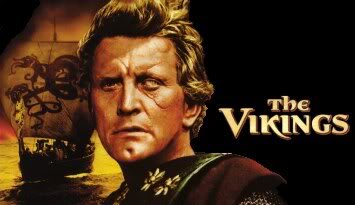
The film that started it all was The Vikings, starring Kirk Douglas, Tony Curtis, Janet Leigh, and the wonderful Ernest Borgnine, whom I recently had the pleasure of meeting.
 The April-May Black Static features new horror fiction from Carole Johnstone (”The Pest House”), Jon Ingold (”Cracks”), Priya Sharma (”The Ballad of Boomtown”), Joel Lane (”The Messenger”) and Daniel Kaysen (”Pale Limbs”).
 as a young boy.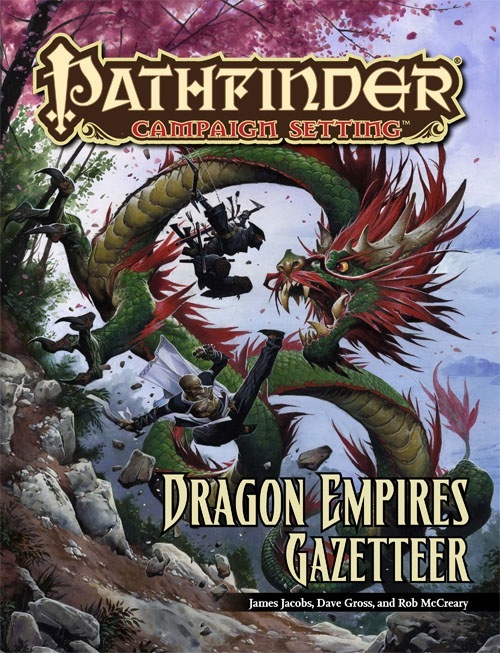
 Summer is almost here, and the time is almost right, for dancing in the streets. Or sitting your butt down in a movie theater to watch a big green thing in purple pants beat up aliens.