Sometimes We Are in the Presence of Awesome and There Simply Are No Words
Yes, that’s a Star Trek Enterprise pizza cutter.
Available for $24.99 at Think Geek.
The brief advertising video must be seen to be believed.
Yes, that’s a Star Trek Enterprise pizza cutter.
Available for $24.99 at Think Geek.
The brief advertising video must be seen to be believed.
Swords From the West
Harold Lamb
Howard Andrew Jones, ed.
Bison Books (602 pp, $26.95, 2009)
Swords From the Desert
Harold Lamb
Howard Andrew Jones, ed.
Bison Books (306 pp, $21.95, 2009)
Reviewed by Bill Ward
Harold Lamb (1892-1962) is an author in danger of being forgotten. This should not be the case, for a number of reasons. Firstly, Lamb is good — from his historical biographies that read like action-adventure novels, to his actual action-adventure stories that cemented his status as a king of the pulps, Lamb is a terrific writer. He is also a diverse writer, having achieved success in both fiction and non-fiction, magazines and books, and even as a Hollywood screenwriter.
And, not to be overlooked, he is a historically significant writer in the evolution of fiction — serving as a bridge from the pulp era to the post-war era, and as a grandfather figure to the kind of adventure fantasy pioneered by Robert E. Howard and then expanded upon by the greats of the field such as Fritz Leiber, C.L. Moore, Michael Moorcock, Karl Edward Wagner, Leigh Brackett, Steven Brust, and Charles Saunders. The idiom in which today’s current crop of rising Sword & Sorcery stars work within can be traced right back to the nineteen teens and twenties, and the historical adventures of Harold Lamb that did so much to inform the approach of the future creator of Conan.
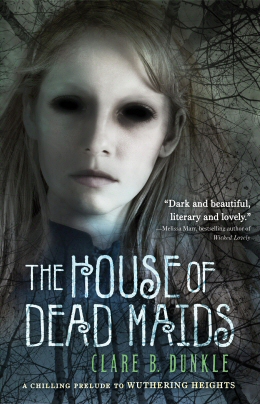
Last week I was contacted by Barbara Fisch at Blue Slip Media, who’s been recommending and sending review copies to me for nearly fifteen years. Barbara had flagged The House of Dead Maids by Clare B. Dunkle (author of the Hollow Kingdom trilogy), just released in hardcover from Holt, as of possible interest to Black Gate readers. And from her description, it sounded like she could be right:
The House of Dead Maids is billed as a prelude to Wuthering Heights, as it features a character who will come to be known as Healthcliff. The novel is a scary blending of Yorkshire lore and Bronte family history. The child (Heathcliff) is already a savage little creature when Tabby Aykroyd arrives at Seldom House as his nursemaid. The ghost of the last maid will not leave Tabby in peace, and her spirit is only one of many. As she struggles against the evil forces that surround the house, Tabby tries to befriend her uncouth young charge, but her kindness can’t alter his fate.
The real task, as always, was matching the ideal reviewer with the book… a bit more of a challenge for a 151-page book with an eleven year-old narrator, I grant you.
As luck would have it, I happened to have an eleven-year old reader in the house, who innocently picked up the book the day it arrived. I know when the stars have aligned, and sat down with a notepad and pen to interview her minutes after she finished reading The House of Dead Maids.
We’ll call this young reader “Tabitha,” because of what happened when her mother found out I was going to use her picture and real name on the Internet.
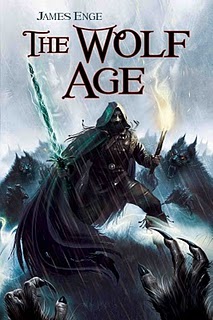
James Enge tells us (rather gleefully) that “A slab of The Wolf Age is up at the Pyr samples site. Werewolves. Ghost-powered zeppelins. The usual stuff.”
The Wolf Age is the third novel of Morlock the Maker. Morlock, the soft-spoken hunchback and recovering alcoholic who may also be the finest artificer the world has ever seen — not to mention a formidable swordsman — featured in Enge’s first published story, “Turn Up This Crooked Way,” in Black Gate 8, and has appeared six times (so far) in our pages, most recently in Black Gate 14.
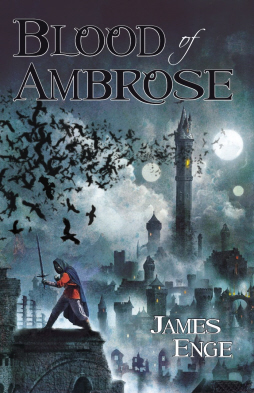
Tired of dominating Black Gate‘s pages with an iron fist, Enge turned to more ambitious goals, producing the first two Morlock novels Blood of Ambrose (2009) and This Crooked Way (also 2009 — it makes other writers look bad, doesn’t it?), both published by Pyr.
Blood of Ambrose was recently nominated for the World Fantasy Award, the obvious next step in Enge’s ruthless plan for domination of Western civilization.
You can read the first two chapters of The Wolf Age at the Pyr website, and see for yourself how Enge’s evil scheme is taking shape. It’s not to late to stop him.
Werewolves. Ghost-powered zeppelins. On second thought, it probably is too late. Join the Black Gate staff in line to sign up as Enge’s evil henchmen, and get your black leather tunics and infrared goggles before they’re all gone.

From the time I was in grade school all the way up until after I graduated from college I wrote in notebooks. It seemed such a natural process that I wonder now how I got away from it, and why it was such a revelation when I took up writing in notebooks again.
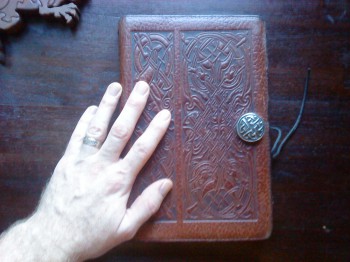
In my school days I used to carefully comb through available notebooks and select one with multiple subjects, college-ruled. Usually it would be a spiral-bound Mead, 8 1/2 by 11, but sometimes I’d experiment with slightly smaller sizes. When I was older and wandering through the Kansas City Renaissance Festival with my wife, I purchased a lovely Celtic leather notebook cover with an unlined sketchbook, and I filled a succession of replacement sketchbooks between those covers with my scribbles for years after.
As striking as that notebook was, though, I eventually fell out of using the thing. It became impractical to drag it wherever I went: my student days were over so I no longer had a backpack over one shoulder, and I didn’t have the kind of job where I always toted a briefcase. In those rare instances where I DID have a briefcase, it was already so loaded down that something weighing as much as a hardback book was a nuisance. I never used a notebook for writing unless I was at home, at which point I might as well have been writing on the computer. I thought that I had “outgrown” the use of a notebook.
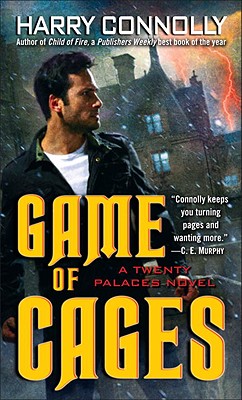
The most interesting title waiting for me when I returned from our adventures at Dragon*Con was Harry Connolly’s Game of Cages, the latest in his Twenty Palaces series and the sequel to his first novel, Child of Fire.
We’ve been big fans of Harry since his first story appeared in Black Gate 2, and his “Soldiers of a Dying God” (BG 10) is one of the finest short pieces we’ve ever published. It’s been great to finally see him get some well-deserved recognition. Child of Fire received some excellent notices, and Jim Butcher said it contained “Excellent reading… delicious tension and suspense.” Here’s the cover copy to Game of Cages:
As a wealthy few gather to bid on a predator capable of destroying all life on earth, the sorcerers of the Twenty Palace Society mobilize to stop them. Caught up in the scramble is Ray Lilly, the lowest of the low in the society — an ex-car thief and the expendable assistant of a powerful sorcerer. Ray possesses exactly one spell to his name, along with a strong left hook. But when he arrives in the small town in the North Cascades where the bidding is to take place, the predator has escaped and the society’s most powerful enemies are desperate to recapture it.
We tracked down Harry at the exclusive club where he now writes, between eating oysters and sipping Châteauneuf-du-Pape. Before we were thrown out by the bankers at the next table, Harry did say a few words about his new novel, which Howard Jones managed to transcribe in the hidden notebook he always carries in his pocket:
Ray Lilly is an ex-con, an ex-car-thief, and current minion in the Twenty Palace Society, a secret organization that protects our world from deadly, magical “predators.” Ray may only be a driver — and a decoy — but he’s the only operative close enough to deal with an emergency situation: An auction has gone terribly wrong releasing a predator into a small town, and the bidders — murderous, wealthy bastards all — tear the town apart looking for it. Ray just has to hold out until his sorcerer bosses arrive, but it may already be too late.
Howard had a few choice words of his own about “wealthy bastards” as we dusted ourselves off, but at least we got an exclusive quote. After his third novel, we’ll probably have to bribe his bodyguards just to get close to Harry. Don’t be one of the last ones to catch on. Check out Game of Cages today — the first three chapters are available online, and the book can be found at better bookstores near you.
Star Soldier by Vaughn Heppner, Book #1 of the Doom Star Series, has reached the Top of Amazon’s bestseller list for Series Science Fiction in its Kindle edition.
Number 2 on the list is the second volume in the series, Bio-Weapon — outselling Dune, Foundation, and Orson Scott Card’s Ender series, among many others. In the general Science Fiction Bestsellers list for Kindle editions, Star Soldier reached #2, second only to the brand new Zero History by William Gibson.
Star Soldier is a full novel, 82,000 words in length, and is available for download for just 99 cents. Here’s the description:
It’s survival of the fittest in a brutal war of extinction! Created in the gene labs as super soldiers, the Highborn decide to replace the obsolete Homo sapiens. They pirate the Doom Stars and capture the Sun Works Ring around Mercury. Now they rain asteroids, orbital fighters and nine-foot drop troops onto Earth in a relentless tide of conquest. Marten Kluge is on the receiving end. Hounded by Thought Police, he lives like an ant in a kilometer-deep city. The invasion frees him from a re-education camp but lands him in the military, fighting for the wrong side. Star Solider is the story of techno hell in a merciless war, with too many surprises for any grunt’s sanity.
Vaughn has sold three really terrific linked Sword and Sorcery tales to Black Gate, the first of which, “The Oracle of Gog,” will appear in our next issue. I asked him to tell us a little bit about the novels:
In many ways Star Soldier is based from my years of reading about the Eastern Front during WWII. Social Unity is like the Soviets. The genetic super-soldiers think like Nazis. Marten Kluge, the hero, just wants to be free. But there is precious little freedom in the Inner Planets of the Solar System in 2350… I’m writing hard these days. I’m working on the third book of the Doom Star Series, Battle Pod.
Congratulations Vaughn!
Jack the Giant Killer, by Charles de Lint
Ace (202 pages, hardcover, November 1987)
Charles de Lint’s Jack the Giant Killer is an urban fantasy novel, but it feels more accurate to call it an urban fairy tale. It’s set in Ottawa and makes frequent references to streets and landmarks; I have a feeling I’d get even more out of it if I were the least bit familiar with the city. Fortunately, geographic familiarity is not required to enjoy this story.
Jacky Rowan has just been through a moderately poor breakup. Her boyfriend stormed out after declaring her a predictable, boring shut-in. Partly because of his accusations, partly because of feeling empty and numb, she cuts off her waist-length hair, goes drinking, and then wanders down to a park, reflecting on her life and whether or not it means anything.
She has a distinct impression of someone watching her from the blacked-out windows of one house, but before she has time to reflect on that, she witnesses what appears to be a biker gang chasing down what looks like a small man.
The August issue of Locus, the Magazine of the Science Fiction & Fantasy Field, contains a review of our latest issue by Contributing Editor Rich Horton.
Black Gate‘s Winter issue is positively huge… and it delivers excellent value. There are three novellas, all entertaining. My favorite was Robert J. Howe’s “The Natural History of Calamity,” which is basically urban fantasy, but with quite a clever central idea. Debbie Colavito is a private detective with a difference: she detects what’s wrong with someone’s “karmic flow” and restores the balance. In this story she takes a case for a nice young man whose equally nice girlfriend has just dumped him. Was it something he did wrong, some bad karma? Or is it something to do with her new boyfriend, a nasty piece of work who, by coincidence, has some history with Debbie? The central idea is pretty intriguing and could, I think, support a series. Nicely done, with some well-handled twists.
Rich also enjoyed “Devil on the Wind” and “The Word of Azrael”:
“Devil on the Wind,” by Michael Jasper & Jay Lake concerns a group of magicians whose power arises from their own suicides (and revivals). One such witch is sent to a nearby Prince to enforce the rule of these magicians. But she learns that her allies have plans that don’t include her… Even better is Matthew [David] Surridge’s “The Word of Azrael.” It concerns Isrohim Vey, who sees the Angel of Death on a battlefield and as a result is spared — more a curse than a blessing — to search again for the Angel. His search almost takes the form of a catalog of sword & sorcery tropes, his many adventures told briefly but with style and an ironic edge. Surridge both celebrates and winks at the genre. It’s very entertaining, clever, and even thought-provoking.
The online counterpart to Locus magazine is the excellent Locus Online, edited by Mark R. Kelly.
I said a few words about Dragon*Con itself in Part 1 of my con report. In this one, I’d like to share our experiences at the largest science fiction and fantasy convention in North America.
After a long journey, Black Gate publisher John O’Neill and I reached Atlanta late Thursday afternoon. Reviews Editor Bill Ward acted as our elite scout, and was not only waiting with con badges, but had scoped out the route we’d need to follow to unload our boxes and boxes of Black Gate magazines and vintage science fiction paperbacks. While John and I have been corresponding with Bill Ward for several years, we’d never before met him in person, and it was a pleasure to be able to do so. Bill proved to be just as indispensable, organized, and articulate as he is online, and possessed a dry, quick wit as well.
Jason Waltz, owner of Rogue Blades Entertainment, shared a quarter of the booth with us, and although he and his friend John Whitman had driven down from Milwaukee and we had driven down from Illinois and Indiana, we somehow arrived within a few minutes of each other without coordination. I doubt it would have worked out as well if we’d actually planned it. Between the five of us we managed to get all the Black Gate gear and RBE gear unloaded within an hour. Unpacking it and putting it on display took a bit longer, and required additional time the following morning.