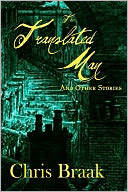
The Translated Man and Other Stories Threat Quality Press (224; 11.99 USD; softcover 2007)
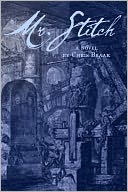
Mr. Stitch Threat Quality Press (248; 11.99 USD; softcover 2010)
Chris Braak
Chris Braaks’s duology featuring Detective-Inpector Elijah Beckett demonstrates that you can tell a book by its cover. These book jackets are dark, primitive and ugly; the novels are set in a steampunk Victorian metropolis called Trowth that is equally dark, primitive and ugly.
It was early morning and the strained watery light that flickered off the mountain of stormy architecture of Trowth did little to alleviate the cold, though it was actually one of the
warmest periods of the day — when warm air swept briefly in from the sea — and the late afternoon were the only times during Second Winter that pedestrians were common; a small, muted collection of passers-by and vendors had tentatively come out into the cold streets above St. Dunsany’s. The air was just barely
tolerable, and tasted faintly of salt and fish. Even the normally antisocial and solitary citizens of the city would take the time to wander about for a few hours, trying to catch a fleeting glimpse of the sun.
ps.52-53 (Mr. Stitch)
What we have here is a police procedural that mixes Sherlock Holmes and H.P. Lovecraft. I’m not much a fan of either (I know, how could I possibly be allowed on the BG staff, but mistakes happen). Nor do I much care for plotting littered with flaws in logic (a character can pick the lock of a room to steal papers without ever thinking they might be noticed missing, but apparently doesn’t think for a second to pick the lock of a suitcase she is forced to deliver to a train station to see if it contains anything potentially explosive, which, of course, it does) that hinges on fantastical mysteries with improbable coincidences (even if they take place in the context of an improbable reality) that seemingly have little point beyond giving the intrepid characters something to do so they can preserve civilization as they know it (though in this case, “civilization” is a questionable term).
That said, I thoroughly enjoyed this short series, mainly because of the characters. Beckett is dedicated to his career as a Coroner, an elite force with a license to kill at will heretics and the consequences of their heretical metaphysical experiments. He also suffers from the “fades,” a disease contracted by factory work as a child that results in deteriorating flesh (he wears a scarf to hide the missing half of his face) and drug addiction to control the pain. Of course, every detective needs a fearless sidekick to fight the forces of evil. Beckett has two. Valentine Vie-Gorgon, an absent-minded aristocrat dabbling as a police functionary, and Elizabeth Skinner, a blind “knocker” aetherically equipped with telekinetic abilities that serve as a sort of radar to detect unchartered passageways and conspirators in hiding.
But the most interesting character of all is the city of Trowth, a mess of overbuilt, over thought architecture that results in dangerous labyrinths that connect ghettos of unusual creatures pressed into subservience to the human overlords.
It was almost evening when Beckett emerged from the depths of the Arcadium. The sky has turned from a dull, dark, sooty gray to a duller, darker sootier gray, redeemed only by the fact that looking at it no longer caused migraines. The perpetual cloud of thick, puissant smoke, spewed out by factories that burned phlogiston and flux and coal, hung low over the stony war of parapets, crenulations, buttresses, towers and arches that composed Trowth’s skyline.
p. 7 (The Translated Man)
…
Read More Read More
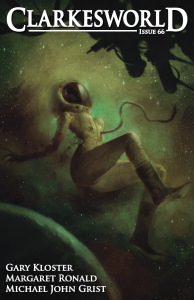 The March issue of Clarkesworld is currently online. Featured fiction: “Sunlight Society” by Margaret Ronald, “The Bells of Subsidence” by Michale John Grist and “From Their Paws, We Shall Inherit” by Gary Kloster. Non fiction by E.C. Ambrose, Jeremy L.C. Jones and Neil Clarke. The cover art is by Sergio Diaz.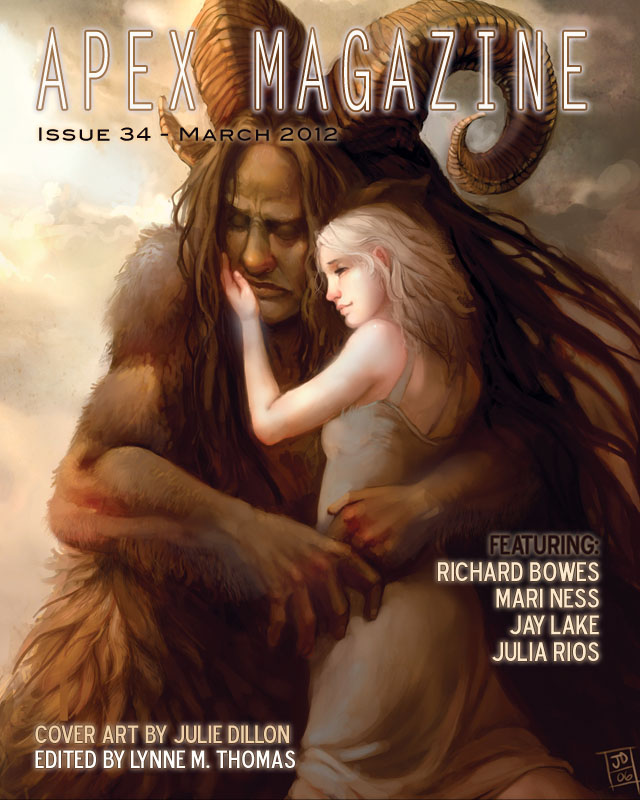
 Further details about this on-line publication can be found
  Journal of a UFO Investigator
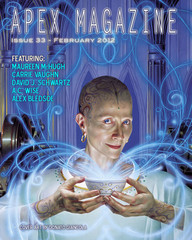 This month’s Apex Magazine features ”Bear in Contradicting Landscape” by David J. Schwarz and ”My Body, Her Canvas” by A.C. Wise; the classic reprint is “Useless Things” by Maureen McHugh, who is interviewed by Maggie Slater. Donata Giancola provides the cover art and Alex Bledsoe and editor Lynne M. Thomas penned columns round out the issue.
 So it now it seems
 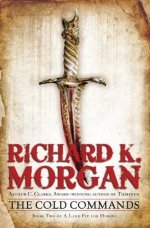 Fit for Heroes (in which the land is neither fit for heroes nor populated with behavior typically classified heroic) by Richard K. (whose middle initial is used on book jackets only on the American side of the pond for some reason) Morgan describe it as “genre busting.” That’s not just some publicist’s hyperbole. You can read the complete review over
 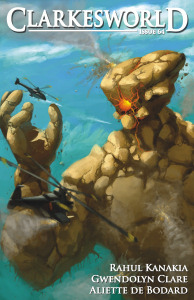 The January issue of Clarkesworld is currently
  Of potential interest to readers of this space is my