Browsed by
Author: Steven H Silver

Birthday Review: Yevgeny Zamyatin’s “The Cave”

Birthday Review: Yevgeny Zamyatin’s “The Cave”

Fantasy and Science Fiction February 1969-small Fantasy and Science Fiction February 1969 TOC-small

Cover by Russell Fitzgerald

Yevgeny Zamyatin (originally Евгений Замятин) was born in Levedyan, Russia on February 1, 1884. He was an early supporter of the Bolshevik Party, joining them before the Russian Revolution of 1917, but he grew disillusioned with their policies following the October Revolution. In 1921 he wrote the essay “I Am Afraid” and also published his major science fiction novel, We (Мы), which became the first work of fiction banned by the Goskomizdat, the Soviet censorship bureau.

The novel was first published in English in 1924 and received a Prometheus Hall of Fame Award in 1994. In 1931, Zamyatin appealed to Joseph Stalin, the General Secretary of the Communist Party and was granted permission to emigrate to Paris, where he died in poverty from an heart attack on March 10, 1937.

Zamyatin’s story “The Cave” (“Пещера) was originally published in Russian in 1922, and reprinted in English in the February 1969 issue of The Magazine of Fantasy and Science Fiction. In Russian the work was seen as focusing attention on the everyday man when they were still trying to establish the Communist State. The story was also seen as a direct challenge to the ideals of the Revolution which Zamyatin has supported only five years before.

Read More Read More

Birthday Reviews: January Index

Birthday Reviews: January Index

Cover by Ho Che Anderson Cover by Howard V. Brown

One twelfth of the way through the year, here’s a listing of the birthday reviews that appeared at Black Gate in January.

January 1, E.M. Forster: “The Machine Stops
January 2, Isaac Asimov: “Buy Jupiter
January 3, Patricia Anthony: “Lunch with Daddy
January 4, Ramsey Campbell: “No End of Fun
January 5, Tananarive Due: “Suffer the Little Children
January 6, Eric Frank Russell: “A Great Deal of Power
January 7, Hayford Peirce: “Mail Supremacy
January 8, Jack Womack: “Audience

Read More Read More

Birthday Reviews: Gene DeWeese’s “The Man in Cell 91”

Birthday Reviews: Gene DeWeese’s “The Man in Cell 91”

Time Twisters
Time Twisters, cover artist unknown

Gene DeWeese was born on January 31, 1934 and died on March 19, 2012. DeWeese wrote several television and gaming tie-in novels, including work in the Lost in Space, Ravenloft, Star Trek, and Man from U.N.C.L.E. universes as well as original YA novels.

DeWeese has collaborated with Robert Coulson and has used pseudonyms including Jean DeWeese, Thomas Stratton, and Victoria Thomas. His novel The Adventures of the Two-Minute Werewolf was adapted into a television film. He served as a technical writer on the Apollo program.

“The Man in Cell 91” was published in Time Twisters, edited by Jean Rabe and Martin H. Greenberg and released in January 2007.

The title of the story, “The Man in Cell 91” provides a certain expectation for the reader as an unnamed man, alone in a cell, is suddenly visited by dreams or visions, each one showing people in despair at the moments of their deaths. Without any agency or understanding why, the man sees people starving to death, being killed in battle, and eventually a priest committing suicide because his sexual transgressions have been discovered, and one of the priest’s victims committing suicide.

As the man comes to an understanding, DeWeese begins to reveal his identity, providing the reader with their own sense of understanding. The story isn’t quite an alternate history, nor a secret history, but does offer a look at a potential alternative to our own timeline.

Read More Read More

Birthday Reviews: Gregory Benford’s “Down the River Road”

Birthday Reviews: Gregory Benford’s “Down the River Road”

After the King-Keith-Parkinson-small After the King-Keith-Parkinson-back-small

Cover by Keith Parkinson

Gregory Benford was born on January 30, 1941. He helped start the first science fiction convention in Germany, WetzCon, in 1956 and the first convention in Texas, Southwestern Con, in 1958. He received the Nebula Award for Best Novelette in 1975 for his collaboration with Gordon Eklund, “If the Stars Are Gods.” His novel Timescape received the Nebula Award for Best Novel, the John W. Campbell Memorial, Jr. Award, the Ditmar Award, and the British SF Association Award. It also loaned its name to a publishing imprint. Benford received a Phoenix Award from the Southern Fandom Confederation in 2004 and a Forry Award from LASFS in 2016. Benford was the Guest of Honor at Aussiecon Three, the 1999 Worldcon in Melbourne, Australia.

“Down the River Road” was included in After the King: Stories in Honor of J.R.R. Tolkien, edited by Martin H. Greenberg. Originally published in January 1992, the book and all the stories in it were translated into Dutch, Italian, and French. The story has not appeared outside of the original anthology.

Gregory Benford is best known as an author of hard science fiction, so while it might be surprising to come across his “Down the River Road” in a collection of stories honoring J.R.R. Tolkien, it isn’t surprising that underneath the fantasy veneer his world seems to have scientific underpinings. John is traveling on the dangerous river, trying to find his missing father. Along the way, he takes on a variety of odd jobs, during one of which he finds himself unloading a ship with the aid of Zoms, the reanimated dead. One of the Zoms could be his father, but he can’t be sure.

Read More Read More

Birthday Reviews: Monte Cook’s “Born in Secrets”

Birthday Reviews: Monte Cook’s “Born in Secrets”

Cover by Cliff Nielsen

Monte Cook was born on January 29, 1968. Cook has mostly focused his attention on the gaming sector, working for Iron Crown Enterprises on Rolemaster and Champions before moving to TSR, where he designed the game Dark•Matter.

After TSR was purchased by Wizards of the Coast, he was put in charge of the 3rd edition of Dungeons and Dragons. He left Wizards of the Coast and eventually started Malhavoc Press and published game supplements. Cook eventually founded another gaming company, Monte Cook Games.

“Born in Secrets” was published in the January 2000 issue of Amazing Stories, edited by Kim Mohan. The story is set in the world of Dark•Matter and the magazine had an essay about the game published alongside the story. Cook would publish a novel, Of Aged Angels, set in the same world the next year.

“Born in Secrets” tells the story of Jessie Campbell and Lewis McAndrews, two hydrogeologists working on a lengthy assignment in South Dakota when they stumble across an old sod house in the desert. Taking a break from their more pedestrian duties, and at Jessie’s urging, they explore the building and find some rusted tools and an old engraving metal platter.

Intrigued by their discovery, Lewis uses the internet to try to figure out what the German engraving means. Although he isn’t able to translate the entire thing, he does come across a reference to “Ministers of the Mind” and tries to learn what he can, sending e-mails to various websites. The few responses he receives are anything but enlightening and he shares them with Jessie before they abandon the mystery to return to their work.

Eventually, they are contacted by people who are tied to the Minsters of the Mind and learn that most of their wild speculations were true. They are now hosts to a second consciousness, which the Ministers believe is the next step in evolution.

Read More Read More

Birthday Reviews: Parke Godwin’s “The Night You Could Hear Forever”

Birthday Reviews: Parke Godwin’s “The Night You Could Hear Forever”

Cover by Kent Bash
Cover by Kent Bash

Parke Godwin was born on January 28, 1929 and died on June 19, 2013. He received the World Fantasy Award in 1982 for his novella The Fire When It Comes. Godwin published the Arthurian novels Firelord, Beloved Exile, and The Last Rainbow as well as the Robin Hood novels Sherwood and Robin and the King. His Snake Oil series was a religious satire. He co-wrote the novels The Masters of Solitude and Wintermind with Marvin Kaye.

“The Night You Could Hear Forever” has only appeared in its original publication, the September/October 1992 issue of Pulphouse: A Fiction Magazine, edited by Dean Wesley Smith.

“The Night You Could Hear Forever” isn’t really a science fiction story, except in the way it describes the way people use technology. Its viewpoint character is located in Truckee, California and when he can’t sleep at night, he signs onto his ham radio equipment.

On the night Godwin describes, the atmospheric conditions are perfect and he is able to connect with other ham operators located in New Jersey, Utah, and Mississippi, each of whom are known to each other on the radio, but not in person, and only by the names of their states. In many ways, their relationship mirrors many relationships people now have online. Although the characters all have very different political views and backgrounds, they are able to remain friends, even as they disagree.

Unlike the online medium, using their voices allows them to get additional context and humanizes them. As they discuss the problems with the state of the country, they are joined by a new voice, from Maryland, who has not joined their nightly rap sessions, although Utah thinks the voice is familiar. Today’s world is mirrored in this story, although the technology has changed tremendously. The internet, however, causes anonymity without the sound of voices and inflection, so the friendship Godwin’s characters have managed to build despite their differences seems rarer in the modern era.

Read More Read More

Birthday Reviews: K.D. Wentworth’s “Her Fair and Unpolluted Flesh”

Birthday Reviews: K.D. Wentworth’s “Her Fair and Unpolluted Flesh”

Treachery and Treason-small Treachery and Treason-back-small

K.D. (Kathy Diane) Wentworth was born on January 27, 1951 and died on April 18, 2012. Wentworth was nominated for the Nebula Award four times, for the short stories “Burning Bright,” “Tall One,” and “Born Again” and for the novelette “Kaleidoscope.” Wentworth published two novels in the Heyoka Blackeagle series and two novels in the House of Moons Chronicles. She also co-wrote two of the novels in the Jao Empire series in collaboration with Eric Flint and two stand-alone novels.

“Her Fair and Unpolluted Flesh” was published in Treachery and Treason, edited by Laura Anne Gilman for Roc in 2000. It has never been reprinted.

K.D. Wentworth creates a religion which based on the holy scripture of the play Hamlet in “Her Fair and Unpolluted Flesh.” Based on what Father Benedicto and Father Frederick say, the religion is extremely misogynistic, claiming that women are soulless and have no reason to learn to read or do anything useful.

Set in a nunnery of ophelias, the women are trained to follow in her tragic footsteps to honor the glory that was the character of Hamlet. One of the sisters is to be selected to participate in a ritualistic drowning and is placed into the care of the young, and unsure Father Frederick.

Read More Read More

Birthday Reviews: Philip José Farmer’s “The Rise Gotten”

Birthday Reviews: Philip José Farmer’s “The Rise Gotten”

Cover by Keith Howell and Charles Berlin

Philip José Farmer was born on January 26, 1918 (Happy Centennial, Phil!) and died on February 25, 2009. In 1953, he received one of the inaugural Hugo Awards for Best New Author or Artist (a forerunner to the John W. Campbell, Jr. Award). He would win the Hugo again in 1968 for his novella “Riders of the Purple Wage” and in 1972 for his novel To Your Scattered Bodies Go. Farmer was the Guest of Honor at Baycon, the 1968 Worldcon in Oakland.

His lifetime achievement awards include the World Fantasy Award and the SFWA Grand Master Award, both awarded in 2001. In 2003, he received the Forry Award and the First Fandom Hall of Fame Award. Farmer was known for expanding the science fiction field to include frank portrayals of sex with his novel The Lovers (Ballantine, 1961, expanded from the 1952 novella of the same title).

His story “The Rise Gotten” was written for an anthology Robert Bloch planned, but never published. The story saws its first publication in 2006 in the collection Pearls from Peoria, which collected previously published and unpublished works by Farmer.

“The Rise Gotten” is the story of a long-married couple who have fallen out of love, and merely survive in each other’s presence. Roger Baird’s impotence is a major sticking point for his wife, Rey, who either ignores him or denigrates him. Roger is just as happy ignoring his wife, whose alcoholic stupors make her less attractive to him even if he weren’t suffering impotence.

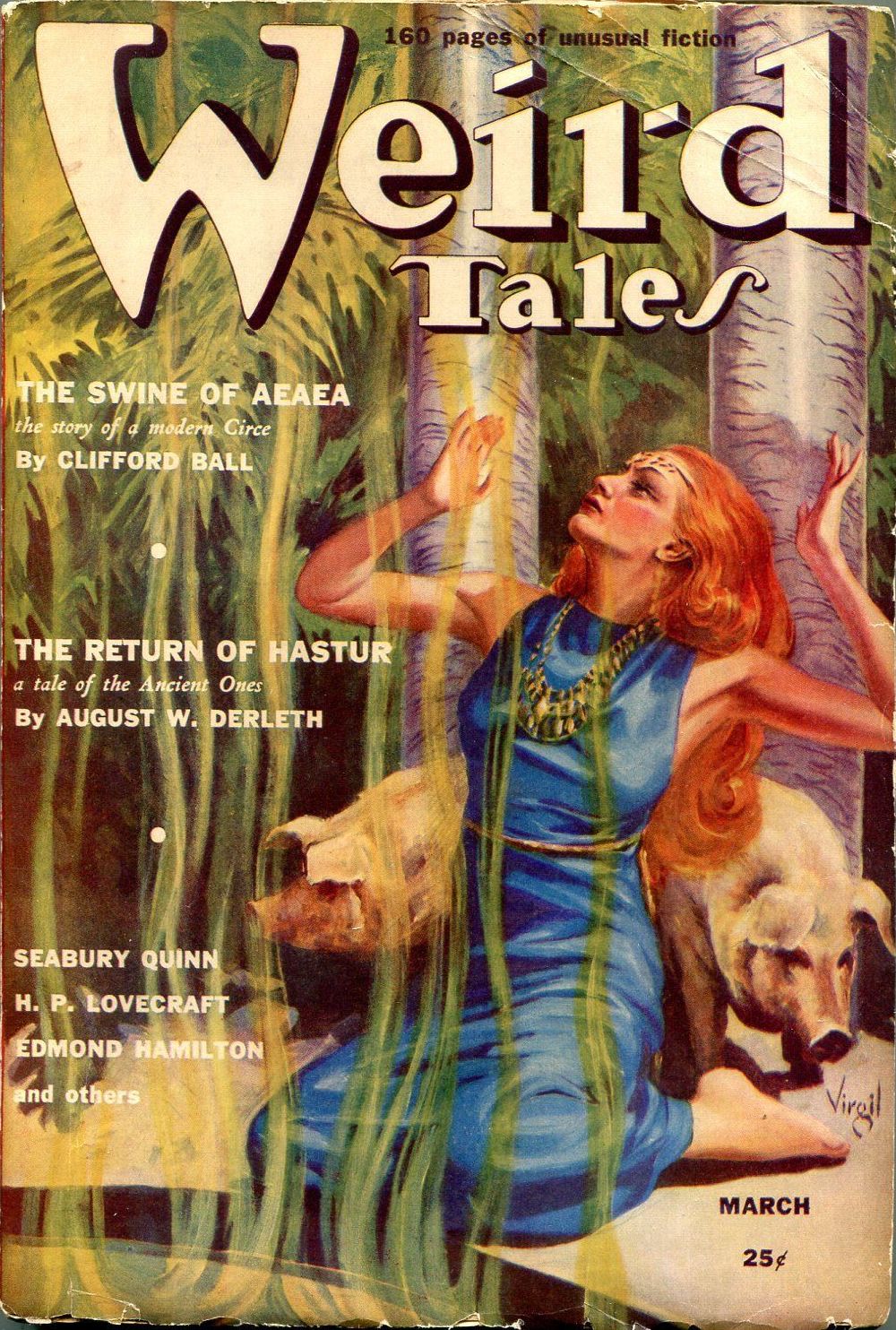
Their relationship, while sad, is completely mundane. Roger retreats to his study to get away from his wife and her sister’s drinking binge and turns his attention to the newspapers, which he reads and finds just as much horror as in the magazines, like Weird Tales, which form his pleasure reading. After his sister-in-law leaves and his wife suggests a cure for his impotence that worked for her brother-in-law, the story takes a decidedly dark turn. While part of the power of Farmer’s story comes from its ending, most of it comes from the sudden switch from a very mundane tale to Roger’s reaction to his years of humiliation by his wife.

Read More Read More

Birthday Reviews: Greg van Eekhout’s “Native Aliens”

Birthday Reviews: Greg van Eekhout’s “Native Aliens”

Cover by Ho Che Anderson

Greg van Eekhout was born on January 25. His first story appeared in the anthology Starlight 3 and his first novel, Norse Code, in 2009. Van Eekhout was nominated for a Nebula Award for Best Short Story in 2005 for “In the Late December,” and received a Golden Duck nomination in 2011 for Kid Vs. Squid. In 2012, his novel The Boy at the End of the World was nominated for the Andre Norton Award.

“Native Aliens” was originally published in 2004 in the anthology So Long Been Dreaming: Postcolonial Science Fiction and Fantasy, edited by Nalo Hopkinson and Uppinder Mehan. Van Eekhout included it in his collection Show and Tell and Other Stories two years later and it was reprinted again in 2013 in Aliens: Recent Encounters, edited by Alex Daily MacFarlane.

“Native Aliens” tells two stories in parallel. One focuses on a Dutch colonial family living in Indonesia in the 1940s. Although the family has been there for generations and has intermarried with the Indonesians, they still consider themselves Dutch even though Indonesia is the only home they’ve ever known. As a result the father is forced to run a gauntlet after the Indonesian Revolution in the second half of the 1940s.

The other story looks at a group of humans who have colonized the world of Breva and who are about to be sent back to Earth. While the Dutch family looks like Indonesians and only know life there, the humans on Breva have been genetically modified to resemble the Brevans, making their return to their native world that much more problematic.

While van Eekhout explores the Brevan-Terran plans to repatriate themselves to the planet of the ancestors, he simultaneously shows us the Dutch family’s attempts to assimilate into Dutch, and later American, culture. Van Eekhout offers an intriguing view of colonization and its effects by focusing on those who are native to the land but still identify with, or are identified as, the colonizing power, without having any experience with the land from which their ancestors came.

Perhaps most poignant is the tale of the son of the character who experienced upheaval in Indonesia and the Netherlands, whose attitude directly leads to the issue facing the Brevan-Terrans centuries later. Fourteen years after its initial publication, when the US government is discussing, or refusing to discuss, the plight of the “Dreamers,” the van Eekhout’s story seems more pertinent than ever.

Read More Read More

Birthday Reviews: C.L. Moore’s “Lost Paradise”

Birthday Reviews: C.L. Moore’s “Lost Paradise”

Cover by Margaret Brundage

C.L. (Catherine Lucille) Moore was born on January 24, 1911 and died on April 4, 1987. From 1940 until his death in 1958, she was married to science fiction author Henry Kuttner. The two had their own careers and also collaborated together, although they claimed that they each worked on all of the other’s stories, sitting down and continuing whatever was in the typewriter at the time. Moore (or Moore/Kuttner) also used the pseudonyms Lawrence O’Donnell, C.H. Liddell, and Lewis Padgett.

In 1956, their collaboration “Home There’s No Returning” was nominated for the Hugo for Best Novelette. She received the First Fandom Hall of Fame Award in 1972, the Forry Award in 1973, and the World Fantasy Award for Lifetime Achievement in 1981. Moore was the Guest of Honor at Denvention Two, the 1981 Worldcon in Denver. Posthumously, she was inducted into the Science Fiction Hall of Fame in 1998 and, along with Kuttner, was named the recipient of the Cordwainer Smith Rediscovery Award in 2004.

“Lost Paradise” is one of her stories featuring her space-faring rogue Northwest Smith and was originally published in the July 1936 issue of Weird Tales, edited by Farnsworth Wright. Moore included it in various collections, including Northwest of Earth, Shambleau, and Scarlet Dream. It has seen additional reprintings and has been translated into French and Italian.

“Lost Paradise” is essentially a bar story with a twist. Northwest Smith and his Venusian friend Yarol are enjoying a meal in New York when Yarol sees a strange man walking along the street below them. When the man is mugged, Yarol manages to retrieve the man’s package and, having recognized him as a member of a strange, secluded race, the Seles, who live in central Asia but don’t intermingle with any other peoples, he tells him that the only reward he desires is to know the great secret of the Seles.

Read More Read More