Browsed by
Author: Steven H Silver

Birthday Reviews: Daniel F. Galouye’s “Sitting Duck”

Birthday Reviews: Daniel F. Galouye’s “Sitting Duck”

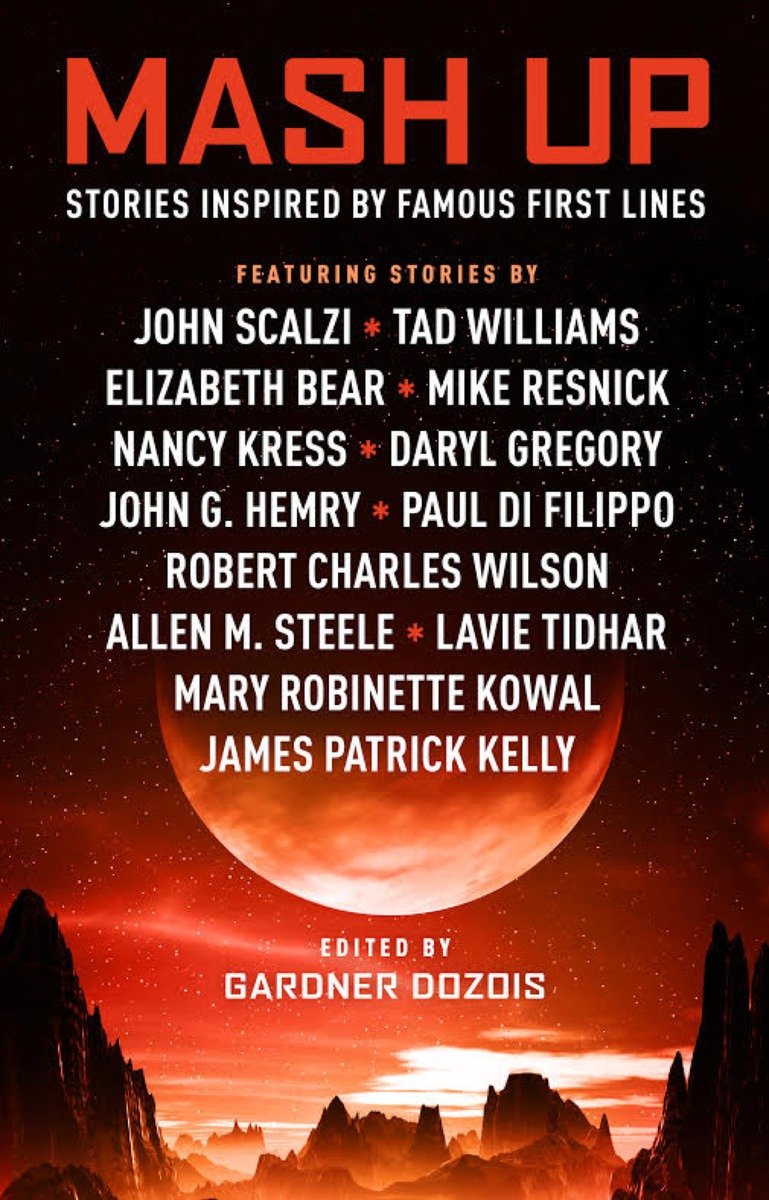
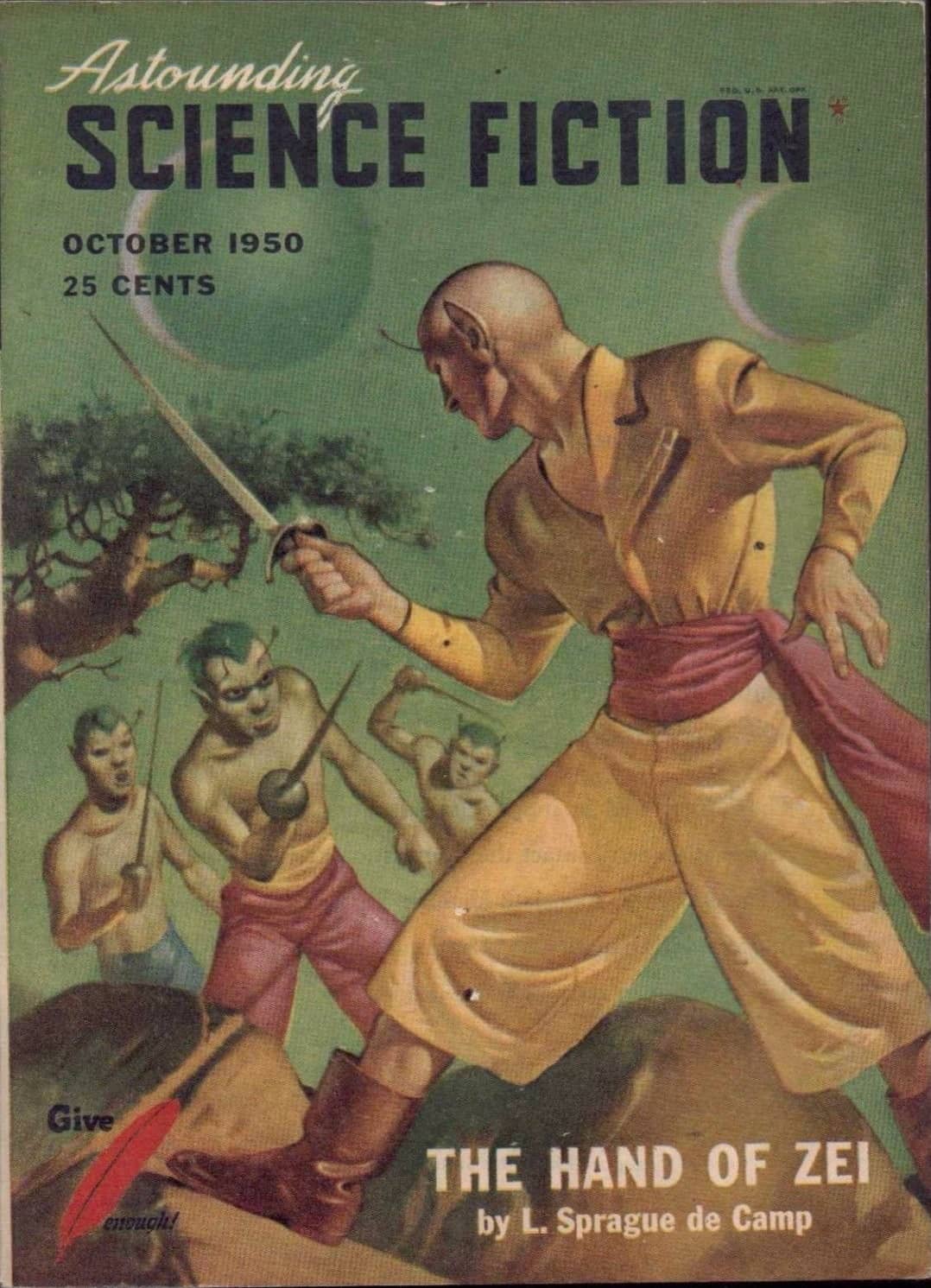
Cover by John Pederson, Jr.

Daniel F. Galouye was born on February 11, 1920 and died on September 7, 1976. His debut novel Dark Universe was nominated for the Hugo Award in 1962. In 2007, Galouye was recognized with the Cordwainer Smith Rediscovery Award.

Galouye’s stories have been collected in The Last Leap and Other Stories of the Super-Mind and Project Barrier. At least five collections of his works have been published in German translation over the years. Galouye published a total of five novels during his career, and numerous short stories beginning in 1952 and ending in 1970. His novel Simulacron-3 was adapted into the film The Thirteenth Floor in 1999. He also published under the pseudonym Louis G. Daniels.

“Sitting Duck” was published in the July 1959 issue of If, edited by Horace L. Gold. It was reprinted in the 1965 anthology The 6 Fingers of Time and Other Stories and a second time in Things from Outer Space, edited by Hank Davis, in 2016.

Ray Kirkland is a reporter in a world where something strange is happening, although nobody knows what it is. It impacts Kirkland directly when his wife suggests they take a look at a house that has suddenly appeared on a plot of land they were considering buying. Something about the house (4 kitchen, , 1½ bedrooms) seems off to him, but when he tries to investigate his editor suggests it is just a marketing ploy and tries to turn his attention another way.

Coincident to all this, Kirkland’s father-in-law is preparing for duck hunting season by building decoys and setting up duck blinds. The juxtaposition of the two threads allows the reader to see that the strange occurrences Kirkland is investigating are simply decoys created by an alien race.

Read More Read More

Birthday Reviews: John Shirley’s “Occurrence at Owl Street Ridge”

Birthday Reviews: John Shirley’s “Occurrence at Owl Street Ridge”

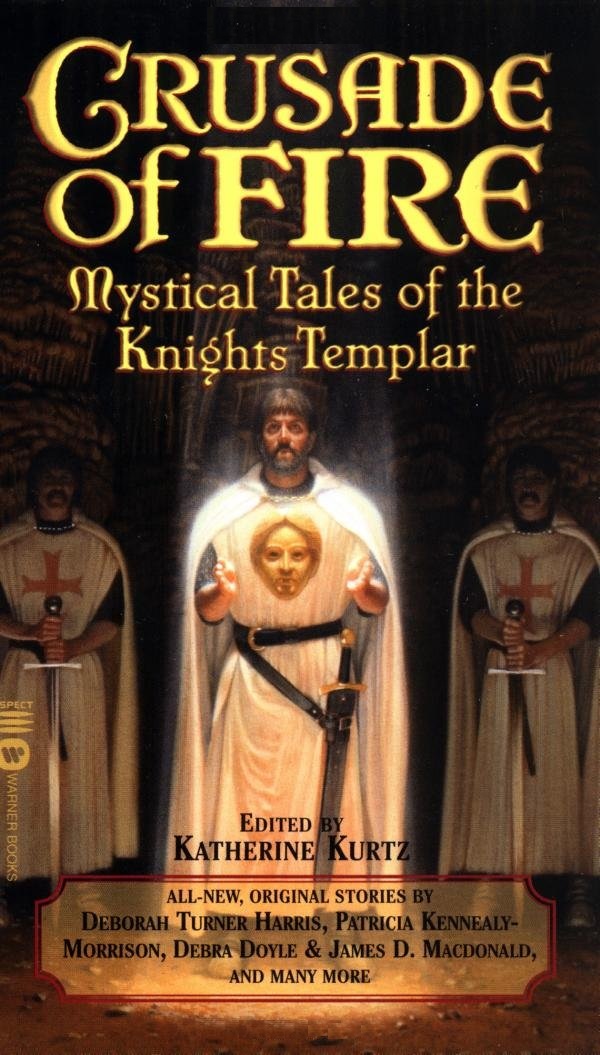
Cover by Lisa Snellings

John Shirley was born on February 10, 1953. Shirley’s novels include his debut, Transmaniacon, inspired by the Blue Öyster Cult song “Transmaniacon MC,” the Eclipse trilogy, and Crawlers. He has written men’s adventure novels under the pseudonyms D.B. Drumm and John Cutter, as well as several film and comic tie-in novels.

Shirley won the Bram Stoker Award and the International Horror Guide Award for his collection Black Butterflies: A Flock on the Dark Side in 1999. That same year, he was the Author Guest of Honor at the World Horror Convention in Altanta. In addition to his career as a writer, Shirley has performed with the band The Screamin’ Geezers and has written lyrics for Blue Öyster Cult and an episode of Star Trek: Deep Space Nine.

Although John Shirley’s “Occurrence at Owl Street Ridge” was originally written for Strange Attraction, an anthology of stories based on the Dark Carnival sculptures of artist Lisa Snellings (itself inspired by the Dark Carnival writings of Ray Bradbury), the story first saw print in the program book for the 1999 World Horror Convention, held in Atlanta with Snellings as the Artist Guest of Honor and Shirley as the Author Guest of Honor. Shirley also included the story in his 2001 collection Darkness Divided.

The title “Occurrence at Owl Street Ridge” is, of course, a reference to Ambrose Bierce’s “An Occurrence at Owl Street Bridge,” and Bierce plays a minor role in the story, which is also modeled after Bierce’s tale of the attempted execution and escape of Peyton Farquhar. In this case, Shirley’s main character is Dana, a disaffected woman who has lost her job as an executive assistant because she was caught using her work computer for her hobby as an artist one time too many.

Returning home to share the news with her husband, Reuben, who is only working part time at the brewery, she comes across her four teenage kids, each with their own issues ranging from asthma to potential drug use to weight issues. Rather than getting the support she needs from her homelife, she only sees how miserable her entire family is.

Read More Read More

Birthday Reviews: Laura Frankos’s “A Late Symmer Night’s Battle”

Birthday Reviews: Laura Frankos’s “A Late Symmer Night’s Battle”

Turn the Other Chick-small Turn the Other Chick-back-small

Cover by Mitch Foust

Laura Frankos was born on February 9, 1960. She has written the historical mystery novel St. Oswald’s Niche, and The Broadway Musical Quiz Book. Frankos has also written several short stories. She is married to author Harry Turtledove and is the sister to author Steven Frankos.

“A Late Symmer Night’s Battle” appeared in Esther Friesner’s Turn the Other Chick, part of her long-running Chicks in Chainmail series. It has not been reprinted.

As the title indicates, the story was inspired by the works of William Shakespeare. Frankos’s fairies are battlemaidens, currently living in a period of peace following their epic defeat of the reremice. They are working on their armor, training, and engaging in more amorous pursuits when their lands are unexpectedly attacked by bands of kobolds.

Read More Read More

Birthday Reviews: Mary Robinette Kowal’s “Just Right”

Birthday Reviews: Mary Robinette Kowal’s “Just Right”

Cover by Sandro Costello

Mary Robinette Kowal was born on February 8, 1969. Originally a puppeteer, she began publishing fiction in 2004, with her first novel, Shades of Milk and Honey, arriving in 2010.

In 2008, she won the John W. Campbell Award for Best New Writers and has gone on to win the Hugo Award three times, each in a different category. In 2011, she won the Hugo for Best Short Story for “For Want of a Nail.” She won for Best Related work for season seven of Writing Excuses, a podcast she produces in collaboration with Brandon Sanderson, Dan Wells, Howard Tayler, and Jordan Sanderson, and in 2014 for her novelette “The Lady Astronaut of Mars.” She has served as both Secretary and Vice President of the Science Fiction and Fantasy Writers of America and continues to volunteer for the organization in various roles.

“Just Right” was Mary Robinette Kowal’s first sale, and it appeared in The First Line in Summer 2004.

On the surface it tells the story of a woman who is dealing with the strange eccentricities of her six year old son. Celia’s husband, Lou, usually handles the morning rituals because Celia leaves each day to teach school. With the start of Summer vacation, however, she has suddenly thrown into the morning domestic routine and learns that her son, Mason, likes to do things in very specific, seemingly childish ways. When Celia stop playing along, Mason throws a very atypical temper tantrum.

While “Just Right” seems like a slice of life tale, it really is a very effective short horror story. Celia doesn’t understand what is happening because she is missing a very basic piece of information.

The effectiveness of the story comes from the banality of Celia situation. Anyone with children has experienced the seemingly random meltdowns when a child doesn’t get its way and learns how to handle the child. In this case, Celia is learning that the typical methods of raising her son aren’t always effective, although she is unaware of the cause.

Read More Read More

Birthday Reviews: Karen Joy Fowler’s “Always”

Birthday Reviews: Karen Joy Fowler’s “Always”

Cover by NASA
Cover by NASA

Karen Joy Fowler was born on February 7, 1950. She began her science fiction career with the stories “Praxis” and “Recalling Cinderella,” both published in March, 1985. Her first novel, Sarah Canary, appeared in 1991. In addition to writing science fiction, Fowler wrote The Jane Austen Book Club, which was turned into a film.

In 1991 Fowler, along with Pat Murphy, founded the James Tiptree, Jr. Award to recognize speculative fiction that expands or explores the understanding of gender.

She has won the Nebula Award for Best Short Story in 2004 for “What I Didn’t See” and in 2008 for “Always.” Fowler won the World Fantasy Award for Best Collection in 1998 for Black Glass and again in 2010 for What I Didn’t See, and Other Stories. She won the 2014 PEN/Faulkner Award for We Are Completely Beside Ourselves, which was also shortlisted for the Man Booker Prize.

“Always” was originally published in the April-May 2007 issue of Asimov’s Science Fiction, edited by Sheila Williams. It was reprinted the next year in Year’s Best anthologies edited by Rich Horton and David G. Hartwell & Kathryn Cramer. Ellen Datlow included it in Nebula Awards Showcase 2009 and Fowler reprinted it in her collection What We Didn’t See, and Other Stories.

Set in 1938, “Always” is a sympathetic view of a cult colony on the California coast called Always. The cult leader, Brother Porter, has promised his followers eternal life. Fowler never fully addresses whether Brother Porter has really discovered the secret of immortality, or if he’s just a leader who’s found a way to fleece people and get sex. More important to Fowler appears to be an attempt to depict someone who has found faith in her beliefs, a faith which endures beyond the bounds of evidence.

Even as Fowler’s protagonist accepts the idea of eternal life, her depictions of the other inhabitants of Always shows the shortcomings of living forever. Winnifred is always complaining about her ailments, John is constantly nostalgic for his old life, Harry is always happy, and the protagonist, who entered Always as a young woman, is supplanted by Kitty, younger and prettier than she is.

Read More Read More

Birthday Reviews: Eric Flint’s “Portraits”

Birthday Reviews: Eric Flint’s “Portraits”

Cover by Tom Kidd (after Pieter Paul Rubens)

Eric Flint was born on February 6, 1947. His first story, “Entropy and the Strangler” appeared in L. Ron Hubbard’s Writers of the Future Volume IX. He has collaborated with numerous authors, both established and new over the course of his career, including David Drake, Mercedes Lackey, S.M. Stirling, Ryk E. Spoor, Dave Freer, Gorg Huff, Paula Goodlett, Charles E. Gannon, Mike Resnick, etc. The list goes on and on.

His time travel novel 1632 has not only led to sequels from Flint, but to a thriving fanbase which he encourages to write their own stories and articles, many of which have been workshopped online and published in online zines and hardcopy books. These include not only short stories, but also novels.

Flint has worked to bring back into print the works of several classic science fiction authors, including Murray Leinster, James Schmitz, Keith Laumer, Tom Godwin, Christopher Anvil, and A.E. van Vogt. With Jim Baen, he established the Baen Free Library and he also served as editor of Baen’s Universe. He has edited various anthologies, including The World Turned Upside Down and When Diplomacy Fails.

“Portraits” first appeared in The Grantville Gazette, an online magazine tied to Flint’s 1632 series, which allows various authors to discuss the setting and try their hand at fiction. When Baen decided to publish hard copies of some of the articles and stories, “Portraits” was reprinted as the first story in Grantville Gazette Volume I (2004) and provided the volume with its cover art. It was subsequently reprinted in Flint’s collection Worlds.

“Portraits” tells the story of Anne Jefferson, an American nurse posing for the Flemish artist Pieter Paul Rubens. The story assumes knowledge of the 1632 situation and characters Flint introduced three years earlier. This is a story which relies on its published context to be fully appreciated.

In its few pages, however, Flint is able to demonstrate some of the differences between Anne Jefferson’s outlook as a twentieth century American trapped in 1635 and a native artist from that period. The scenes set between Jefferson and Rubens, or Rubens and his wife, can stand well on their own and hint at the larger world.

Read More Read More

Birthday Reviews: Joseph H. Delaney’s “Survival Course”

Birthday Reviews: Joseph H. Delaney’s “Survival Course”

Cover by Ed Soyka
Cover by Ed Soyka

Joseph H. Delaney was born on February 5, 1932 and died on December 21, 1999. He worked as an attorney before he began publishing in 1982 with the story “Brainchild.” Delaney was a nominee for the John W. Campbell Award for Best New Writer in 1983 and 1984.

He was nominated for the Hugo Award for Best Novella three years in a row, beginning in 1983 for “Brainchild,” “In the Face of My Enemy” the following year, and finally for “Valentina,” written with Marc Stiegler, in 1985.

“Survival Course” was purchased for Analog by Stanley Schmidt and appeared in the June 1989 issue. It has not been republished.

“Survival Course” is a pretty typical time safari story, reminiscent of L. Sprague de Camp’s A Gun for Dinosaur and subsequent stories. What sets Delaney’s version apart is that his characters, Clint Mineau and Cletus Running Wolf, have been sent back to the Tertiary period to confirm the cause of the destruction of dinosaurs. Their mission was spurred on by a glancing blow by an asteroid which wiped out millions of people.

Delaney spends quite a bit of the story providing a travelogue of the period, allowing Clint and Cletus to see the local megafauna while they worry that their timing is off. There aren’t as many dinosaurs then they would have expected to find.

Unfortunately, this section runs a little long. Although it sets the scene, it also has a feel of Delaney wanting to share his homework with the reader, catching them up on the most recent (and now thirty years out of date) understanding of dinosaurs. When he finally gets around to the cause of saurian extinction, it almost feels like an afterthought, coming a little too late and a little too slight, and it feels like it lacks originality.

Read More Read More

Birthday Reviews: Neal Asher’s “Owner Space”

Birthday Reviews: Neal Asher’s “Owner Space”

Galactic Empires Dozois-back-small Galactic Empires Dozois Galactic Empires Dozois-flap-small

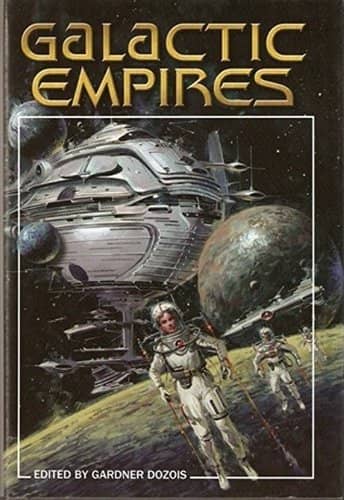
Cover by Vincent di Fate

Neal Asher was born on February 4, 1961. His first published story was “Another England” in 1989. He began his long-running Polity series in 2001 with the appearance of the novel Gridlinked. His 2006 novel, Cowl was a finalist for the Philip K. Dick Award.

“Owner Space” was published in 2008 in Gardner Dozois’ anthology Galactic Empires. The story is the fourth Asher wrote about the Owner, following “Proctors,” “The Owner,” and “Tiger Tiger.” Three years later, he would publish the Owner trilogy, beginning with The Departure, in which he explored the Owner’s origins. For the purposes of “Owner Space,” however, the details of who the Owner is and how he got to where he is are unimportant, making him something of a deus ex machina in the story.

Neal Asher introduces a complex world in “Owner Space,” offering readers three separate groups to follow. He opens the story with refugees fleeing about the spaceship Breznev and quickly introduces the crew of the spaceship Lenin, chasing after them. With these two assemblages, Asher provides the context of an doctrinaire culture which tries to control all aspects of its people.

Read More Read More

Birthday Reviews: Alex Bledsoe’s “Shall We Gather”

Birthday Reviews: Alex Bledsoe’s “Shall We Gather”

Cover by Jonathan Bartlett

Alex Bledsoe was born on February 3, 1963. His story “The Big Finish” appeared in the June 1998 issue of Crossroads and his first novel, The Sword-Edged Blonde, which kicked off the Eddie LaCrosse series, was published in 2007. To date, the series includes five novels and a short story. He co-wrote the novel Sword Sisters with Tara Cardinal.

“Shall We Gather” was purchased by Paul Stevens for Tor.com, appearing on May 14, 2013. At the same time, it was released as an e-chapbook by Tor.com, and would later be included in the e-anthology The Stories: Five Years of Original Fiction. It is part of his Tufa series, which began with the novel The Hum and the Shiver and continued through five additional novels, with The Fairies of Sadieville scheduled for an April release.

“Shall We Gather” is set in eastern Tennessee in Bledsoe’s mythical Cloud County, where a fantastic race, the Tufa, have lived since before the coming of the Native Americans. Akin to Celtic fairies, the Tufa do not permit any churches to be built in the county, where most inhabitants have at least some Tufa blood.

When Old Man Foyt, one of the few humans who lives in Cloud County, is dying, he requests that Methodist minister Craig Chess attend to him to help him pass to the other side. After checking with his girlfriend, a Tufa, to ensure that his presence won’t offend the Tufa, Chess travels to help ease Foyt. Before he can enter the house, however, he is approached by Mandalay Harris, a powerful Tufa, who wants him to find out from Foyt whether the Tufa will face the same God as Christians upon their death. She believes that since Foyt has lived his entire life in Cloud County, something of the Tufa has infiltrated him and he might be able to share the answer with Chess at the moment of his death.

Despite Chess’s trepidation about entering Cloud County to perform in his capacity as a minister, all of the interactions between him and the Tufa or humans are completely amicable. The way Harris phrases her question for Foyt is interesting and seems Christiancentric rather than assuming a central place of her own race in her worldview.

Read More Read More

Birthday Review: Selina Rosen’s “Food Quart”

Birthday Review: Selina Rosen’s “Food Quart”

Cover by Clyde Caldwell

Selina Rosen was born on Groundhog’s Day in 1960. Her first story, “Closet Enlightenment” was published in Marion Zimmer Bradley’s Fantasy Magazine in the Summer 1989 issue. She founded Yard Dog Press in 1995. Through Yard Dog, she published the Bubba series of anthologies as well as novels written by a variety of beginning and mid-list authors. Rosen published her first novels in 1999 through Meisha Merlin. In 2011 Rosen received the Phoenix Award for Lifetime Achievement for the work she did at Yard Dog Press and for supporting and encouraging up and coming authors.

“Food Quart” was purchased by Esther Friesner for Fangs for the Mammaries, a 2010 anthology of humorous vampire stories set in suburbia. It has not been reprinted.

Mark has been working as a nighttime security guard at a suburban mall for three years when he’s called into his boss’s office over an incident the security cameras caught. A body had been found at the mall and while reviewing the evidence, Mark’s boss, Walt, and a local police officer began wondering why Mark didn’t appear in any of the security footage.

Having lived a long time, Rosen’s vampire is unconcerned being discovered. Rather than wait for his interrogators to come to their own conclusions about his nature, Mark admits it. Rosen’s story explores the response the three have to the revelation, from complete disbelief to acceptance to Mark’s plan to quickly leave the area and set up someone else, even as he comes to realize that he had been working at the mall longer than he had stayed in one place since becoming a vampire.

Rosen’s take on vampires is also quite mundane and she looks at what might be important to an immortal being and how they would view the world and protect their own existence. Mark is a long way from the vampires of Bram Stoker or F.W. Murnau or even Stephanie Meyer, offering instead the worldview of a working class version of Chelsea Quinn Yarbro’s Saint-Germain. A final encounter between Mark and Walt provides an unexpected ending for Mark as he prepares to leave for newer pastures.

Read More Read More