Dark Muse News: Unearthing Black Gate, and the Cave of Wonders – Interviewing John O’Neill
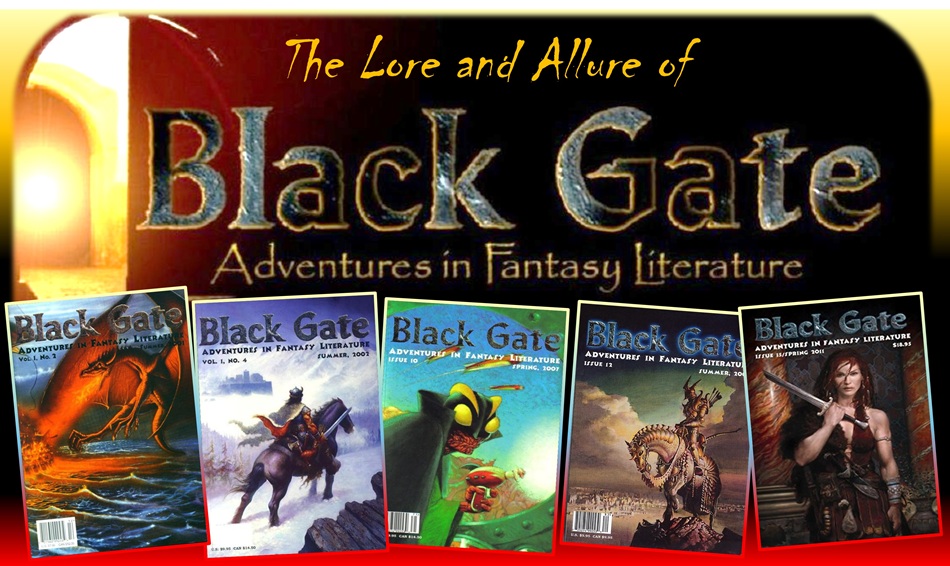
Learn the lore and allure of Black Gate!
Building on our June 2026 coverage of The Legend of Top-Shelf Books Open Mic, the near-mythical, yet true, confluence of many Black Gate contributors and authors, this Dark Muse News post corners Chief Editor John O’Neill to detail the history of the magazine. It’s over 25 years old!
I learned about Black Gate magazine in 2010 at the World Fantasy Convention, when Howard Andrew Jones espoused about it on a panel. I immediately ordered Issue #15, and then the print run ended! Eh gad. I was late for the party again! (Context in The Legend of Top-Shelf Books post).
What I adore about Black Gate is its community of contributors and readers. It attracts people (“Blackgaters”) who love fantasy literature and helping others enjoy it. If you are like me, you did not join back in 2000, and the magazine, in all its forms, deserves some explanation.
A condensed history of Black Gate magazine.
- 2000: Publisher and Editor John O’Neill launched Black Gate’s website in August, ahead of the print release at the World Fantasy Convention in Corpus Christi in October.
- 2008: Howard Andrew Jones spearheaded the Black Gate: Adventures in Fantasy Literature blog to create a premier destination for heroic fantasy on the internet.
- 2011: The 15th and final print issue was released, and the blog transformed to post free, original pieces of short fiction every Sunday alongside non-fiction essays.
- 2016: Black Gate crossed 2 million page views per month and won both an Alfie Award from George R.R. Martin and a prestigious World Fantasy Award.
- 2026: You are here!
Learn the secrets of the grimoire that you are reading now.
Become part of the lore. Record your Black Gate memories in the comments!

Thanks for answering our questions, John. Why the name “Black Gate”?
I love this question, because it delves right into the nitty-gritty of BG’s history.
Black Gate came out of the dot.com boom of the mid-nineties. I’d invested in a company called Cyberus – a play on Cerberus, the 3-headed dog that guarded the gate to the underworld – that grew to become the largest ISP in Ottawa, Canada. During the heady days of the 90s, we dreamed of leveraging that success into other ventures, like an online gaming company. My friend Wayne MacLaurin, CEO of Cyberus, registered blackgate.com as a possible subsidiary of Cyberus, keeping that underworld motif alive.
Fast-forward a few years, and I’m researching prospective names for my new fantasy magazine. Every URL I came up with had been nabbed by that point. But I was surprised that one of my favorites was held by none other than Wayne MacLaurin. With one quick email, Wayne and I partnered to launch blackgate.com. Once we had the name, the magazine’s identity came together quickly.
What were your motivations? The initial editorials (BG #1 and #2) show a passion for keeping the fantasy magazine form alive.
I thought of Black Gate primarily as an online business in those days. By the late 90s, I’d been deeply involved in a number of internet startups, and had helped Dell Magazines and others launch the first websites for Asimov’s SF, Analog, The Magazine of Fantasy & Science Fiction, and many others. Demand for online content was exploding.
In 1995 I created an online science fiction hub called SF Site, using Cyberus equipment and expertise. It grew to over a hundred thousand monthly readers with virtually zero marketing, and we hosted F&SF and other magazines for decades. Based on that success, I thought there was a golden opportunity to launch a print magazine with a cutting-edge digital presence.
In those days, magazines didn’t even sell subscriptions online. I was convinced we could quickly establish a sizable online presence, and show the world how to use the internet to rapidly grow a reader base and launch a digital brand. I didn’t want us to repeat ourselves with another SF property, so we chose fantasy.
I picked a genre that the market was clearly clamoring for – adventure fantasy – and leveraged much of the talent we’d already attracted with SF Site. We launched the website on August 30, 2000, and our first issue went to press a few weeks later, just in time for the World Fantasy Convention in October.
Somehow you got a crew of a dozen people to launch the magazine. How did you enlist them?
That was easy. At that point SF Site had over 30 regular reviewers and staff, and I invited the most talented among that crew to contribute – including Rich Horton, Victoria Strauss, Don Bassingthwaite, Marc Goldstein, David Soyka, Charlene L. Brusso, Lisa DuMond, Paul J. McAuley, and Todd Ruthman.
The big difference, of course, was that SF Site was a fan site, whereas Black Gate was a professional publication – meaning we paid for content. It was not a hardship to get most of the team to join.
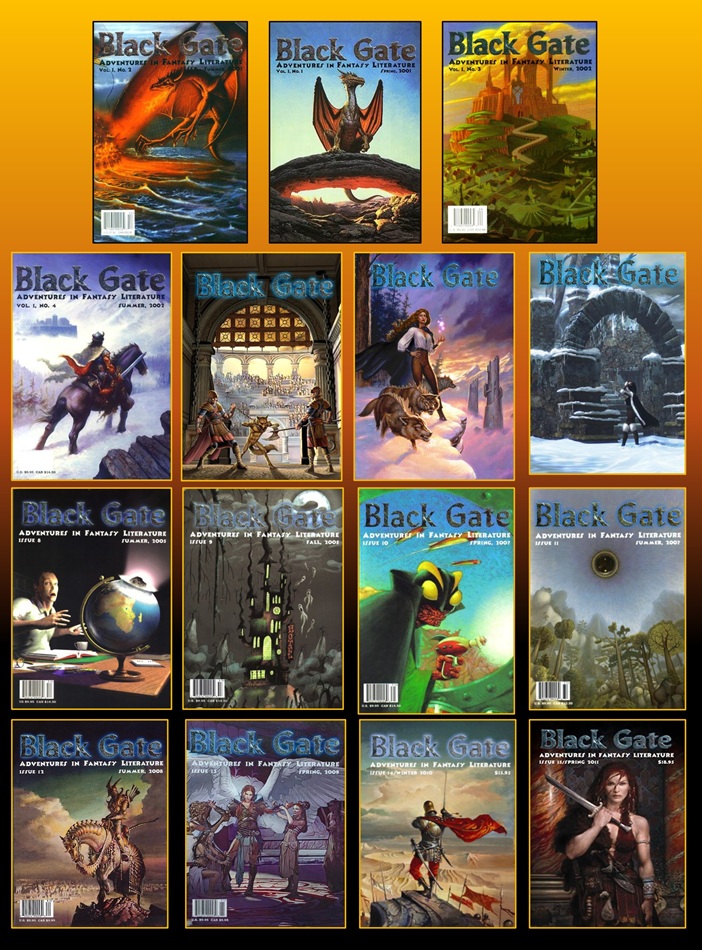
Black Gate 1 – November 2000, the print magazine was born, but the first edition is a different size than the rest. I recall you had a story about that. What was it?
Glad you asked about that. By 1998 I was part of the Business Operations team for Motorola, in Schaumburg, Illinois, doing software acquisitions. In one of the great bits of serendipity of my life, the corporate lawyer I worked with on those deals was a guy named David Kenzer. I worked with him every day for two years before discovering that he was the same David Kenzer who owned one of my favorite game companies, Kenzer & Company, publishers of Knights of the Dinner Table.
When Dave learned I wanted to publish a magazine, he brought me to Skokie to introduce me to his printer, A to Z Printing. I knew that I wanted a magazine that had the same sense of fun and adventure as the pulp magazines I loved, and for that first meeting I brought a copy of Astounding Science Fiction from the 1930s with me, to show the printer the size and feel I was aiming for.
We settled on the oversize format we used for the first issue, partly because it was the same size as the RPG supplements the printer was used to. But we quickly discovered that a small reduction would allow us to use smaller paper, at significant savings. Later issues were all published at the smaller size.
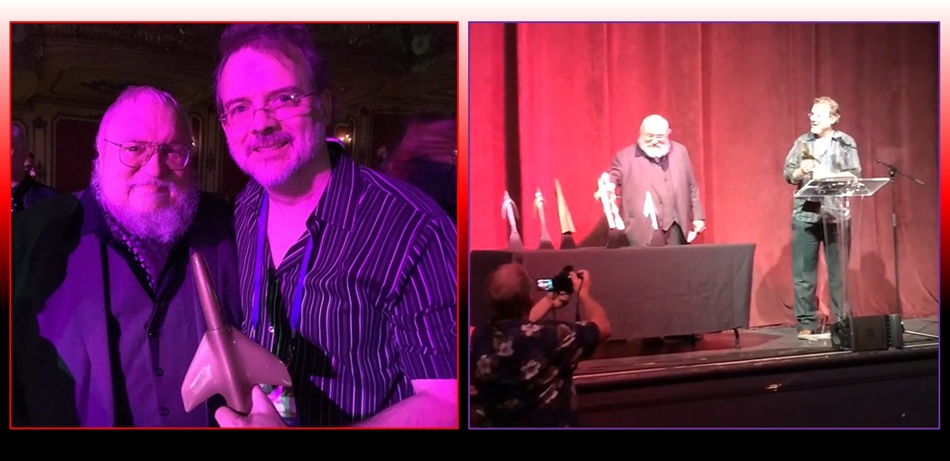
Alfie Award for Integrity and Boneheadedness – Honored by George RR Martin
This excerpt from John O’Neill comes from an Aug 2016 post. Watch the award acceptance speech on Youtube
Yesterday, while I was walking through the crowded halls of Worldcon in the Kansas City Convention Center, I was given an invitation to the Hugo Losers party, courtesy of the party’s distinguished host, George RR Martin. I was quite flattered, as Black Gate was not even up for a Hugo (we declined the nomination, as we did last year, to make room for another nominee on the ballot), but didn’t think much more about it.
The Hugo Losers party is the hottest ticket of the convention, as I soon discovered. George personally hands out the Alfie Awards to those Hugo losers whom he feels (quite rightly, I think) were unjustly robbed of an award by slate shenanigans. And this year he spared no expense to do it in style, renting out the Midland Theater, hiring a band, and plying hundreds of guests with fabulous food and drink. The Awards themselves are gorgeous, constructed of vintage hood ornaments, in honor of the design inspiration for the first Hugo Awards.
George funds and hosts the awards, but the Alfie’s are in truth a fan award… the winners are determined by the results of the Hugo voting. But after the first few were awarded, George announced that the Alfie committee had the right to give out special awards. And as the sole member of the committee, he’d decided to give a special award this year to recognize one publication “for integrity” in declining a Hugo nomination two years in a row. Without further ado, George announced the award was to be given to Black Gate, and I was called to the stage to accept it.
It was a very real honor for me. In a very real way George exemplifies all that’s best about fandom — its inclusiveness, its quest to reward excellence, and especially its talent for building a community. I was very proud to accept the award on behalf of everyone who’s worked so hard to make Black Gate a success these last few years.
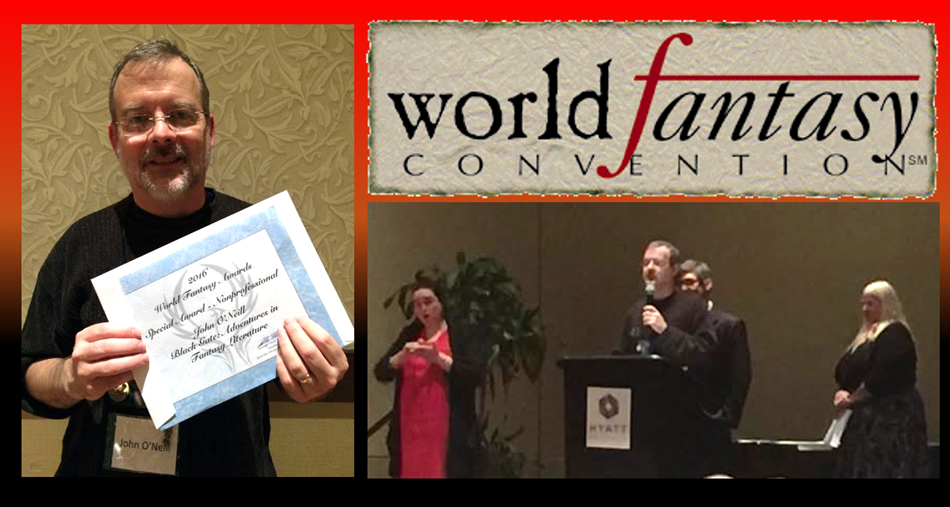
Black Gate wins World Fantasy Award
Oct. 2016, John O’Neill posted about winning the award; excerpt below.
Wow.
In 1996, I started SF Site, one of the first genre websites. It quickly grew to over 150,000 readers per month. By 1998, as the most innovative and forward-thinking publications in the genre were creating the first ground-breaking websites, we decided to do something REALLY forward-thinking: Launch a print magazine.
Black Gate lasted for 15 print issues, until 2011. In November 2008 our Managing Editor, Howard Andrew Jones, said we should revamp the magazine’s website. I was the voice of reason. “Seriously, who wants to read more than one article a month, Jones?”
Undaunted, Howard put together a top-notch team of writers, and committed to putting daily content on the Black Gate blog. It was his vision, and speaking personally, I still think it’s completely bonkers.
But thanks to Bill Ward, David Soyka, Scott Oden, James Enge, EE Knight, Judith Berman, Rich Horton, and especially Ryan Harvey for getting the site off the ground (I still think it’s a crazy idea).
In 2010, C.S.E. Cooney commented that my articles would be taken more seriously if the majority of the words were spelled correctly. She became our first website editor, and she did an extraordinary job. She raised our standards enormously.
Today Black Gate has 58 regular and semi-regular bloggers — including many of you in the audience. Our mandate is to cover the best neglected fantasy, past and present.
We’ve received many honors over the last decade, but nothing like this. This is the highlight of 20 years of love and celebration of fantasy, and on behalf of the entire Black Gate community, thank you from the bottom of my heart.

Howard Andrew Jones championed expanding the Black Gate website, transforming it into a mega-blog as it complemented the print issue.
In January 2025, after Howard Andrew Jones lost his life to brain cancer, John O’Neill remembered his dear friend; the excerpt below captures Howard’s heroism.
Howard has been a huge part of my personal and professional life since 2002, when I opened a submission to Black Gate magazine and found a long, rambling, and extremely enthusiastic cover letter from him, expressing his delight at finding a quality magazine devoted to heroic fantasy. The letter ended with “I want in, bad,” and was attached to a terrific tale featuring two adventurers named Dabir and Asim…
In November 2008 Howard told me he wanted to remake our website, and post new articles every single day, instead of a few times a month. I told him he was crazy. How in the world could we produce that much content, especially without a budget?
Undaunted, Howard put together a top-notch team of writers, and committed to putting daily content on the Black Gate blog. It was his vision, and he executed it magnificently, with a little help from Bill Ward, David Soyka, Scott Oden, James Enge, EE Knight, Ryan Harvey, and others. Eight years later, the website won a World Fantasy Award — an honor that I still believe should have been presented to Howard.
Thoughts on the last print issue/stopping print?
Ending the print magazine with issue #15 was a hard decision to make. I loved the magazine, and I deeply loved publishing fiction — especially finding new writers, like James Enge, Harry Connolly, Iain Rowan, Aaron Bradford Starr, Michael Livingston, John C. Hocking, Matthew David Surridge, Sarah Avery, and many others.
Black Gate started as a business, and that meant keeping costs manageable. But it was always a side hustle, something I did at night and on weekends while holding down a full time job. As my career advanced, those jobs became more and more demanding, and it became more and more clear that Black Gate was unlikely to ever make enough to allow me to quit the day job.
As Black Gate became more of a hobby, rather than a potential off-ramp to my business career, that meant I could treat it as one, and I no longer had to be quite so rigorous controlling costs. I didn’t mind spending an extra $300 if it meant getting the cover art I wanted. Or $685 to add an extra 32 pages. Or $2,300 so we could continue to have top quality interior art. Gradually it became harder and harder to make the compromises that were keeping us profitable.
By our tenth year in business we were losing over $12,000 an issue. No one on the staff was paid, including me. At that point the magazine was a true labor of love, and we were publishing only one issue a year – a huge annual production, nearly 400 pages of original fiction, art, and reviews, most of which I paid for out of my own pocket. As long as I was employed, the cost really wasn’t a burden.
But in 2012 I left my job as CEO of a small software business in central Illinois, and the senior position I was expecting at Motorola didn’t materialize, as the company abruptly announced it was being acquired by Google. The print version of Black Gate was the first expense that had to go to stabilize our family finances. I found a job just a few months later, but by that point it was too late to save the magazine.
I sometimes wonder if there was some way we could have saved the print version by bridging those months with a crowdfunding campaign or something similar. But the hard truth is that the print version never sold more than 1,600 copies per issue. Giving it up allowed us to put all our focus on the online version of Black Gate, which reached vastly more readers.
By 2015 we finally surpassed SF Site, with over a hundred thousand monthly readers and 1.6 million page views/month, and in 2016 we won a World Fantasy Award. Our readership has gone up and down in the years since, but our core readership has proven incredibly loyal, sticking with us through multiple ups and downs as we’ve weathered the storms of industry change and provider hiccups.
Are PDFs or back issues still available?
We still have a small number of print copies. Some of our older issues are sold out, but the rest can still be purchased here.
That’s not the case with PDFs. A few years ago, when we transitioned from the legacy Cyberus servers to our new service provider, Hostgator, we lost the custom download functionality our architect Rose had built for us. We also lost the original PDF files. We’d love to rebuild it at Hostgator, but step one is recreating the high-quality PDFs. Most of our original production files were lost in a hardware failure in 2006, so this is a more challenging task than we’d like. But we haven’t given up, and hope to recreate the original PDFs in the next year or so.
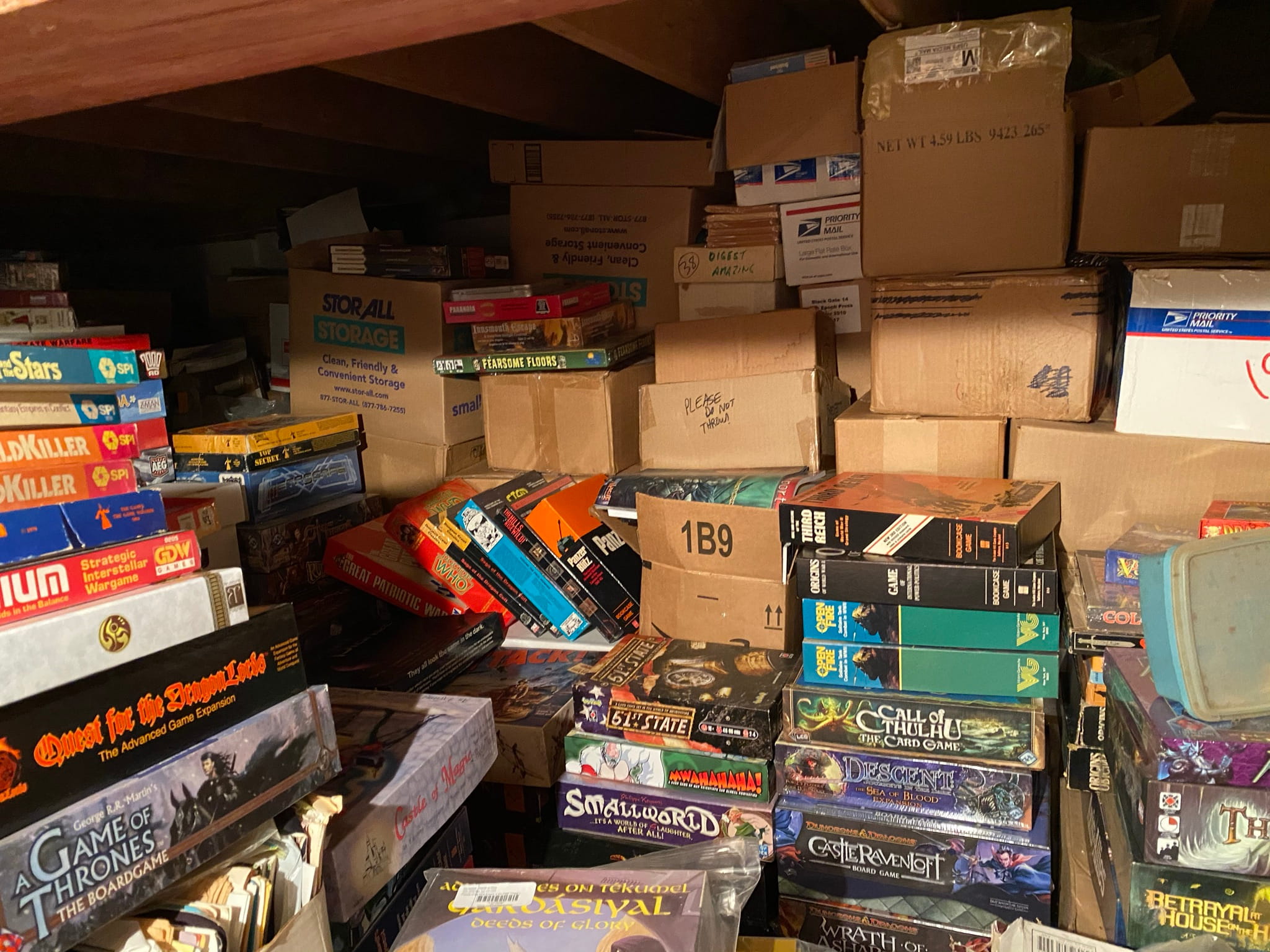
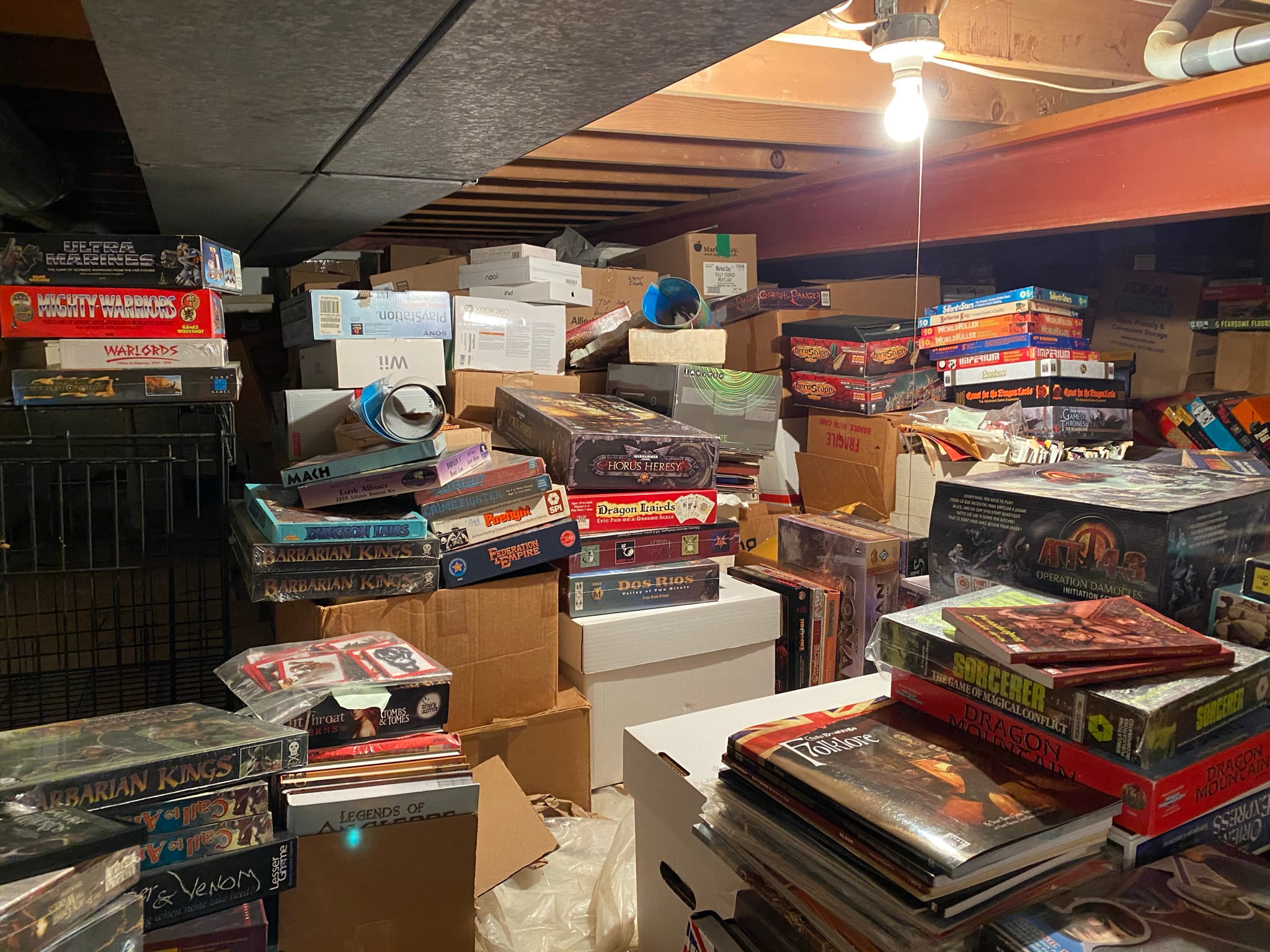
Can we talk about unearthing your basement? Are Black Gate relics in there?
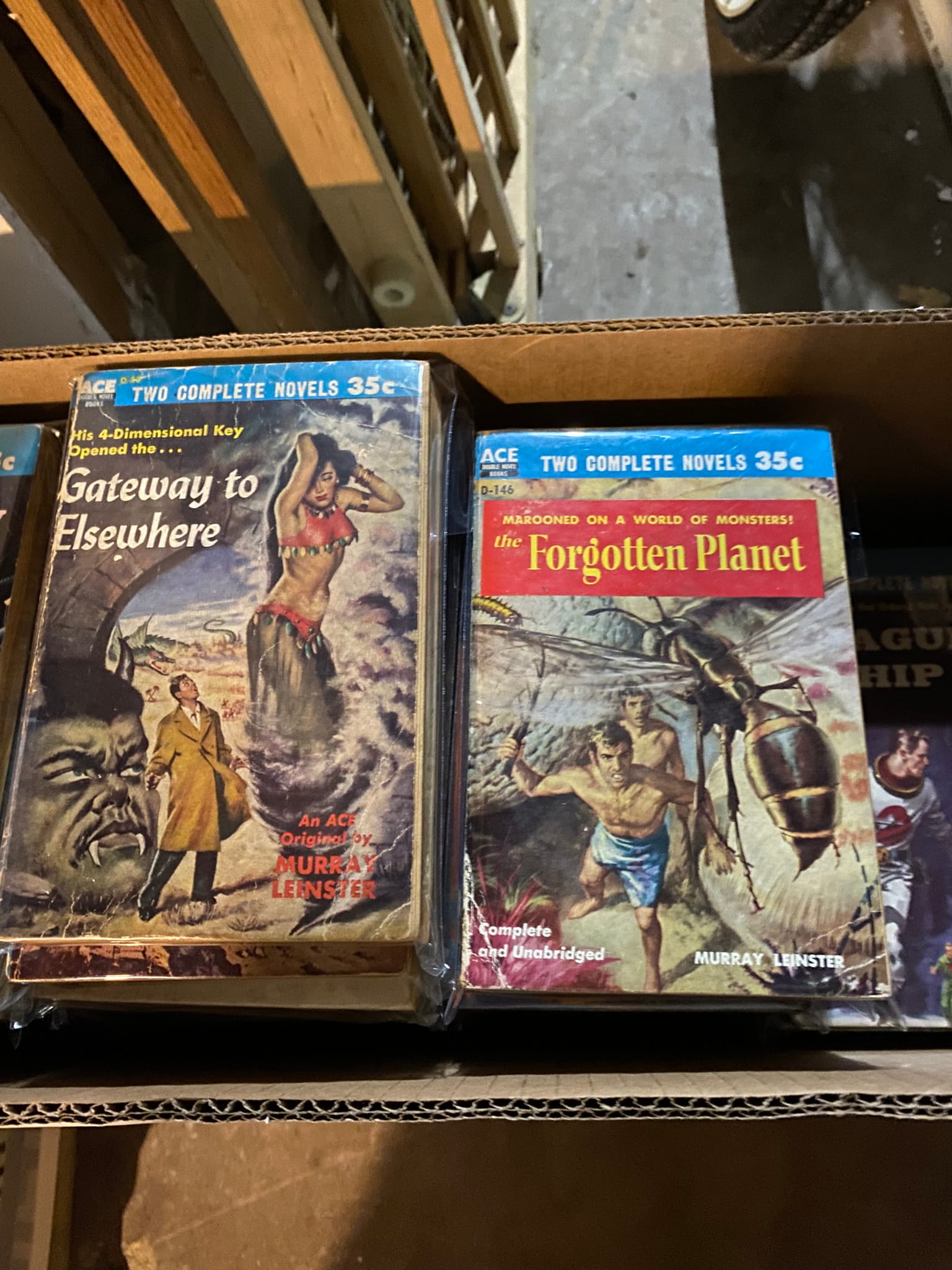
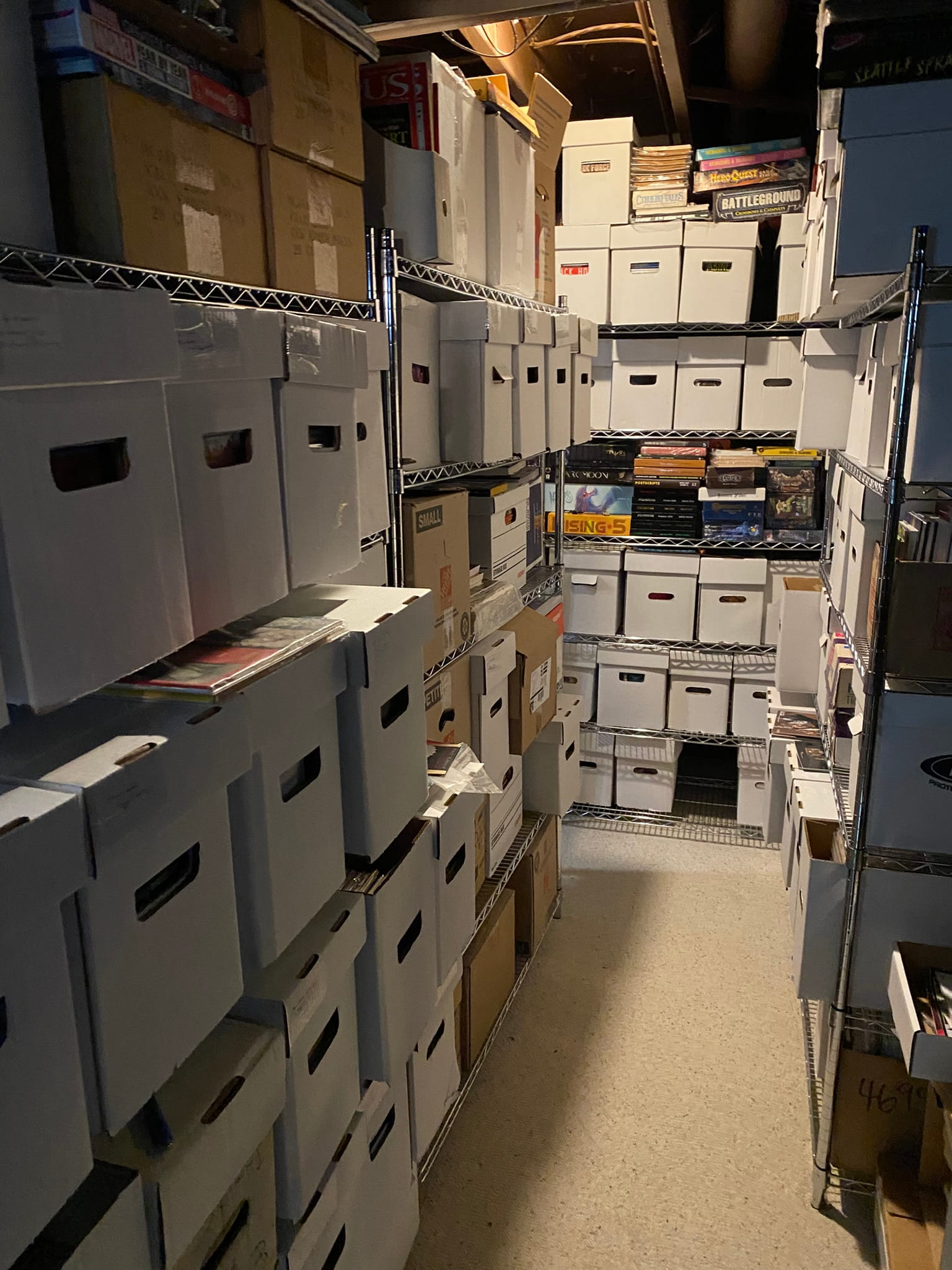
[Click the images for Cave-of-Wonder sizes.]
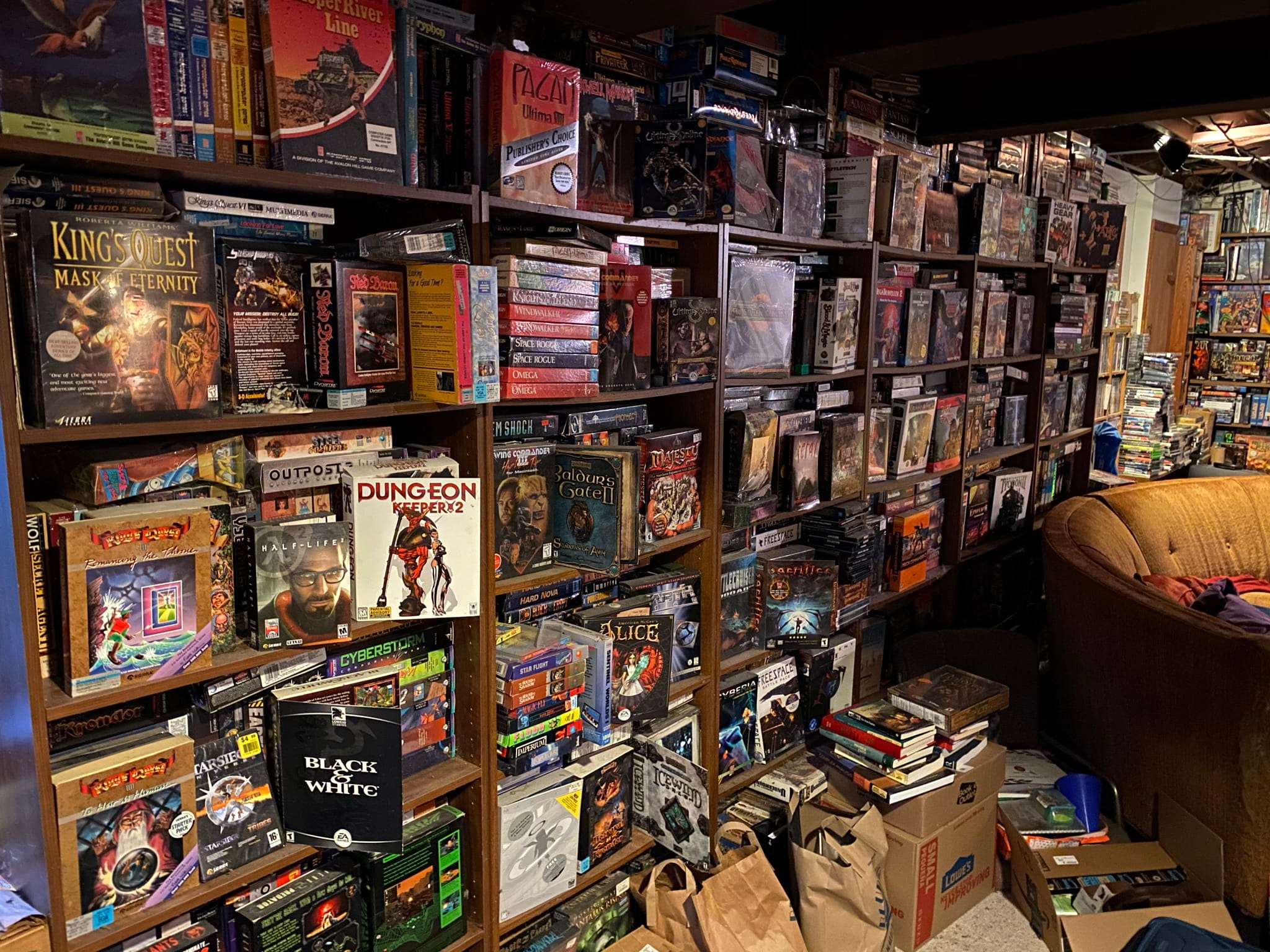
There’s certainly a fair amount of Black Gate history!
In the late 90s we finished our basement, and I built an oversize desk as a work space. That humble office was the global headquarters for Black Gate’s vast publishing empire for the next two decades. I assembled all the magazines there, and handed all the printing, distribution, and financial details. When 2,000 copies of Black Gate magazine arrived from the printer and were dumped in our garage, the whole family would gather in the kitchen to help me stuff them in envelopes by hand.
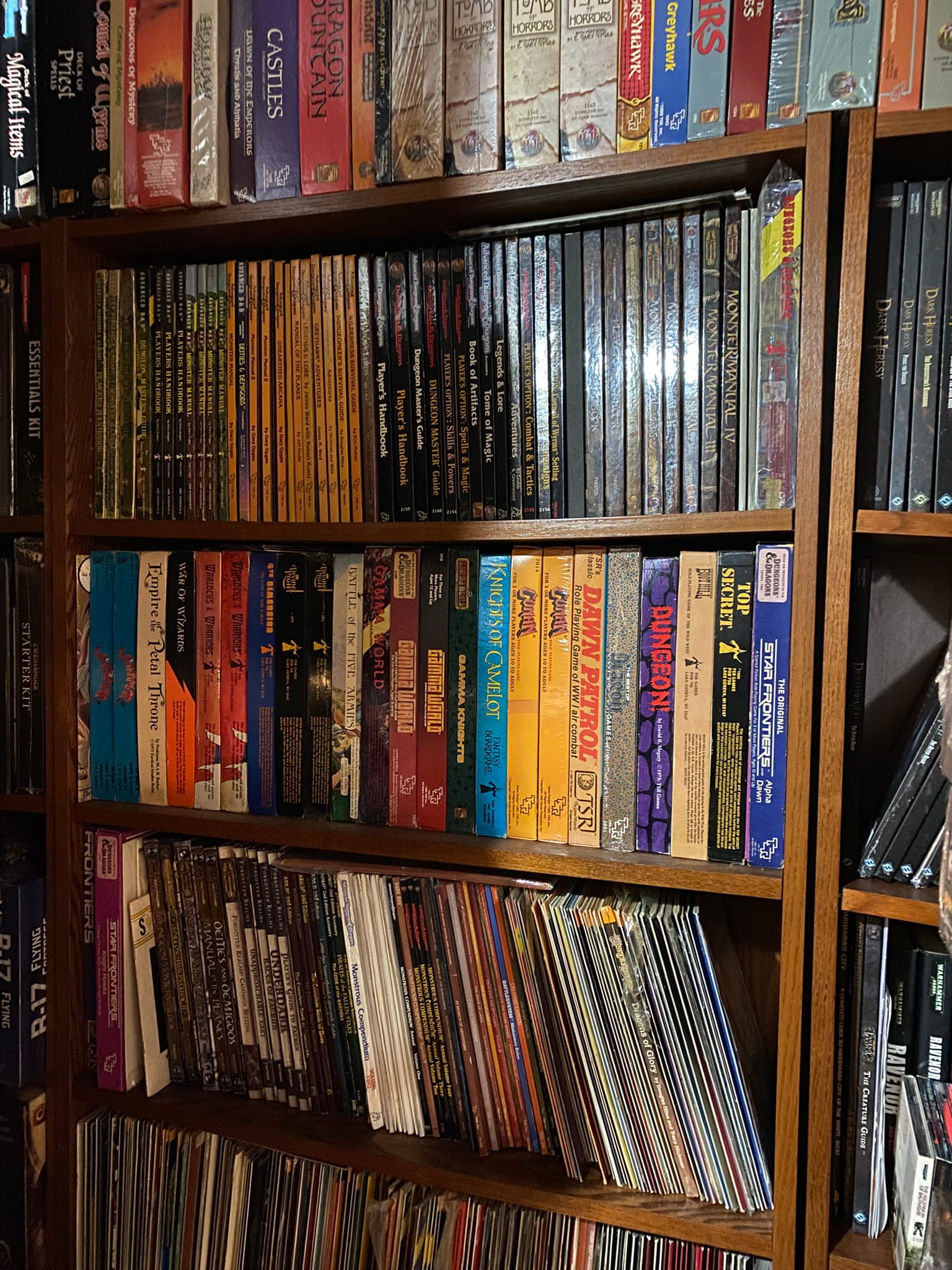
Obviously, we haven’t had to do that since the print version died in 2011. This summer I finally dismantled the desk and cleared out the old filing cabinets, getting rid of 25-year old fax messages, tax receipts, distributor correspondence, and the metric ton of paperwork that goes with running a small business. That included two cabinets worth of editorial work, mostly hand-corrected printer galleys of our first dozen issues. (Why did I keep those? No idea).
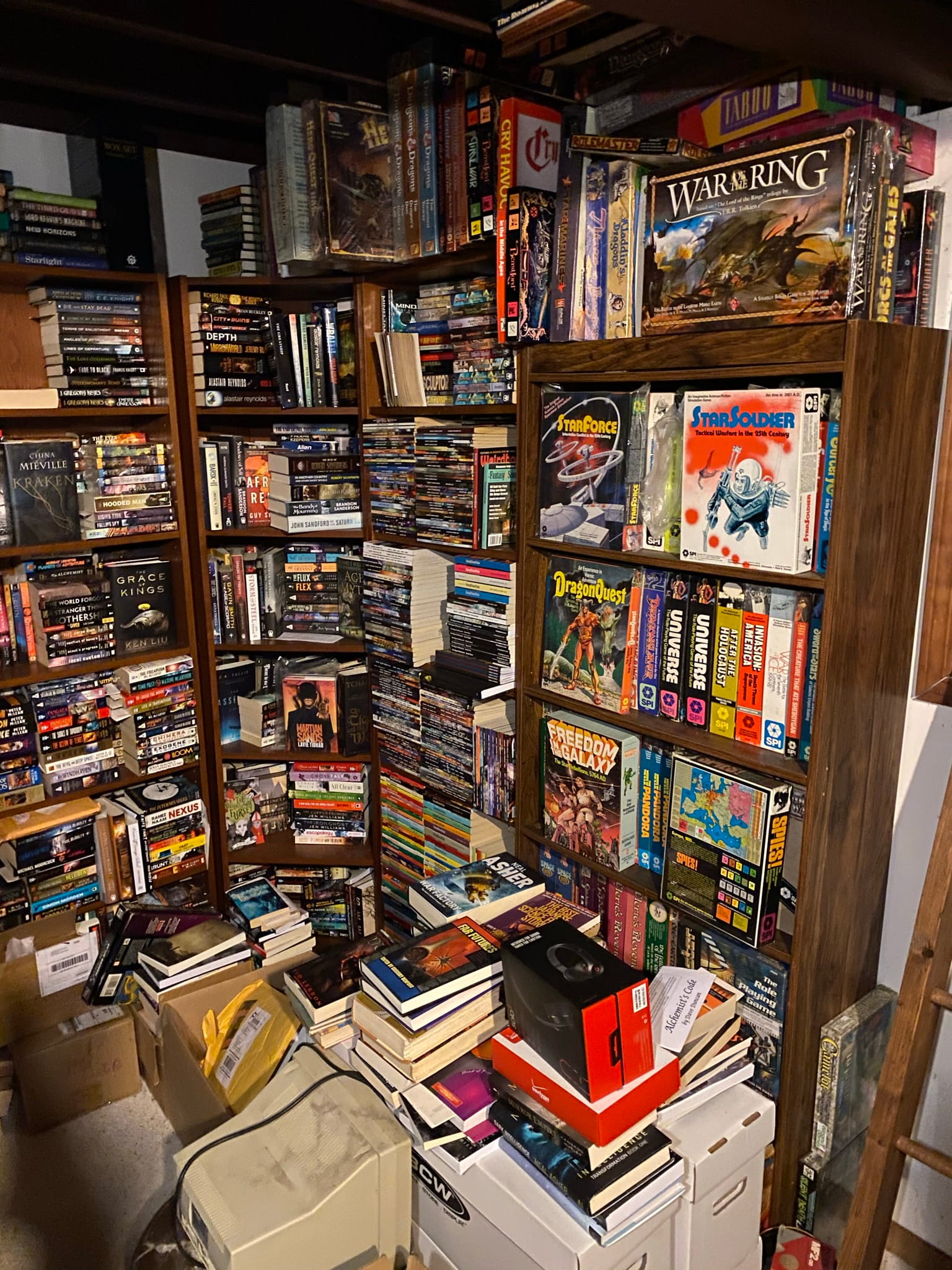
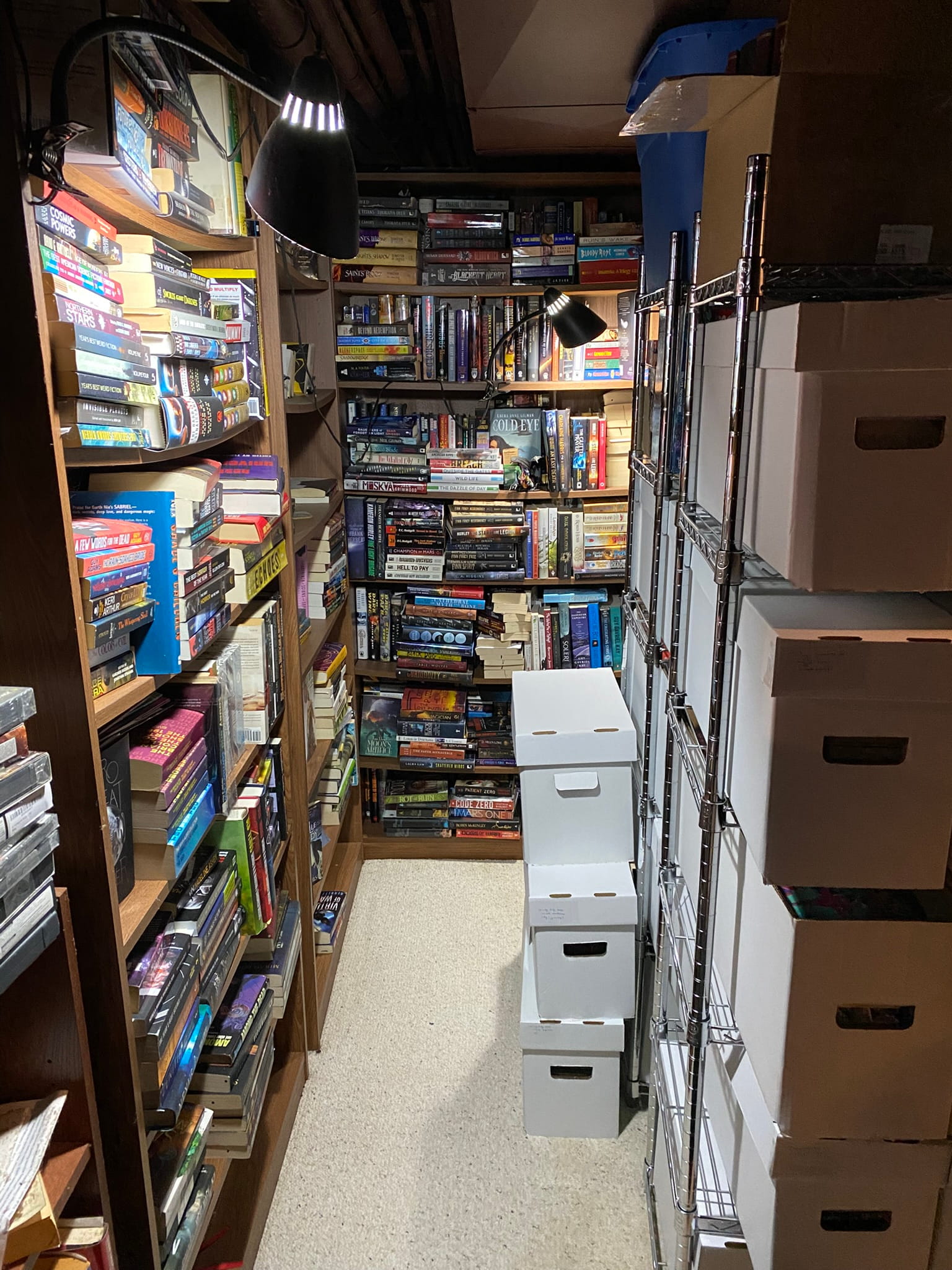
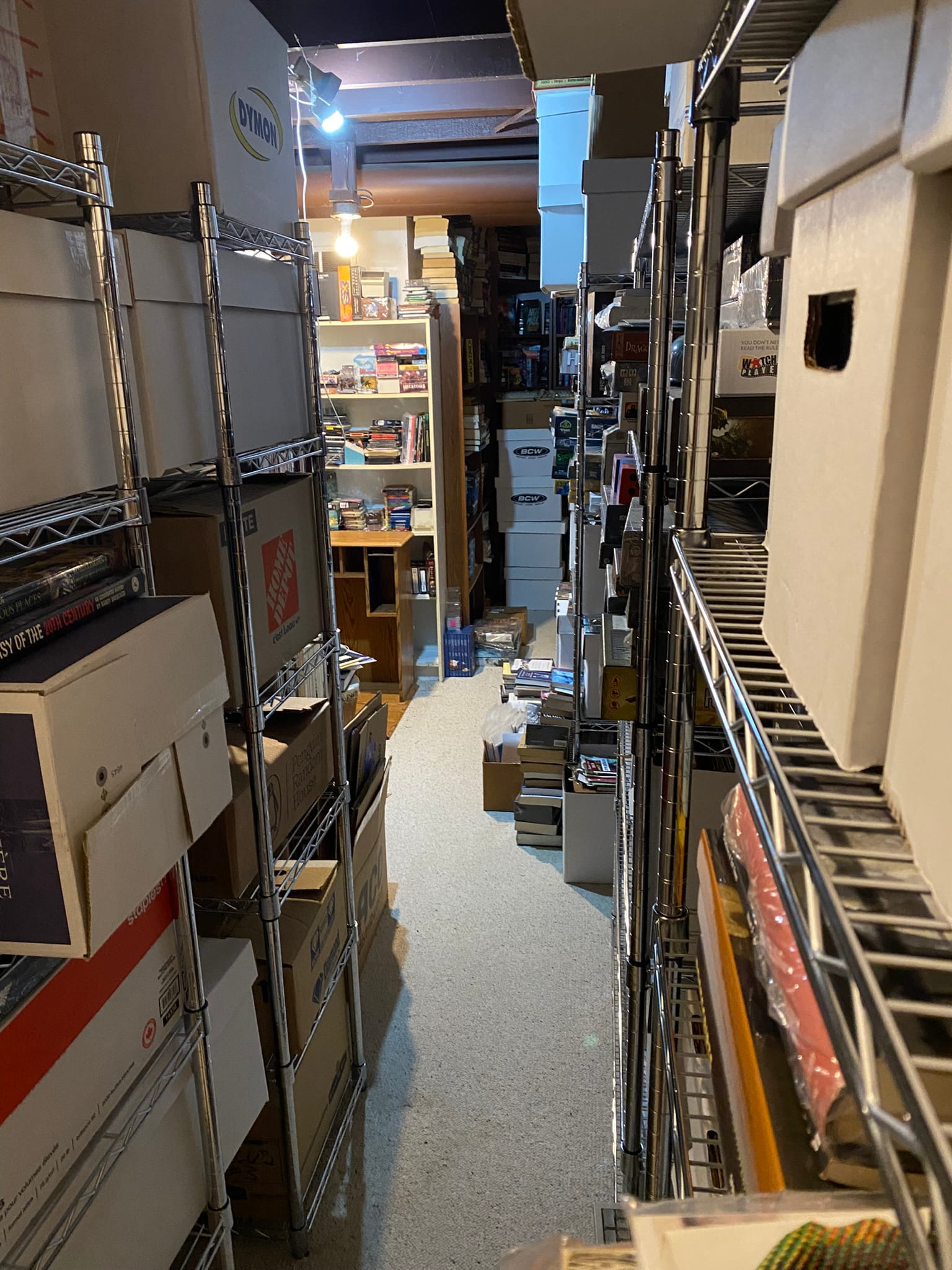
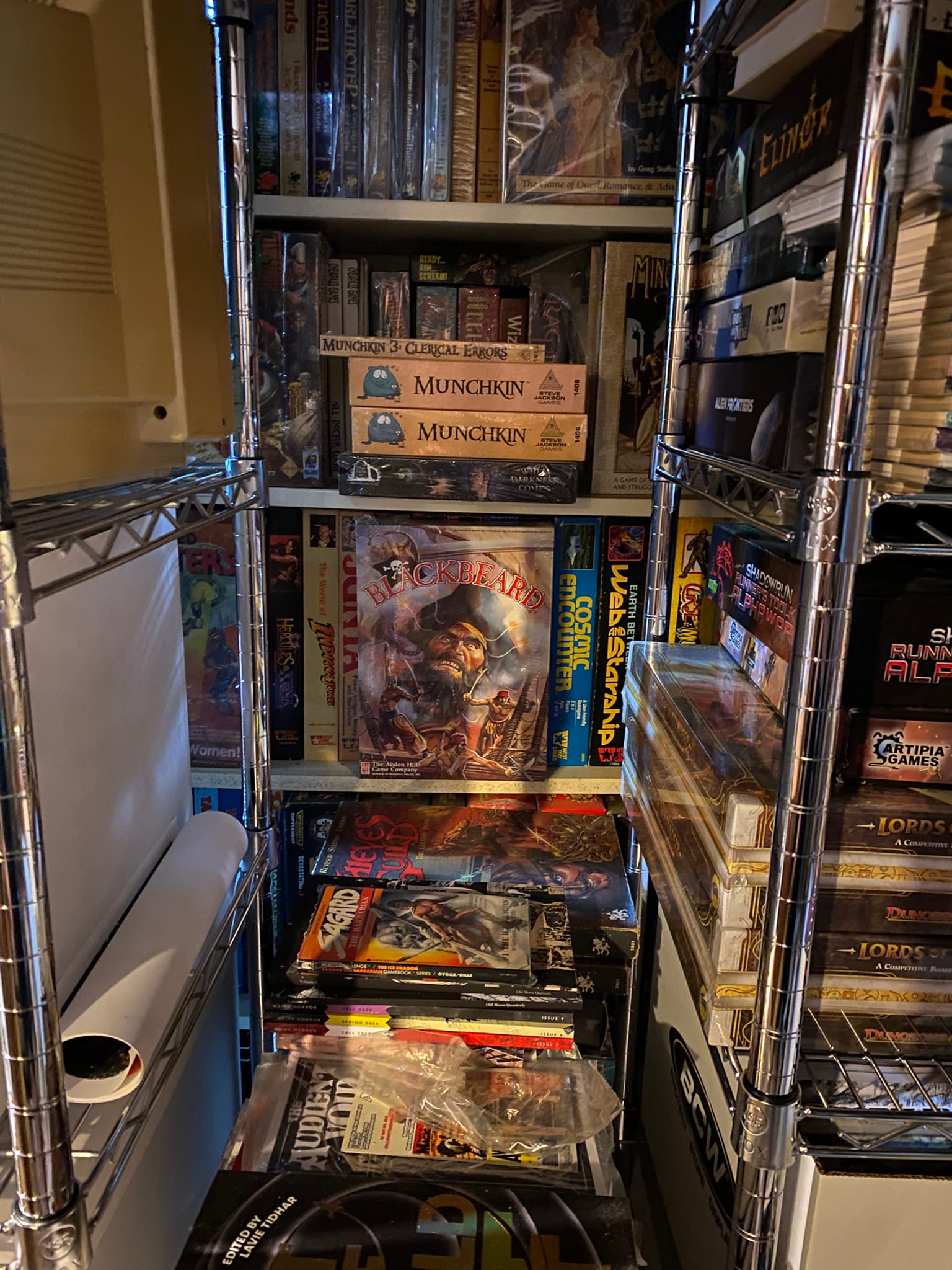
When we finished the basement we left it as a single room, to give the kids a place to run around. Over the years I built 56 bookshelves lining the walls of the basement, and those gradually filled with computers games, books, pulps, comics, science fiction magazines, and vintage role playing games. Howard used to call it the Cave of Wonders, because it sort of looked like a well-stocked gaming store.
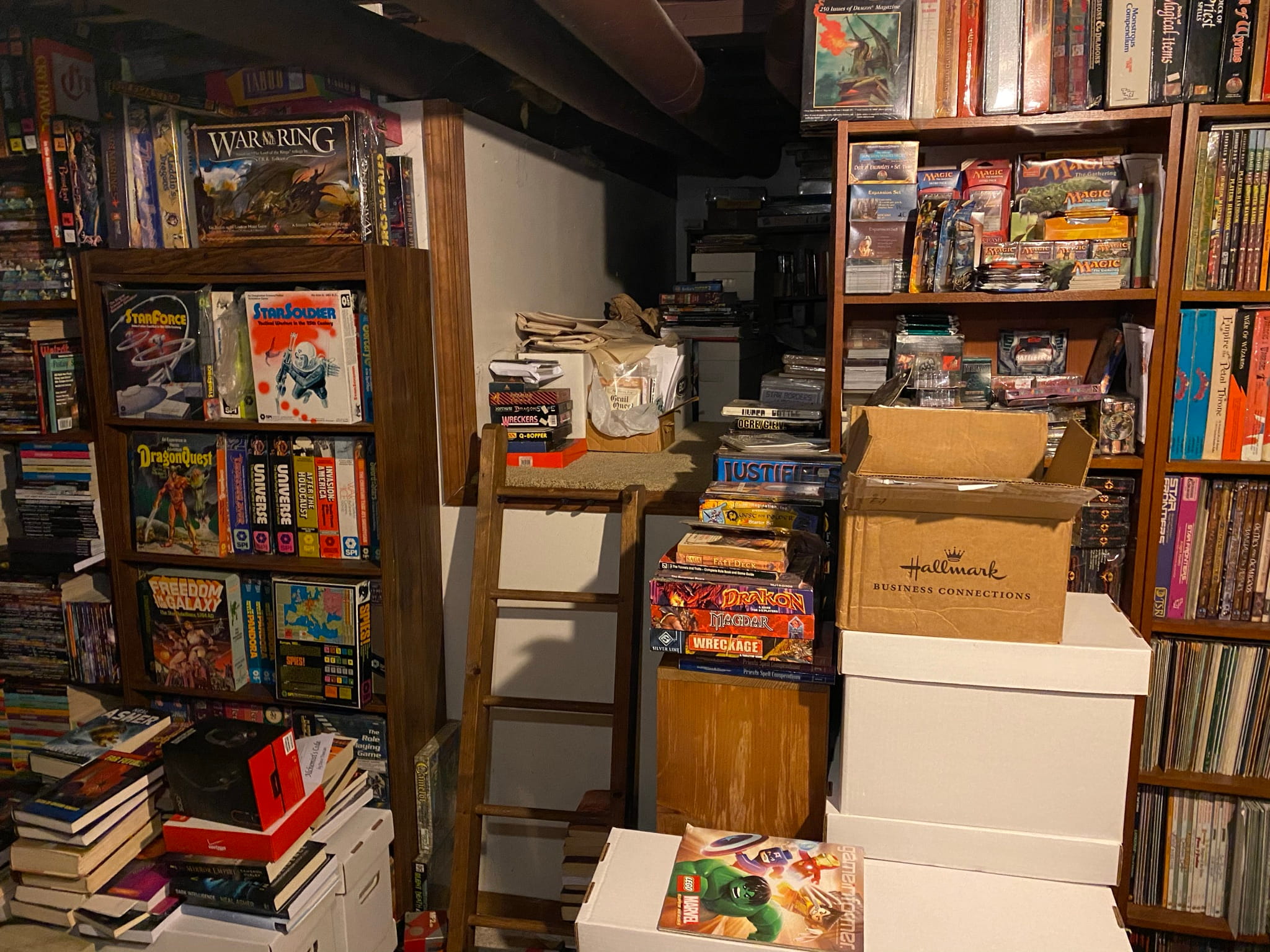
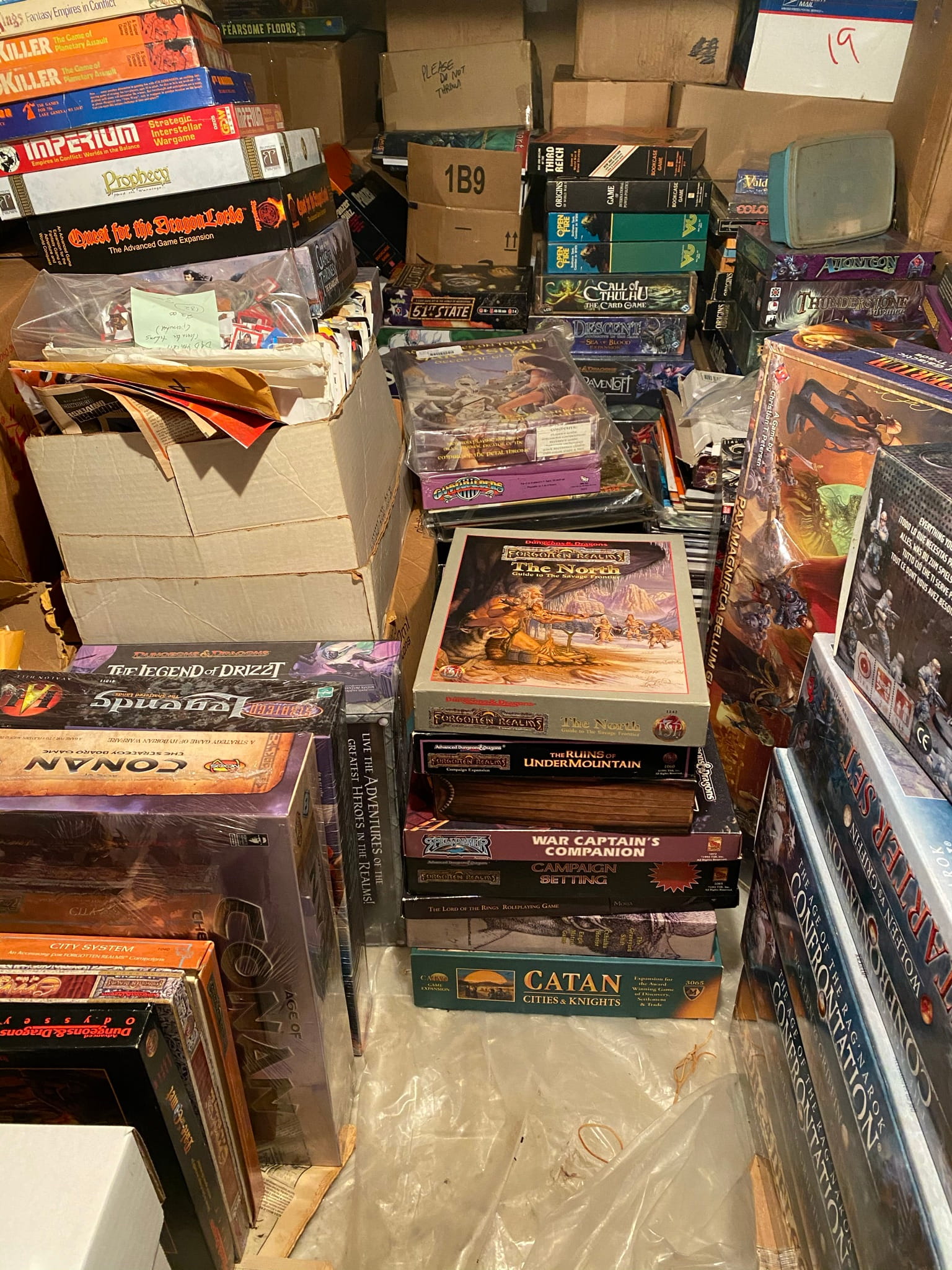
When we finished the basement the contractor asked what we wanted to do with our two crawlspaces. On a whim we decided to have them carpeted, and put in some lighting. Our kids called them ‘comic nooks,’ because on rainy days they’d crawl inside to read comics or play board games. Over the next 25 years they gradually filled floor-to-ceiling with comics and old games. Mostly I stay out of them now, and they’re home to a lot of spiders.
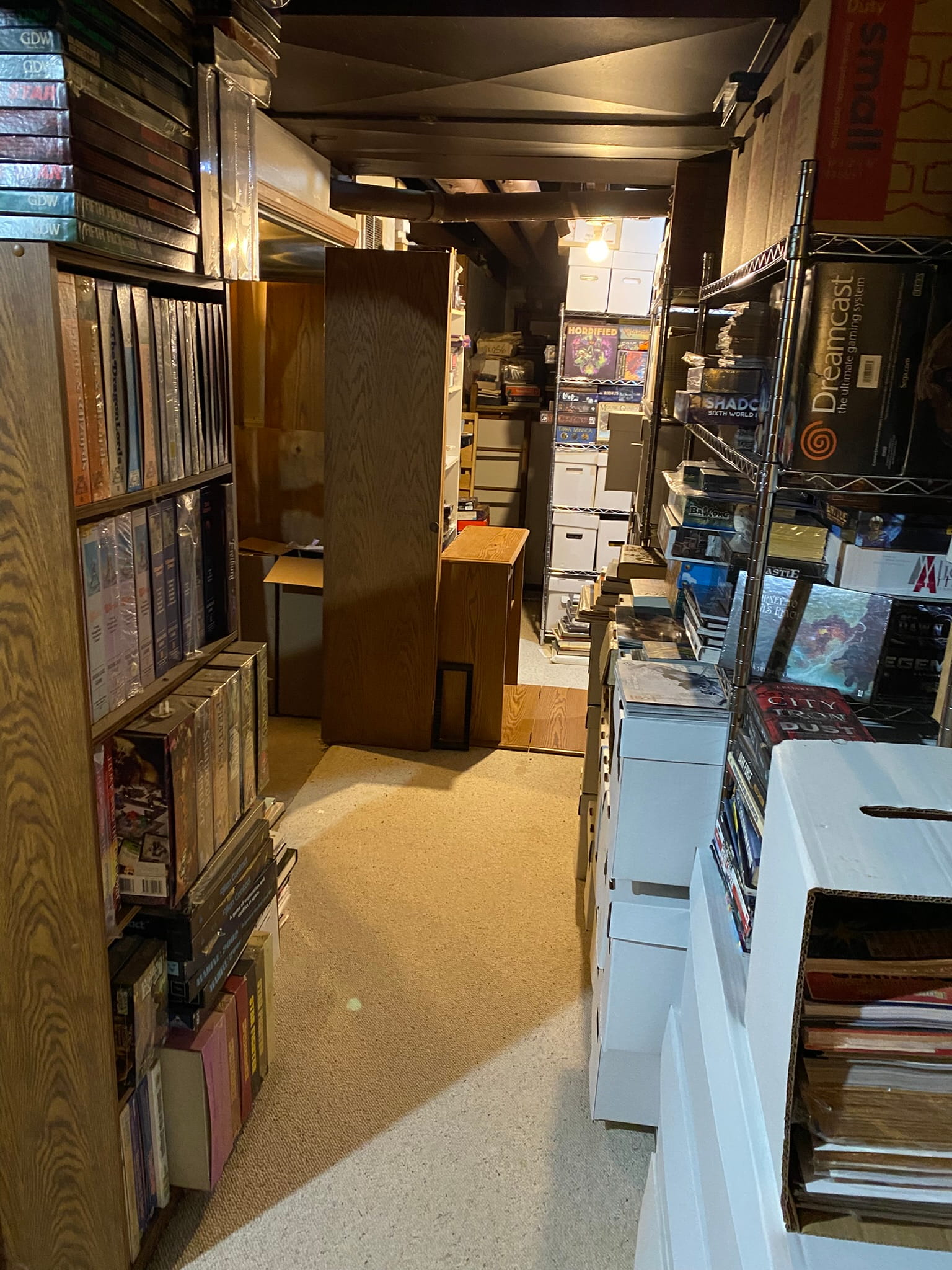
About a decade ago I started building shelving units to house my growing paperback collection. Those fill half of the basement now, making a lot of twisting corridors. Each shelf holds 35 long boxes, or about 3600 paperbacks or old magazines. It’s a great way to store a lot of old paper, but it does make it tough to find what you’re looking for. Especially since the collection isn’t organized nearly as well as it should be.
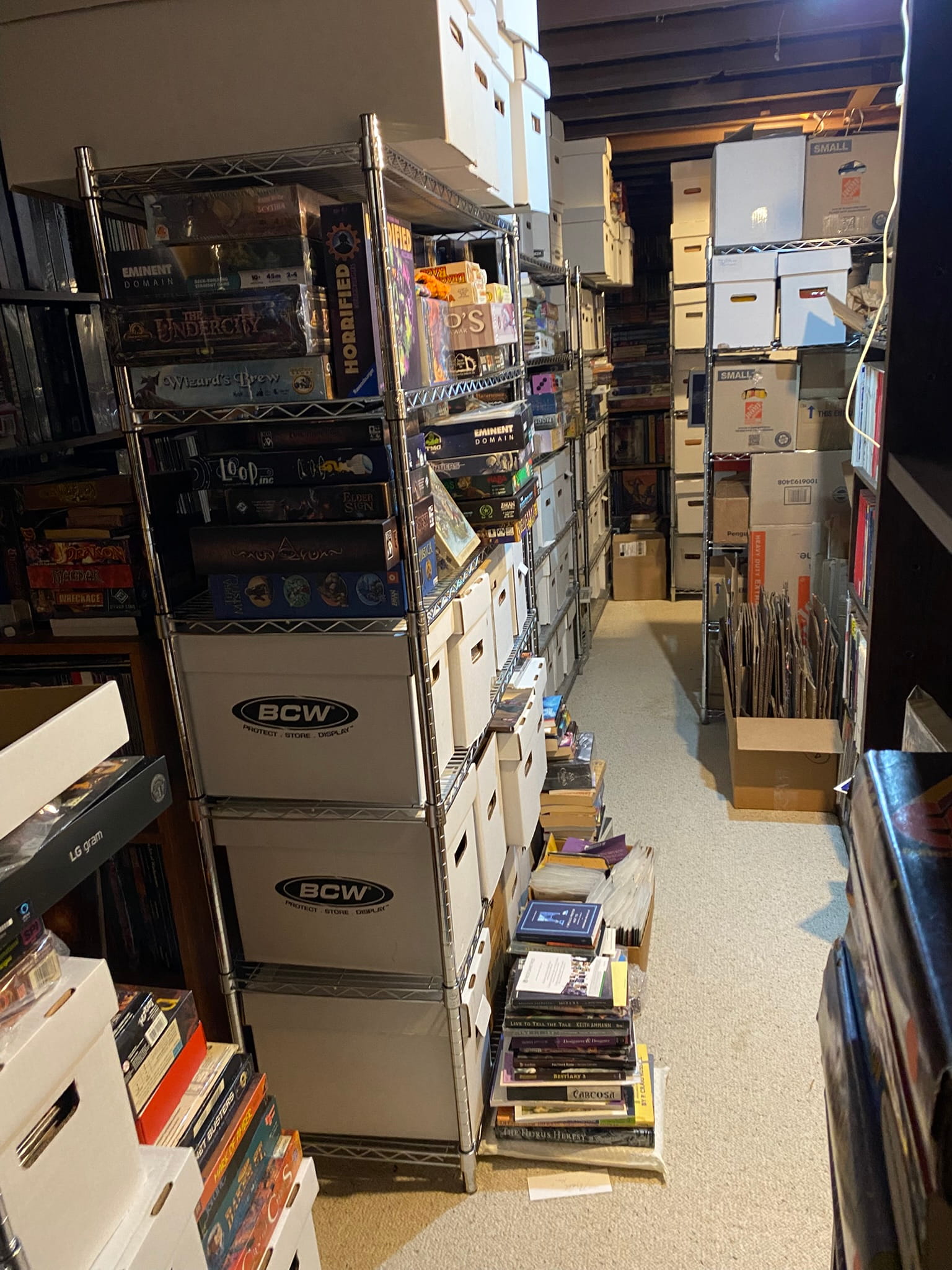
I’ve posted a few pics below to give you a sense of what the Cave looks like today.
Any reflections about most-fun/memorable/impressive submissions or interactions with artists/authors/fans?
When I look back at the last 25 years, they’re filled with countless fond memories. It’s true what they say. You forget the tough times, and remember the good.
I don’t want to close out without sharing a few of my favorite memories. First and foremost, there were the writers. Being an editor is a thankless task, especially if you can’t afford to pay yourself. But what made it all worthwhile was finding those magical stories in the slush pile. The tales from an unknown — or relative unknown — that dragged you to the edge of you seat, and got your pulse pounding. Finding and publishing the first tale of Morlock, by the amazing James Enge. Publishing an early story by Cory Doctorow. Derek Kunsken’s third published story. Discovering Harry Connolly. Publishing early work by Martha Wells, Judith Berman, John C. Hocking, Howard Andrew Jones, Richard Parks, John R. Fultz, Devon Monk, David B. Coe, Constance Cooper, David Wesley Hill, Ellen Klages, Tina Jens, Peadar Ò Guilin, Iain Rowan, Aaron Bradford Starr, Michael Livingston, Jonathan L. Howard, Edward Carmien, Matthew David Surridge, David Evan Harris, Pete Butler, and so many more.
Something I haven’t had the chance to talk about much was the artwork. I was very proud of the fact that we published so much amazing artwork by some many brilliant artists. Richard Corben, Chris Pepper, Bernie Mireault, Chuck Lukacs, Charles Keegan, Todd Lockwood, Leif Jones, Jim Pavelec, Malcolm McClinton, and so many others.
The last thing I want to talk about is how welcoming the fantasy community was, and is. We received immediate support and incredible advice from countless corners as we tried to get our humble magazine off the ground. There was a very fine fantasy magazine that had just gone on hiatus, and the publisher contacted me — unsolicited — and quietly emailed me his entire subscription database. We had a surprising number of subscriptions before we even released our first issue. Rich Horton sent me a check for an 8-isusue sub a week after we announced the magazine.
The fantasy community is still centered around conventions, and they’re still the place to be if you want to meet readers, writers, and artists, and get plugged into what’s happening in the field.
There are more fantasy magazines alive today then there were when we got started in 1999. Most of them are, like Black Gate, very small, and run by folks with very little experience, but a whole lot of love for the genre.
It’s heartwarming to see that grass-roots drive to create is still alive in this field. I hope to stay a part of it for a long time.
S.E. Lindberg is a Managing Editor at Blackgate.com, regularly reviewing books, interviewing authors on ‘Beauty & Art in Weird-Fantasy Fiction’, and running Dark Muse News. He has taken lead roles organizing the Gen Con Writers’ Symposium (2021-2023) and the Goodreads Sword & Sorcery Group; he even interned for Tales from the Magician’s Skull magazine and is an Assistant Editor for Battleborn magazine. As for crafting stories, he has contributed eight entries across Perseid Press’s Heroes in Hell and Heroika series, and has an entry in Weirdbook Annual #3: Zombies. He independently publishes novels under the banner Dyscrasia Fiction®; short stories of these have appeared in Whetstone and Swords & Sorcery online magazine, Rogues In the House Podcast’s A Book of Blades (Vol. I and Vol. II), DMR’s Terra Incognita, Tales From the Magician’s Skull, Savage Realms Magazine, and Michael Stackpole’s S&S Chain Story 2 Project.
John, I just showed your basement pics to Marianne. She says, “You tell John, I said ‘God bless his wife.’ Type it!”
So I did.
I read your comment out to Alice.
She says it’s nice that SOMEONE understands.
I’m not sure I know what she means, but perhaps Marianne does?
Thank you John for leading the community over so many conventions and decades. Black Gate has been an integral part of my growth as a writer and reader.
It’s been a genuine pleasure to have you on the team, Seth. Thanks for doing all the research to put this article together, and for pestering me relentlessly to answer all your questions. The end result looks terrific. And you’ve managed to edit three months of incoherent responses into something that almost sounds rational. I owe you one, buddy.
Having wandered that basement and survived, I think it’s fair to say that I often hear it whispering, beckoning me, in the unravelled moments before sleep descends.
You survived? I think I’m still stuck in there.
Jason — last time you visited, I’m pretty sure you slept on the couch. Next time, we’re going to dispense with sleep altogether, and finally recreate E.E. Knight’s epic HEROQUEST campaign. To arms!!
Neil — it’s been roughly ten years since we hosted your family, and we are STILL finding spent ammunition under the couch cushions from that epic nerf battle. My kids demand a rematch!
Wow. I’ve never been envious of anyone’s basement before.
Charles — I’ve seen pics of your very impressive library. You have nothing to be jealous of.
Besides, collecting is a poor substitute for reading. And, with the possible exception of Rich Horton, you are certainly the most well-read individual I know. It’s an honor to share your posts on the blog.
I look upon those pictures with awe and with envy. And I still treasure my complete print run of Black Gate.
Thanks Joe! Those readers who’ve been with us since the beginning are the heart and soul of the Black Gate community.
Thank you for the article, Seth. It’s great to know some of the history of Black Gate as well as celebrating John and all he has done. I came late to the site, probably finding it during Covid but now it’s an every day occurrence for me to check it out . It has introduced me to so many different authors and titles as well as showing me a lot of vintage works. Keep up the good work.
My “brush with the famous John O’Neill” story comes from the Windy City Pulp and Paper con in April 2024. I had learned about the con from Black Gate and since it was close (Detroit to Chicago) and had lots of vintage paperbacks to sell, I went. I was rummaging through a box of books talking to another searcher when I mentioned that I had heard about the con from a site called Black Gate. John, who was nearby, stepped up and introduced himself. He took time to wander the con with me as we talked about sci fi /fantasy, RPGs, and collecting (I was not aware of the extent of his collection until now) and other things that men 50+ years old with common interests talk about. At some point I asked (and got) a selfie with him. He mentioned that no one had ever asked for a selfie with him before (such a humble celebrity). Thanks John for all you do and for not making me feel like the stack of 150 books on my TBR list is excessive. I showed my wife the pics of the cave of wonders and we are both in awe.
Jim — thanks so much for the comment! It was a pleasure to meet. Was it really two years ago?
And thanks especially for mentioning Windy City, Doug Ellis’ wonderful convention/celebration of all things pulp and pulp-adjacent. I’m glad you made that drive from Detroit. Next time you do, I hope you join our annual Black Gate dinner.
Also — I’m pretty sure you’re still the only guy to ask me for a selfie. 🙂
Seth and John — fantastic! Loved the photos of the Book Basement, disappointed th learn that Black Gate wasn’t a nod to Sauron and Mordor, so I guess I’ll quit with my, “All hail the Great Eye!” I discovered BG in the mid-2000s, and that became the first of 3 main reasons why I returned to writing my fantasy. Never I’d meet anyone involved in the magazine, or contributing scores of articles and two short stories to the digital version of BG – or have my books reviewed therein! I am honored and feel very privileged to have been (still am, I hope) a part of a wonderful team!) I look forward to meeting up again soon! Until then . . .oh, to hell with it . . . All hail the Great Eye!
Hey Joe! I have always been proud of the fact that we were able to lure you into reviewing for us. It’s hard to believe that you’ve written an amazing 77 articles for us over the years.
It’s tough to pick the highlights. But if I had to, the ones that come to mind first are your epic interview with our very own Fletcher Vredenburgh, your hilarious review of B.C. Bell’s The Bagman, your thoughtful discussion of Milton J. Davis’ Changa’s Safari, your entertaining look at Seth Lindberg’s Lords of Dyscrasia, your fond look back at the Hercules TV show, your delightful Personal History of Sword & Sorcery and Heroic Fantasy, and your lengthy examination of the underappreciated work of Janet Morris & Chris Morris.
And I still think you’re the only reviewer who understood The Last Voyage of the Demeter, or at least, you’re the only one who enjoyed it as much as I did.
In short, I’ve learned to trust your taste, Joe. And that’s a rare and precious thing these days. You will always be welcome here.
2014 – Bob Byrne starts his long-running weekly column. Monday views increase by 1000%
2016 – A (Black) Gat in the Hand starts- staving off hard-pressing creditors who want to convert the site into a Lord of the Rings wiki.
2020 – John O’Neill uses COVID as an excuse to fire “that Bryne guy” for the 43rd time
Further missing data to be provided later…
Bob,
I think you’re underestimating the increase in Monday traffic since you started your column.
Also, you’re fired. Pack your bags.
You are the best, Bob!
Reads John’s comment.
Reads Seth’s comment.
Begins pans for a coup d’etat at Black Gate World Headquarters.
Just as soon as he finds the bricked up stairs out of the dungeon…cellar…sub-basement…basement…journalist’s room.
For the love of God, Montresor!
Hmm. Those photographs get shown the next time someone comes over and suggests I thin out my shelves.
It’s possible to carpet a crawl space? Wow.
“Black & White!” Love that game! One of the San Diego museums included it in an interactive video game history display alongside the “Monkey Island” games a few years ago, though, and that about shattered me. Ooh! And “King’s Quest,” too? I bought stocks based on who was buying up the Sierra back catalogue, and never regretted it.
What a potential paradise that basement is.
Thanks for putting together this history of Black Gate. Great to know it all, now! I arrived very late to the party, via the “Robots of Gotham”>”Haunted Stars”>Todd McAulty>John O’Neill>Black Gate route. This article fills in a great number of gaps. How very cool. Hoping the high-quality PDFs will be re-makeable/retrievable some day!
K,
Thank you for appreciating the small section of the Cave of Wonders devoted to vintage computer games. Very few of my fellow book collectors understand my obsession with the early days of computer gaming. It’s a pleasure to find someone who shares my specialized interest. (Or mental illness,. Either way, it’s nice.)
Also, plenty of Black Gate readers generously supported my novel when it was released. It’s always a delight when someone follows the opposite route, and finds Black Gate through my fiction-writing hobby.
And yes — you can carpet a crawl space. It makes a remarkably cozy nook for reading comics on rainy days. Although our contractor confessed (after he’d built ours) that the only other client he’d done something similar for was chiefly interested in ‘growing a crop’ away from the prying eyes of law enforcement. So for the next 20 years I didn’t mention it to the neighbors, in case they got the wrong idea. 🙂
John:
Oh! Oh! I may have a gaming history/design-appreciation book to recommend to you, then, if you don’t have it already! Have you read the Museum of Modern Art’s “Never Alone: Video Games as Interactive Design”? It’s a touch lightweight, but it’s a beautifully put-together book that approaches the history of computer games as an art form and cultural archive treasure. Generally relaxing to read, if you ignore the one or two blatantly political references, and the scattered odd comments that make it clear the writers are not necessarily of gamer culture. Divided into roughly five sections, with a game chronology for each:
1. Introduction
2. The Input:
–Magnavox Odyssey
–Pong
–Space Invaders
–Asteroids
–Pac-Man
–NetHack
–Tetris
–Snake
–Monument Valley
–Katamari Damacy
–Canabalt
3. The Designer:
–Tempest
–Yar’s Revenge
–Another World
–Myst
–Portal
–Dwarf Fortress
–Passage
–flOw
–Flower
–Journey
–Papers, Please
–Never Alone
–This War of Mine
–Inside
–Everything Is Going to be OK
–Getting Over It (with Bennett Foddy)
–Return of the Obra Dinn
4. The Player:
–Street Fighter II
–SimCity 2000
–The Sims
–Vib-Ribbon
–EVE Online
–Mine craft
–Biophilia
–The Stanley Parable
5. Indices
MoMA reports that it has been trusted to archive and preserve the complete source code for the majority of these games, and it is still working to acquire more for its collection!
K — I never HEARD of this book, but it sounds marvelous! I just spent ten minutes pouring over the sample pages on Amazon, and I immediately added it to my cart. Thanks for the tip!
If you have any spare room in your basement, I have tons of books and comics that need a place to be stored…
Lou — Sadly, room is probably the one thing I don’t have in my basement….
Maybe it’s time to expand the basement!
This sparked some appreciative comments from James Enge on Facebook. I did not realize Black Gate’s role in bringing Morlock into the market. Super cool.
Seth — thanks for the head’s up! Black Gate is just a small part of James’ story. Lou Anders at Pyr recognized his talent immediately, and James had his first book contract with them in a matter of minutes after Morlock appeared in print. His received a World Fantasy Award nomination for his first Morlock novel, Blood of Ambrose, in 2010, and after that he belonged to the world.
But some of us remember those short few hours when James was one of us, still toiling in relative obscurity in the pages of Black Gate. Good times, good times!
Thanks for this amazing deep dive into history and the wonders of the basement.
And John: thanks for buying that story. It travelled a long, crooked road to reach the sanctuary of Black Gate.
James — publishing your first story “Turn Up This Crooked Way” in Black Gate 8 (after checking with Rich Horton and others to make certain it wasn’t a stolen Jack Vance story I’d never heard of) was without a doubt the editorial decision that put us on the map. There were many other delightful discoveries in the slush pile afterwards, but nothing like that one.
What I miss most from the print issues was John’s editorials. Good fiction I could find elsewhere if needed, but those nonfiction stories were some of my favorites.
Alas, looking at the pictures, I’m afraid the Cave will collapse in on itself before I’m able to visit.
That’s enormously kind of you to say, Jeff. My editorials were always the last thing done for the magazine (since everything else required waiting on artists, authors, or reviewers), and since the magazine was almost invariably 4-5 months late, they were always done very hurriedly, usually in a late-night session the night before we went to press.
But they did give me a platform to share some things I’d always long to talk about, like the once-in-a-lifetime science fiction games I played in Ottawa in 1985-87, and which I talked about in Black Gate 14. I miss having a forum to do that, although the blog makes up for it more than a little.
Was BG14 about the sprawling play-by-mail game? I loved that one.
Yes. NOVA, the massive computer moderated play-by-mail science fiction game that wasn’t computer moderated and wasn’t played by mail (as the gamemaster Randy Pippus used to describe it).
It was designed by Chris Wilkes in Ottawa, and Randy used to run weekly sessions out of his gaming store, Fandom II. You started off with a single planet on a hidden map, and would hand in your turn to Randy on Friday and pick up your results on Monday. You could research tech, build space ships, explore nearby star systems, form alliances, go to war, and much more. No one had any idea how many players there were or what the map looked it.
After Randy taught me how to play I started up a few games of my own while I was in grad school. NOVA wasn’t so much a game as an all-consuming lifestyle. When you got together with friends everyone was talking about how well their little stellar empire was doing — what strange artifacts they’d found, the ships that had been lost in dark nebulas, the hostile aliens making threats at their border, the new warships they’d designed or the big tech breakthrough they’d just had. Nicole, Wayne MacLaurin’s girlfriend, said it was the only game worse than D&D because everyone played, and it dominated every conversation.
I wrote about the game in Tiny Empires, my editorial in BG 14. Ironically, when I visited Ottawa last year and finally picked up the last of my old junk from my sister’s basement, I found one of my first NOVA maps, a massive grid of over 200 connected star systems hand drawn on the back of a University of Ottawa poster from 1986, the only relic I have from those old games. Pretty darn cool.
Excellent interview! I learned a lot about the background of Black Gate, and the photos of the Cave of Wonders give me a new life goal.
Congratulations on the piece, Seth, and John, congratulations on the magazine and all you’ve done with Black Gate!
Thanks Matthew! I know how well read you are, so I’m confident that while you may have hoarded slightly less old paperback than I, you bow to no one in your own knowledge and appreciation of genre fiction and pulp history.
I still remember the first time I read an issue of Black Gate. It was the issue with the cover illustration of the green-helmeted, bug-eyed fellow with the ray gun. I cracked the cover open in a waiting room, and a kid in the next chair, maybe 12 years old and in his own personal golden age of SFF, stared at the cover the way leading men in romantic movies stare across the rooms when gobsmacked my true love and emitted an entirely involuntary WOW. The letters column had some discussion of C.L. Moore’s Jirel of Joiry stories, and I remembered having exactly that kid’s reaction the first time I saw the 80’s cover for a Hirel collection. I knew right then I wanted to get a story into BG, and I barely managed it in time for the last print copy.
I made so many of my online writing friendships during the years when I posted reviews and columns about teaching at BG. Was it M. Harold Page who talked about living in the parenting submarine? I recognized my experience in that expression immediately. When parenting required me to go periscope-down and dive for several years, one of the things I missed most was being part of BG’s conversation.
Great to hear from you Sarah. And if memory serves, it was Martin who made that marvelous analogy about parenting.
We miss your warm presence on the blog. If you ever get the itch again, we’d love to have you!
I’ve been a “blackgater” since 2013 when I first stumbled across it and won a “write a winning definition of ‘hero'” contest. The prize was Jason M. Waltz’s edited *Writing Fantasy Heroes*, along with the opportunity to write a review of the book–my first post in May (or June?) 2013. To my best count I’ve had over 70 articles/essays/reviews published on Blackgate since then. I’ve always loved the “this is my house”-approach that John O’Neill has had for this site over the years. Even when issues got heated “in the field”, the articles and comments have always been moderated to the more constructive and helpful. No trolls or flame wars here. I think that’s kept BG in a more Switzerland-like, everybody is truly welcome-kind of place. Yet excellence is still the rule–no crap articles on BG! Thanks for keeping BG alive all these years.