Browsed by
Author: Steven H Silver

Birthday Reviews: Raymond Z. Gallun’s “Magician of Dream Valley”

Birthday Reviews: Raymond Z. Gallun’s “Magician of Dream Valley”

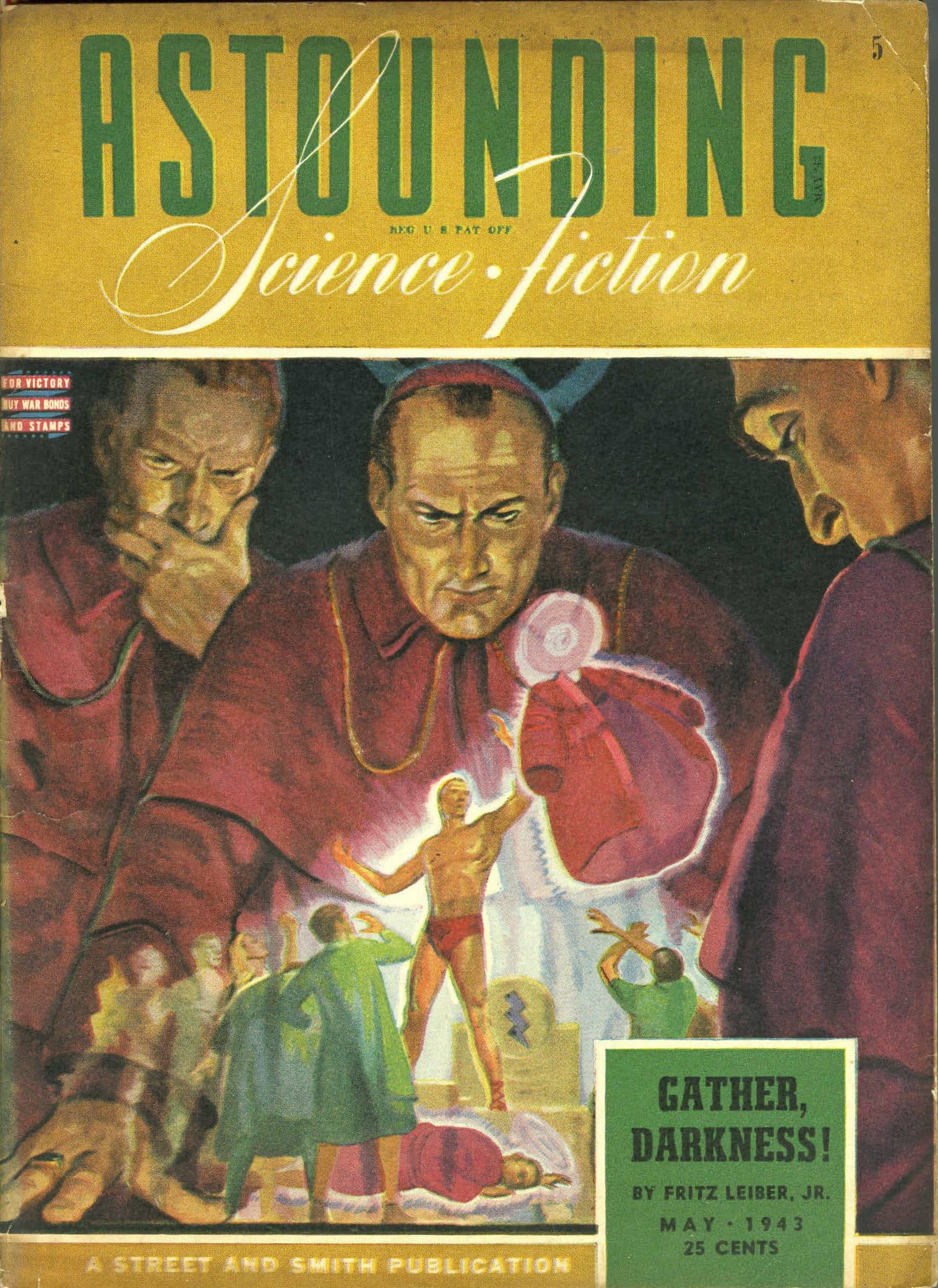
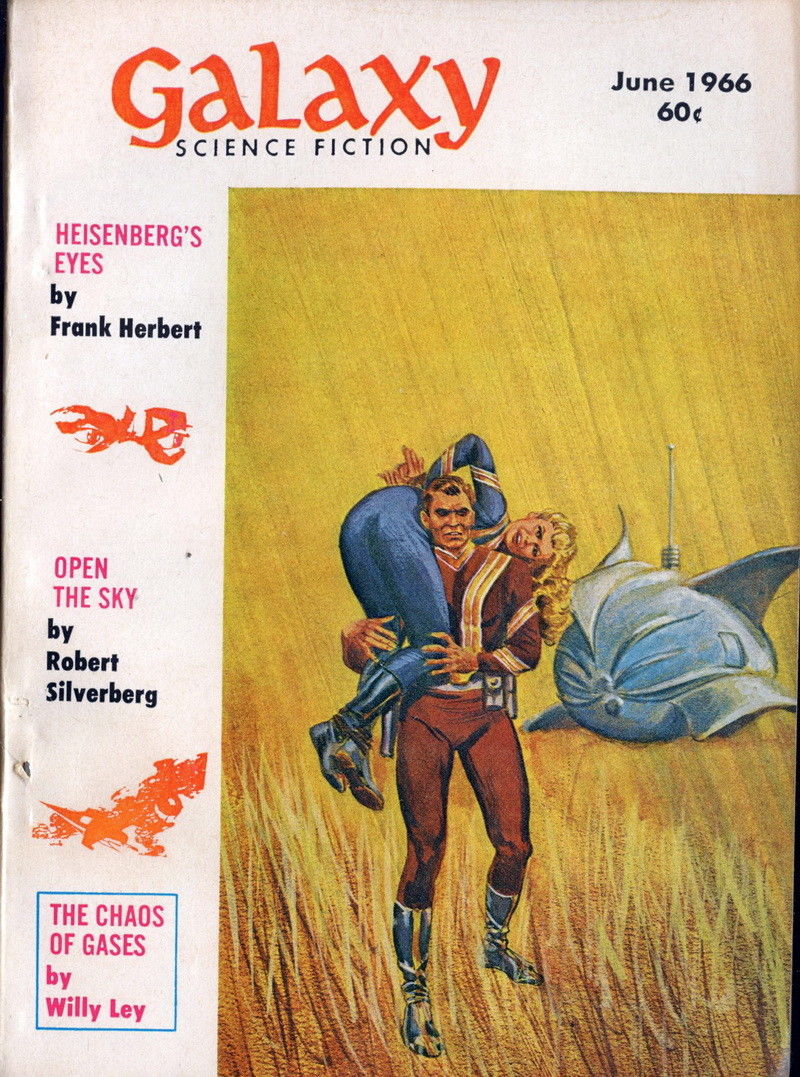
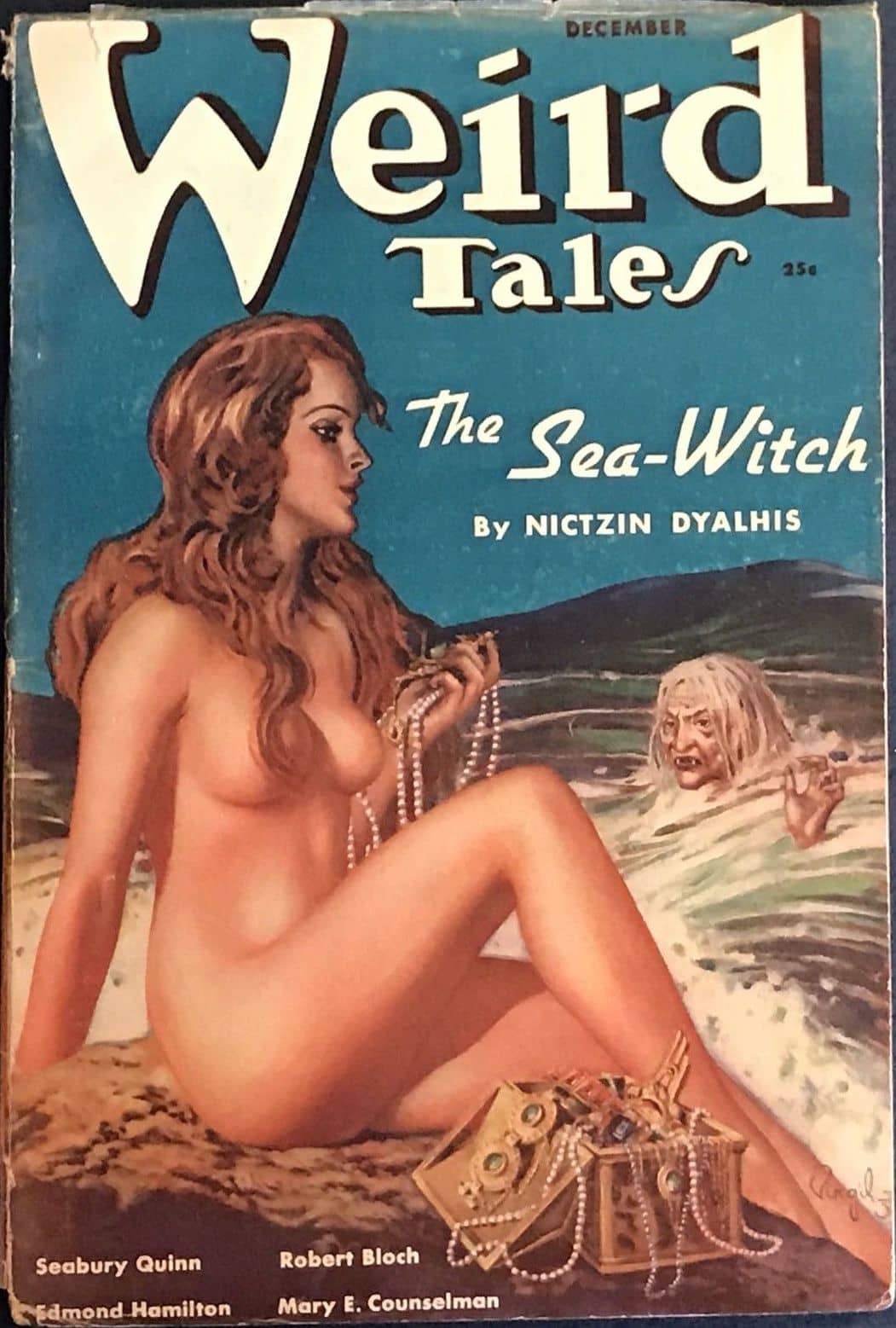
Cover by Howard V. Brown

Raymond Z. Gallun was born on March 22, 1911 and died on April 2, 1994.

Gallun was inducted into the First Fandom Hall of Fame in 1979. He wrote during a period when many authors focused on short fiction, and he did, although he also published several novels, including The Planet Strappers, Skyblaster, and Bioblast. His short fiction has been collected in two volumes, The Best of Raymond Z. Gallun and Anthology of Sci-Fi V4: Raymond Z. Gallun.

Gallun has collaborated with Robert S. McReady, Jerome Bixby, and he based a story on an outline by fan John B. Michel. In 1936, he participatws in a series novel with Eando Binder, Jack Williamson, Edmond Hamilton, and John Russell Fearn. Gallun has also used the pseudonyms Dow Elstar, William Callahan, and Arthur Allport.

“Magician of Dream Valley” was first published in the October 1938 issue of Astounding Science Fiction, edited by John W. Campbell. Forrest J. Ackerman and Pat LoBrutto included it in Perry Rhodan #71: The Atom Hell of Grautier in 1975 and in 1978 it was reprinted in The Best of Raymond Z. Gallun. In 1982, the story was translated into Italian for inclusion of a short collection of Gallun stories.

Jack Vickers in a reporter who had traveled to the moon to interview a recluse, Clyde Athelstane, also known as the “Magician of Dream Valley.” The valley, near Mare Imbrium, has a strange phenomenon known as Hexagon Lights. Vickers wants to learn what they are and what Athelstane might have to do with them.

Athelstane isn’t what Vickers was expecting and the hermit immediately presses the newsman into his service to care for the Hexagon Lights, which Athelstane claims are being threatened by human lunar mining and may, in fact, be sentient beings. Even as Vickers realizes the Athelstane is insane, he works with him to try to protect the Hexagon Lights against possible destruction. In the end, however, Vickers breaks free from Athelstane’s spell, believing the Lights to be more dangerous than endangered.

Read More Read More

Birthday Reviews: Terry Dowling’s “The Last Elephant”

Birthday Reviews: Terry Dowling’s “The Last Elephant”

Cover by Nick Stathopoulos

Terry Dowling was born on March 21, 1947. Most of Dowlings fictional output is at short story length, although the stories about Tom Rynosseros are connected and have been collected in four volumes. Dowling has also published the novel Clowns at Midnight. He edited the anthology Mortal Fire: Best Australian SF with Van Ikin and worked with Richard Delap and Gil Lamont to edit The Essential Ellison.

Dowling has received four Aurealis Awards and twelve Ditmar Awards. In 1988, he won the Ditmar for Best Long Fiction for his story “For as Long as You Burn” and the Ditmar for Best Short Fiction for “The Last Elephant.” His collection Basic Black: Tales of Appropriate Fear won an International Horror Guild Award and the collection Wormwood received a Readercon Award. Basic Black was also nominated for the Bram Stoker Award, and Dowling has three World Fantasy Award nominations.

“The Last Elephant” first appeared in Australian Short Stories issue #20, published in 1987 and edited by Bruce Pascoe. In 1994, Paul Collins included it in his Metaworlds: Best Australian Science Fiction and Dowling has reprinted the story in three collections, An Intimate Knowledge of the Night, Antique Futures: The Best of Terry Dowling, and Make Believe: A Terry Dowling Reader.

Dowling tackles endangered species in “The Last Elephant,” describing the festivities and hoopla around Terrence Harm, whose job it is to inspect Caza, believed to be the last living elephant. While Harm cares about the creature and understands the importance of preserving it for as long as possible, he also understands the quality of life issues that come into play and realizes that the more humane course of action may be to announce that Caza is ready to die.

However, when Harm finally visits the last elephant, it is not quite the situation Dowling has prepared the reader for. The questions of ecology Dowling appeared to be setting up are not the issues that Harm actually faces, and Caza is important to the culture in a very different way. Dowling’s story shows that while preservation is important, it can be achieved in different ways, and although they may not be entirely satisfying, they carry their own significance.

Read More Read More

Birthday Reviews: Pamela Sargent’s “Broken Hoop”

Birthday Reviews: Pamela Sargent’s “Broken Hoop”

Rod Serling’s The Twilight Zone Magazine June 1982-small Rod Serling’s The Twilight Zone Magazine June 1982-back-small

Cover by Malcolm MacNeill

Pamela Sargent was born on March 20, 1948. Sargent edited the Women of Wonder anthologies, which explore the work of women science fiction authors. She has also edited three Nebula award anthologies. Her own fiction includes the Venus trilogy, the Seed trilogy, and the Watchstar trilogy. Stand alone novels include Climb the Wind, Ruler of the Sky, and The Shore of Women. She has co-written Star Trek novels with her husband, George Zebrowski.

Pamela Sargent’s story “Danny Goes to Mars” received the Nebula Award for Best Novelette and was also nominated for the Hugo Award and Theodore Sturgeon Memorial Award. Her novel Climb the Wind was nominated for the Sidewise Award and she was long listed for the James Tiptree Jr. Memorial Award twice. In 2000, she and Zebrowski received the Service to SFWA Award and in 2012, she received a lifetime Pilgrim Award from the Science Fiction Research Association.

“The Broken Hoop” first appeared in Rod Serling’s The Twilight Zone Magazine in its June 1982 issue, edited by T.E.D. Klein. Josh Pachter selected it for his 1985 British anthology Top Fantasy and Pamela Sargent included the story in two of her collections, The Best of Pamela Sargent and Eye of Flame.

Read More Read More

Birthday Review: John Gribbin’s “Something to Beef About”

Birthday Review: John Gribbin’s “Something to Beef About”

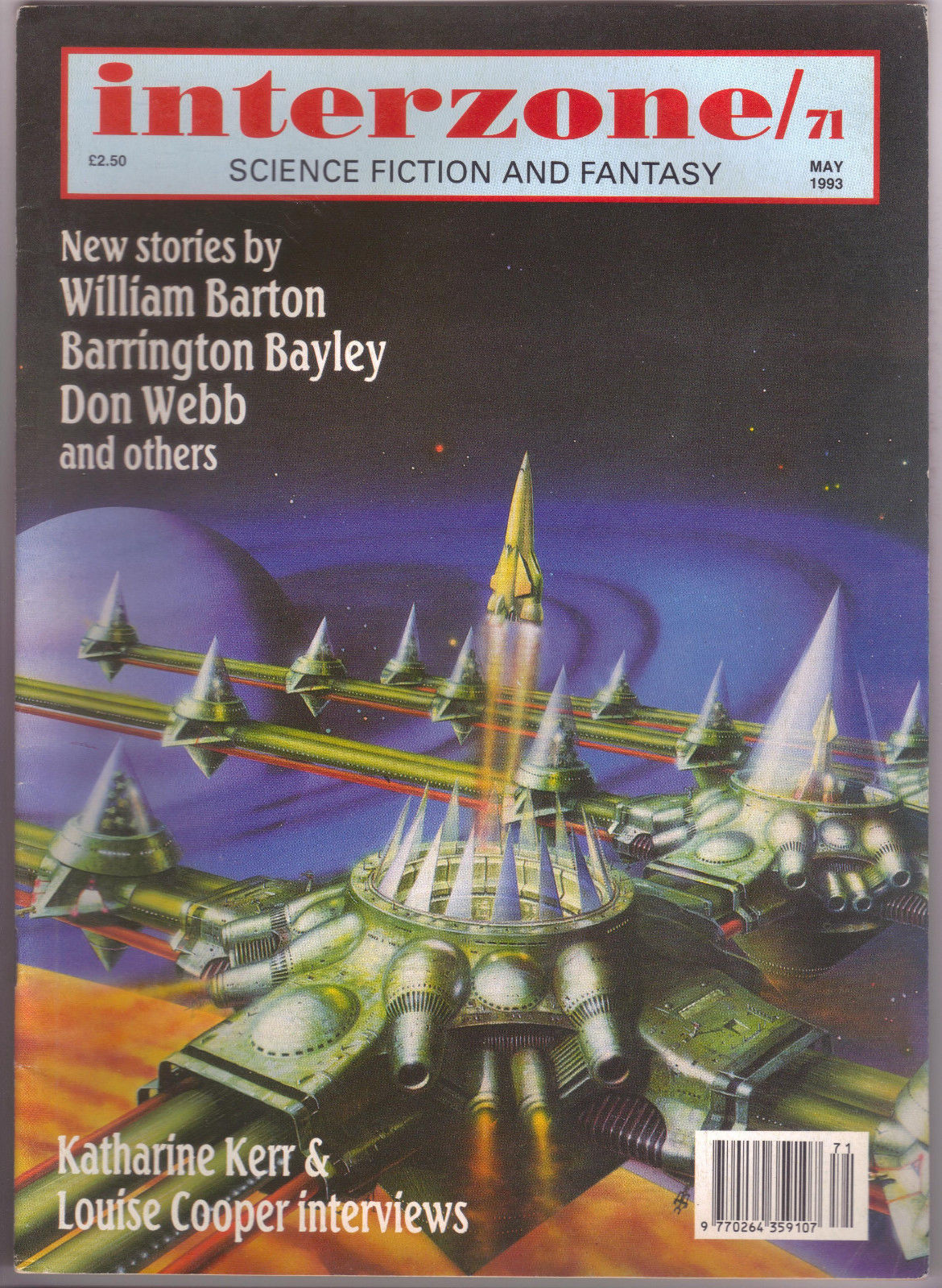
Interzone 49-small Interzone 49-contents-small

Cover by Tim White

John Gribbin was born on March 19, 1946. Gribbin has published both fiction and non-fiction, including non-fiction titles The Jupiter Effect with Stephen Plagemann, In Search of the Big Bang, and The Science of Philip Pullman’s His Dark Materials with Mary Gribbin. His own novels include The Sixth Winter with Douglas Orgill, Ragnarok with D.G. Compton, and solo works Timeswitch and Father to the Man.

“Something to Beef About” was first published in Interzone 49 in July 1991, edited by David Pringle and Lee Montgomerie. In 2016, a revised version of the story was reprinted in the anthology Existence is Elsewhen, published by Elsewhen Press.

Gribbin opens “Something to Beef About” by falling into the trap described by Mark Rosenfelder in his satirical “If All Stories Were Written Like Science Fiction.” He describes the mundane aspects of David Jenkins’s life in an attempt to set up a future society in which Jenkins lives, but for the most part it comes across as telling the readers something they should already know. Instead of setting the scene, it makes the reader very aware that the story is a construct.

Read More Read More

Birthday Reviews: Marcos Donnelly’s “As a Still Small Voice”

Birthday Reviews: Marcos Donnelly’s “As a Still Small Voice”

Full Spectrum 2-small Full Spectrum 2 flap-small

Cover by Peter Stallard

Marcos Donnelly was born on March 18, 1962. He has published a handful of short stories, mostly dealing with religious themes and three novels, Prophets for the End of Time, Letters from the Flesh, and The Mostly Weird Chronicles of Steffan McFessel, the last in collaboration with Ted Wenskus.

Donnelly’s debut story, “As a Still Small Voice,” appeared in 1989 in Full Spectrum 2, edited by Lou Aronica, Shawna McCarthy, Amy Stout, and Pat LoBrutto. It has never been reprinted.

Father Jim is a priest at a small seminary where the rumors that one of the students, Danny, actually hears God’s voice. Jim has mixed views about Danny’s gift and sees him as an innocent child who needs to be protected, particularly from one of the other students, Bob, an older man who has come to the seminary after servicing in the marines. Jim can only see Bob as a bad influence on Danny, although the reasons for Jim’s mistrust don’t seem to be fully justified by anything aside from Jim’s own biases.

Read More Read More

Birthday Reviews: James Morrow’s “The Fate of Nations”

Birthday Reviews: James Morrow’s “The Fate of Nations”

Cover by John Picacio

James Morrow was born on March 17, 1947. In addition to the novels in his Godhead trilogy, beginning with Towing Jehovah, Morrow has written several other books, including Galápagos Regained and The Last Witchfinder.  Many of his works deal with the role of religion in a rational society.  He has also edited three volumes of Nebula Award anthologies as well as the SFWA European Hall of Fame, the last with his wife, Kathryn Morrow.

James Morrow won the Nebula in 1989 for his Short Story “Bible Stories for Adults No. 17: The Deluge” and again in 1993 for the novella City of Truth. His novel Towing Jehovah and novella Shambling Towards Hiroshima were nominated for both the Hugo and the Nebula.  Towing Jehovah and Only Begotten Daughter both received the World Fantasy Award for Best Novel and Shambling Towards Hiroshima won a Theodore Sturgeon Memorial Award. A translation of Towing Jehovah received the Grand Prix de l’Imaginaire.

“The Fate of Nations” was originally published in Ellen Datlow’s Sci Fiction on May 14, 2003.  Morrow included it in his 2004 collection The Cat’s Pajamas & Other Stories and it was also reprinted by Paula Guran in Future Games.

Morrow produces a short, clever conspiracy story in “The Fate of Nations.” It’s written as a diary entry by Carlotta, who explains something she’s just learned that has surprised her.  Her husband has developed an avid interest in sports, cheering on all sorts of teams and watching games to the detriment of their relationship. When she asks him to attend a marriage counselor, she learns the truth about a conspiracy of all men with interstellar ramifications.

Read More Read More

Birthday Reviews: P.C. Hodgell’s “Knot and the Dragon”

Birthday Reviews: P.C. Hodgell’s “Knot and the Dragon”

Cover by Tom Wood
Cover by Tom Wood

P.C. (Patricia Christine) Hodgell was born on March 16, 1951. She has written the eight volume Chronicles of the Kencyrath, which began with God Stalk and continued most recently with The Gates of Tagmeth in 2017. God Stalk was nominated for the Mythopoeic Award as was its follow-up, Dark of the Moon.

“Knot and the Dragon” was originally published in Esther Friesner’s Chicks and Balances, the most recent addition to her long-running Chicks in Chainmail series. The story has not been reprinted.

One of the common tropes in fairy tales is the step-daughter whose father has died, leaving her with an unloving mother. Hodgell uses this set up for “Knot and the Dragon,” with Knot living with her step-mother, Marta, and her two step-sisters. Everyone in town makes it clear to Knot that she doesn’t fit in with them.

Knot’s character comes across as a mixture of a Cinderella-type mixed with Belle from Disney’s Beauty and the Beast, for Knot is constantly striving to learn more about the world in which she finds herself, lamenting the death of her father, with whom she had things in common, but also accepting her current life.

Reports of nearby dragon attacks further bring out the town’s character, with the villagers firm in their belief that since they haven’t done anything wrong, there is no reason the dragon would punish them. Naturally enough, this conviction is enough (narratively) to bring a dragon down on their village, and they decide that Knot should essentially be a sacrifice to the dragon.

Rather than do as she was instructed, Knot seeks out the witch who lives nearby ever since she was forced from her home by the dragon. Although the witch’s first inclination is to flee with her son, who was accidentally turned into a pig during her last encounter with the dragon, the witch agrees to offer (dubious) help to Knot.

Read More Read More

Birthday Reviews: Rosel George Brown’s “David’s Daddy”

Birthday Reviews: Rosel George Brown’s “David’s Daddy”

Fantastic Science Fiction Stories June 1960 Fantastic Science Fiction Stories June 1960-contents 2-small

Cover by Burt Shonberg

Rosel George Brown was born on March 15, 1926 and died on November 26, 1967. She participated in the Milford Writers Workshop and in 1959 was nominated for a Hugo for Best New Author (losing to No Award; Brian W. Aldiss and Kit Reed were also nominated that year!)

Brown wrote the novel Galactic Sibyl Sue Blue and a sequel that was published posthumously. She also collaborated with Keith Laumer on Earthblood. Many of her short stories were collected in A Handful of Time.

“David’s Daddy” was originally published in Fantastic Science Fiction Stories in the June 1960 issued, edited by Cele Goldsmith. Judith Merril included the story in The 6th Annual of the Year’s Best SF and Ellen Datlow reprinted it in Sci Fiction on July 2, 2003.

In many ways “David’s Daddy” is a sadly prescient story. It is set in an elementary school where Lillian is a new teacher, learning the ropes from Miss Fremen, who has been there for twenty years. In the process of sharing tips, Miss Fremen also mentions that one of her students, Jerome, seems to have a strange sort of mental telepathy.

Read More Read More

Birthday Reviews: Tad Williams’s “Go Ask Elric”

Birthday Reviews: Tad Williams’s “Go Ask Elric”

Elric Tales of the White Wolf-small Elric Tales of the White Wolf-back-small

Cover by Brom

Tad Williams was born on March 14, 1957. He published the Memory, Sorry & Thorn fantasy series beginning in 1988 and followed up with the Otherland series in 1996 and Shadowmarch in 2004. Williams has also published a handful of stand alone novels, including Tailchaser’s Song and Caliban’s Hour. He collaborated with Nina Kiriki Hoffman on Child of an Ancient City.

Williams was a nominee for the John W. Campbell, Jr. Award in 1986 and the next year Tailchaser’s Song was a nominee for the William L. Crawford Award. Two of his novels have been nominated for Germany’s Phantastik Preis.

“Go Ask Elric” was published in 1994 in Elric: Tales of the White Wolf, a Michael Moorcock Festschrift which allowed other authors to play with Moorcock’s settings, characters, and themes. The story was translated into French for inclusion in an abridged version of the anthology as a whole. Williams later included it in his collection Rite: Short Work, which also included an essay Williams wrote as an introduction to Moorcock’s novel Gloriana.

Williams manages a successful homage to Michael Moorcock in “Go Ask Elric,” pulling in elements from Moorcock’s stories “Elric at the End of Time” as well as “the Vanishing Tower” and “Sailing to the Future.” Rather than focusing on Elric, William’s main character is Pogo Chapman, a young kid who worships Jimi Hendrix in the mid-1970s. During an acid trip, Pogo is sucked into the multiverse where he meets up with an imprisoned Elric and helps him escape. As Moorcock did in “Elric at the End of Time,” Williams switches between Elric’s point of view and Pogo’s, allowing the reader to see just how much Elric misreads the situations he is in.

Read More Read More

Birthday Reviews: Alastair Reynolds’s “A Spy in Europa”

Birthday Reviews: Alastair Reynolds’s “A Spy in Europa”

Cover by SMS
Cover by SMS

Alastair Reynolds was born on March 13, 1966.

Reynolds has won the British SF Association Award for his novel Chasm City, the Seiun Award for a translation of his short story “Weather” and the Sidewise Award for his short story “The Fixation.” His various works have been nominated for the Italia Award, addition Seiun and BSFA nominations, the Philip K. Dick Award, John W. Campbell Memorial Award, the British Fantasy Award, the Arthur C. Clarke Award, and the Hugo Award. His novella Diamond Dogs was adapted as a play by Althos Low at the Chopin Theatre in Chicago.

“A Spy in Europa” was originally published in issue #120 of Interzone, edited by David Pringle, in June 1997. Gardner Dozois reprinted the story the next year in The Year’s Best Science Fiction: Fifteenth Annual Collection and Reynolds included it in his 2006 collection Galactic North. Part of the Revelation Space series, the story was translated into Japanese in 1997.

Marius Vargovic is the titular agent in “A Spy in Europa.” With the four Galilean moons divided between two political entities, the Demarchy on Europa and Io and Gilgamesh Isis on Ganymede and Callisto, Vargovic is being sent to Callisto because a sleeper agent, Cholok, has become active and has information that he needs to retrieve.

Vargovic’s exact mission is never fully laid out, but it involves getting information from Cholok about a method of undermining the floating cities of Europa, and undergoing surgery to alter his body to allow him to breathe underwater, part of the cover he has given to the local authorities.

Europa is a world of bioengineering, and one of the subspecies are the Denizens, created for slave labor and now banished to portions of the Europan sea near heated vents. Little is known about the Denizens and Vargovic tries to supplement his mission by finding out about them, a goal made easier when his rendezvous point is changed and he finds himself chased by Europan agents until he is rescued by the Denizens.

Read More Read More