Browsed by
Author: Steven H Silver

Birthday Reviews: Peter S. Beagle’s “King Pelles the Sure”

Birthday Reviews: Peter S. Beagle’s “King Pelles the Sure”

Cover by Lisa Snelling

Peter S. Beagle was born on April 20, 1939.

Beagle received the Nebula Award and Hugo Award for his novelette “Two Hearts,” set in the same world as his classic novel The Last Unicorn. He received the Mythopoeic Award in 1987 for his novel The Folk of the Air and in 2000 for the novel Tamsin.  His collection The Rhinoceros Who Quoted Nietzsche and Other Odd Acquaintances received the Grand Priz de l’Imaginaire and his story “El Regalo” received the WSFA Small Press Award. He has been nominated for the World Fantasy Award seven times, and in 2011 received their Lifetime Achievement Award. In about a month, Beagle will be inducted as a SFWA Grand Master at the 2018 SFWA Nebula Conference in Pittsburgh, PA.

“King Pellas the Sure” was first published in the chapbook Strange Roads, which contained three original stories by Beagle. David G. Hartwell and Kathryn Cramer included the story in Year’s Best Fantasy 9 and Rich Horton included it in The Year’s Best Science Fiction and Fantasy, 2009 Edition. Beagle has included the story in two of his own collections, We Never Talk About My Brother and Mirror Kingdoms: The Best of Peter S. Beagle.

“King Pelles the Sure,” focuses on the monarch of an infinitesimal kingdom who yearns for the glory that he sees warrior kings attaining. Despite the protestations of his Grand Vizier, who has already seen what war really does, as opposed to the glorification of war that is the stuff of bards and legend, King Pelles insists that they arrange to be invaded by one of their neighbors.

In this strangely manufactured war, Beagle’s story recalls the 1955 Leonard Wibberley novel The Mouse That Roared, although Beagle’s story is much less satirical than Wibberly’s. After the war begins, King Pelles finds that no matter what his intentions, once the dogs of war have been loosed, they can not be effectively reined in. The tale could have been a trite fairy tale, but the manner in which Beagle teaches Pelles a variety of lessons makes it a memorable fable.

Reviewed in its original publication in the collection Strange Roads, by Peter S. Beagle, DreamHaven, 2008.

Read More Read More

Birthday Reviews: Adrian Rogoz’s “The Altar of the Random Gods”

Birthday Reviews: Adrian Rogoz’s “The Altar of the Random Gods”

Almanahul literar
Almanahul literar

Adrian Rogoz was born on April 19, 1921 in Bucharest Romania, and died on July 28, 1996. He was a founding member of the first science fiction fan club in Romania, SF Cenacle. In addition to his own work, Rogoz translated works by Ivan Efremov and Stanislaw Lem into Romanian.

“The Altar of the Random Gods” was originally published in Almanahul literar in 1970 as “Altarul zeilor Stohasrici.” Its English translation first appeared in Franz Rottensteiner’s anthology of European science fiction View from Another Shore, and has been included in several reprints of that volume. The story has also been translated into French, Dutch, Hungarian, German (twice), Serbian, and Italian.

In this translation of “The Altar of the Random Gods,” by Matthew J. O’Connell, Rogoz describes the trip from Mobile to Huntsville Alabama via a superfast highway of computer controlled cars. Homer is making the journey and looking forward to seeing Barbara at the end of it when a freakish malfunction occurs.

The story is interesting not because of its predictions about technology or the way Homer takes the superhighspeed transportation for granted, but rather because of the way it feels like a mixture of science fiction and fantasy. The first half of the story, up until the collision, is clearly in the realms of science fiction, tothe point where Rogoz’s descriptions (or at least the translations of those descriptions) feels clichéd.

Following the accident, the story moves more into the realm of fantasy, with Homer meeting three gods, who may well be aliens, who explain to him what has happened. Rather than speak in the terms gods in fantasy stories usually use, the gods in “The Altar of the Random Gods” speak in terms of probability, using mathematics to tell Homer what has happened to him and what he can expect for his life going forward.

Read More Read More

Birthday Reviews: Keith R.A. DeCandido’s “A Vampire and a Vampire Hunter Walk into a Bar”

Birthday Reviews: Keith R.A. DeCandido’s “A Vampire and a Vampire Hunter Walk into a Bar”

Amazing Stories
Amazing Stories

Keith R.A. DeCandido was born on April 18, 1969.

DeCandido has written the Precinct series as well as works in a number of licenses series, including Star Trek, Buffy the Vampire Slayer, StarGate SG-1, and Dungeons and Dragons  In 2005, he published the official novelization of the film Serenity. DeCandido has also written numerous comics and blogs for Tor.com. In 2009, he was inducted as a Grand Master by the Scribe Awards for his work on media tie-in publications.

“A Vampire and a Vampire Hunter Walk Into a Bar” was published in the final print issue of Amazing Stories from Paizo Publishing, cover dated February 2005. The story has not been reprinted since.

The very clichés which DeCandido skewers in “A Vampire and a Vampire Hunter Walk Into a Bar” are what cause the story to work. On its surface, it’s the tale of the two title characters sitting in a bar complaining about the expectations the public has about them, particularly the vampire, based on the films Nosferatu, Dracula, and the television series Buffy the Vampire Slayer.

However, the very sense of camaraderie the characters show is based on the idea that during the Victorian period, when Dracula was first published, gentlemen antagonists would have a level of respect for each other’s abilities.

The story is a lighthearted look at two individuals whose (incredibly long) lives are linked together. The humor of the piece comes from how pedestrian their interaction is under the most extraordinary of circumstances. The story also serves to deconstruct the vampire story by questioning all of the things people “know” about vampires.

Read More Read More

Birthday Reviews: Lloyd Biggle, Jr.’s “Gypped”

Birthday Reviews: Lloyd Biggle, Jr.’s “Gypped”

Galaxy Science Ficiton July 1956-small Galaxy Science Ficiton July 1956-back-small

Cover by Jack Coggins

Lloyd Biggle, Jr. was born on April 17, 1923 and he died on September 12, 2002.

Biggle was nominated for the Hugo Award for his short story “Monument” and for the William Atheling, Jr. Award for Criticism or Review for his essay “The Morasses of Academe Revisited.” He was a musician and oral historian and helped found and run the Science Fiction Oral History Association. He was also the founding treasurer of the Science Fiction Writers of America.

His first published short story was “Gypped,” which was bought by H.L. Gold and published in the July 1956 issue of Galaxy Science Fiction. It was translated into French for an appearance in the French edition of the magazine the following year. Its only other appearance was in the anthology Science Fiction for the Throne: One-Sitting Reads, edited by Tom Easton and Judith K. Dial.

“Gypped” is the story of a bureaucrat assigned a desk in a distant backwater. Occasionally he has to deal with strange cultural requests and in order to make his life easier, he sends people on wild goose chases covering many light years, figuring that if they ever returned, he could deal with the situation then. In the meantime, he continues his work reasonably uninterrupted and amuses himself by thinking of the places he’s sent people.

Read More Read More

Birthday Reviews: Kingsley Amis’s “Mason’s Life”

Birthday Reviews: Kingsley Amis’s “Mason’s Life”

The Young Oxford Book of Nightmares-small

Cover by George Smith

Kingsley Amis was born on April 16, 1922 and died on October 22, 1995.

Amis won the 1977 John W. Campbell Memorial Award for his alternate history novel The Alteration. In 1990 he was knighted and made a Commander of the British Empire for his services to literature. Some of his major works included the novel Lucky Jim and the essay collection New Maps of Hell. He edited the five volume anthology series Spectrum with Robert Conquest. Amis’s son, Martin, also became a novelist and has written within the speculative fiction genre.

Amis originally published “Mason’s Life” in The Sunday Times in 1972. Harry Harrison and Brian W. Aldiss included it in their Best SF: 1973. Helen Hoke included the story in Ghostly, Grim and Gruesome. The story reappeared in Amis’s collection Collected Short Stories. Peter Haining used it in Ghost Tour and Sebastian Wolfe included it in The Little Book of Horrors: Tiny Tales of Terror. When James E. Gunn expanded his The Road to Science Fiction, he included the story in volume 5, The British Way, and in 2000 it was included in The Young Oxford Book of Nightmares, edited by Dennis Pepper. “Mason’s Life” was translated into French in 1979 and 1984.

“Mason’s Life” is an existential piece of fiction that describes an encounter between Daniel Pettigrew and George Herbert Mason. In their encounter, Pettigrew seems exceedingly pushy, demanding personal information of Mason moments after the two meet. Although Mason balks, he does provide Pettigrew with the requested details. Pettigrew eventually explains that he needs them so he can discover if Mason is part of Pettigrew’s dream or one of the few real people in the world.

Read More Read More

Birthday Reviews: Jim C. Hines’s “Spell of the Sparrow”

Birthday Reviews: Jim C. Hines’s “Spell of the Sparrow”

Sword and Sorceress XXI-small Sword and Sorceress XXI-back-small

Cover by Arthur Rackham, 1910

Jim C. Hines was born on April 15, 1974.

Hines took first place in the Writers of the Future first quarter contest in 1999 for his story “Blade of the Bunny.” His novel Red Hood’s Revenge was nominated for the Gaylactic Spectrum Award. In 2012, he won the Hugo Award for Best Fan Writer.

“Spell of the Sparrow” first appeared in Sword and Sorceress XXI, edited by Diana L. Paxson. An audio version was included in PodCastle 13, edited by Rachel Swirsky. Hines included it in his e-book collection Kitemaster and Other Stories and it was also reprinted in his collection The Goblin Master’s Grimoire.

While there are many tales of changelings and children who are abducted by fairies, Hines goes for a different story in “Spell of the Sparrow.” Alycia and James are two happily married former thieves with a daughter who, against her mother’s wishes, sneaks off to practice magic. Their lives are thrown into turmoil when Basi, a Cloudling, turns up, having cast a love spell on James. Although Hines explains that Cloudlings use bird magic, and Basi has a sparrow as a familiar, he never fully explains what she is, nor why she chose to cast a spell on James.

“Spell of the Sparrow” is a puzzle story, with James in love with both Alycia and Basi, unable and unwilling to betray either one. Alycia and their daughter, Mel, must try to figure out a way to break the spell, although Basi, and Hines, set enough strictures on the way Cloudling magic works and Mel’s abilities that breaking the spell becomes nearly impossible.

Read More Read More

Birthday Reviews: Rachel Swirsky’s “The Monster’s Million Faces”

Birthday Reviews: Rachel Swirsky’s “The Monster’s Million Faces”

Cover by Shaun Tan
Cover by Shaun Tan

Rachel Swirsky was born on April 14, 1982. To this point, her writing career has been focused on short stories, although in 2010 she co-edited the anthology People of the Book: A Decade of Jewish Science Fiction and Fantasy with Sean Wallace. Her stories have been collected in two volumes, Through the Drowsy Dark and How the World Became Quiet: Myths of the Past, Present, and Future.

Swirsky won the Nebula Award for Best Novella in 2010 for her story “The Lady Who Plucked Red Flowers beneath the Queen’s Window” and the Nebula for Best Short Story in 2014 for “If You Were a Dinosaur, My Love.” She has been nominated for four additional Nebulas as well as four Hugos and four World Fantasy Awards, including nominations for both of her Nebula winning stories for all of those Awards. Swirsky was a Theodore Sturgeon Memorial Award finalist for “Eros, Philia, Agape” and also has a Rhysling Award nomination for her poem “The Oracle on River Street.”

“The Monster’s Million Faces” was first published at Tor.com on September 8, 2010, acquired by Patrick Nielsen Hayden. In February of the following year, Tor issued the story as an electronic chapbook and they included it in their massive e-book The Stories: Five Years of Original Fiction on Tor.com in 2013. That same year, the story saw its first print publication when Swirsky included it in her collection How the World Became Quiet: Myths of the Past, Present, and Future.

Monsters come in all forms and Swirsky examines them in “The Monster’s Million Faces,” a story about Aaron, who was kidnapped and abused for five days when he was eight years old. As an adult he is trying to deal with the trauma, especially after he attacked his boss in a blind rage brought on by her sexual advances.

Aaron is working with a psychiatrist, Dana, who puts him into a series of trances, not just to have him confront his abuser, but to try to figure out what sort of false memory they can graft onto him to help him move past what happened to him. Never entirely explicit, the false memories he undergoes are each horrifying in their own way as he confronts different versions of his attacker, each with their own motive, many of which remain hidden to Aaron. At the same time, he tries to work through his own fear, anger, and rage to understand why a stranger, who has never been caught, would do what he did to an innocent eight year old.

Read More Read More

Birthday Reviews: Bill Pronzini’s “Cat”

Birthday Reviews: Bill Pronzini’s “Cat”

Cover by David Palladini

Bill Pronzini was born on April 13, 1943.

Although he has written significant science fiction, Pronzini is better known as a mystery author, specifically of the Nameless Detective series. He has also served as an editor on nearly 100 books, including some science fiction and fantasy anthologies, and occasionally with co-editors such as Martin H. Greenberg, Marcia Muller, to whom he is married, Ed Gorman, and others.

In 1981 Pronzini was nominated for the British Science Fiction Association Award for his story “Prose Bowl,” co-written with Barry N. Malzberg. He received a World Fantasy Award nomination the following year for his anthology Mummy! A Chrestomathy of Crypt-ology.

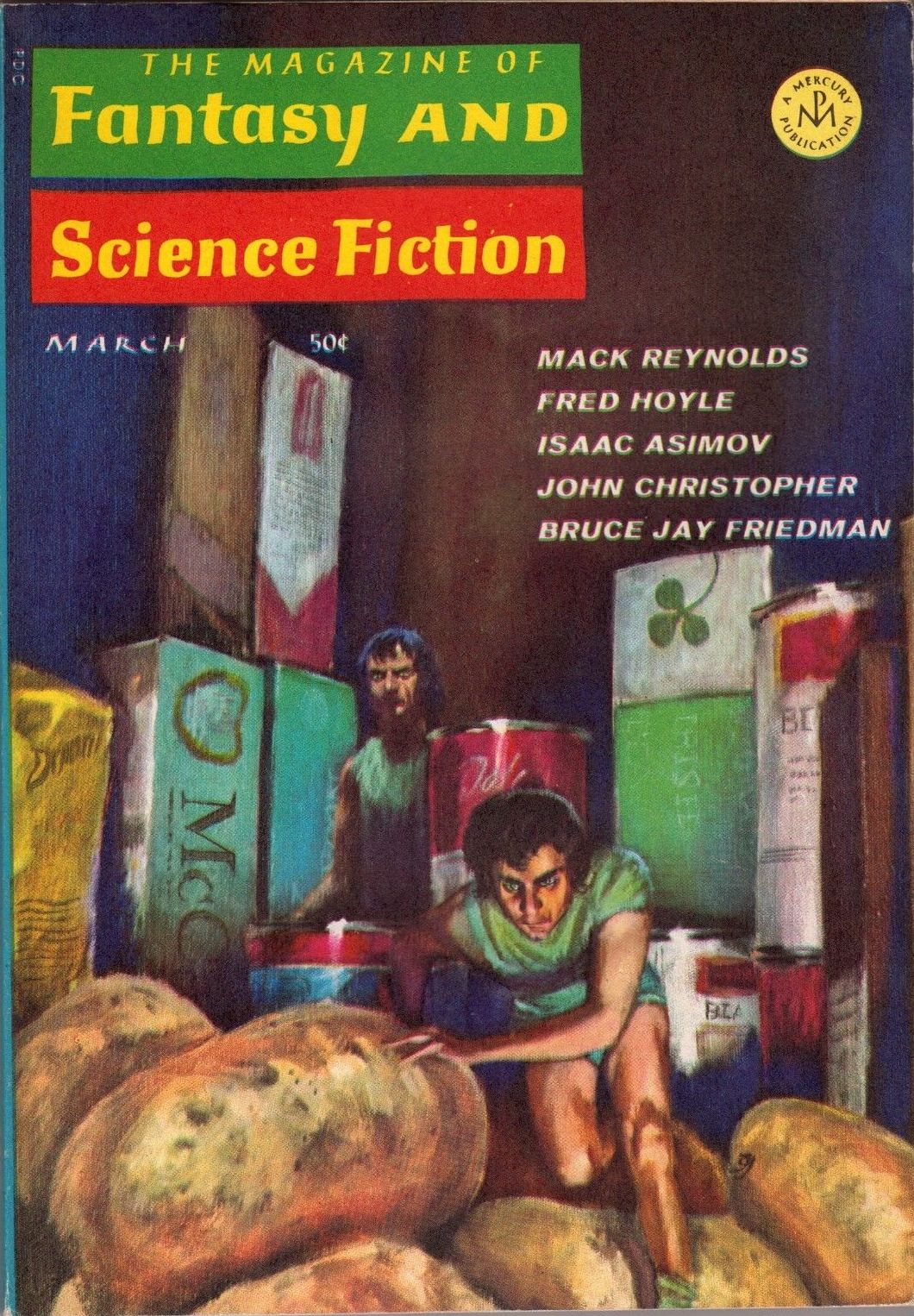
“Cat” was originally published by Edward L. Ferman in the November 1978 issue of The Magazine of Fantasy and Science Fiction. It was reprinted in a Portuguese edition of the magazine within a few years and was also translated into Italian for publication in Urania.

Cat stories are ubiquitous in science fiction, enough so that Andre Norton was able to publish five volumes in her Catfantastic anthology series, and other authors have also published anthologies of feline science fiction and fantasy. Pronzini’s “Cat,” surprisingly, hasn’t been reprinted in any of these anthologies. It is a sort of recursive science fiction, not in the usual sense, but because Benson, Pronzini’s main character, not only reads science fiction, but refers to the stories, by author and title, giving shout-outs to multiple Fredric Brown stories, as well as works by E. Hoffman Price, Jerome Bixby, George Langelaan, James Thurber, and others.

The basic premise is that a cat has wandered into Bronson’s house and he doesn’t know how it got there. Allowing his imagination to run wild, Bronson begins to feel uneasy about the cat’s presence, eventually turning to fear. Bronson’s emotion and response to the cat builds quite rapidly, until he decides to shoot the animal.

Read More Read More

Birthday Reviews: Emil Petaja’s “Found Objects”

Birthday Reviews: Emil Petaja’s “Found Objects”

Cover by Hannes Bok
Cover by Hannes Bok

Emil Petaja was born on April 12, 1915 and died on August 17, 2000.

Petaja published thirteen novels and more than 150 short stories. His Otava series, beginning with the novel Saga of Lost Earths, is based on the Finnish epic the Kalevala. Petaja was a close friend of artist Hannes Bok and founded the Bokanalia Foundation, which included a small art press, in 1967. He published three portfolios of Bok’s work as well as a commemorative volume. He was also the chairman of the Golden Gate Futurians, a San Francisco based science fiction club for professionals and fans. He was named the first Author Emeritus by SFWA in 1994.

“Found Objects” was originally published in Petaja’s collection Stardrift and Other Fantastic Flostsam in 1971, published by William L. Crawford’s Fantasy Publishing Company. Robin Wayne Bailey chose the story as one of five stories to represent Petaja in Architects of Dreams: The SFWA Author Emeritus Anthology, which covered the first five Author Emeriti named by SFWA.

Set in a contemporary San Francisco, “Found Objects” revolves around a party for a group of amateur artists as one of their number, the benefactor Triptich, is planning on departing San Francisco. He tells one of the guests, Jack Clay, that the purpose of the party is to help all of the attendees achieve a crest in their lives, a moment of perfect enjoyment before he has to leave, a concept which dovetailed neatly with thoughts Jack had while driving to the party.

Jack and his wife Mab don’t see eye to eye on things.  Jack just wants to do his own thing and move forward, while Mab likes to make life as difficult for those around her as possible, making a big show at the end to draw attention to herself. Her actions are passive-aggressive and for the purposes of Triptich’s party take the form of a refusal to wear the clothing he selected for her and then to disappear once she is at the party.

Read More Read More

Birthday Reviews: James Patrick Kelly’s “Rat”

Birthday Reviews: James Patrick Kelly’s “Rat”

The Magazine of Fantasy & Science Fiction June 1986-small The Magazine of Fantasy & Science Fiction June 1986-back-small

Cover by Michael Garland

James Patrick Kelly was born on April 11, 1951.

Although Kelly has published the novels Wildlife and Look Into the Sun, the majority of his fiction has been at shorter lengths, including the stories “Bernardo’s House,” “Mr. Boy,” and “One Sister, Two Sisters, Three.” In addition to his own novels and short stories, Kelly has edited several anthologies with John Kessel, and has collaborated with Kessel, Jonathan Lethem, Robert Frazier, and Mike Resnick on stories and poems.

Kelly won the Hugo Award for his novelettes “Think Like a Dinosaur” and “1016 to 1.” His novella Burn won the Nebula Award as well as the Italia Award. His works have also been nominated for the Seiun Award, the Gaylactic Spectrum Award, the James Tiptree, Jr. Award, and the Theodore Sturgeon Memorial Award. He is the author most published in Asimov’s Science Fiction Magazine, with both fiction and a regular column appearing in the magazine.

“Rat” was originally published in the June 1986 issue of The Magazine of Fantasy and Science Fiction, edited by Edward L. Ferman. It received a Nebula Award nomination for Best Short Story and was picked up by Orson Scott Card for the anthology Future on Fire and by Ursula K. Le Guin and Brian Attebery for The Norton Book of Science Fiction: North American Science Fiction, 1960-1990. Card reprinted it again in Masterpieces: The Best Science Fiction of the Century and Kelly included it in his collection Think Like a Dinosaur and Other Stories. When F&SF’s new editor, Gordon van Gelder, edited The Very Best of Fantasy & Science Fiction, Volume 2, he selected the story to be in the table of contents. The first two times the story was reprinted, it was translated into German for an appearance in Wolfgang Jeschke’s L wie Liquidator and French for Scott Baker’s Ombers portées.

Read More Read More