Medea
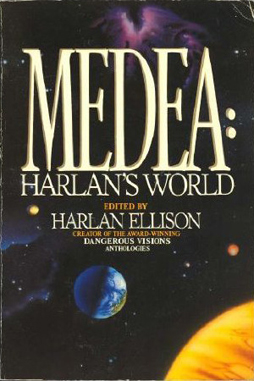 Lately in this space I seem to be writing a lot, one way or another, about worldbuilding. As it happens, I also read a book not long ago which both imagines a detailed science-fictional world and determinedly lifts the curtain on the group act of creation that generated the world. The book is Medea: Harlan’s World, and there are some interesting things to take away from it — not just ideas about worldbuilding, either.
Medea is in the lineage of shared-world books, though Ellison, who has expressed disdain for shared worlds, would likely dispute that; at any rate, it was originally conceived in 1975, but not published as a whole until 1985, so was imagined before Thieves’ World or Wild Cards or Liavek, before the articulation of the ‘shared world’ as a specific kind of endeavour. Perhaps ironically, Medea would spawn a kind of conceptual sequel, Murasaki, edited by Robert Silverberg, one of the participants in the Medea collaboration. Medea‘s an anthology of stories by different writers, all set on what is notionally the same science-fictional planet. Many of the individual stories were highly praised. Ellison’s “With Virgil Oddum at the East Pole” was selected for inclusion in The 1986 Annual World’s Best SF; Larry Niven’s “Flare Time” placed ninth in that year’s Locus poll for best novella; Frederik Pohl’s “Swanilda’s Song” placed fourth in the novelette category; Poul Anderson’s “Hunter’s Moon” won the Hugo Award for Best Novelette. Whether they work well together is in the eye of the beholder.
It doesn’t much read like the typical shared-world anthology. Ellison’s quite specific about that in his introduction, where he describes an editorial process that gladly welcomed individual takes on the basic concepts of the fictional world, even encouraging contradictions between stories: “Not only do I admit to the contradictions in these yarns, I champion them!” It probably does help give the book an idiosyncrasy unlike many shared worlds; the problem, I found, was that the individual stories were of varying quality (as one would expect of an anthology), none were really excellent, and they didn’t seem collectively to create a real unity out of the book. Then again, I also thought Medea as a whole was well worth reading for the extensive look at the creative process behind the making of the fictional world, and indeed for the look it gives us at a specifically science-fictional kind of creativity.
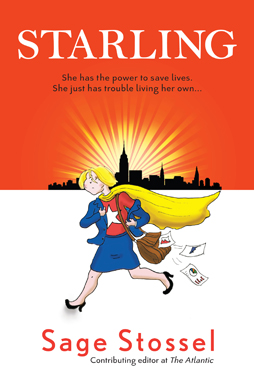 There’s a suspicion common in genre circles when a writer or creator from ‘the mainstream’ uses genre conventions or plot points. It’s sometimes a justified suspicion, as the writer unfamiliar with genre falls into cliché or loses control of their material through inexperience with the form. But sometimes something else happens: fresh eyes can find new truths. And every so often somebody approaching a genre by starting at square one can show why the classic genre material works in the first place — and even twist that material a bit to find new life for it going forward.
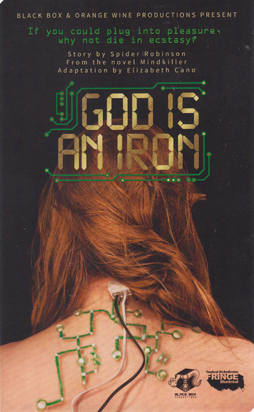 Monday, June 16, I went to see a show at the
 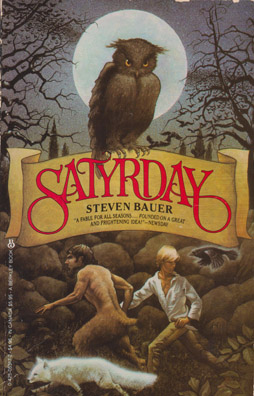 One of the interesting things about going back to the beginning of any tradition is seeing how things might have gone. Seeing, that is, possibilities unexplored and roads not taken. Sometimes you catch a glimpse of what, in retrospect, is an earlier stage of evolution. Sometimes there’s a sense of a missed chance. And then sometimes you can see why things went the way they did.
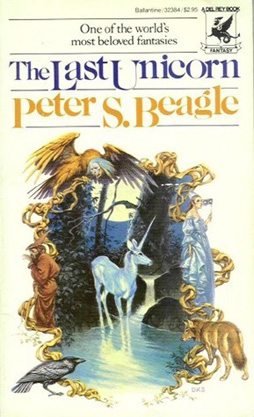 In 1962, Peter S. Beagle began writing a fantasy novel he called The Last Unicorn. Published in 1968, the book was both serious and whimsical, a kind of extended fable about a unicorn who found she was the last of her kind and adventured through a medieval fantasyland, possibly Irish and possibly not, in search of the wicked king holding all other unicorns captive. The tone embraced both the comic (one of the major characters is an incompetent magician named Schmendrick) and the dreamlike (as in the terrifying Red Bull who emerges as a crucial antagonist). The book’s a tremendous accomplishment, a vivid working-out of classic fantasy themes.
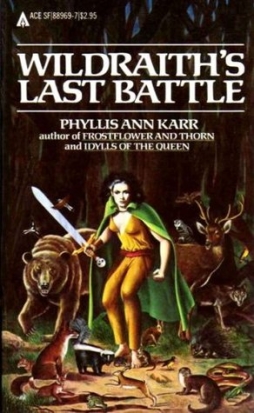 A little while ago,
 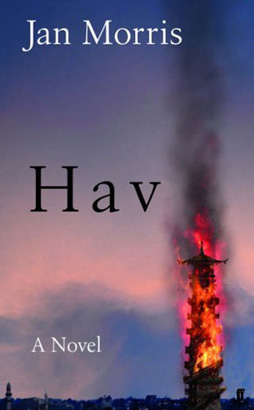 In 1984, writer Jan Morris spent several months in Hav, an idiosyncratic city in the Eastern Mediterranean. She left it just ahead of a violent insurrection and collected her letters describing the city into a book, Last Letters From Hav. Twenty years later, she returned to Hav to document what had changed, in a piece called Hav of the Myrmidons. Both were collected together in one volume, called simply Hav.
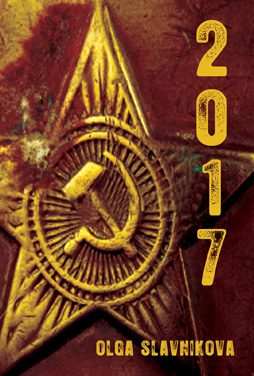 Every so often, I come across a book so idiosyncratic I have to write about it just to work out what it is I’ve read. A book strange and powerful, but whose power is difficult to locate or specify. Sometimes it’s hard even to be sure whether the book can be called ‘good’ in any meaningful way. By writing about it, I can get some thoughts in order, and see where they lead. And as such, I want to take a look here at Olga Slavnikova’s 2017.
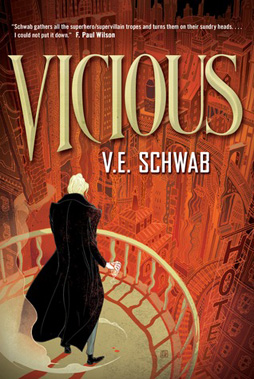 V.E. Schwab had written a number of YA novels when, in 2013, Tor published her book Vicious. Billed by some as a super-hero story, it had elements of that genre while also, to some extent, questioning its assumptions. Reading it, I found that the book seemed interested in questions of morality, heroism, and villainy, but that the super-hero aspects were so attenuated I doubt it would have occurred to me to consider it as a super-hero story without the claims of the book jacket. Its handling of ideas of heroism felt like a reiteration of themes comics (Marvel, DC, and independent) have been interrogating relentlessly (if not neurotically) for at least thirty years. In some ways, it’s best to simply ignore the ‘super-hero’ tag. If you do, you’re left with a well-paced and sharply-structured novel. And on its own terms, it’s an enjoyable tale.
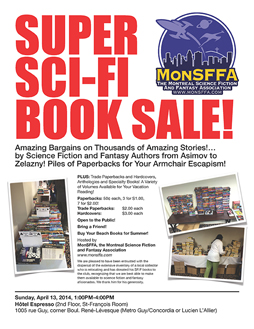 Leaving the dark brick stairwells of the Lucien L’Allier métro last Sunday morning at 10, we found the rain was holding off: something not to be expected. Forecasts called for meteorological chaos in Montréal over the following days. Up to 24 degrees celsius, down to 2, thunderstorms, snow. But that was in the future. For the moment, Grace and I were looking for books to hold us through those unsettled days and more.