Browsed by
Author: John ONeill

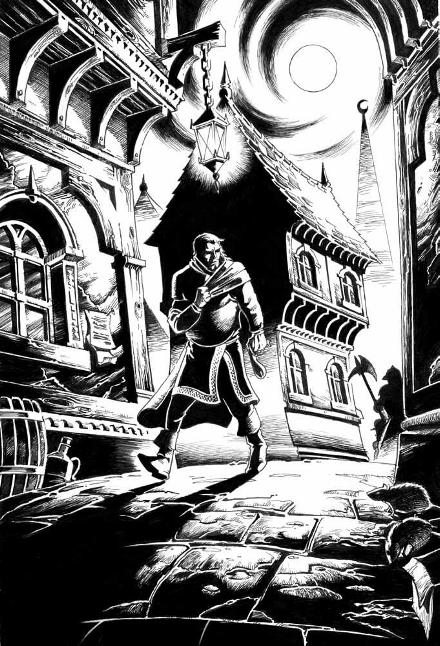
Black Gate Online Fiction: “The Daughter’s Dowry” by Aaron Bradford Starr

Black Gate Online Fiction: “The Daughter’s Dowry” by Aaron Bradford Starr

daughters-dowry-cropA famous explorer relates one of his earliest adventures, an exciting sea journey to a sunken tower where a legendary treasure awaits:

I inserted the key into the lock, amazed at how free of corrosion or accumulated grit the inner mechanism was. Yr Neh cocked his ears forward in surprise as well. Our eyes met, and we smiled to each other as I turned the key.

It didn’t open. I felt the tension in the key, then its complete freedom of movement. Puzzled, I put an ear to the side. It was ticking softly. Yr Neh backed away warily, and I had begun to do the same when the box jumped into the air before me.

Flashing and turning, the box changed shape as it fell, landing again on the floor completely transformed. It was now a complex faceted spike of brightest gold. The point pounded into the floor and continued through the stone.

I lunged for the rope, diving through the shallow water on the floor. There followed a moment of silence, broken only by the squeak of the rope from which I still clung, soaked to the skin. Yr Neh sighed in relief, and I joined him. Then the shattered floor collapsed.

Aaron’s first published story was “Mortal Star” in Black Gate 8, which SF Site called “complex and fascinating in design… A very fine story that is impossible to predict.”

You can read the complete catalog of Black Gate Online Fiction, including last week’s 25,000-word novella of dark fantasy “The Quintessence of Absence” by Sean McLachlan, and Jason E. Thummel’s adventure fantasy novelette “The Duelist,” here.

“The Daughter’s Dowry” is a complete 9,000-word novelette of heroic fantasy offered at no cost, with original art by Aaron Bradford Starr.

Read the complete story here.

Weird Tales 360 Arrives This Week

Weird Tales 360 Arrives This Week

weird-tales-360-smallWeird Tales 360,  the first issue helmed by new editor Marvin Kaye, is scheduled to ship this Friday, October 19.

It’s an auspicious and entirely appropriate number, I think. After changing direction several times over the last few years, Weird Tales has now turned 360-degrees and returned to where it started: publishing classic weird fiction.

The theme of the first Kaye issue is “The Elder Gods,” and the table of contents makes it clear that he is whole-heartedly embracing the Lovecraftian fiction that helped make Weird Tales one of the most sought-after magazines of the pulp era:

FICTION: THE ELDER GODS

  • “The Long Last Night” by Brian Lumley
  • “Momma Durtt” by Michael Shea
  • “The Darkness at Table Rock Road” by Michael Reyes
  • “The Runners Beyond the Wall” by Darrell Schweitzer
  • “Drain” by Matthew Jackson
  • “The Thing in the Cellar” by William Blake-Smith
  • “Found in a Bus Shelter at 3:00 am, Under a Mostly Empty Sky” by Stephen Gracia

FICTION: UNTHEMED

  • “To Be a Star” by Parke Godwin
  • “The Empty City” by Jessica Amanda Salmonson
  • “Abbey at the Edge of the Earth” by Collin B. Greenwood
  • “Alien Abduction” by M. A. Brines

Read More Read More

Vintage Bits: Black Isle Resurfaces

Vintage Bits: Black Isle Resurfaces

black-isle-smallInterplay, publisher of some of the most acclaimed fantasy role playing games of all time – such as the Bard’s Tale series, Wasteland, Dragon Wars, Baldur’s Gate, Fallout, and Icewind Dale — has announced that the legendary development studio behind many of its most popular titles, Black Isle Studios, has reformed.

Black Isle was owned by Interplay and created in 1996 by Feargus Urquhart. It was formed from the crack team of developers who had created Fallout. Over the next few years, they developed many hits, including Fallout 2, Planescape: Torment, and Icewind Dale. Working with a tiny outfit in Canada named BioWare, they also produced Baldur’s Gate and Baldur’s Gate II: Shadows of Amn.

Interplay began to experience serious financial difficulties in 2001-2002, after publishing a number of high-budget failures such as Messiah and Kingpin. Black Isle was dissolved as Interplay imploded, a move that shocked the industry. All the employees were laid off on December 8, 2003.

Their last titles were the poorly-received PC game, Lionheart, and Baldur’s Gate: Dark Alliance II for the Playstation 2. At the time they were dissolved, they were working on Baldur’s Gate III: The Black HoundBaldur’s Gate: Dark Alliance III and Fallout 3, none of which ever saw the light of day. A nearly bankrupt Interplay eventually sold the rights to the Fallout series to Bethesda, who developed and released its own version of Fallout 3 in 2008.

The closing of Black Isle was a serious blow to RPG gamers, and it marked the end of Interplay as a force in the industry. As someone whose all-time favorite games include Dragon Wars and Icewind Dale, I saw it as the end of an era. Interplay survived for most of the next decade by re-packaging its classic games, especially Fallout, Baldur’s Gate, and Icewind Dale, as well as their sequels.

Most of the star developers associated with Black Isle, including Feargus Urquhart and Chris Avellone, are not on board for this new iteration. Urquhart and Avellone founded the successful Obsidian Entertainment (Star Wars: Knights of the Old Republic II, Neverwinter Nights 2). But Mark O’Green and Chris Taylor (designer of the original Fallout) have both reportedly returned.

No announcement yet on what titles the resurrected Black Isle is working on. But I’m certainly looking forward to finding out.

New Treasures: Three Parts Dead by Max Gladstone

New Treasures: Three Parts Dead by Max Gladstone

three-parts-dead-smallThe fall is a big time for fantasy releases. We see a lot of press releases and advance proofs in the build-up to the holiday season, and everyone here has their favorites. I’m usually a fan of serial fiction — Fritz Leiber’s Fafhrd and the Gray Mouser tales, Jame Enge’s Morlock the Maker, Howard Andrew Jones’s Dabir and Asim novels — and I’m always on the lookout for the next breakout fantasy series.

But this year the book that most grabbed my attention was a first novel by Max Gladstone. I first saw the cover hanging on the wall at a Tor party at Wiscon in May, and I’ve been anxiously awaiting it ever since. Set in a decaying city on the verge of destruction, Three Parts Dead offers a high-stakes tale of dead gods, necromancers, and dark dealings in a richly-imagined urban landscape.

A god has died, and it’s up to Tara, first-year associate in the international necromantic firm of Kelethres, Albrecht, and Ao, to bring Him back to life before His city falls apart.

Her client is Kos, recently deceased fire god of the city of Alt Coulumb. Without Him, the metropolis’s steam generators will shut down, its trains will cease running, and its four million citizens will riot.

Tara’s job: resurrect Kos before chaos sets in. Her only help: Abelard, a chain-smoking priest of the dead god, who’s having an understandable crisis of faith.

When Tara and Abelard discover that Kos was murdered, they have to make a case in Alt Coulumb’s courts — and their quest for the truth endangers their partnership, their lives, and Alt Coulumb’s slim hope of survival.

Set in a phenomenally built world in which justice is a collective force bestowed on a few, craftsmen fly on lightning bolts, and gargoyles can rule cities, Three Parts Dead introduces readers to an ethical landscape in which the line between right and wrong blurs.

Three Parts Dead was published by Tor Books on October 2. It is 333 pages, and sells for $24.99 in hardcover and $11.99 for the digital version.

Adventures in Stealth Publishing: The Return of the Sorcerer

Adventures in Stealth Publishing: The Return of the Sorcerer

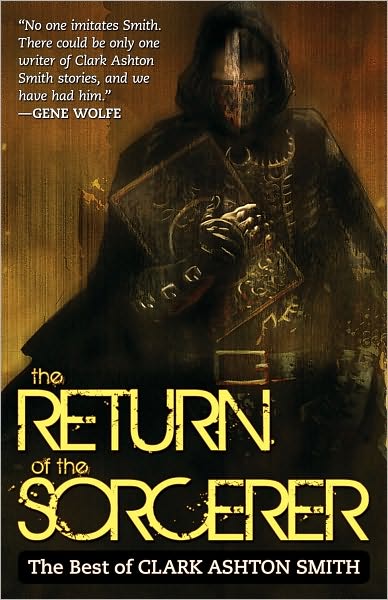
return-of-the-sorcerer-smallSome time, I dunno, about four years ago, I saw the cover for The Return of the Sorcerer: The Best of Clark Ashton Smith online, and I knew I had to have it.

Maybe it was the cool cover. Maybe it was the Gene Wolfe cover blurb. I can’t say. But I wanted it. Real bad.

Of course, it wasn’t published yet. So I had to wait. I added it to my Amazon cart, where it sat. For months. The publication date changed a few times, and then Amazon slapped it with one of those “Currently Unavailable” warnings that are code for “We have no clue when it’s going to ship, dude.”

So I reluctantly took it out of my cart. But I still kept an eye out in bookstores. For years. It was a long, lonely vigil, like Penelope waiting for Odysseus. Exactly like that, now that I think about it.

There were false reports from time to time. Private sellers listed it on Amazon, but when I queried them they admitted it was “available for pre-order.” Bastards. Our own Brian Murphy, usually rock-solid reliable, even wrote a detailed review in July of 2010, the poor deluded fool. It’s sad what deadline pressure can do, I know. When I have to, I make up books to review too, I’m not throwing stones.

Then today I saw it listed for sale by the Book of the Month club. Yes, the Book of the Month club. That’s just weird. They don’t sell books that don’t exist, usually.

So I dug a little further. I discovered, to my astonishment, that Amazon.com had it listed. So did Barnes & Noble. Apparently it came out in 2010.

Excuse me? 2010?? How the hell did it get past me? I had, like, a dragnet the size of Rhode Island out for this book. I’m usually pretty plugged in to the publishing industry. Really. I’m connected, man. It hurts that this book managed to get past me. For two years.

I blame the publisher, because they’re small and I can pick on them. Prime Books, you owe me an apology. And maybe a cinnamon danish.

Read More Read More

Black Gate Online Fiction: “The Whoremaster of Pald” by Harry Connolly

Black Gate Online Fiction: “The Whoremaster of Pald” by Harry Connolly

w-master2One of the most popular pieces of short fiction we’ve published in Black Gate magazine was Harry Connolly’s first fiction sale, “The Whoremaster of Pald,” which originally appeared in Black Gate 2.

Since that early sale, Harry has become a celebrated fantasy novelist, with titles including the Twenty Palaces novels Child of Fire and Game of Games. Featuring a brilliant and resourceful merchant in a corrupt and violent port city, “The Whoremaster of Pald” has all the hallmarks of his later fiction, and is filled with mystery, surprising twists, and great characters. Here are the opening paragraphs:

My prison cell stank like a bird cage. It was terribly dark, and I listened for the sound of rats. I despise rats. I lay down on the wooden plank that would serve as my bed for the night. My bruised back throbbed, but at least I could still breathe. It’s always nice to breathe after a beating.

In the morning a sweet little sparrow of a girl would testify against me. The charge was murder, and she had seen me do it. It had started only the evening before, when I decided that something had to be done about the new Warden.

RPGNet called the story “remarkably rich and textured,” and Locus magazine said:

[“The Whoremaster of Pald”] was one of my favorites. Harry James Connolly’s unlikely hero is a fat master of a whorehouse who cringes before bullies; not your usual fantasy hero at all. His story is told with smooth, vivid prose that is strongly reminiscent of Jack Vance, Connolly’s Zed gradually engages reader sympathy as he veers between bullying protection racketeers, a new worker who decides she can’t really stick to prostitution, a conniving rival, and the mayor’s lout of a nephew… an unputdownable tale. Connolly works the twists and turns so cleverly it’s impossible to guess what will happen. It’s hard to believe this is Connolly’s first published story.

Several years ago, we published the story in its entirety on the Black Gate website; we’re proud to offer it again here as part of the new line up of Black Gate weekly Online Fiction.

Read the complete story here, and the complete catalog of Black Gate Online Fiction, including the adventure fantasy novelette “The Duelist” by Jason E. Thummel and Sean McLachlan’s novella of dark fantasy, “The Quintessence of Absence,” here.

Art by Chris Pepper.

Mystery 101: Books To Die For is a Complete Course in Mystery Fiction

Mystery 101: Books To Die For is a Complete Course in Mystery Fiction

books-to-die-for-smallI don’t read much mystery fiction, and if I’m honest with myself it’s because I feel a little lost in the mystery section of the bookstore. I don’t know the authors or the major titles, and there are just so many choices it’s overwhelming. Safer to take my money and retreat back to the science fiction aisle, and buy that Asimov reprint.

But if I were a little more adventurous, or had a knowledgeable friend to hold my hand, I bet I’d find a lot of great reading in those shelves. There’s always a ton of old ladies buying mystery paperbacks, anyway. And if there’s a more discerning paperback reader than the American old lady, I haven’t met her.

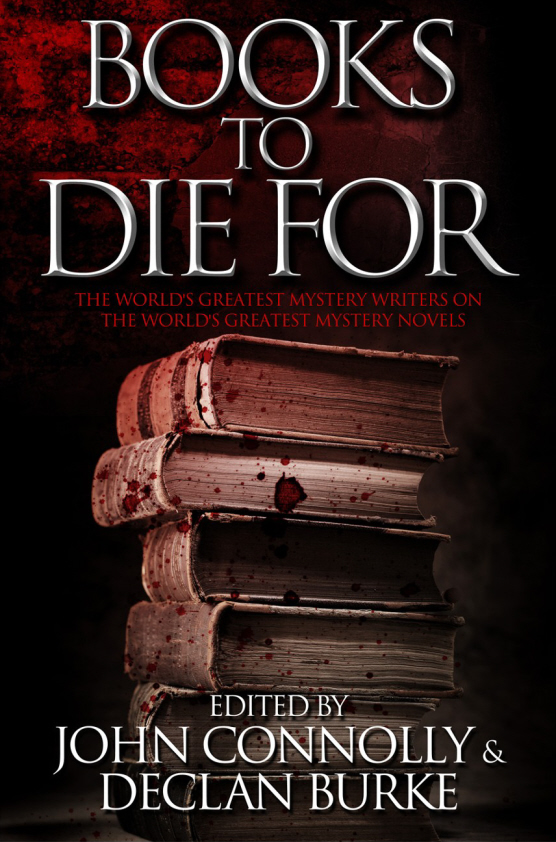
It’s very possible that knowledgeable friend arrived in the mail this week, in the form of Books to Die For: The World’s Greatest Mystery Writers on the World’s Greatest Mystery Novels, a fabulous book that looks like it could open the door to a lifetime of mystery reading.

With so many mystery novels to choose among, and so many new titles appearing each year, where should a reader start? What are the classics of the genre? Which are the hidden gems?

In the most ambitious anthology of its kind yet attempted, the world’s leading mystery writers have come together to champion the greatest mystery novels ever written. In a series of personal essays that often reveal as much about the authors and their own work as they do about the books that they love, 119 authors from 20 countries have created a guide that will be indispensable for generations of readers and writers. From Agatha Christie to Lee Child, from Edgar Allan Poe to P. D. James, from Sherlock Holmes to Hannibal Lecter and Philip Marlowe to Lord Peter Wimsey, Books to Die For brings together the cream of the mystery world for a feast of reading pleasure, a treasure trove for those new to the genre and for those who believe that there is nothing new left to discover.

Even if you’re not in the mood for a mystery novel marathon, Books To Die For is perfectly suited for browsing, with brief personal essays from the world’s most illustrious mystery writers, chatting about the finest mystery novels ever written. The book is arranged chronologically, starting in 1841 with Edgar Allan Poe’s The Dupin Tales; the second entry is Charles Dickens’ Bleak House (covered by Sara Paretsky). The last one is The Perk, by Mark Gimenez, published in 2008.

In between are 118 enthusiastic mini book reviews, most averaging two to four pages, by writers including Rita May Brown, Linda Barnes, Carol O’Connell, Chuck Hogan, Joseph Finder, Charlaine Harris, Joe R. Lansdale, Laura Lippman, Max Allan Collins, Phil Rickman, Bill Pronzini, Jeffery Deaver, F. Paul Wilson, John Connolly, Joseph Wambaugh, Elmore Leonard, Eoin Colfer, Anne Perry, and many, many others.

Books To Die For is edited by John Connolly and Declan Burke; it was published by Atria on October 2. It is 560 pages in hardcover, and priced at $29.99. The digital edition is $14.99.

New Treasures: Castle Waiting, Volume Two

New Treasures: Castle Waiting, Volume Two

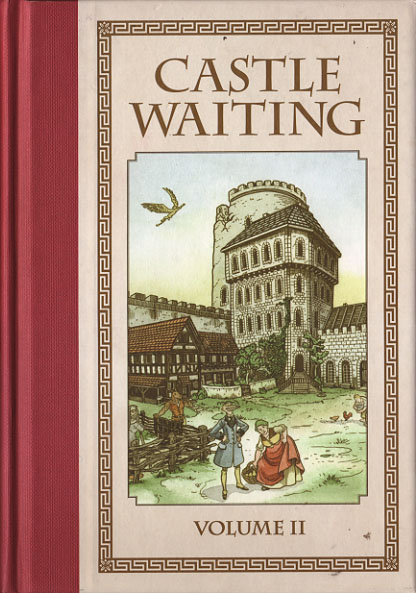
castle-waiting-volume-two-smallI first discovered the brilliant and touching Castle Waiting through Linda Medley’s self-published comic in the late 90s. Eventually collected into the graphic novel Castle Waiting: The Curse of Brambly Hedge, it retold the fairy tale of Sleeping Beauty (sort of), as seen by an odd cast of mostly minor characters. It was well written and beautiful, feminine in perspective and mood, incredibly slow-paced, and wholly original. I loved it.

And then it pretty much vanished. Stray issues popped up now and again in my local comic shop over the years, but it looked to me like Castle Waiting would always be one of those undiscovered indie treasures that never broke into the mainstream.

Fanatagraphics turned all that around in 2006 with the massive Castle Waiting, a 472-page omnibus collecting virtually all the early issues in an attractive and affordable format. Picking up the story many years later, Medley follows the new inhabitants of Sleeping Beauty’s ancient castle, most of them fairy tale characters with mysterious origins. Managed by the unflappable (literally) stork Rackham, the Castle is home to an eclectic mix of humans, outcasts, and friendly but mischievous sprites and other spirits.

This volume was successful enough that it allowed Medley to return to publishing Castle Waiting on a regular schedule in 2006. She published fifteen issues with Fantagraphics, and those issues were finally collected in 2010. Focusing chiefly on the pregnant Lady Jain, who has fled to the castle to escape an abusive husband, this second volume drew wide praise from NPR, Time Magazine, and many other sources, and Publishers Weekly ranked it one of the best comic books of 2006 in a critics’ poll.

With its long-awaited second volume, Linda Medley’s witty and sublimely drawn fantasy eases into a relaxed comedy of manners as Lady Jain settles into her new life in Castle Waiting.

Unexpected visitors result in the discovery and exploration of a secret passageway, not to mention an epic bowling tournament. A quest for ladies’ underpants, the identity of Pindar’s father, the education of Simon, Rackham and Chess arguing about the “manly arts,” and an escape-prone goat are just a few of the elements in this delightful new volume.

The book also includes many flashbacks that deepen the stories behind the characters, including Jain’s earliest romantic entanglements and conflicts with her bratty older sisters, the horrific past of the enigmatic Dr. Fell, and more.

Interestingly, except for a tiny copyright notice on page 377, the book is published totally anonymously, with no mention of Linda Medley anywhere on the cover, spine, or title pages.

Castle Waiting, Volume Two was published in December 2010 by Fantagraphics. It is 384 pages in hardcover for $29.99. There are no paperback or digital editions. With its slow pacing and glacial (almost non-existent) plot, it’s not for everyone. But I recommend it highly.

Vintage Treasures: Hong on the Range by William F. Wu

Vintage Treasures: Hong on the Range by William F. Wu

hong-on-the-range4I admit this one doesn’t seem very vintage to me, but perhaps that’s just because I’m getting a little vintage myself.

William F. Wu’s fourth novel, Hong on the Range, was published 23 years ago. It was originally published in hardcover and has never had a paperback release.

And that’s too bad, since it’s the kind of off-the-wall science fantasy that I think would really appeal to a modern audience. Set in a post-apocalyptic American West where cities have decayed and the surviving towns cling to the railway, where most people have cyborg enhancements, meat is harvested from cows without harming them, and a young man named Louie — a “control-natural” forbidden by law from enhancing himself, and who is shunned and misunderstood by others — heads West to find his fortune.

The Old West Was Never This Wild! In a New West filled with cyber-enhanced cowboys and mechanized singing steers, Louie Hong must make his way through hostile territory filled with cattle rustlers and bank robbers, and a passel of cyborg bounty hunters who think he’s both! A story about coming of age in a strange and dangerous land where a young man’s most faithful friend may just turn out to be a computerized steer named Chuck.

While it’s the only novel in the sequence, Hong on the Range is part of a series of stories written by Wu that began in 1985 with “Wild Garlic.” Most of them were published in Pulphouse magazine; the last one, “In the Temple of Forgotten Spirits,” in 1993.

Hong on the Range was published by Walker & Co in 1989. It is 286 pages in hardcover. It has never had a paperback release, but it was re-released in a digital edition for $2.99 last October.

Adventures Fantastic on “The Duelist”: “Black Gate‘s Online Fiction Debut Has Set a High Standard”

Adventures Fantastic on “The Duelist”: “Black Gate‘s Online Fiction Debut Has Set a High Standard”

jason-e-thummelOur first Online Fiction Feature of 2012 was Jason E. Thummel’s adventure fantasy novelette “The Duelist,” posted last Sunday. Adventures Fantastic was one of the first to review it this week:

Was it worth the wait? The answer is “Yes!”… This is a tale of a drunken duelist who is the top in his field… the plot is a solid sword and sorcery story. First I like the protagonist, Androi Karpelov, because even though he’s a very flawed hero, he’s still a man with honor. And he’s willing to take great risks to satisfy that honor… The story moves at a nice clip, never dragging.

Black Gate‘s online fiction debut has set a high standard of quality. That’s a good thing.

Thummel is also the author of the novel The Spear of Destiny and the short story collection In Savage Lands… I liked them a lot. Look for a review sometime in the next few months. This is a writer whose work I’m going to keep an eye out for.

I’m looking forward to more of Black Gate‘s fiction offerings. It’s been one of my favorite publications for a long time.

Author Donald Crankshaw turns a critical eye to our format at the Back of the Envelope blog:

How well does Black Gate‘s new format work for reading stories? Are they comfortable to read? Is it easy to keep track of your place? I find these questions particularly interesting… the story uses the same unusual color-scheme, light blue letters on a black background, as for Black Gate‘s blog… Surprisingly — or perhaps not so surprisingly, assuming that their web designer knows what he’s doing — I found the blue-on-black color scheme to be comfortable to read, and had no trouble with eye strain. Another thing that surprised me was that the lettering was large enough to read clearly on a mobile device…

Black Gate‘s blog posts have in-line commenting on the article page. This is how I prefer to see comments on blogs, but it can work to the detriment of long stories, partly by making a long page even longer, and partly because spamming and trolling can distract from the story. The solution Black Gate came up with works well. The story does not contain in-line comments, but a link to the blog post announcing the story, allowing readers to comment there. It also keeps all the comments in one place, to prevent a proliferation of pages.

Overall, I think the formatting that Black Gate used worked well. My only real concern is how well it will handle even longer stories, and I suppose we’ll see that when it happens.

Our complete schedule of upcoming fiction is here.