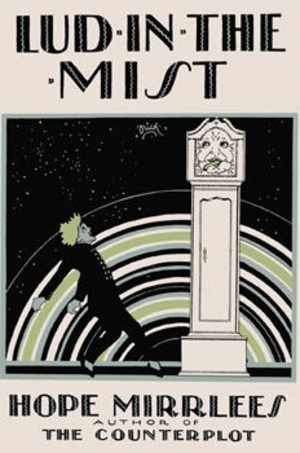
A Potent Draught of Distilled Fairy Fruit: Lud-in-the-Mist by Hope Mirrlees
I’m back with a new column. Each first Friday of the month I’ll be writing about a work of fantasy I’ve never read (or read only once a long time ago; I insist on room for maneuvering!). Because of Lin Carter’s magnificent taste, it may at times seem I’m simply going through titles from his Ballantine Adult Fantasy series, but my goal is to rummage around in the basement and attic of fantasy, exploring works that preceded, or exist outside of, modern commercial fantasy. My reach will extend at least as far back as the Gothic novels first appearing in the late 18th century, and I hope it will come forward to today. So far, my planned reading includes Gormenghast, The Last Unicorn, Once Upon a Time, The Ship of Ishtar, Melmoth the Wanderer, and Frankenstein. If all goes well, I’ll even go for The Worm Ouroboros and The Manuscript Found in Saragossa, too.
Fantasy has become a successful commodity. Witness the gargantuan force of A Song of Ice and Fire, both in print and on the screen. And what are the leotard-clad protagonists of superhero movies but updated versions of the heroes panegyrized by the skalds and griots? Fantasy, to which I’ve dedicated untold numbers of hours reading and writing about, is more successful than I could ever have imagined forty-odd years ago when I first read The Hobbit, and yet I’ve found my taste for it diminishing with each passing year.
Excellent and original work is being created, but you have to hunt for it. Most new fantasy simply mimics ideas already done to death a long time ago, bringing nothing new or substantial to the field. I love the Ramones, but after four or five albums, you’ve heard everything they have to say. I feel the same way about new fantasy. And yet, I still find myself drawn to fantasy, remembering how it’s allowed me to shrug off the bonds of reality and slip into the world of dreams. I just don’t want another thousand-page story exploring the magically-augmented struggle for the throne of some imaginary kingdom, or a supposedly realistic disquisition on power politics in a “grittier” analogue of the real world, or about how there really isn’t good and evil, only gray morality. Even my beloved sword & sorcery begins to seem a little wan after reading eighty or ninety stories a year. Only in the best of hands do I find new stories that still hold my interest.
I recently reread Mikhail Bulgakov’s The Master and Margarita, a tale of the devil visiting Moscow, a writer and his lover, and a novel about Pilate and Christ. While a serious novel about art, love, and totalitarianism, it’s also fantasy. The form allowed Bulgakov to explore ideas he might not, under Stalin, have attempted otherwise (and still it was censored until decades after his death). Some of the deepest, most affecting scenes are pure fantasy, drawing on myth and nightmare instead of psychology and our five senses, allowing them to find a way to our soul that a realistic version could not. Bulgakov wrote to satisfy himself, not the dictates of the market. And though there’s nothing wrong with the latter, the result will rarely be a Bulgakov. You won’t encounter another book like The Master and Margarita because it wasn’t written to conform to genre considerations. Bulgakov never set out to become a “fantasy” writer, just a writer who would find the best way to tell the stories he wanted to tell.