In 1937, Holmes made his first appearance on American television in The National Broadcasting Corps’ rendition of The Three Garridebs, starring Louis Hector. Regular television service from NBC hadn’t even begun yet when this test show was transmitted and it’s likely few people saw it. Sadly, I’m only aware of one picture taken from a television screen, though I believe someone in the industry once told me there are other stills in the archives. There’s certainly no belief an actual recording of the broadcast exists!
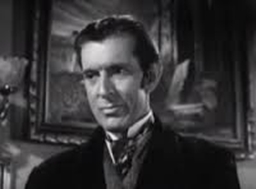
In 1949, CBS aired a series of 30-minute literary adaptations in the Your Show Time program. The tenth episode was The Speckled Band, starring Alan Napier as Holmes. Napier was certainly a stuffy, stiff detective, with a bit of Raymond Massey (Holmes in a 1931 film of the same story) and Leonard Nimoy in his look.
Last week, we talked a lot about Humphrey Bogart as we roamed around The Maltese Falcon. And I had already done a post on Bogie’s only horror-sci fi film, The Return of Doctor X. Today, I’m going to talk about one of my favorite aspects of Bogart’s career. In the annals of Hollywood, never has one actor so torpedoed his own career, while making another actor a star at the same time. Let’s take a look, shall we?
George Raft grew up in Hell’s Kitchen, New York, where he was a childhood friend of Owney Madden, who would become a powerful mobster in the days of Prohibition. Raft toyed with being a boxer and then taught himself to dance, hitting it big in Vaudeville in the early twenties. At the same time, he hung out with professional gangsters, gaining access to them through his friendship with Downey. He studied how they walked and talked, and mastered the ability to imitate them.
After appearing in a few films as a dancer, Raft broke through in 1932. Long before Rod Steiger and Al Pacino played Capone roles, Paul Muni made a classic gangster film: Scarface – Shame of a Nation. Raft had a part as Rinaldo, a coin-flipping gunman. Emulating the men he knew, he received strong reviews for his performance.
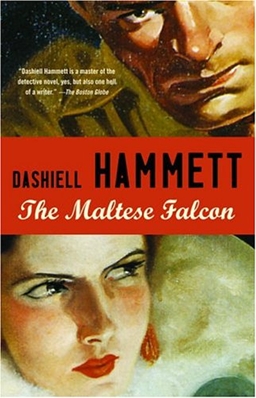
Last week marked the 86th anniversary of Dashiell Hammett’s The Maltese Falcon in book form. It had been serialized the year before in the pages of Black Mask Magazine. Hammett gets my vote for best writer of the hard-boiled genre. And I am quite the fan of Red Harvest (the uncredited source for Bruce Willis’ under-appreciated gangster film, Last Man Standing) and of the Continental Op stories (well worth reading). But I happen to think that The Maltese Falcon is the best private eye novel yet to be written. Period.
Sam Spade (who looked like a blonde Satan) also appeared in three short stories, which I wrote about in a prior post here at Black Gate. Sadly, they aren’t particularly memorable and definitely aren’t in the upper half of Hammett’s works. In 2009, Joe Gores wrote Spade and Archer, an authorized prequel. I love Gores’ Daniel Kearney Associates series of books, but I’m still saving this Sam Spade gem for a future read.
A great deal has been written about Hammett’s novel and about Spade himself, including William Maynard’s post here. It’s certainly worthy of a post all by itself. But I’m going to focus on the media Falcon: specifically the third of three filmed versions. It’s far and away the best known and I’m guessing that many people who haven’t actually read the book have seen the movie.
Sherlock Holmes was rather a jerk. His people skills needed some serious work. It’s blatantly obvious in Benedict Cumberbatch’s over-the-top obnoxiousness in BBC’s Sherlock, but it’s all over the Canon as well. I wrote about his unwarranted negative attitude towards Dr. Watson’s detective work in a previous post. And the Canon is replete with snide comments and remarks at Watson’s expense: to say nothing of the official police force’s!
“Come at once if convenient – if inconvenient come all the same.”
Thus does Sherlock Holmes summon Watson in “The Adventure of the Creeping Man.” And Watson obeys. We get a sample of Holmes’ imperious attitude from this quote. But Watson’s response is also rather telling.
When Grimesby Roylott of Stoke Moran confronted Holmes, he referred to the detective as a “meddler, a busybody and a Scotland Yard jack-in-office.” One has to wonder if some villain or policeman in the Canon didn’t refer to Watson as Holmes’ lapdog, lackey or errand boy?
I’m writing this in the aftermath of hosting a sleepover for my son and three of his eight-year old friends. My state is…I don’t know what it is, but it’s not normal. I’ve been reading a lot of Nero Wolfe-related stuff lately, so I’ll riff on that. Speaking of the gargantuan detective, I wrote about him earlier here at Black Gate.
Back in September, I’m sure you read my post, “Who Needs a Hard Boiled Detective?” It looked at how, during the rise, rule and decline of the American hard-boiled school of fiction, August Derleth was writing Solar Pons stories that were pure throwbacks to the Victorian Era mysteries of Sherlock Holmes. I’d say more, but you already either know it or should go read essay if you haven’t!
And the following excerpt is from the initial version of “Hard Boiled Holmes,” an essay I wrote tracing the roots of the American hard boiled school back to Victorian London and Holmes:
Rex Stout created Nero Wolfe in 1934 and the last story was published in 1975, a month before the author’s death. Fortunately, there were over sixty Wolfe tales in between. Stout created a synthesis of Holmes and the hard boiled school that has yet to be surpassed.
Nero Wolfe was a brilliant, disagreeable and incurably lazy detective. He seems very much to be a successor to Mycroft Holmes, with a bit of Sherlock thrown in. His chronicler and assistant was the smooth talking tough guy, Archie Goodwin.
Goodwin himself stacks up with the best of the hard-boiled private eyes. To over-simplify, Stout paired Mycroft/Sherlock Holmes with Sam Spade. Two characters, representing the Doylean and hard-boiled approaches, worked together in each story. This characteristic is probably one of the primary reasons that the Wolfe books have enjoyed so much success over three-quarters of a century.
Black Gate‘s ‘Discovering Robert E. Howard’ series had ranged far and wide across the writings of REH. But we had not yet tackled his poetry. Consider it tackled! Barbara Barrett, who put together the extensively detailed The Wordbook: An Index Guide to the Poetry of Robert E. Howard, is the planet’s resident expert on the poetry of REH. And the author of Conan was quite a poet. Read on!
By the time I discovered Howard’s poetry, Solomon Kane, King Kull, Conan and El Borak were familiar characters. I didn’t think Howard’s writing could get any better than the poetic prose in those stories. At least, until I picked up a copy of Shadow Kingdoms: The Weird Works of Robert E. Howard and read these lines from his poem “The Ride of Falume.”
A league behind the western wind, a mile beyond the moon,
Where the dim seas roar on an unknown shore and the drifting stars lie strewn
I was transported to a place straight out of a Hubble star-strewn space photo where I sat on some unknown seashore, gazing at a moon larger than I had ever seen, and listening to the roaring waves crash against sand and rock. I could see it all clearly.
I was reading fantasy before I discovered Sherlock Holmes and it’s still one of my two favorite genres. Now, one of my favorite series’ has finally been brought to the screen. Last October, Fletcher Vrendenbuergh posted about his re-read of Terry Brooks’ classic, The Sword of Shannara. Sword, loved by many (me among them) and reviled by many, was a huge hit upon release, appealing to the horde of Tolkien fans who wanted more of that style of fantasy. It’s a good essay with lots of comments: go check it out.
After Sword, Brooks wrote a big chunk of a sequel, which (Lester) Del Rey told him to chuck and start over. Brooks did so and in 1982, we got The Elfstones of Shannara, which took place two generations after Sword. Shea’s grandson, Wil Ohmsford, now had the magical elfstones. Wishsong of Shannara rounded out the trilogy.
Two dozen more Shannara books would follow, with another due out later this year. Some take place before Sword, with most afterwards. Back when fantasy films consisted of “efforts” such as The Sword and the Sorcerer, Krull, Ator and even Ah-nuld’s two Conan movies, I always wondered why someone didn’t take Sword to the screen; be it live-action or animated. But nope: nothing.
Of course, Peter Jackson redefined fantasy films with his six movies from Tolkien’s books. And HBO created a monster with George R. Martin’s Game of Thrones. The 44-episode Legend of the Seeker, based on Terry Goodkind’s Sword of Truth novels, did not fare so well and was cancelled after two seasons on television.
But now, in 2016, we finally have The Shannara Chronicles, a ten-episode miniseries, based on The Elfstones. For that, we have MTV to thank. Well, it’s a mixed blessing. You got a sneak preview and some Black Gate commentary HERE last summer.
Sure, I’m all about Sherlock Holmes and Solar Pons, which you are certainly aware of if you read The Public Life of Sherlock Holmes every Monday here at Black Gate (blatant self-plug). But of all the mystery (and swords and sorcery, for that matter) series that I read and love, Rex Stout’s Nero Wolfe tales hold the top spot for me.
You can a get a primer on Wolfe from this post I wrote in the summer of 2014. And of course, you can buy a book and check him out first hand. I mentioned here that there are definitely Wolfean characteristics in Glen Cook’s Garret, PI series. Mystery grand master Lawrence Block (Matthew Scudder, Keller, Bernie Rhodenbarr series’ and more) tinkered with an R-rated version of Wolfe in two novels and two short stories featuring Leo Haig (Wolfe) and Chip Harrison (Archie Goodwin).
The stories don’t just emulate Wolfe and Goodwin. They specifically talk about them! As Harrison tells us in Make Out With Murder:
I don’t have any idea how to salvage this train wreck of a show. Do you?
So, for the first post of 2016, I think the most important thing to recognize is that I made it to the end of my second calendar year at Black Gate without getting axed (it helps that I work cheap. As in, ‘free.”). By my reckoning, The Public Life of Sherlock Holmes has appeared here every single Monday morning for the past 96 weeks. As I had serious doubts that John O’Neill would even approve a Holmes-themed column (I mean, it’s a fantasy website!), I’m pretty pleased it’s still around.
During 2015, I helped with Black Gate’s outstanding “Discovering Robert E. Howard” series, which featured guest columns from a slew of very knowledgeable folks; and there are still a couple fine posts remaining in the series. Personally, I thoroughly enjoyed putting together Part One of my history of Necromancer and Frog God Games, Dungeons and Dragons and Pathfinder RPG publishers extraordinaire. Part Two is pretty much written, but still needs some serious editing.
The three-part piece on Granada’s Adventures of Sherlock Holmes, starring Jeremy Brett, was a favorite and there will certainly be another in the series: likely a few more. And I even managed to have the most viewed post in a month with a look at what went wrong in season three of BBC Sherlock (sadly, my hopes that the January 1 special episode would get the franchise back on track were horribly dashed).
With a couple of extras that I wrote outside of PLoSH included, I’ve linked 54 posts from 2015 below. It’s no surprise, with the name of this column, 27 were about Sherlock Holmes or Arthur Conan Doyle. With another 5 about the best of the Holmes pastiches, Solar Pons.
Next up were 8 posts related to fantasy and 1 for science fiction. Then we’ve got 5 Hard Boiled/mystery posts and 8 miscellaneous ones.
If you’re at least a semi-regular reader of the column, I try not to write “here’s my opinion” posts. I like to share information about things I like, be it the Richard Diamond radio series or a different way to look at a Holmes story. Hopefully in 2015 you came across a topic that you either wanted to go explore a bit or that you learned a little more about. There’s lots more I plan on writing about in 2016 (can’t believe I didn’t write a single Nero Wolfe post last year!), so grab a cup of coffee and check in on Monday mornings. And thanks for reading The Public Life of Sherlock Holmes!
August Derleth created Solar Pons as a successor to Sherlock Holmes. You know that, of course, because I’ve written about Pons several times and I mention him at the bottom of every post. A Praed Street Dossier was a collection of Pons odds and ends written by Derleth, related to the ‘Sherlock Holmes of Praed Street.’
Included were some “Notebook” entries, attributed to Dr. Parker. Derleth would write two more “Notebook” installments for The Pontine Dossier, the newsletter of the Praed Street Irregulars.
The “Notebooks” are among my favorite Pons writings by Derleth. They provide additional insights into Pons and even add a case or two to the Pontine Canon. In fact, I like them so much I have continued on with the series, including ‘Notebook’ entries in several issues of my Solar Pons Gazette. I plan on adding more.
Tongue a bit in cheek with the names, here is a case from one of my ‘Notebooks’ entries in the Gazette. While Dr. Parker included this case, he never saw fit to fully write it up and publish it, so you are likely not familiar with it.
20 April, 1921
“Did you see this letter in the Herald, Pons?” I asked, handing him the item of discussion. He briefly glanced at it and then tossed it aside without a word. “You don’t think much of the suggestion, then?”
Solar Pons looked at me with the trace of a smile. “I believe that you are intentionally baiting me, Parker. So be it. No, I do not believe that ‘optograms’ will aid in finding the killer of Andrew Treacher.”