Browsed by
Author: Bob Byrne

A (Black) Gat in the Hand: William Patrick Maynard’s ‘Shades of Yellow’

A (Black) Gat in the Hand: William Patrick Maynard’s ‘Shades of Yellow’

Because I find it’s easier to get somebody else to do all the heavy lifting, I secured another guest poster for this week! Fellow Black Gater William Patrick Maynard knows more about Fu Manchu and the Yellow Peril genre than anybody else I know. And if you see his credentials at the end of the post, you’ll understand why! Today, he takes a pulpy look at the ‘menace from the Far East’ topic. Read on!


You’re the second guy I’ve met within hours who seems to think a gat in the hand means a world by the tail.” — Phillip Marlowe in Raymond Chandler’s The Big Sleep

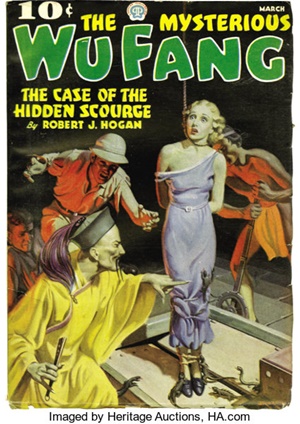
Maynard_WuFangMagEditContext is a challenge in politically correct times that seek to view the past through the myopic lenses of an eternal present. Over 130 years ago, Sir Arthur Conan Doyle created an archetype in fiction with his consulting detective Sherlock Holmes. While Holmes lives on at least in name and reputation, most of his antecedents, contemporaries, and successors in the fantastic fiction of the Victorian and Edwardian eras are rapidly fading into obscurity.

While forgotten by the public at large, the traits and exploits of many of these same characters have been disseminated into today’s pop culture icons (James Bond, Star Wars, Indiana Jones, and the glut of superheroes that continue to dominate movie screens). What remains of the past is largely through the efforts of pulp specialty publishers and public domain reprint specialists who keep these classic works in print for a niche market that still reads works from a different, simpler, though not always better, world.

Much of this fantastic fiction sprung directly from colonial viewpoints of the British Empire. Among the xenophobic byproducts of colonialism in popular culture was the Yellow Peril, the paranoid delusion that Chinese immigrants were plotting to conquer the West. There was certainly crime in Chinatown: there is always crime among the economically underprivileged, but what made the Yellow Peril thrive as a sub-genre of the thriller was the creation of a brilliant, amoral Chinese criminal mastermind in the same fashion as Conan Doyle’s Professor Moriarty and Guy Boothby’s Dr. Nikola.

Sax Rohmer’s Fu Manchu became the personification of the Yellow Peril. Without the character’s introduction, the sub-genre would never have prevailed. Fu Manchu took the reading public by storm just before the outbreak of the First World War and remained a bestselling franchise up to the Cold War. Rohmer’s insidious fiend was everywhere: magazines (slicks, not pulps), books, newspaper strips, comic books, radio series, films, the theater, and eventually television.

Holmes and Fu Manchu were certainly among the most influential characters in the first half of the last century. Arthur B. Reeve’s American variation on Holmes, the scientific detective Craig Kennedy was likewise pitted against a variation on Fu Manchu, the diabolical Wu Fang in The Exploits of Elaine (1914), The Romance of Elaine (1915), and The Triumph of Elaine (1915). The Elaine triptych were inspired by the phenomenal success of the 1914 serial, The Perils of Pauline.

Read More Read More

A (Black) Gat in the Hand: Joe Bonadonna’s ‘Hardboiled Film Noir’ (Part Two)

A (Black) Gat in the Hand: Joe Bonadonna’s ‘Hardboiled Film Noir’ (Part Two)

I reached out to some friends to help me with A (Black) Gat in the Hand, as I certainly can’t cover everything and do it all justice. Our latest guest is author and fellow Black Gater, Joe Bonadonna. Last week, Joe delivered an in-depth look at hardboiled adaptations on the silver screen. So, here’s part two!


Hardboiled Film Noir: From Printed Page to Moving Pictures (Part Two)

“You’re the second guy I’ve met within hours who seems to think a gat in the hand means a world by the tail.” — Phillip Marlowe in Raymond Chandler’s The Big Sleep

Bonadonna_CainDoubleEDITEDAnd now, on to Raymond Chandler, one of the two writers who inspired my Heroic Fantasy, the other being Fritz Lieber, another pulp magazine maestro. Considered by many to be a founder of the hard-boiled school of detective fiction, along with Dashiell Hammett, James M. Cain and other Black Mask writers, Chandler had been an oil company executive who turned to writing after he lost his job during the Great Depression.

To me, his prose is pure poetry, his use of simile and metaphor, his imagery and turn of phrase are top notch. His novel, The Big Sleep, was turned into a motion picture in 1946, starring Humphrey Bogart as Philip Marlowe. His Lady in the Lake (1947) became an interesting vehicle for Robert Montgomery (the father of Bewitched’s Elizabeth Montgomery.) Farewell, My Lovely was first filmed as Murder, My Sweet (1944), starring Dick Powell. Chandler’s novel, The High Window, was filmed twice: first as Time to Kill (1942) and again in 1947 as The Brasher Doubloon. Chandler also had a lucrative career as a Hollywood screenwriter.

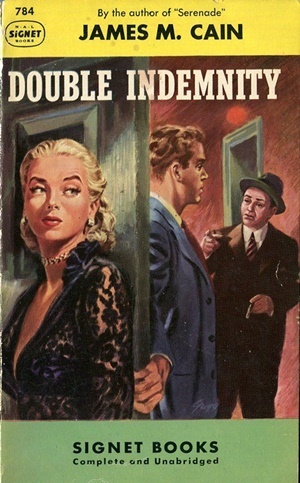
In 1944 he scripted (along with director Billy Wilder) James M. Cain’s masterpiece, Double Indemnity, wrote an original screenplay called The Blue Dahlia (1946), and co-wrote (along with Whitfield Cook and Czenzi Ormonde) the screenplay for Alfred Hitchcock’s Strangers on a Train (1951), which was based on the novel by Patricia Highsmith, the author of The Talented Mister Ripley and Ripley’s Game.

 For me, the 1940s also gave us the last of what I consider to be the truly great gangster films of Hollywood’s Golden Age. High Sierra, released in 1941 and based on the novel by W.R. Burnett, was a departure from the usual gangster epic, in that it portrayed a much more sympathetic criminal, Roy Earle (played by Humphrey Bogart.)

Bogart also played the character of Vincent Parry in Dark Passage (1947), which was written for the screen by David Goodis, who adapted his own novel. Another film, based on the play by Maxwell Anderson, was 1948’s Key Largo, the perfect blend of old-school gangster and the new wave of film noir, and it was a tour de force for Bogart, Edward G. Robinson and Claire Trevor.

Read More Read More

A (Black) Gat in the Hand: Joe Bonadonna’s ‘Hardboiled Film Noir’ (Part One)

A (Black) Gat in the Hand: Joe Bonadonna’s ‘Hardboiled Film Noir’ (Part One)

I reached out to some friends to help me with A (Black) Gat in the Hand, as I certainly can’t cover everything and do it all justice. Our latest guest is author and fellow Black Gater, Joe Bonadonna. And Joe delivered an in-depth look at hardboiled adaptations on the silver screen. In fact, he covered so much ground, it’s gonna be a two-parter! So, let’s dig in! 


Hardboiled Film Noir: From Printed Page to Moving Pictures (Part One)

“You’re the second guy I’ve met within hours who seems to think a gat in the hand means a world by the tail.” — Phillip Marlowe in Raymond Chandler’s The Big Sleep

Prologue

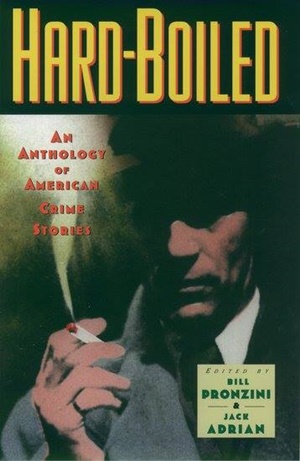
Bonadonna_HardboiledAnthologyCrime does not discriminate. From city streets and slums to quiet suburbia, from the mansions of the rich to the boardrooms of the powerful, crime is alive and well. It can be found in dance halls, beer halls and gambling halls . . . speakeasies, seedy gin joints, smoke-filled pool halls, dive hotels, and wharf-side saloons. Crime exists everywhere, and writers and filmmakers have been telling stories about crime since Gutenberg invented the printing press.

This article deals mainly with American pulp fiction, novels and films, and a few theatrical plays, too. I’m going to give a little background history on the source material for these films and on some of the writers who penned the original stories upon which they were based.

Long ago, long before television came along, the film industry turned to books, magazine stories, theatrical plays, and radio shows for their source material, as well as original screenplays. Movie moguls bought the rights to numerous best-selling novels, mined the pages of pulp magazines, comic books, and even newspaper comic strips.

Many films made during this period were Saturday matinee serials such as Flash Gordon, Buck Rogers, Superman, Batman, Captain Marvel, and The Shadow. Dick Tracy was actually given a series of stand-alone films, and of course we had Edgar Rice Burroughs’ Tarzan.

Most of these serials were the “comic book” films about pulp fiction superheroes, caped crusaders, masked avengers, and magical crime fighters. Many others films, however, were turned into “programmers,” as they were sometimes called: B-pictures with low budgets, made by up-and-coming directors, and featuring actors who had not yet attained A-list status.

Read More Read More

A (Black) Gat in the Hand: Thomas Parker’s ‘Pulp Repurposed – They Shoot Horses, Don’t They?

A (Black) Gat in the Hand: Thomas Parker’s ‘Pulp Repurposed – They Shoot Horses, Don’t They?

Gat_RobinsonCoverClassicFellow Black Gater Thomas Parker and I have been exchanging our thoughts on the various topics covered here in this column. I mentioned Horace McCoy’s Jerry Frost, head of Hell’s Stepsons, sort of a Seals team for the Air Texas Rangers (also fictional). McCoy is, of course, best-known for his novel, They Shoot Horses, Don’t They?. Which I’ve never read. Nor have I seen the movie. So, I asked Thomas. if he’d like to write a guest post on that book. And boy, did he! Read on.


“You’re the second guy I’ve met within hours who seems to think a gat in the hand means a world by the tail.” — Phillip Marlowe in Raymond Chandler’s The Big Sleep

A while back our own Hardboiled Bob Byrne gave us a run-down of the May, 1934 issue of Black Mask, which featured a story by Horace McCoy, a writer whose fame rests solely on his 1935 novel, They Shoot Horses, Don’t They? which probably more people know from the fine 1969 film version starring Jane Fonda than from actually having read. McCoy’s novel is an ambitious piece of work, and with it he was clearly seeking to extend himself beyond the boundaries of commercial pulp – and yet, the mark of Black Mask and its ten and fifteen cent brethren is everywhere in the book. In They Shoot Horses Don’t They?, pulp atmosphere and pulp devices are deployed, but with a deadlier intent than any found in the pages of Dime Detective. Call it pulp repurposed.

In what amounts to a manifesto for the American pulp style, Raymond Chandler famously declared (in his 1944 essay, “The Simple Art of Murder”), that Dashiell Hammett had started the ball rolling because he

gave murder back to the kind of people who commit it for reasons, not just to provide a corpse; and with the means at hand, not with hand-wrought dueling pistols, curare, and tropical fish. He put these people down on paper as they are, and he made them talk and think in the language they customarily use for these purposes.

In other words, Hammett and those who followed him were realists, in both style and substance – at least as compared with proponents of the unbearably artificial (in Chandler’s estimation, anyway) English school like Agatha Christie, Dorothy Sayers, and the American S.S. Van Dine, the creator of amateur sleuth Philo Vance, dismissed by Chandler as “the most asinine character in detective fiction.”

If the American pulp style praised by Chandler consists of realistic characters with realistic motives using realistic means to commit crimes in contemporary urban settings, then They Shoot Horses, Don’t They? must be considered a prime example of the form, even more so than Chandler’s own Philip Marlowe stories, with their stainless hero and romantic patina.

Read More Read More

A (Black) Gat in the Hand: MORE Cool & Lam!!!!

A (Black) Gat in the Hand: MORE Cool & Lam!!!!

Top of the Heap-small“You’re the second guy I’ve met within hours who seems to think a gat in the hand means a world by the tail.” — Phillip Marlowe in Raymond Chandler’s The Big Sleep

Last week’s post was on Hard Case Crime’s upcoming reissue of The Count of Nine. Since I was in a Cool and Lam mood, I went ahead and re-read the prior reissue from Hard Case, Top of the Heap, which was only the third book from the imprint. I recommend reading one of my prior posts on the Cool and Lam series to help provide some background for this post. You can find them here, here, and here (last week’s).

As usual, a client is not up front with them, but he pays well, so also as usual, Bertha doesn’t care. Donald is always a little cautious, but business is business and he quickly delivers results. Once again, Bertha does nothing. But Donald keeps digging and the client stops payment on the check. Bertha is pissed at Donald.

As always, there’s a lot going on and Donald has angles everywhere, heading up from Los Angeles to San Francisco for most of the case. He’s actually less cagey with the police than he usually is, but the bay area’s Lieutenant Sheldon doesn’t think so and wants Lam picked up and brought to headquarters.

A dead gangster’s moll, a dead businessman, missing bodies, a wounded gangster, mining companies, an undercover gambling joint, a yacht club: you need a scorecard for this one.

Read More Read More

A (Black) Gat in the Hand: More Cool & Lam From Hard Case Crime!

A (Black) Gat in the Hand: More Cool & Lam From Hard Case Crime!

CoolLam_CrimeHCC

“You’re the second guy I’ve met within hours who seems to think a gat in the hand means a world by the tail.” – Phillip Marlowe in Raymond Chandler’s The Big Sleep

In 1938, Erle Stanley Gardner was struggling with his Perry Mason series, though it was successful and he’d written about a dozen books. His agent had died and he clashed with the man’s widow (she took over the business) to the damage of his reputation and ability to sell to other markets.

The prolific pulpster and novelist decided a new approach. He would write a book about a mismatched pair of private eyes and send it to his publisher under an assumed name. I like this guy!

Following his usual pattern, he churned out a novel in three months and send The Bigger They Come to William Morrow & Company. Nobody knew it was written by Gardner. After it was accepted, Gardner told the president, Thayer Hobson, that he was actually A.A. Fair. It remained a secret for some time.

Gardner wrote thirty Cool and Lam novels in thirty-one years (The second one was rejected by the publisher). He was already putting out four novels nearly every year when he started this series, along with much other writing: both fiction and non. I wrote about the series here.

Bertha Cool is a big, profane, money-centric, tough as nails woman. She brought the undersized but brainy Donald Lam into the agency she got from her husband when he died. Lam proves to be a money maker and indispensable to the business and forces his way into a partnership. It’s a mismatched paring that works perfectly on the page, though I don’t know how Lam puts up with her.

On October 23rd, Hard Case Crime is reprinting The Count of Nine, the eighteenth book and out of print for almost forty years. It had earlier reprinted the thirteenth book, Top of the Heap. And Hard Case published, for the first time ever, that rejected second novel, The Knife Slipped. 

Read More Read More

A (Black) Gat in the Hand: William Campbell Gault

A (Black) Gat in the Hand: William Campbell Gault

Gat_GaultCryForMe

“You’re the second guy I’ve met within hours who seems to think a gat in the hand means a world by the tail.” – Phillip Marlowe in Raymond Chandler’s The Big Sleep

“I’m proud of what I can do in my field. And I’m proud of the field. I don’t need any false additions to that. If I could write like John Cheever, I’d write like Cheever. Unfortunately, I can’t, so I write as well as I can and as fast as I can. And some of it is good.”

That was William Campbell Gault, of whom Frederic Brown wrote, “…this boy Gault can write, never badly and sometimes like an angel.”

William C. Gault was a quality pulpster in the forties and fifties who created two top notch private eye series’ in paperback. Gault won an Edgar Award in 1952 for his first novel, Don’t Cry For Me. He said that it was out of print two months after it came out. Writing juvenile sports novels was more lucrative for him and in the sixties he focused on them, rather than mysteries. Gault, well-respected in the hardboiled genre, hasn’t received the popularity he is due.

“Hibiscus and Homicide” was the first of two stories featuring Hawaiian detective Sandy McCane and appeared in the October, 1947 issue of Thrilling Detective. “Waikiki Widow” followed in March of 1948 in Street & Smith’s Detective Story Magazine.

In the first story, McCane is hired to find a missing singer/dancer by her boyfriend, Juan Mira, an undersized, former boxer. Gault drew heavily on this story for his 1955 novel, Ring Around the Rosa/Murder in the Raw; the first of several to star Brock ‘The Rock’ Callahan.’

McCane is an honest, diligent private eye who gets drugged and finds himself framed in bed with a dead girl next to him. Never a good thing, right? He keeps at it, connecting with a childhood friend who grew up into a beautiful blonde. And she’s rich!

Read More Read More

A (Black) Gat in the Hand: Frank Schildiner’s ‘Max Allen Collins & the Hard Boiled Hero’

A (Black) Gat in the Hand: Frank Schildiner’s ‘Max Allen Collins & the Hard Boiled Hero’

Gat_CollinsTrueDetective“You’re the second guy I’ve met within hours who seems to think a gat in the hand means a world by the tail.” – Phillip Marlowe in Raymond Chandler’s The Big Sleep

(Gat — Prohibition Era term for a gun. Shortened version of Gatling Gun)

I met Frank Schildiner through our mutual love of Robert E. Howard’s writings and I recruited him to write the Solomon Kane entry in Black Gate‘s Discovering Robert E. Howard. We share a lot of reading interests, such as John D. MacDonald’s Travis McGee and… hardboiled stories. Frank is a leading light in the New Pulp movement and he appreciates pulp and hardboiled works from ‘now and then.’ So, I was happy when he decided to write about Max Allen Collins’ best-selling hardboiled PI, Nate Heller. Without further ado, I’ll turn it over to Frank!


“I was off-duty at the time, sitting in a speak on South Clark Street drinking rum out of a coffee cup.” Nathan “Nate” Heller, True Detective

Can you get more noir than that opening line? Welcome to the word of modern hardboiled fiction, Max Allan Collins style. The road is long and twisty, but the trip is ultimately satisfying to all lovers of this style of fiction. True Detective’s star, Nathan Heller is one of the heirs to a tradition established by such luminaries as Hammett, Chandler, and Cave.

Collins established his hardboiled credits back in 1977 when he took over the daily writing of the long-established daily comic strip, Dick Tracy. His work is still considered one of the reasons the strip continued after many storyline missteps throughout the 60’s and 70’s. One of his first acts was ending the sci-fi elements as well as removing the pseudo-hippy heroes that inhabited the strips.

When we meet Nate Heller, he is a morally ambivalent plainclothes police officer residing in Al Capone’s Chicago. He got his job on the department by asking a banker uncle to pull strings – a typical move in the moral cesspool that wracked the city’s politics. Heller’s position as a detective came as a reward for his willingness to lie for the Chicago mob in a murder case.

Read More Read More

A (Black) Gat in the Hand: Erle Stanley Gardner’s “The Shrieking Skeleton”

A (Black) Gat in the Hand: Erle Stanley Gardner’s “The Shrieking Skeleton”

Gat_GardnerSkeletonEven the best-selling Erle Stanley Gardner struggled to break into the better markets early in his career. Of these early days, Gardner said, “I wrote the worst stories that ever hit New York City. I have the word of an editor for that, and he hadn’t seen the worst stories because the worst ones I wrote under a pen name.”

Gardner sold his first two stories to Breezy Stories and they were published in 1921. Then we have this bit of fun…

In 1923, under the name of Charles M. Green, he submitted a novelette, “The Shrieking Skeleton” to The Black Mask (‘The’ was dropped for the May, 1927 issue). Gardner said that “It was a major opus as far as I was concerned, and looking back on it, I guess it must have been a dilly.” George Sutton was the editor at this time. While Joseph ‘Cap’ Shaw is given credit for making Black Mask the leading institution of the hardboiled school, Sutton published the first detective stories of Carroll John Daly and Dashiell Hammett and was at the helm when Race Williams and The Continental Op debuted. He played a big part in the development of the genre.

Upon receipt of the story, somebody thought it was so bad, they sent it on to circulation editor Phil Cody (who would succeed Sutton as editor). They told him it was to be the lead story and they wanted a publicity campaign to promote it. Oh, those scamps!

Cody blew his top and sent it back to the editorial department. He wrote that the story gave him a pain in his neck and it was pretty near the last word in childishness. The characters talked like dictionaries and the so-called plot had whiskers on it like unto Spanish moss hanging from a live oak in a Louisiana bayou (???). He foresaw the end from the beginning and the story was puerile, trite, obvious and unnatural. He begged that the story not be used.

The joke having succeeded, the story was sent back to Gardner with the usual rejection slip (which Gardner was receiving by the dozens). The slip stated that just because the story was returned, it did not necessarily imply that there was any lack of literary merit, it simply did not fit in the schedule. Gardner (who later became good friends with Cody) knows this because Cody’s note was inadvertently included with the returned manuscript.

Read More Read More

A (Black) Gat in the Hand: Black Mask — Spring, 2017

A (Black) Gat in the Hand: Black Mask — Spring, 2017

BlackMask_Spring2017“You’re the second guy I’ve met within hours who seems to think a gat in the hand means a world by the tail.” – Phillip Marlowe in Raymond Chandler’s The Big Sleep

(Gat — Prohibition Era term for a gun. Shortened version of Gatling Gun)

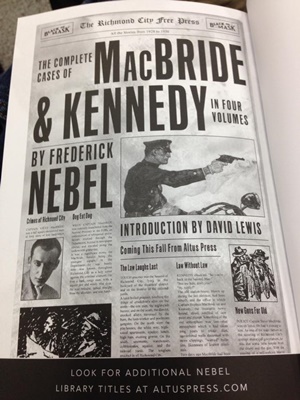
In the Fall of 2016, Altus Press revived the legendary Black Mask magazine, reprinting stories from the old pulps with a mix of new hardboiled tales; including a cover story from my talented friend Paul Bishop. Altus also relaunched two other classic pulps: Argosy (which only lasted one issue) and Famous Fantastic Mysteries (just two issues). However, the fifth issue of Black Mask will be out this Fall (with an essay from yours truly).

Today in A (Black) Gat in the Hand, we’re going to look at each of the entries in the second issue of the new Black Mask, from the Spring of 2017. And this issue starts big!

Carroll John Daly’s “Murder for a Stuffed Shirt” is a previously unpublished tale!

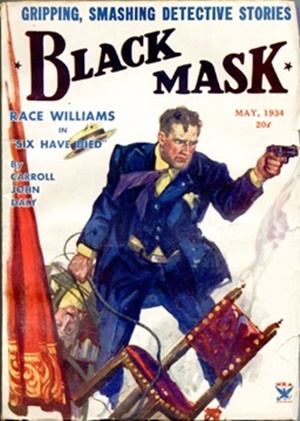
Carroll John Daly was the biggest star at Black Mask in the twenties and thirties. Putting Race Williams on the cover guaranteed increased sales. When he fell out of favor at Black Mask, Daly took Williams to Dime Detective, where he also created Vee Brown (I have a tough time buying into Brown, a hardboiled special DA operative and also a wealthy composer of hit sentimental songs. I wrote about Daly’s creation of the hardboiled genre with “Three Gun Terry Mack” here.

But this issue of Black Mask contains a never-before-seen Daly story, uncovered by his grandson. It feels very much like a pre-hardboiled piece and not one person is shot! It’s different than any other Daly story I’ve read and I liked it.

“Mr. Detective is Annoyed” by William Robert Cox originally appeared in the March, 1938 issue of Captain Satan. Cox had over 130 stories published in the pulps under his own name, plus more using various pseudonyms. He wrote eighty novels, many westerns and was the creator of Cemetery Jones and the Maverick Kid.

The story is one of four to feature Donny Jordine, who doesn’t like to sit around and wait for the machinery of justice to creak along. He makes things happen on his own. “Mr Detective is Annoyed” isn’t a bad story, but it didn’t leave me wanting more Jordine.

Read More Read More