Browsed by
Category: Reviews

Birthday Reviews: Harlan Ellison’s “Pennies, Off a Dead Man’s Eyes”

Birthday Reviews: Harlan Ellison’s “Pennies, Off a Dead Man’s Eyes”

Galaxy Science Fiction November 1969-small Galaxy Science Fiction November 1969 back cover-small

Cover by Jack Gaughan

Harlan Ellison was born on May 27, 1934.

Ellison has received 8 Hugo Awards, beginning with his short story “’Repent Harlequin!’ Said the Ticktockman.” His other Hugo Award winners include the short stories “I Have No Mouth, and I Must Scream,” “The Beast that Shouted Love at the Heart of the World,” “The Deathbird,” “Adrift Just Off the Islets of Langerhans: Latitude 38° 54′ N, Longitude 77° 00′ 13″ W,” “Jeffty is Five,” and “Paladin of the Lost Hour.” His screenplay for the Star Trek episode “City on the Edge of Forever” also earned him a Hugo. Ellison has also won four Nebula Awards for his stories “’Repent Harlequin!’ Said the Ticktockman,” “A Boy and His Dog,” “Jeffty is Five,” and “How Interesting: A Tiny Man.” SFWA has also given him the Bradbury Award for 2000x, in collaboration with Yuri Rasovsky and Warren Dewey. He has also won the World Fantasy Award, Bram Stoker Award (5 times), British Fantasy Award, British SF Association Award, the Jupiter Award (twice), the Prometheus Hall of Fame Award, and has three Worldcon Special Convention Awards.

LASFS presented Ellison with the Forry Award in 1970. He received a Milford Award for Lifetime Achievement in 1986, a World Fantasy Lifetime Achievement Award in 1993, an International Horror Guild Living Legend Award in 1995 and he received a Bram Stoker Lifetime Achievement Award the following year. He won the Gallun Award from I-Con in 1997. Ellison was named a World Horror Grandmaster in 2000. SFWA named him a Grand Master in 2006. In 2011, he was inducted into the Science Fiction Hall of Fame and received the Eaton Award for Lifetime Achievement. He was a Worldcon Guest of Honor at IguanaCon II in 1978 and a World Horror Con Guest of Honor in 2005.

Read More Read More

Birthday Reviews: Caitlín R. Kiernan’s “Glass Coffin”

Birthday Reviews: Caitlín R. Kiernan’s “Glass Coffin”

Silver Bird Blood Moon-small Silver Bird Blood Moon-back-small

Cover by Tom Canty

Caitlín R. Kiernan was born on May 26, 1964.

Kiernan novel The Drowning Girl was nominated for the Nebula Award, the World Fantasy Award, the Bram Stoker Award, the British Fantasy Award, the James Tiptree, Jr. Award, the Shirly Jackson Award and the Mythopoeic Award. It received the Tiptree and Stoker Awards. Kiernan also won a Stoker Award for the graphic novel Alabaster: Wolves. She won two World Fantasy Awards in 2014 for her collection The Ape’s Wife and Other Stories and the short story “The Prayer of Ninety Cats.” Kiernan has won four International Horror Guild Awards for her novels Silk and Threshold and for her short fiction “Onion” and “Le Peau Verte.”

“Glass Coffin” was originally published in Ellen Datlow and Terri Windling’s 1999 fairy tale anthology Silver Birch, Blood Moon. It is part of her Salmagundi Desvernine series of short stories. It was reprinted, along with the other three stories in the sequence, in Kiernan’s 2000 collection Tales of Pain and Wonder, along with several other short stories.

Although part of a series of stories featuring Salmagundi Desvernine and Jimmy DeSade, “Glass Coffin” can be read and understood on its own, although that understanding may be quite different for readers familiar with Kiernan’s other stories. “Glass Coffin” itself is a retelling of Snow White and the Seven Dwarfs. Replacing the woodland cottage of the more familiar setting is a salvage yard that was formerly Salmagundi’s family’s shipyard. The Dwarfs are replaced by the foster children Salmagundi has taken in. Each of the six children described have their own personality and abilities, with the seventh off stage. While they all await Jimmy DeSade’s return, Salmagundi cuts herself and dies for all intents and purposes.

Read More Read More

Birthday Reviews: Vera Nazarian’s “Salmon in the Drain Pipe”

Birthday Reviews: Vera Nazarian’s “Salmon in the Drain Pipe”

Vera Nazarian After the Sundial-small

Vera Nazarian was born on May 25, 1966.

Nazarian was nominated for a WSFA Small Press Award for her short story “Port Custodial Blues” in 2007. The following year she received a nominated for the Nebula Award for Best Short Story for “The Story of Love.” She also received a Nebula nomination in 2009 for her novella The Duke in His Castle. In addition to writing, Nazarian has worked as the editor and publisher of Norilana Books since the company’s founding in 2006.

“Salmon in the Drain Pipe” was published as an original story in Nazarian’s collection After the Sundial, in 2010. The story has not been reprinted.

Nazarian’s “Salmon in the Drain Pipe” is a relatively short piece that has her protagonist looking at the wonders of nature in an unspecified future. As he looks more closely, however, he discovers that rather than being flora or fauna, what he is really seeing is the detritus of civilization filling lakes and grasslands. Fish moving through algae have been replaced by collections of bottlecaps.

Read More Read More

Birthday Reviews: Irving E. Cox, Jr.’s “Too Many Worlds”

Birthday Reviews: Irving E. Cox, Jr.’s “Too Many Worlds”

Cover by Walter Popp

Irving E. Cox, Jr. was born on May 24, 1917 and died on February 13, 2001.

Cox began publishing in 1951 with “Hell’s Pavement,” which appeared in Astounding Science Fiction. He published most of his work during that decade, and only his final two stories, “Impact” and “Way Station,” appeared during the 1960s. During that time, however, his stories appeared in several different magazines as well as in original anthologies.

“Too Many Worlds” was originally purchased by Howard Browne for Amazing Stories, where it appeared in the November 1952 issue. It was reprinted in May of the following year in the British edition of the magazine. In 1973, the story appeared in the May issue of Science Fiction Adventures. More recently it appeared in Science Fiction Gems, Volume Twelve, edited by Gregory Luce.

Science fiction authors have long had their characters travel from one version of the world to another, which is how Cox begins “Too Many Worlds.” He dumps Albert Hammond into a world that resembles his own. In the new world, however, Hammond’s shipping company is much more successful than the one he knows. Where Cox tries something different is by making Hammond very aware of who he is, but unable to respond to things the way he wants to. Instead, no matter how hard he tries, the words and tone that come out of his mouth belong to the new world’s Albert Hammond, who is a much harder man.

A psychiatrist, naturally, tells Hammond that the world he sees is the way the world is ,and his view of himself as less rigid, having a smaller company, and two children who don’t exist is a delusion he has built up for some reason. The new world’s Hammond indulges in business practices that the original Hammond feels are poor choices and bad for business, yet invariably turn out to work to his benefit.

His situation takes a turn for the worse, although more interesting for the reader, when in addition to his memories of his reasonably successful life, he begins to experience a life in which he didn’t even achieve the level of success he had in his original life. The constants in the different versions of his reality are the company he works for, his wife, and, he comes to realize, an old high school friend, Willie Tuttle. Once Tuttle comes into the picture, the cause of the different worlds becomes obvious, but Hammond must still try to figure out how to break the cycle.

Read More Read More

A Pair of Gonzo Mysteries from a Fantasy Master: Rich Horton on Pink Vodka Blues and Skinny Annie Blues by Neal Barrett, Jr.

A Pair of Gonzo Mysteries from a Fantasy Master: Rich Horton on Pink Vodka Blues and Skinny Annie Blues by Neal Barrett, Jr.

Pink Vodka Blues-small Skinny Annie Blues-small

Neal Barrett, Jr. received a Hugo and Nebula Award nomination for his 1988 story “Ginny Sweethips’ Flying Circus,” and in 2010 he was named Author Emeritus by the Science Fiction and Fantasy Writers of America. A discussion of his four Aldair novels — which Fletcher Vredenburgh called “a blast of strangeness and adventure” — broke out in the comments section of my 2013 post about Mark Frost’s The List of 7. And in his 2014 review of The Prophecy Machine, Fletcher wrote:

The late Neal Barrett Jr. wrote around thirty novels and seventy short stories. I’ve only read a little bit from his works, which include sci-fi and fantasy as well as crime fiction and magic realism. He seems to have slipped under the radar of most genre readers. On the other hand, everything I’ve read about the man marks him as one of those special authors held in high esteem by other writers.

As usual, Fletcher is bang on in his assessment. I haven’t read any of Barrett’s crime fiction either, and I’ve always been very curious about it.

But that’s why we have Rich Horton. Over at his website Strange at Ecbatan Rich reviews two of Barrett’s mid-90s mystery novels, Pink Vodka Blues (1992) and Skinny Annie Blues (1996), calling them ‘funny’ and ‘wild.’ That qualifies them for a closer look in my book.

Read More Read More

Birthday Reviews: Joe Patrouch’s “The Attenuated Man”

Birthday Reviews: Joe Patrouch’s “The Attenuated Man”

Cover by Barclay Shaw

Joseph F. Patrouch, Jr. was born on May 23, 1935.

Patrouch was a teacher in Ohio who had a brief career writing science fiction. In the early 1970s, he wrote several essays about Asimov’s fiction and published his first short story, “One Little Room an Everywhere” in the February 1974 issue of Vertex. Most of his fiction has never been reprinted, with the exceptions “The Man Who Murdered Television” and “Legal Rights for Germs.” He also published The Science Fiction of Isaac Asimov in 1974.

“The Attenuated Man” was published by Edward L. Ferman in the March 1979 issue of The Magazine of Fantasy and Science Fiction. It has never been reprinted.

Ken Hamilton sneaks into his father’s company to use the Transmat machine to become the first man on Mars, in an attempt to prove to his father than he isn’t completely worthless. Unfortunately, things go wrong for him almost immediately as he starts bleeding from his eyes, ears, and mouth. Back on Earth, Ken’s excursion has been discovered and his father’s staff is trying to figure out how to get him back, especially once they realize something has gone wrong and they can’t send someone after him without the same problems occurring.

Patrouch has an interesting look at some of the dangers of teleportation, although the impact seems to be different when transmatting people to different places, a discrepancy which he discusses in the story. Furthermore, although he indicates that Hamilton has a very low opinion of his son’s intelligence and abilities, the son figures out part of the solution that will allow him to return to Earth safely, and understands what has happened to him.

Read More Read More

Into the Grimness: Shadows Linger by Glen Cook

Into the Grimness: Shadows Linger by Glen Cook

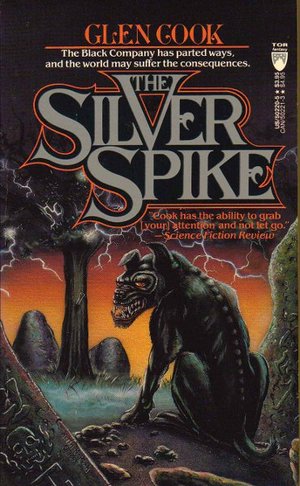
SHDWSLN1984Let me start off with a warning: there will be spoilers galore in this and all future Black Company posts. There’s just no way to avoid them at this point. So if you haven’t read the books, do us all a favor and read them.

Shadows Linger (1984) amps up the proto-grimness of Cook’s seminal epic fantasy series, at the same time taking much of the focus away from the titular Black Company and the previous book’s narrator, Croaker. It’s a surprising approach when so much of the initial book’s story was about the company itself as an almost living thing, complete with its own complicated history and traditions. It works though, due to Cook’s jaundiced view of human nature, and skill at crafting a harsh, noir atmosphere and setting.

At the end of The Black Company, ex-nobleman and all-around badass Raven realized that Darling, the nine year-old girl the Company rescued, was the White Rose. It was prophesied that the White Rose, who in centuries past had defeated and imprisoned the Dominator and the Lady, would be reincarnated when the need for her again arose. Now is that time.

Shadows Linger begins nine years after the close of The Black Company. The Company has become the Lady’s fire brigade, marching back and forth across her vast empire, forever extinguishing any signs of rebellion. Resistance leaders are hunted down and killed and the peace of iron-fisted repression is enforced. Still, the Company holds on to a sliver of its members’ humanity.

The Lady’s service has not been bad. Though we get the toughest missions, we never have to do the dirty stuff. The regulars get those jobs. Preemptive strikes sometimes, sure. The occasional massacre. But all in the line of business. Militarily necessary. We’d never gotten involved in atrocities. The Captain wouldn’t permit that.

The Dominator, the Lady’s husband and once the the North’s resident Dark Lord, remains imprisoned in the Barrowlands, held in place by spells, soldiers, and a dragon. Something, though, is stirring and it seems as if he is preparing to somehow escape his bonds. An investigation leads members of the Company and two of the Taken, the Lady’s own ringwraith sort of wizards, to Juniper. Juniper exists in the most remote part of the North on a bay that is free from ice only half the year. There, a strange black castle has been growing year by year. Somehow it is connected to the Barrowlands and the Dominator.

Read More Read More

Birthday Reviews: Wallace West’s “No War Tomorrow”

Birthday Reviews: Wallace West’s “No War Tomorrow”

Cover by Milton Luros

Wallace West was born on May 22, 1900 and died on March 8, 1980.

West began publishing speculative fiction in 1927 with the story “Loup-Garou,” which appeared in Weird Tales. Working mostly at short fiction lengths, he didn’t limit himself to science fiction and fantasy and his story “Muddy Waters” was turned into the 1933 film Headline Shooter.

“No War Tomorrow” was printed in the first issue of Science Fiction Quarterly, published in May 1951 with Robert A.W. Lowndes as the editor. In January of the following year it appeared in the magazine’s British edition. West included the story in his 1962 collection Outposts in Space.

The world of West’s “No War Tomorrow” is something of a mess. The major power is the United Stars, which seems to govern Earth, the Moon, Mars, and part of Venus, all of which appear to be inhabitable and suitable for human life, although there may be domes or terraforming that has occurred on Mars and the Moon. West’s focus, however, is on Venus, which is divided by the United Stars and the local Big Shots, who rule an anarchic area where the laws requires people to fend for themselves, although at the same time there is a civilization and police force, without explanation for how either survive.

Although West’s hero is Captain Frank Sage of the Space Patrol (part of the United Stars), his protagonist is really Sage’s girlfriend, Sadie Thompson, who dresses in barely enough clothing to highlight her figure, and who varies between being hyper competent and acting like a flirtatious girl who barely knows what is going on. While this might make sense if West used these variations to further the plot, they mostly seem to be used at random when he isn’t sure what to do with the character. Despite Thompson’s general ability, as well as the abilities of another female character, Greta, the depiction comes across as misogynistic.

Read More Read More

Birthday Reviews: Manly Wade Wellman’s “The Terrible Parchment”

Birthday Reviews: Manly Wade Wellman’s “The Terrible Parchment”

Cover by Margaret Brundage

Manly Wade Wellman was born on May 21, 1903 and died on April 5, 1986.

In 1956, his story “Dead and Gone” received an Edgar Award for Best Fact Crime Story. Wellman’s collection Worse Things Waiting received a World Fantasy Award for Best Collection in 1975, and in 1976 he received a Phoenix Award at DeepSouthCon. He received a World Fantasy Award Life Achievement Award in 1980 and in 1983 was a Guest of Honor at the World Fantasy Convention in Chicago. At ConStellation, the 1983 Worldcon, Wellman was inducted into the First Fandom Hall of Fame. He received a Special Award from the British Fantasy Society in 1985.

“The Terrible Parchment” first appeared in the August 1937 issue of Weird Tales, edited by Farnsworth Wright. The story was dedicated to the memory of H.P. Lovecraft, who had died five months earlier. In 1972, Meade and Penny Frierson reprinted it in the first issue of their fanzine, HPL. Wellman then included the story in his 1973 collection Worse Things Waiting. In 1996, Robert M. Price selected it for the Chaosium Cthulhu Cycle anthology The Necronomicon: Selected Stories and Essays Concerning the Blasphemous Tome of the Mad Arab. It was also included in the Wildside Press e-book The Second Cthulhu Mythos Megapack in 2016.

While preternatural horror is often the goal of fiction set in Lovecraft’s Cthulhu mythos, humor also has a tendency to sneak in. Wellman’s meta-fictional “The Terrible Parchment” is definitely an early example of humorous Cthuliana, positing a copy of Weird Tales delivered to its subscriber and containing a page from The Necronomicon.

Although the idea of the characters being terrorized by the volume Lovecraft and so many of his followers have described works on a conceptual level, Wellmen’s depiction of the attack undermines the horror and turns the story into a more humorous work. As readers of Weird Tales, the characters are aware of The Necronomicon and its role in Lovecraft’s mythos, and Gwen even suggests that the book has achieved reality based on its legendary nature and fame, already occurring in 1937. The page’s method of attack, moving along the floor like an inchworm and seeping up the narrator’s leg, however, leaves much to be desired as a preternatural horror, as does his means of defense, stabbing at it with his wife’s umbrella.

Read More Read More

Birthday Reviews: Adam-Troy Castro’s “MS Found Paper-Clipped to a Box of Jujubes”

Birthday Reviews: Adam-Troy Castro’s “MS Found Paper-Clipped to a Box of Jujubes”

Cover by Amy Sterling

Adam-Troy Castro was born on May 20, 1960.

Castro has been nominated for the Nebula Award 8 times in the three short fiction categories, beginning with a Best Novella nomination for “The Funeral March of the Marionettes” and most recently for the novella “With Unclean Hands.” “The Funeral March of the Marionettes” was also nominated for the Hugo Award, and Castro later shared a Hugo nomination with Jerry Oltion for “The Astronaut from Wyoming.” Castro and Oltion would go on to win the Seiun Award for “The Astronaut from Wyoming” in 2007. He won the Philip K. Dick Award for the novel Emissaries from the Dead in 2009. Four of his stories have topped the Analog Readers Poll, including “The Astronaut from Wyoming,” “Sunday Night Yams at Minnie and Earl’s,” “With Unclean Hands,” and “The Coward’s Option.”

“MS. Found Paper-Clipped to a Box of Jujubes” was an original story included in Castro’s 2000 collection An Alien Darkness. It is the only time it has been published and was one of three stories first published in that collection.

It is only natural to look at a Ferris wheel and think about what would happen if it broke loose from its moorings. Of course, the reality of the situation would be deadly and horrific, but Castro paints a more surrealistic scene in “MS Found Paper-Clipped to a Box of Jujubes.”

Joe and Mary Sue are riding on a Ferris wheel, ignoring pretty much everything except for each other, when the wheel jumps from its holder and begins to roll down the midway and eventually out of the fairgrounds, gaining speed as its goes and causing Mary Sue to fall out of the wheel (unharmed). Joe just goes along for the ride as police try to stop the runaway wheel, treating it more like a speeding driver than anything else. Eventually, the wheel goes on to achieve cross-dimensional status and the wheel’s riders begin to work to regain control of the ride.

Read More Read More