Future Treasures: The Captive Condition by Kevin P. Keating
Future Treasures: The Captive Condition by Kevin P. Keating

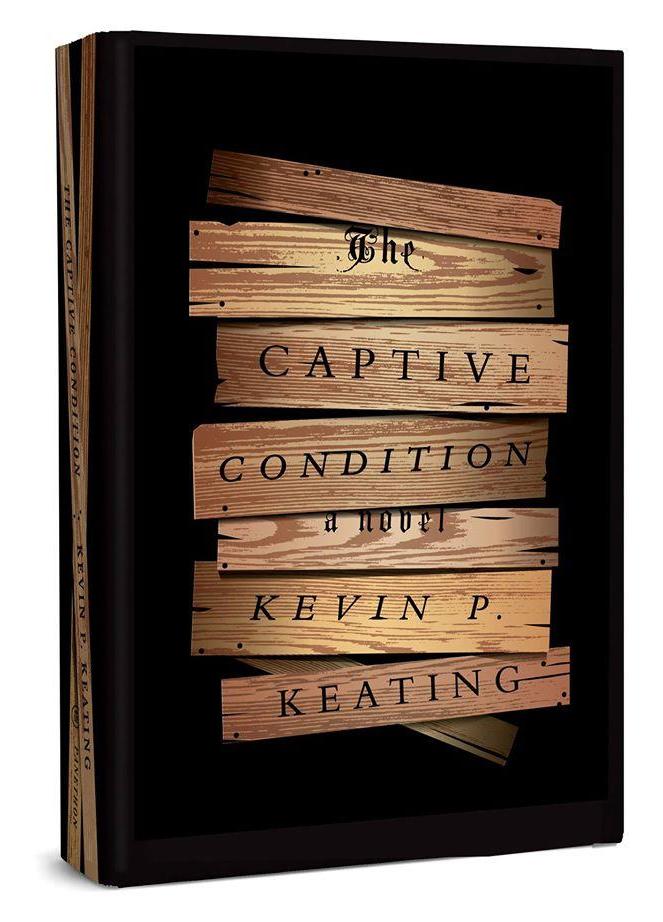
The Captive Condition-smallPantheon isn’t known for publishing horror or fantasy… so when they do, it’s worth sitting up and taking notice. Their latest release, by the author of The Natural Order of Things, is a deliciously dark novel about an idyllic Midwestern college town that turns out to be a nexus of horror.

For years Normandy Falls has been haunted by its strange history and the aggrieved spirits said to roam its graveyards. Despite warnings, Edmund Campion is determined to go there and pursue an advanced degree in literature. At first things proceed wonderfully, but Edmund soon learns he isn’t immune to the impersonal trappings of fate: his girlfriend Morgan Fey smashes his heart, his advisor Professor Martin Kingsley crushes him with frivolous assignments, and his dead end job begins to take a toll on his physical and mental health.

One night he stumbles upon the body of Emily Ryan, a proud and unapologetic “townie,” drowned in her family pool. Was it suicide, Edmund wonders, or murder? In the days following the tragedy, Emily’s husband Charlie, crippled by self-loathing and ultimately frozen with fear, attempts to flee his disastrous life and sends their twin daughters to stay with the Kingsleys. Possessed with an unnamed, preternatural power, the twins know the professor seduced their mother and may have had a hand in her death. With their piercing stares, the girls fill Martin with the remorse and dread he so desperately tries to hide from his wife.

Elsewhere, a low-level criminal named The Gonk takes over a remote cottage, complete with a burial ground and moonshine still, and devises plans for both; Xavier D’Avignon, the eccentric chef of a failing French restaurant, supplies customers with a hallucinogenic cocktail he makes in his kitchen; and Colette Collins, an elderly local artist of the surreal and psychedelic, attends a New Year’s Eve retrospective that is destined to set the whole town on fire.

The Captive Condition will be published by Pantheon on July 7, 2015. It is 265 pages, priced at $24 in hardcover and $9.99 for the digital edition.
Interzone #258 Now on Sale

Interzone #258 Now on Sale

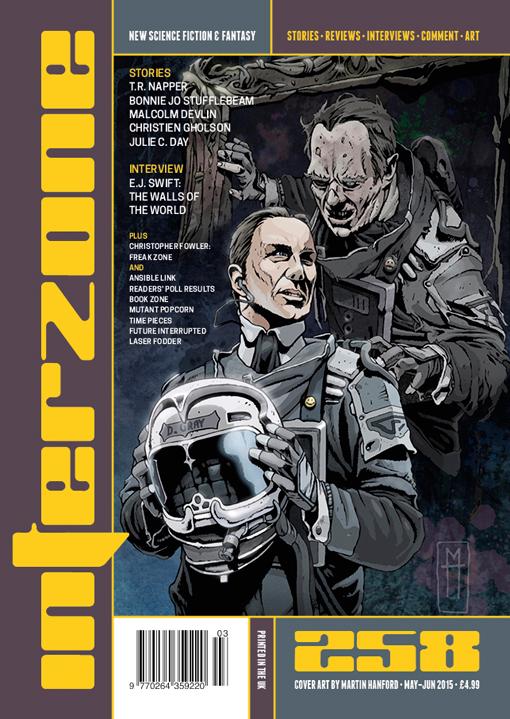
Interzone 258-smallThe May–June issue of Britain’s longest running science fiction and fantasy magazine is now on sale.

The cover, by Martin Hanford, is titled “Dorian Gray,” and is a fine (and terrifically creepy) re-interpretation of the 1891 novel by Oscar Wildle… with space suits. I like it. Click the image at right for a bigger version.

Interzone #258 contains five stories:

“a shout is a prayer / for the waiting centuries” by T.R. Napper
“The Re’em Song” by Julie C. Day
“Doors” by Bonnie Jo Stufflebeam
“Angel Fire” by Christien Gholson
“Her First Harvest” by Malcolm Devlin

Non-fiction this issue includes “Freak Zone” by Christopher Fowler. Here’s the first paragraph:

My former agent once told me, “I accept any kind of fiction except science fiction.” When I asked her why, she explained, “I just don’t think I could do it justice,” which was a polite way of saying that she didn’t understand it. But to me, not understanding everything was the point and purpose of reading.

There’s also “Future Interrupted,” by Jonathan McCalmont, and Nina Allan’s “Time Pieces” column, this month titled: “Election Special: the Hugos, the Puppies, and the Big Pile of Poo.”

Read More Read More

May Short Story Roundup

May Short Story Roundup

oie_6212435zQMwrmTD (1)I’m sorry that I let April pass without a short story roundup. The outpouring of new heroic fiction continues unabated on the pages of numerous magazines the genre is lucky to have. I’m back on track and here to tell you about last month’s must-reads.

I have never left any doubt in my reviews about which is my favorite fantasy magazine, so let me start by singing the praises of Adrian Simmons and his cohorts at Heroic Fantasy Quarterly. Each issue has terrific cover art, two or three stories and a number of poems, and in the three years I’ve been reading and reviewing the magazine it has always been at least satisfactory and usually splendid. What makes HFQ so strong is the editors’ love for and knowledge of the genre, which is obvious by their singular ability to select and edit stories. Always true to the traditions of heroic fiction, they yet manage to publish tales that push the genre in new directions.

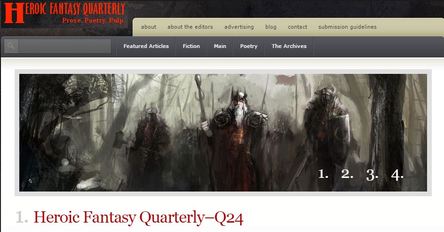
Issue 24 is maybe their best yet. This quarter’s artwork is a dark, brooding piece titled “Wizard With Army” by Vuk Kostic. Click this link to see the painting in its full glory.

The issue opens with Cullen Groves’ first published story, “The Madness of the Mansa,” a tale of a capricious monarch with a peculiar penchant for poetry.

Following a night in which “a great storm arose over the western ocean, and many citizens and sailors in the port of Asongai told how they had seen the demons of madness walking the black winds in the darkness.”, the ruler, the Mansa, is struck by a curious madness. From that point on he allows people to address him only poetically, using “the old meters” of songs and legends.

In the wake of the Mansa’s madness, the merchants of Asongai find themselves unable to successfully compete for his attention against the skilled singers of his tribal subjects. When a merchant named Bukra overhears the ex-gladiator, Draba, singing in a tavern, he hires him to petition the Mansa on his behalf.

Read More Read More

Vintage Treasures: Dragonflight and Dragonquest by Anne McCaffrey

Vintage Treasures: Dragonflight and Dragonquest by Anne McCaffrey

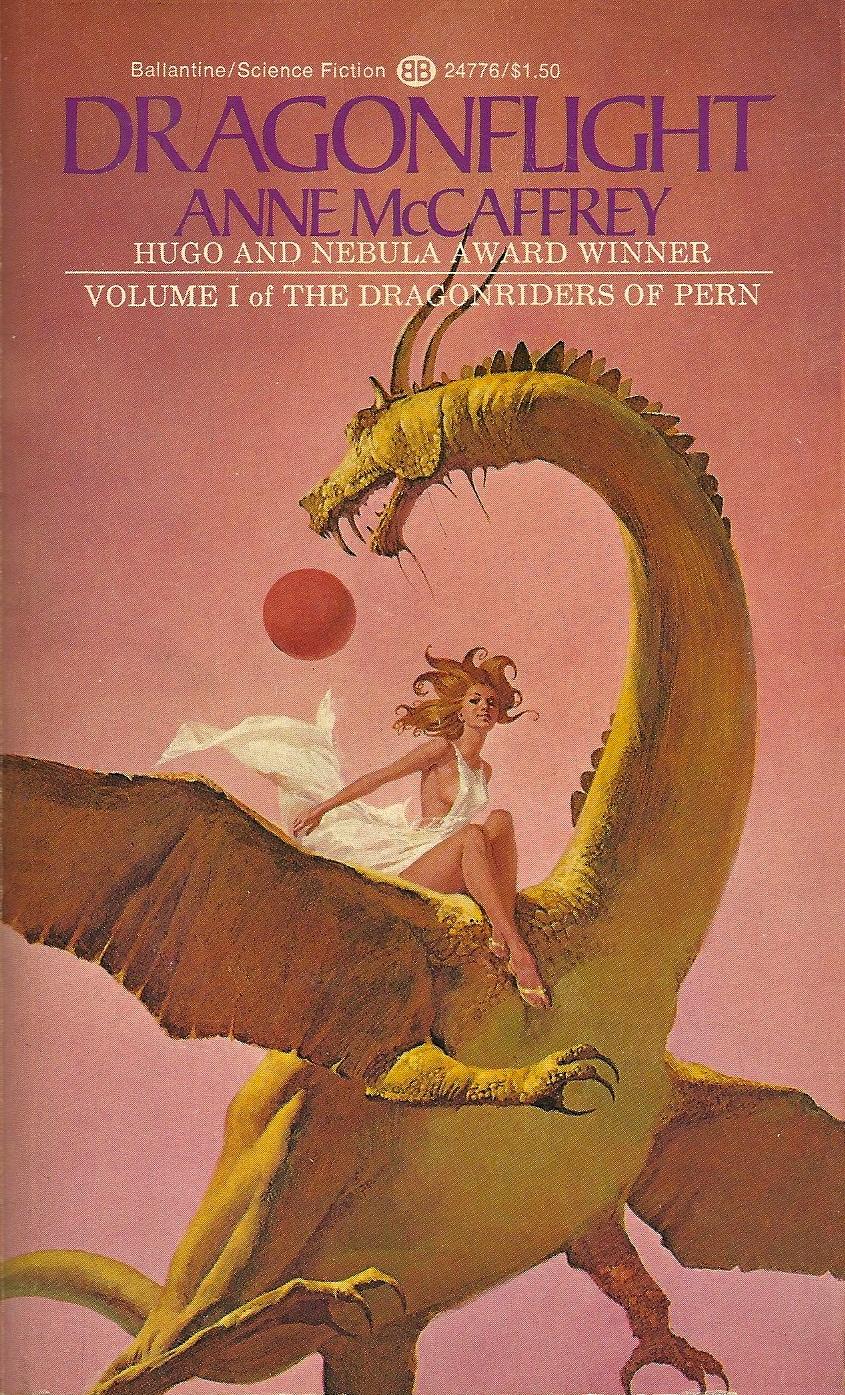
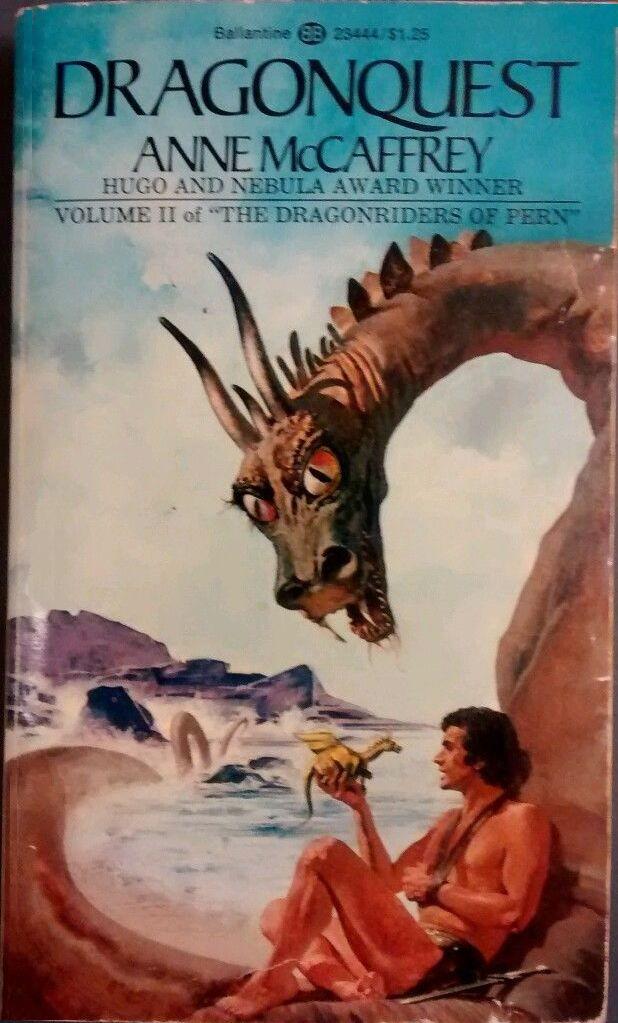
Dragonflight McCaffrey-small Dragonquest McCaffrey-small

Anne McCaffrey’s Dragonriders of Pern is one of the most famous and bestselling science fantasy series of all time. All told there are sixteen novels, written between 1968 and 2006, the last two in collaboration with her son Todd.

The artist most closely associated with it is probably Michael Whelan, who was hired to paint the cover for the third novel, The White Dragon, published in June 1978. The White Dragon became the first bestseller in the series, and Whelan was hired by Ballantine to create new covers for the first two novels, Dragonflight and Dragonquest, late in 1978. He did a fine job, and was subsequently hired for the next four volumes in the series.

But I still admit a great fondness for the early 70s covers of the first two books (above), both painted by Gino D’Achille. Both books were Ballantine paperback originals. The covers are more whimsical and fairy-tale like, and speak to me of 1970s fantasy.

Read More Read More

The Camera Can Lie: FairyTale: A True Story

The Camera Can Lie: FairyTale: A True Story

Cottingley FairiesNews flash: Sir Arthur Conan Doyle, having created literature’s greatest rationalist in the form of Sherlock Holmes, spent his later years heavily invested in the occult, the supernatural, and the possible existence of (yes) fairies.

Of course, people have always evinced a desire to believe — sometimes in this, sometimes in that — and so it is perhaps not so surprising that Conan Doyle played a large role in one of history’s great photographic deceptions, that of the so-called Cottingley Fairies.

In fact, he was one of those most willing to champion the trumped-up, cheap-looking fakes (black and white stills of young girls posing in shrubbery with paper cut-outs of highly Romanticized winged fairies) His role in this debacle (the girls only recanted decades later) is the subject of a FairyTale: A True Story (1997), a film well worth revisiting given our drone-happy, GPS-driven, target-rich world.

You see where I’m going with this, yes? Given our present era of photo manipulation and computer generated graphics, our collective ability to dupe the unwary has never been greater, and just like statistics, images lie.

Read More Read More

Neil Gaiman and Kazuo Ishiguro on Sword & Sorcery

Neil Gaiman and Kazuo Ishiguro on Sword & Sorcery

Neil Gaiman in The New Republic-small

The New Republic has posted a lengthy conversation on fantasy, titled Breaking the Boundaries Between Fantasy and Literary Fiction, between Neil Gaiman (The Graveyard Book, American Gods) and Kazuo Ishiguro (The Remains of the Day, The Buried Giant). Among other fascinating topics, the two discuss sword & sorcery, and the different cultural approaches to swordfights.

Read More Read More

New Treasures: Hannu Rajaniemi: Collected Fiction

New Treasures: Hannu Rajaniemi: Collected Fiction

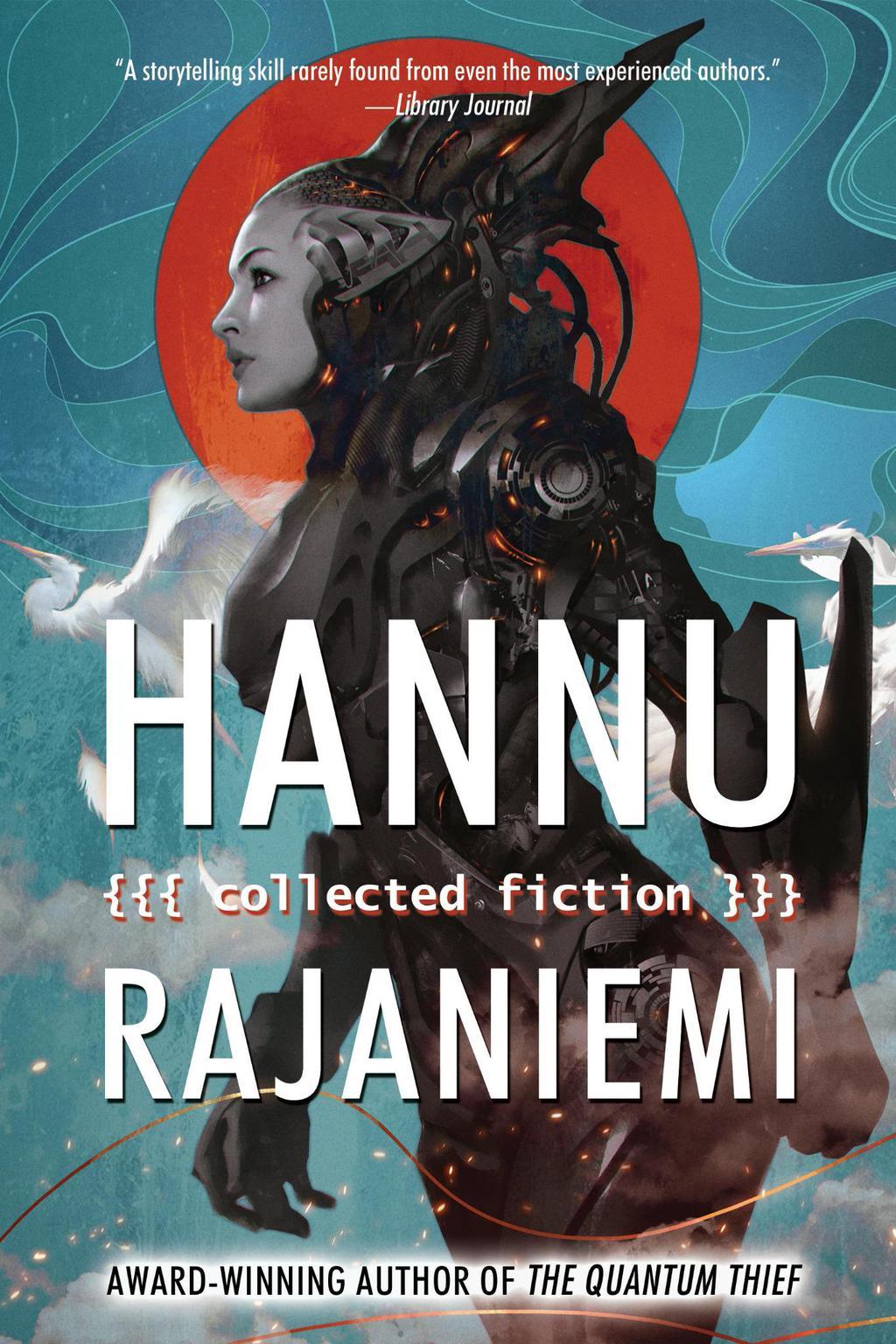
Hannu Rajaniemi Collected Fiction-smallOne of the more enjoyable parts of the Nebula Awards weekend was the autograph session late Saturday night — when folks like Greg Bear, Larry Niven, Connie Willis, Nancy Kress, Joe Haldeman, Jack McDevitt, Aliette de Bodard, Tobias Buckell, and dozens more sat down to sign autographs for fans. The author with the biggest line was unquestionably Cixin Liu, author of Nebula-nominated The Three-Body Problem, who’d flown all the way from China, but there was plenty of love to go around. Greg Ketter from Dreamhaven was doing a brisk business in the middle of the room, selling books to eager autograph hounds. I decided to limit myself to one book and, oddly enough, despite the rare opportunities to get autographs from some of my favorite authors, the title I couldn’t resist was Hannu Rajaniemi: Collected Fiction, from an author who wasn’t even in attendance. It’s a beautiful limited edition hardcover from Tacyhon Publications. I’d heard rumors it was almost sold out, and when I saw Greg had a single copy, I snatched it up.

Inside the firewall, the city is alive. Buildings breathe, cars attack, angels patrol, hyperintelligent pets rebel.

Hannu Rajaniemi (The Quantum Thief) is always on the cutting edge. His postapocalyptic, postcyberpunk, and posthuman tales are full of extraordinary beings and unpredictable optimism. With his remarkable agility at merging science with storytelling, Rajaniemi makes the impossible possible — or even probable.

Rajaniemi’s much-anticipated first collection contains seventeen stories, with two original tales, a neurofiction experiment, and his Twitter micro-fiction. Journeying deep into inner and outer space, he asks us, how will human nature evolve when the only limit to desire is creativity? What happens when the distinction between humans and gods is as small as nanomachines — or as large as the universe? So whether you think the next big leap in technology might be genetic engineering, unlimited energy, or space travel, know this: Hannu Rajaniemi the arbiter of what happens after.

Hannu Rajaniemi: Collected Fiction was published by Tachyon Publications on May 19, 2015. It is $25.95 for the limited edition hardcover; there is no digital edition. The cover art is by Lius Lasahido.

The Public Life of Sherlock Holmes: Looking at The Bruce Partington Plans

The Public Life of Sherlock Holmes: Looking at The Bruce Partington Plans

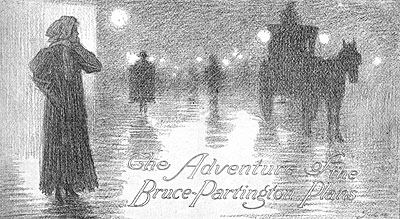
BruceP_FDSSolar Pons is, of course, the next best thing to Sherlock Holmes (which you know because you read THIS post, right?). I’m a Pons fan and I run www.SolarPons.com, the only website dedicated to The Sherlock Holmes of Praed Street.

Along with my two free, electronic newsletters (The Solar Pons Gazette and Baker Street Essays), the heart of the site is a collection of (non-spoiler) case commentaries for August Derleth’s stories. Some day, it will also host commentaries for the Basil Copper pastiches.

One of the many projects on my ‘To Do’ list (which might as well be Wish list) is to write case commentaries for the sixty Holmes stories written by Sir Arthur Conan Doyle. I’ve done one (woohoo!!!). First, if you haven’t done so, you really, really, really (I mean, really) need to read “The Bruce Partington Plans.” It’s a short story; won’t take long. And the rest of this post will actually mean something to you.

Each case commentary includes a non-spoiler preview of the story, some notable quotes, and a plethora of miscellaneous observations and comments. I’m probably in the minority, but I think there is some good stuff below and you’ll know a bit more about the story after you read it. So, come, the game is afoot!

Read More Read More

Presenting the 2015 Nebula Awards

Presenting the 2015 Nebula Awards

Presenting the 2015 Nebula Award for Best Novelette
Presenting the 2015 Nebula Award for Best Novelette. Photo by Keith Stokes

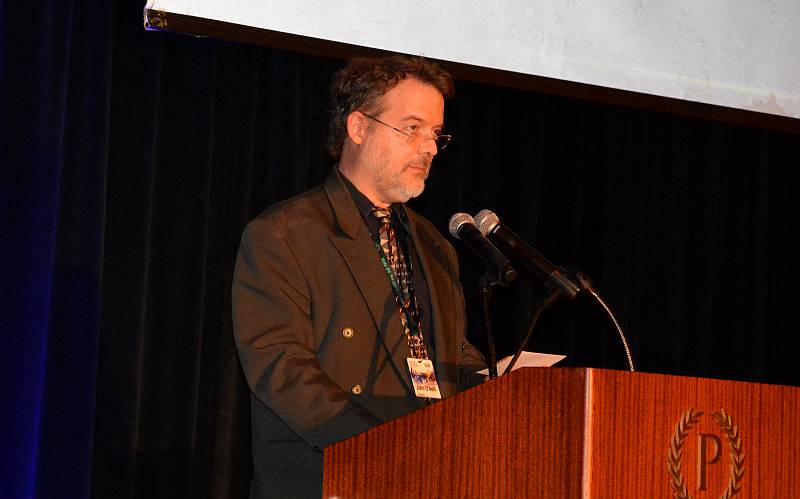
I don’t mean that title metaphorically. Like, “Here are the 2015 Nebula winners, so awesome!” I mean it literally. As in, presenting a Nebula Award on stage, in front of God and everybody, while wearing a suit and desperately hoping I pronounced all the names correctly. How’s that for awesome?

The 2015 Nebulas were presented by the Science Fiction Writers of America at the 50th Annual Nebula Awards Weekend on Saturday, June 4th, at the Palmer House in downtown Chicago. The event was attended by the brightest and most dazzling talents in the industry (plus, I was there too). I was invited to present the Nebula for Best Novelette, which was a fabulous honor that made me all giddy. If at any point on Saturday I shook your hand and tried to give you a Nebula Award, I hope you can understand — when I’m nervous, rehearsing make me feel better.

Please forgive me. Unless your name is Alaya Dawn Johnson, in which case, congratulations again on winning, and I’m very sorry I added three extra vowels to your first name. Ha ha ha, Alaya. It looked so damn easy on paper.

Anyways, the Nebulas. Super-big deal. The biggest names in the industry, gathered together to celebrate the very best writing of the year. And also to see and be seen, to socialize, discuss the big issues of the day, renew friendships, make new friends, gossip, catch up on all the news. Plus, to give out some Nebula Awards.

Derek Kunsken posted a fine summary of the weekend earlier today. After working with him for so many years, I was delighted to finally meet Derek for the first time, and he turned out to be just as articulate and entertaining in person. He wasn’t the only Black Gate writer to attend — I also caught up with Steven Silver, Jeremiah Tolbert, Tina Jens, and Beth Dawkins.

The highlight, of course, was the awards ceremony. And without any further ado, here’s a complete rundown on the winners.

Read More Read More

Self-published Book Review: The Age of Heroes by Scott Robinson

Self-published Book Review: The Age of Heroes by Scott Robinson

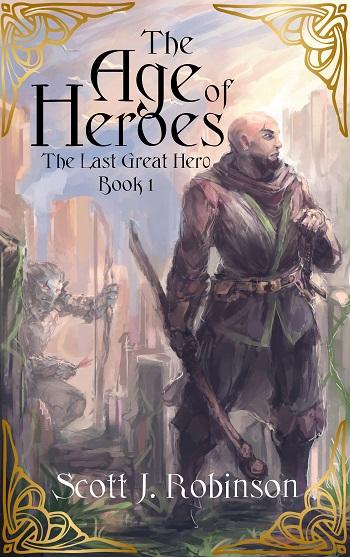
The Age of Heroes Robinson-smallThis month I’m reviewing The Age of Heroes by Scott Robinson. I’ve reviewed one of Scott’s books before, The Brightest Light, a self-described crystal-punk story. This time around, Scott’s story is straight up sword and sorcery.

Rawk is the last of the great heroes.  Famed for his great deeds, everyone in the city of Katamood knows him, he has a crowd of fans following him everywhere he goes, and women decades younger throw themselves at him.  He could easily retire — his friend Weaver declared himself Prince and took charge of Katamood thirty years ago — but despite the fact that he’s well past his prime, he refuses to. It’s a matter of pride, of preserving his reputation: he’s a hero, not a former hero.  But there just isn’t a lot for a hero to do these days.  Since Weaver banned sorcery, and the nearby city-states started to do the same, there’s been a distinct lack of exots — the weird and horrible creatures that require a hero to deal with.  Anyone else who wants to get into the heroism business has to travel far and wide to do so, leaving Rawk as the last active hero whose deeds are still known in Katamood.  So when an oversized wolf shows up one day, he’s the person that everyone calls on.

Heroism is a young man’s game — not just in the Age of Heroes, but in heroic fantasy in general.  People complain about the man part, but you’re more likely to see a woman as the protagonist in heroic fantasy than anyone over forty.  I couldn’t find Rawk’s exact age, but he’s at least in his fifties. He gets aches and pains even when he’s not particularly active, and his first fight almost ends badly when his knee nearly gives out. He spends the rest of the novel in a perpetual state of pain, unwilling to back down and let the soldiers whose job it is to deal with such threats steal his glory. Rawk’s age is a significant factor, and is the main reason this book is such a change of pace from most books in the genre. His point of view feels like that of a mature, older man, but he doesn’t necessarily act like one.

Read More Read More