Fantasia 2016, Day 16: Two Fish Stories (Collective Invention and Too Young To Die!
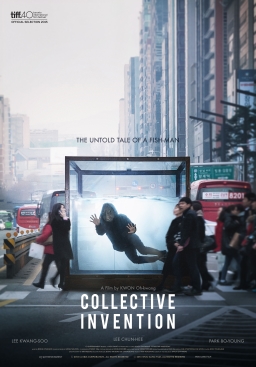 By July 29, the sixteenth day of the Fantasia Festival, I was beginning to feel exhausted. I’d had some thoughts of watching three movies that Friday, but in the end could only manage two. I made it down to the Hall Theatre in the afternoon to watch the Korean satire Collective Invention (Dolyeonbyuni), then came back right after for the raucous Japanese comedy Too Young To Die! (Too Young To Die! Wakakushite Shinu). Neither struck me as flawless, but both in different ways were interesting experiences.
Collective Invention tells the story of Park Gu (Lee Kwang-soo), a Korean man whose head has been changed into that of a giant fish thanks to unexpected side effects from medical tests. We get his story through the eyes of Sang-won (Lee Cheon-hee), an aspiring reporter who breaks Park’s story and makes him famous. Park’s not entirely happy about becoming a major media figure, and the medical company behind his transformation isn’t happy about the bad publicity they get. Their counterpunches, and the ups and downs of Park’s life and public profile, make the spine of the movie — along with the moral choices Sang-won and the others around him find themselves making, balancing the exploitation of Park against their own careers and ideals.
Directed and written by Kwon Oh-kwang, Collective Invention is a wide-ranging satire. It reads to me as though it takes on specific targets (the media, fame, the medical industry, the law, and more) as part of a general social critique. And at this point I need to repeat something I’ve mentioned before in these articles: I’m a North American with no particular insight into Korean society. So I can’t speak to how people with more knowledge than I will react to this movie; the point of my writing this review is that perhaps what I write may be relevant to an international audience. On the other hand, I get the distinct impression that this movie is primarily concerned with speaking to the Korean media landscape, to the concerns of Korean youth, and to Korea in general. That’s appropriate for a satire, but does it work for an international audience?
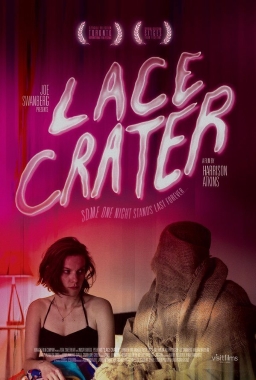 At 7:30 PM on Thursday, July 28, I was in a seat in the De Sève Theatre waiting to see a screening of an American independent horror-comedy called Lace Crater, about a woman who catches a venereal disease from a ghost. After that I’d cross the street to the Hall theatre for a showing of the Iranian horror movie Under the Shadow. I wasn’t entirely sure what to expect from either film, which from experience I knew was often the best way to come to a screening at Fantasia. I was pondering this when the lights went down and Adam Kritzer, producer of Lace Crater, was introduced to the crowd. He thanked us for coming, and urged all of us in the audience to turn to our neighbours, whether we knew them or not, and say whether we believed in ghosts. There was an aisle to my left. I glanced to my right. The man beside me shrugged. “Not particularly,” he said in French. “Same here,” I replied.