Blogging Sax Rohmer’s The Hand of Fu Manchu, Part Four – “The Queen of Hearts”
 “The Queen of Hearts” was the fourth installment of Sax Rohmer’s The Si-Fan Mysteries. The story was first published in Collier’s on November 25, 1916 (after a surprising gap of five months after the last installment) and was later expanded to comprise Chapters 15 – 18 of the third Fu-Manchu novel, The Si-Fan Mysteries first published in 1917 by Cassell in the UK and by McBride & Nast in the US under the variant title, The Hand of Fu Manchu. The US book title marks the first time that the hyphen was dropped from the character’s name, although it was retained within the text.
“The Queen of Hearts” finally gives readers the return of the Devil Doctor they had been so eagerly awaiting since first learning Fu-Manchu still lived six months earlier. The story starts with Rohmer’s trademark abrupt beginnings (in this instance Dr. Petrie yells, “Come in!” rather than “Who’s there?” in the opening line) with the unexpected arrival of a telegram from Cairo announcing that Petrie’s fiancée, Karamaneh will reach London by boat the next day. Nayland Smith speculates that the Si-Fan is the cause of her sudden departure from Egypt. That night, Smith awakens Petrie to inform him that Sir Baldwin Fraser, the prominent surgeon has been abducted and the description of the cab driver suggests that Zarmi has resumed her earlier disguise. They are joined by Inspector Weymouth at Sir Baldwin’s home in Half-Moon Street where they interrogate the surgeon’s secretary and learn that a beautiful Eurasian (whose description matches Zarmi) had been an unexpected visitor the prior night claiming her mother needed immediate medical attention. It was only after Sir Baldwin failed to return that his secretary learned the address given was a false one.

 This week concludes Black Gate‘s interview with author and editor James L. Sutter with a discussion of the pros and cons of media-tie in fiction, the Before They Were Giants anthology which collects the first sale short fiction of many big name writers, and a look at what James is working on now. Be sure to check out parts


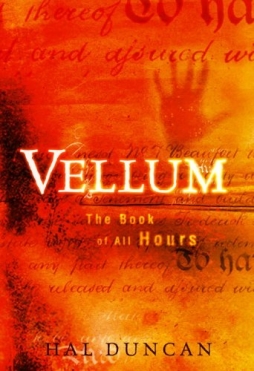 Hal Duncan’s The Book of All Hours is a dazzling, fascinating, frustrating work. A duology consisting of 2005’s Vellum and 2007’s Ink, it plays with structure and story in powerful ways, while also seeming to fall back too easily into black-and-white absolutes and traditional forms. The oddity of the book is that although in some ways it appears radically new, in other ways, as one reads further into it, it comes to feel more and more familiar.