Styrbiorn the Strong, a review
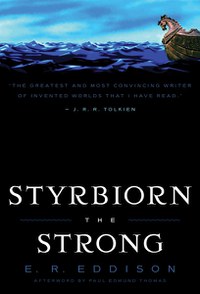
Styrbiorn the Strong, a review

styrbiorn1There is but one way for a man, and that is to remember that none may avoid his fate. This is to a man as the due ballast to the ship, which maketh the vessel indeed loom somewhat deeper, but keepeth it from tossing too lightly upon the uncertain waters.”

–E.R. Eddison, Styrbiorn the Strong

As a youth, E.R. Eddison (1882-1945) so loved William Morris’ translations of the Old Norse sagas that he taught himself Old Icelandic, desiring the pure injection of North Sea ice water into his veins that the stories in their original tongue delivered. He carried that love of the Sagas with him as a writer of fantasy fiction. Their echoes can be felt in Eddison’s best known work, The Worm Ouroboros (1922), but four years after the Worm Eddison set to work on the real thing, trying his hand at his own saga Styrbiorn the Strong (1926).

Styrbiorn the Strong tells the story of Styrbiorn Olaffson, teenage heir to the throne of Sweden. Denied his birthright and exiled from Sweden, Styrbiorn spends three years a-viking, during which his power and influence waxes mightily. Three years later he returns to claim his share of the kingdom. Except for a few minor characters everyone in the story is an historical figure. The main facts of the tale are also historical, including the concluding bloody Battle of Fýrisvellir, but the details and characterizations are of Eddison’s own making.
Read More Read More

Josh Wimmer Reviews Shades of Milk and Honey

Josh Wimmer Reviews Shades of Milk and Honey

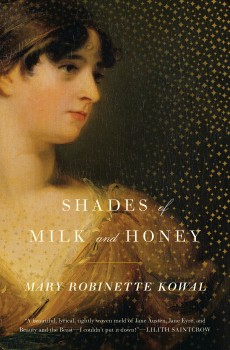
milkhoney_fnlcoverShades of Milk and Honey
Mary Robinette Kowal
Tor (304 pp, $14.99, trade edition June 2011)
Reviewed by Josh Wimmer

If you have read anything about Shades of Milk and Honey, then you have seen it described as “Jane Austen, but with magic” or something along those lines. That is pretty much unavoidable. The novel, the first by Hugo nominee Mary Robinette Kowal, isn’t just written in a style and voice resembling that of the British author’s Regency-era romances, but also features sisters – one pretty, one smart – yearning for suitable suitors; a low-key but loving father who wants to see his girls married because he can’t provide for them forever; a cavalcade of potential husbands of various sorts; and a lot of house parties. In other words, the book takes plenty from Pride and Prejudice and the rest of Austen’s oeuvre.

What it adds is a mild but meaningful undercurrent of fantasy, and a slightly more modern-day message than might be found in the early-19th-century works that inspired it. Jane Ellsworth is unmarried and, at age 28, likely to remain that way. To recommend her, she has her wits, her emotional steadiness, and her skill with glamour – the magical crafting of visual and audible illusions, typically for aesthetic purposes. All fine qualities, but perhaps not enough to make up for her plain appearance (which Jane resolutely and admirably refuses to enhance with glamour).

Read More Read More

Goth Chick News: Welcome to Scotland, Where Vampires Still Suck

Goth Chick News: Welcome to Scotland, Where Vampires Still Suck

image0041A few nights ago my inbox lit up with an email entitled, “They still suck over here.”

Now I believe I’ve already explained that one of the job hazards I face regularly (besides the toilet seat being left up in Black Gate’s unisex bathroom) is being the recipient of email clearly meant for an entirely different “Goth Chick” in an entirely different profession which is substantially older than my own.

However, in this particular case I recognize the sender as a former colleague from my time as an expat residing in the UK. “Ian” lives in eternal hope of enhancing Black Gate’s content by passing along what he considers appropriate Goth Chick fodder from the British Isles.

Honestly, to talk about the British horror industry is nearly as much of an oxymoron as British top chefs or British fashion designers. And as snarky a sweeping generalization as that may appear; suffice to say that if I ever penned the book A Yankee Goth Chick at Cambridge it would now stand as the primary source on adult bullying.

But even still, I did become chummy with a few nice, normal folks who weren’t still harboring secrets resentments over July 4th and one of these was my good friend Ian.

Read More Read More

Walter Jon Williams Explains Why UFOs Are Actually Made of Bread, and Other Little Known Facts

Walter Jon Williams Explains Why UFOs Are Actually Made of Bread, and Other Little Known Facts

williams1The first time I saw Walter Jon Williams, he was singing a song to mock Asimov’s then editor, Gardner Dozois. Melinda Snodgrass, Ellen Datlow, and Pat Cadigan sang backup.

My second sighting was a picture in that month’s Locus of Walter standing with Daniel Abraham and his bride, Kat, several other writers, and a toilet prominently displayed in the foreground. Said toilet was the writers’ group gift to the newlywed couple. Rather than slip a gift receipt into a card, or have the toilet delivered to the house, the writers group decided to carry the appliance into the reception on their shoulders.

And no, neither of those are the craziest stories I know about the award winning, bestselling author, Walter Jon Williams. By all means, read on!

Read More Read More

Art of the Genre: Curse of the Crimson Throne

Art of the Genre: Curse of the Crimson Throne

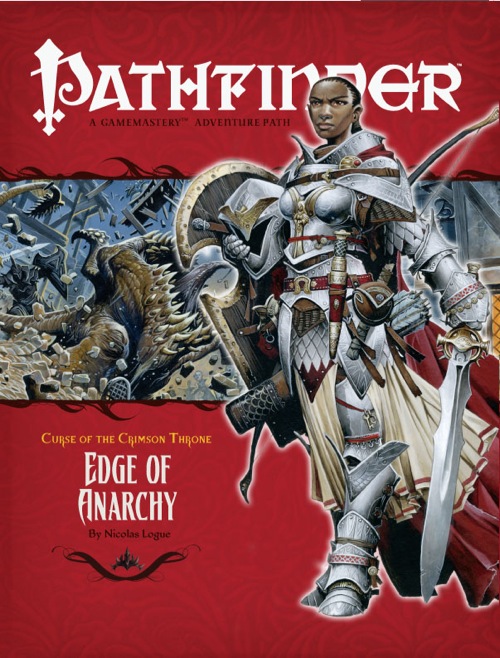
pzo9007_500Ok, so I don’t get to game as much as I like, and that’s a shame, but there are still times when I do get to have fun with RPGs. I mean, I’ve been doing this for 28 years, and during that period the bulk of what I’ve run as a Dungeon Master has been all home brew, which in gamer terms means I made it up. There is something to be said for the creativity of doing so, and as an imagination centered guy I get a great kick out of creating adventures, timelines, histories, legends, and anything else you can name.

That being said, I’ve also had the opportunity to sit back and use someone else’s creative spark to frame my adventures when I DM. In Old School terms this means using a module, and many and many again famed ones exist from the 1980s when D&D was new to the mass populace and DMs were raw and could use a little help when driving their business.

I’d like to say in my time within the genre ‘I’ve played them all’, which of course isn’t true, but I will debate the concept that I’ve played all the ones that truly matter… Yet for all their old school wonder, I was always on the lookout for something, anything, in today’s market that could rival the simple genius that were those original supplements.

Enter Paizo’s Pathfinder Adventure Paths. With ‘Edition Wars’ in full swing and Wizards of the Coast trying to rally a bloodied banner with 5th Edition, I’m not going to disparage any game that helps creative people gather around a table and share face time for fun, but I will hold up Paizo’s Pathfinder as an example of what ‘good’ really is in today’s RPG market.

Read More Read More

Real Magicians: Interviewing the Editors of Podcastle

Real Magicians: Interviewing the Editors of Podcastle

bgpodcastleThe thing is, I love Podcastle.

I can’t help it. I love theatre and oral storytelling, I read a lot, I listen to audiobooks myself; I love big collaborative projects that involve massive influxes of talent, that are broad-minded and multi-faceted, that promote both exciting new voices and the old classics. Podcastle — with its podsisters EscapePod and Pseudopod — does all that.

Every time I hear a story over at Podcastle that guts me or makes me fly a little, I want the whole world to hear about it. I only wish my voice were louder.

So, one day in the not too very distant past, riding on some Podcastle story high — maybe a Tim Pratt or a Leah Bobet — I asked the editors, Dave Thompson and Anna Schwind, if they wouldn’t mind doing an interview for Black Gate magazine. Like most collaborations (especially the ones I’m involved in, oops), this took more months than anticipated, but — also like most collaborations — was ultimately worth it.

Ladies and Gentlemen, may I introduce you to the movers and shakers of the Fantasy Podcast?

Read More Read More

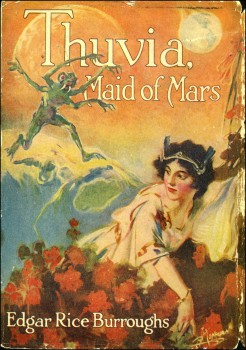
Edgar Rice Burroughs’s Mars, Part 4: Thuvia, Maid of Mars

Edgar Rice Burroughs’s Mars, Part 4: Thuvia, Maid of Mars

thuvia-maid-of-mars-mcclurg-coverJohn Carter’s story appeared finished with The Warlord of Mars. But readers wanted more, and Burroughs was fired with productive energy. Less than a year after “ending” the Martian novels, he launched into the second phase of the series, with a new hero, new heroine, and new point-of-view style.
Our Saga: The adventures of earthman John Carter, his progeny, and sundry other native and visitors, on the planet Mars, known to its inhabitants as Barsoom. A dry and slowly dying world, Barsoom contains four different human civilizations, one non-human one, a scattering of science among swashbuckling, and a plethora of religions, mystery cities, and strange beasts. The series spans 1912 to 1964 with nine novels, one volume of linked novellas, and two unrelated novellas.

Today’s Installment: Thuvia, Maid of Mars (1916)

Previous Installments: A Princess of Mars (1912), The Gods of Mars (1913), The Warlord of Mars (1913-14)

The Backstory

Burroughs wrote the fourth Barsoom novel in April–June of 1914 under the stunningly uninspired working title of “A Carthoris Story.” But it wouldn’t appear in magazine form until two years later, where it ran in All-Story in three installments in April 1916. Burroughs was deep in the middle of the busiest period of his life, and he spent most of 1915 trying to sell his new properties to Hollywood, all without success. The delay getting Thuvia, Maid of Mars to market may reflect how crazy the author’s life was getting — and that he realized that Tarzan was going to be his big franchise.

Read More Read More

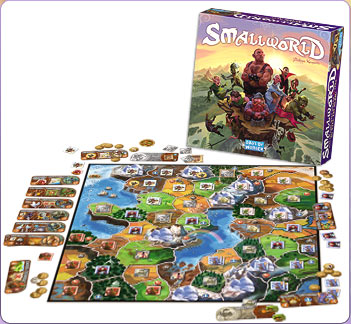
It’s a World of Slaughter: Small World Board Game

It’s a World of Slaughter: Small World Board Game

smallworldSmall World (Amazon)
Days of Wonder ($49.99)
2 to 5 players
Recommended ages: 8+
Playtime: Around 1 hour

Reviewed by Andrew Zimmerman Jones

Small World is a game where various fantasy races get to fight over a world that’s just too small for them all to coexist. The intriguing gameplay mechanic ultimately drives your races into decline, forcing you to select new races to sweep in and take their place. The victor is the one with the most Victory Points at the end of the game.

Each Race has special powers which are randomly chosen each game, resulting in a total of 280 different possible Race & Special Power combinations, from Swamp Giants to Dragon Master Skeletons to Seafaring Dwarves. (Or, in another permutation, Dragon Master Giants, Seafaring Skeletons, and Swamp Dwarves.)

The set-up can be a bit overwhelming when you first open the game, but once you’ve played it once, it’s a quick, fun game for the whole family. One nice feature is that there’s nothing hidden about the game, so this is excellent for introducing younger players to gaming. Though the recommended age is 8+, my precocious 6-year-old son and I have played this game multiple times. He often has questions about the way certain powers work, so the game lasts longer than an hour, but it’s loads of fun.

Read More Read More

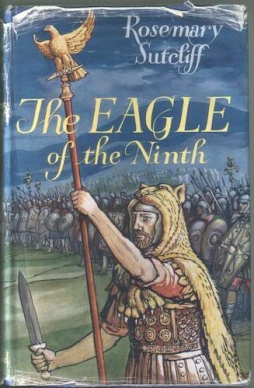
Some Notes on The Eagle of the Ninth

Some Notes on The Eagle of the Ninth

The eagle of the NinthWhat I know about Rosemary Sutcliff:

She was born in 1920. At age two she was struck by a terrible form of juvenile arthritis; she was in a wheelchair most of her life. She didn’t learn to read until she was nine, but was read to by her mother — Dickens, the Mabinogion, Kipling, King Arthur, Robin Hood. She became a writer in 1950, with a book drawing from those tales: The Chronicles of Robin Hood. In 1954, she wrote a book about Roman Britain, The Eagle of the Ninth, that became the first of a well-known series. She died in 1992.

I recently read The Eagle of the Ninth. And as a result of that I know this, too: I will be reading more of her work, in the very near future.

The Eagle of the Ninth follows Marcus Flavius Aquila, a Roman Centurion assigned to Britain in the second century AD. Wounded in battle, he’s discharged from the military, recovers, and eventually begins a dangerous quest into the mysterious lands north of the Roman walls — into the wilderness haunted by strange tribes of barbarians.

Read More Read More

Don Lee Reviews The Adventures of Huckleberry Finn and Zombie Jim and The Adventures of Tom Sawyer and the Undead

Don Lee Reviews The Adventures of Huckleberry Finn and Zombie Jim and The Adventures of Tom Sawyer and the Undead

huckleberry_finn_and_zombie_jimThe Adventures of Huckleberry Finn and Zombie Jim: Mark Twain’s Classic with Crazy Zombie Goodness
Mark Twain and W. Bill Czolgosz
Coscom Entertainment (206 pp, $15.99, 2009)

The Adventures of Tom Sawyer and the Undead
Mark Twain and Don Borchert
Tor (304 pp, $13.99, 2010)
Reviewed by Don Lee

I like zombies better than vampires. It is a lot harder to prettify zombies. They shamble. They eat brains. You blow their brains out. In origin, of course, the Romero-esque brain-eating zombies have about as much to do with “real” Haitian zombies as the sexy noble vampires of Twilight have to do with the monster that is Dracula, much less the original walking bags-of-blood from whose folklore the modern literary vampire descends.

The Adventures of Huckleberry Finn and Zombie Jim: Mark Twain’s Classic with Crazy Zombie Goodness, and The Adventures of Tom Sawyer and The Undead are, of course, part of the recent trend of Classic Novel plus fill-in-the-blank-monster that has brought us such gems as Little Vampire Women, Queen Victoria: Demon Hunter, Sense and Sensibility and Sea Monsters, Android Karenina, Robin Hood and Friar Tuck: Zombie Killers, The Undead World of Oz, Mansfield Park and Mummies, Jane Slayre, Alice in Zombieland, and Emma and the Werewolves. So far.

Read More Read More