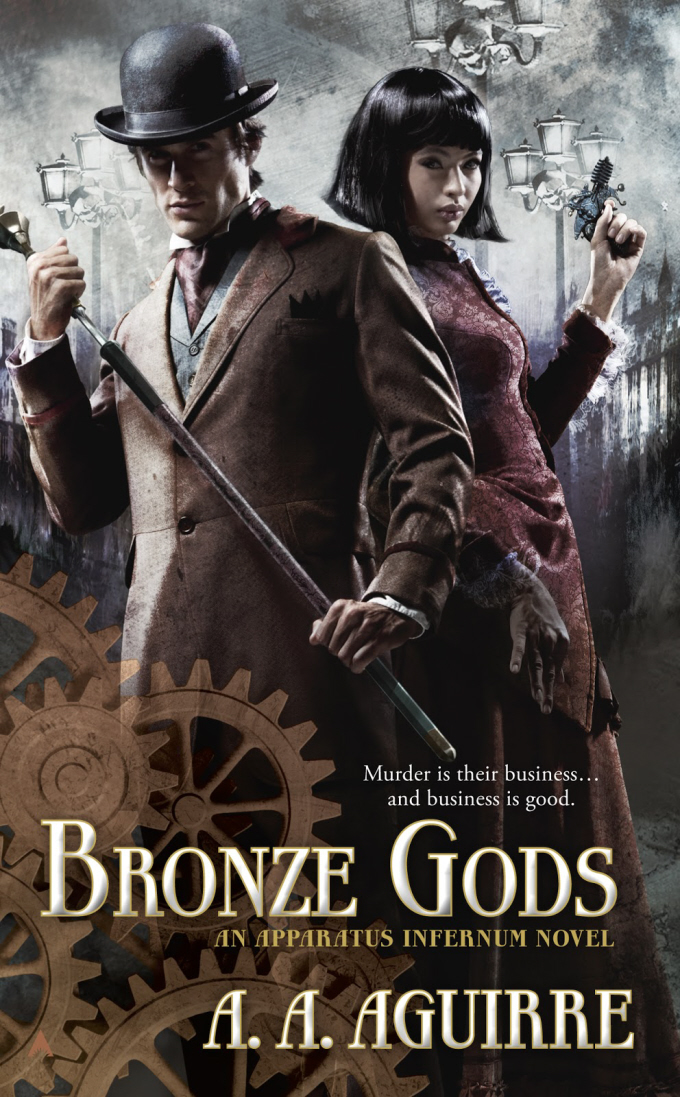
New Treasures: Bronze Gods, by A.A. Aguirre
 Ann Aguire is a very, very busy woman.
In the last five years alone she’s written six novels in the Sirantha Jax science fiction adventure series (Grimspace, Wanderlust, and four others); five Corine Solomon urban fantasies (beginning with Blue Diablo and Hell Fire); the YA post-apocalyptic dystopian Razorland trilogy (Enclave, Outpost, Horde); the paranormal romantic suspense Skin series (written as Ava Gray; four volumes beginning with Skin Game); the apocalyptic romance Dark Age Dawning (three so far, co-written with Carrie Lofty, under the name Ellen Connor); and the upcoming dark SF series The Dred Chronicles (starting with Perdition, scheduled for release in August).
That’s 22 novels since 2008. Allow me to express my sincere admiration, with a heartfelt WOW.
Now, you’d think someone with six series on the go already wouldn’t feel particularly pressured to launch a new sequence of steampunk noir fantasy novels. But apparently, you’d be wrong.
The Apparatus Infernum novels are co-written with her husband Andres Aguirre, and released under the name A.A. Aguirre. They sound like an appealing mix of steampunk and mystery.
Here’s the back cover copy for Bronze Gods, the first volume.

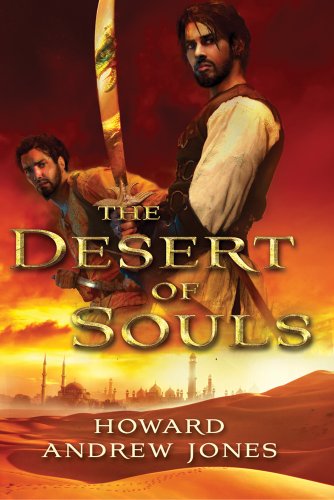 Howard Andrew Jones’s “Two Sought Adventure” details the problems and potentials in stories that have more than one hero. A story with multiple heroes is very different from a one-hero story with a sidekick, love interest, foil, nemesis, or whatever. There are plenty of straightforward techniques for using secondary characters to reveal a single protagonist’s character. Using two (or more) heroes to do this for one another in a way that feels balanced and gratifying for the reader is a tougher trick. Dialogue is crucial, and Jones offers close readings of dialogue from his own work and others’ that illustrate ways to welcome the reader into the shorthand, in-jokes, and shifting tones in conversations between longtime friends. He also addresses a problem I’ve seen in too much professionally published fiction: the duo that bickers like an old married couple, to the point where you wish they would split up, go away, or get eaten by the monster already. Friends have conflict, and friends engaged in epic heroics may have epic conflicts, but bickering is only entertaining in small doses, and it’s rarely illuminating. Jones offers a variety of specific alternative ways to handle conflict between heroes, and to interweave it with a story’s other conflicts.