Browsed by
Category: Vintage Treasures

New Treasures: Wilderlands of High Fantasy

New Treasures: Wilderlands of High Fantasy

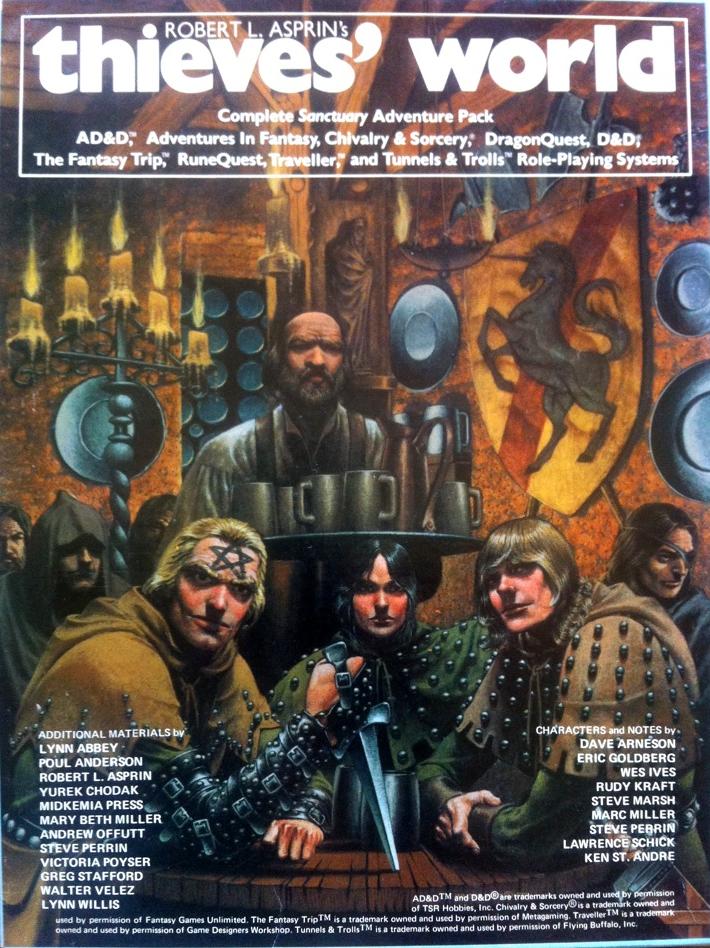
Wilderlands of High FantasyIn the very early days of adventure gaming, there were two companies you could count on: TSR, creator of Dungeons and Dragons, and Judges Guild.

Judges Guild was admittedly second tier. While TSR was constantly innovating, with full color cover art and high production values, Judges Guild saw no reason to deviate from the look they established in 1976: rudimentary layout and typesetting, and two-color covers that looked torn from a coloring book.

But they were prolific. My weekly pilgrimages to the gaming store in 1979 rarely yielded a new TSR release — they were few and far between — but Judges Guild never let me down, and I went home satisfied with many a JG product tucked under my arm. At their peak in the early 80s, they employed 42 people and had over 250 products in print, an astounding output.

Judges Guild was founded by Bob Bledsaw and Bill Owen; their first major product (and claim to fame) was the City State of the Invincible Overlord. The ambitious setting for the City State — a massive 18 maps covering nine continents drawn from Bledsaw’s home campaign, ultimately used as the locale for numerous adventure modules — became their next major release: The Wilderlands of High Fantasy, the first licensed D&D product and the first true campaign setting for the game.

Wilderlands was different in other ways, too. Perhaps most importantly it had a true sandbox feel, rather than the tightly-focused adventures of Gygax and Co, in which players were expected to follow a linear path. It encouraged a wide-open style of gaming, focused on exploring vast and wondrous forests and rugged landscapes, rather than dungeon crawls.

Read More Read More

Vintage Treasures: Vampire, Edited by Peter Haining

Vintage Treasures: Vampire, Edited by Peter Haining

Vampire by Peter Haining-smallI’m a fan of modern horror and dark fantasy — especially writers like Laird Barron, Dan Simmons, and Stephen King.

But that doesn’t mean I don’t also enjoy classic horror, particularly when it comes in the form of creepy and fun short stories. So when I discovered this little gem at the Starfarer’s Despatch booth — run by two of my favorite booksellers, Rich Warren and Arin Komins — at Capricon this weekend, I snatched it up immediately.

The text on the back reminded me of the monster movies I adored in my youth:

The Blood is the Life…

The distant howl of a wolf in the night… A faint but persistent tapping at your window-pane… An empty tomb… A solitary figure swathed in black, his face the colour of death but for his lips which are a deep scarlet …

Beware — for the Undead have risen from their graves. And they must feed …

Yeah, that brings me right back to 1975, when paradise was an issue of Tomb of Dracula and a ticket to the Saturday double feature of Frankenstein Conquers the World and Destroy All Monsters.

The contents look just as enticing — including stories by Bram Stoker, Richard Matheson, Edith Wharton, Robert E. Howard, Robert Bloch, and Ray Bradbury. Most of the stories read like 1960s-era Creature Features too, including Curt Siodmak’s “Experiment With Evil,” in which the intrepid Professor Windford responds to an urgent summons from Count Norlasky in the remote Austrian Alps. Long ago a curse was laid on the Count’s ancestral home, and for most of his life he’s battled demons, werewolves, and vampires in an attempt to reclaim it. But one opponent has vexed him more than any other, and now he’s fallen victim to a soul-sucking thing.

Read More Read More

New Treasures: Dream Castles: The Early Jack Vance, Volume Two

New Treasures: Dream Castles: The Early Jack Vance, Volume Two

Dream Castles-smallI spent this past weekend at Capricon 33, a local Chicago science fiction convention. The panels and readings were excellent, and perhaps the highlight was a Saturday night panel titled “Judging a Book by Page 119.” Steven Silver, Rich Horton, Kelly Strait, and Helen Montgomery read page 119 of some of their favorite novels, and the audience was left to guess the book. Someone in the back row correctly identified Poul Anderson’s The High Crusade, and I was pretty close with Robert Holdstock’s Mythago Wood trilogy (although I got the exact book wrong), but the panelists  managed to stump us on Iain M. Banks Consider Phlebas, Patrick Rothfuss’s The Name of the Wind, Saladin Ahmed’s The Throne of the Crescent MoonRange of Ghosts by Elizabeth Bear, The Little Country by Charles de Lint, and many others.

I can’t spend more than an hour or two at a good convention without realizing I’m not reading enough good books. I scurried to the Dealer’s room first chance I got and spent a few bucks in an attempt to rectify the situation. I found plenty of great treasures, but the real gem of the lot was the sole copy of the out-of-print Dream Castles: The Early Jack Vance, Volume Two, which I stumbled on at Larry Smith’s table.

I’ve been looking for a copy of Dream Castles for nearly a year — ever since I bought the first volume, Hard Luck Diggings. Both were published by Subterranean Press, and both gather early pulp fiction from one of the greatest 20th Century science fiction and fantasy writers.

Dream Castles collects short stories and novellas from Astounding Science Fiction (“I’ll Build Your Dream Castle,” Sept. 1947), Marvel Science Stories (“Golden Girl,” May 1951), and many other pulps — including Fantastic Science Fiction Fantasy, Space Science Fiction, and Orbit Science Fiction. The short novel, “Son of the Tree,” originally appeared in the June 1951 issue of Thrilling Wonder Stories.

Read More Read More

Win a Copy of The Complete John Thunstone, by Manly Wade Wellman

Win a Copy of The Complete John Thunstone, by Manly Wade Wellman

The Complete John Thunstone-smallHaffner Press has released the long-awaited pulp compilation The Complete John Thunstone, and we have two copies to give away.

To be completely blunt, I don’t want to give them away. You wouldn’t either, if you held this fabulous book in your hot little hands as long as I have. But that’s showbiz. If it were legal, I’d enter my own contest, like, three dozen times. (In fact, is that legal? Hmmm.)

Anyway. Yes, we’re having a contest. If no one enters, I suppose I get to keep the books. So… there’s a contest, but that’s all you get to know.

All right, fine. Bunch of complainers. Here’s the scoop: Just send an e-mail to john@blackgate.com with the title “John Thunstone” and a one-sentence review of your favorite Manly Wade Wellman novel or short story (don’t forget to mention the story). Two winners will be drawn at random from all qualifying entries, and we’ll publish the best reviews here on the Black Gate blog.

All entries become the property of New Epoch Press. No purchase necessary. Must be 12 or older. Decisions of the judges (capricious as they may be) are final. Not valid where prohibited by law. Or anywhere postage for a hefty hardcover is more than, like, 10 bucks. Seriously, this thing is huge and we’re on a budget.

Haffner’s archival-quality hardcovers  — including Henry Huttner’s Detour to Otherness, Terror in the House: The Early Kuttner, Volume One, and Thunder in the Void; Leigh Brackett’s Shannach – The Last: Farewell to Mars; and Robert Silverberg’s Tales From Super-Science Fiction — are some of the most collectible books in the genre, and The Complete John Thunstone promises to be no exception. Our original article on the book is here.

The Complete John Thunstone is edited by Stephen Haffner and was published December 22, 2012. It is 640 pages and priced at $40. Additional details at Haffner Press.

The Pop Culture Class of 1960 – 1969: Marvel Firsts: The 1960s

The Pop Culture Class of 1960 – 1969: Marvel Firsts: The 1960s

Marvel Firsts The 1960s-smallI remember the first time I read Origins of Marvel Comics, Stan Lee’s seminal 1974 anthology collecting the first appearances of the Fantastic Four, the Hulk, Spider-Man, Thor, and Doctor Strange. It was memorable because, for one thing, Stan’s bombastic introductions were frequently more entertaining than the comics themselves, and for another… the comics sure looked old.

Stan knew that, and he also knew a collection of first issues didn’t necessarily reflect Marvel Comics at its best. So alongside each origin story he also reprinted a tale that did showcase what made these characters special, including the FF’s epic battle with the Silver Surfer (from issue #55), Spider-Man’s tussle with the Shocker (issue #72), and others classic stories from the late 60s.

It made for a terrific book — and a great seller. Stan followed it a year later with Son of Origins of Marvel Comics, and then Bring on the Bad Guys; all told Marvel produced a total of 24 different books in similar format with publishing partner Fireside Books.

Origins of Marvel Comics hasn’t been in print in nearly three decades (ignoring the oddity with the same title released last May, which condenses the origin of each of the Marvel’s most popular characters into a single page), which is a shame. However, Marvel finally rectified this oversight late in 2011, kicking off an ambitious program to collect the first appearances of virtually every one of its major and minor characters.

This is a massive undertaking, and while I miss the partner tales Stan included alongside his selections, it’s an understandable sacrifice for the sake of completeness. While another reprinting of The Fantastic Four #1 or Amazing Fantasy #15 wouldn’t normally get me to crack open my wallet, an omnibus volume that also collects The Rawhide Kid #17 (from 1955), Daredevil #1 (1964), Western comic The Ghost Rider #1 (1967) and numerous others was definitely worth a look.

Read More Read More

Vintage Treasures: The Fuzzy Papers by H. Beam Piper

Vintage Treasures: The Fuzzy Papers by H. Beam Piper

the fuzzy papersThe Fuzzy Papers was one of the first science fiction books I ever read, and it’s one of the small handful of books that made me an SF reader for life.

The Fuzzy Papers contains two novels by H. Beam Piper, Little Fuzzy (1962) and Fuzzy Sapiens (1964, also known as The Other Human Race), and was published by the Science Fiction Book Club  in 1980. I joined the SFBC at the age of 12 at the urging of my friend John MacMaster, who turned me on to science fiction by loaning me book club editions from many of its finest writers, including Frank Herbert and Clifford D. Simak. The club specialized in low-cost reprints of popular SF and fantasy, ideal for a teen with little disposable income, and best of all, it occasionally produced magnificent omnibus editions of genre classics.

The Fuzzy Papers was a perfect example. Available exclusively through the club, it collects two long out-of-print paperbacks in a durable hardcover with a beautiful Michael Whelan cover, all for under 7 bucks. Not the kind of thing an impressionable teen could resist, and I didn’t even bother to try. I checked off my order form and put it back in the mail pronto, and impatiently waited for it to arrive.

I was not disappointed. Piper’s novels follow the adventures of down-on-his-luck space prospector Jack Holloway, who’s been exploring the planet Zarathrustra — a Class III uninhabited world run for profit by mining magnate Victor Grego. But everything changes when Holloway discovers the Fuzzies, curious little humanoids that almost seem to have the power to reason.

In fact, the more he interacts with them, the more Holloway is convinced they can reason — and if the Fuzzies are intelligent, that makes Zarathrustra a Class IV inhabited world, and Grego’s mining privileges would be gone for good. His company isn’t going to let that happen, no matter what the cost.

Read More Read More

New Treasures: The Complete John Thunstone, by Manly Wade Wellman

New Treasures: The Complete John Thunstone, by Manly Wade Wellman

The Complete John Thunstone-smallIf you’ve been reading Josh Reynolds’s excellent series The Nightmare Men here at Black Gate (And if you haven’t, what’s your deal? It’s packed with monsters, ghosts, and ghoulies, and the stalwart men who face them in dark corridors. I swear, every column is like The Exorcist re-made as an Indiana Jones movie), you know he covered Manly Wade Wellman’s supernatural sleuth John Thunstone last February. Here’s a snippet:

Big and blocky, with a well-groomed moustache and eyes like flint, Thunstone is an implacable and self-described ‘enemy of evil’. He hunts it with the verve of a Van Helsing and strikes with the speed and viciousness that puts Anton Zarnak to shame.

Well read and well-armed against vampires, werewolves and all things dark and devilish, Thunstone seeks out malevolent occult menaces in a variety of locales. The sixteen stories and two novels have settings which range from the steel and glass corridors of Manhattan to the mountains of the rural South, or the pastoral fields of England. He faces off against Inuit sorcerers, demonic familiars and worse things in the name of protecting the Earth and all its peoples from the hungry shapes in the dark that would otherwise devour it and them.

I bet you’re sorry you missed it now. Anyway, Josh also plugged the upcoming volume The Complete John Thunstone from Haffner Press, which he noted would contain “both the short stories AND the two Thunstone novels.”

Sweet! That was worth haunting the Haffner Press website for (not that I wasn’t doing it anyway).  I checked on a daily basis… for months. Man, not for nothing did Stephen Haffner earn his rep as a painstaking craftsman and perfectionist. Just when I’d resigned myself to slipping peacefully into old age without seeing it, two review copies landed on my doorstep (with an impressive thud). Good timing too, as old age is a few weeks away at most.

John Thunstone first appeared in “The Third Cry to Legba” in the November 1943 issue of Weird Tales. This volume collects that story and 15 others, along with the novels What Dreams May Come (1983) and The School of Darkness (1985). It’s a gorgeous package, and I can finally settle in and read Thunstone’s exploits against vampires, werewolves, the diabolical sorcerer Rowley Thorne, and the enigmatic shonokins, a race who claim to have ruled North America before the coming of humans.

The Complete John Thunstone is edited by Stephen Haffner, and was published December 22, 2012. It is 640 pages, and priced at $40. Stay tuned to the Black Gate website, where we’ll announce a contest in which you can win a copy in the next two weeks. In the meantime, you can read additional details at Haffner Press.

Vintage Treasures: Creatures From Beyond, edited by Terry Carr

Vintage Treasures: Creatures From Beyond, edited by Terry Carr

Creatures from Beyond-smallIt shouldn’t be a surprise that I didn’t discover science fiction and fantasy through novels — not really. I discovered it by reading short stories in Junior High, and especially the enticing anthologies on display every week in the library at St. Francis School in Halifax, Nova Scotia. I didn’t really know what science fiction was; but if it had monsters on the cover, I was all over it.

The first anthology I can recall reading was Creatures From Beyond, a marvelous monster-fest if ever there was one. When I tracked it down again decades later, I was delighted to discover the editor was none other than Terry Carr, the legendary editor whose Best Science Fiction of the Year and Fantasy Annual paperbacks I read avidly all through high school — and who pulled William Gibson’s Neuromancer out of the slush pile at Ace Books.

I think the reason I still remember it so well after all these years is that, unlike most of the collections I checked out of the library, it wasn’t a kid’s book. It’s a genuine SF anthology, with short stories from Henry Kuttner, Clifford D. Simak & Carl Jacobi, Theodore Sturgeon, Donald A. Wollheim, Brian W. Aldiss, Robert Silverberg, and other top-flight authors.

Carr reasoned — correctly — that there was no better source for action-filled monster tales than pulp science fiction magazines and he mined them heavily to generate Creatures From Beyond. The fiction is drawn from Amazing Stories, Astonishing, Unknown, Other Worlds, Comet, Thrilling Wonder, Future, and a smattering of anthologies.

Of course, the other reason I remember it is Eric Frank Russell’s brilliant novelette “Dear Devil,” the tale of a handful of children who survive a nuclear apocalypse on Earth… and the curious (and hideous) explorer from Mars who helps put them back on track towards a new and better civilization. Rejected by all the major SF magazines of the time, it landed at Ray Palmer’s fledgling Other Worlds, where it almost single-handedly put the magazine on the map — and instantly made a name for the young editor who pulled it from the slush, 26-year-old Bea Mahaffey, who’d been thrust the reins of the magazine when Palmer was incapacitated in an accident.

Read More Read More

Vintage Treasures: The Fox Woman & Other Stories by A. Merritt

Vintage Treasures: The Fox Woman & Other Stories by A. Merritt

The Fox Woman-smallI’m a pulp fan, and I have been for decades. The next time I’m marooned on a desert island, I’m taking as many magazines from the 1930s and ’40s as I can cram in the life raft.

Pulp novels though… you know, that’s another story. Ask me to name the great fantasy novels of the pulp era, and I run out of air pretty quickly. The fast action and colorful settings of great pulp fiction seem to work best at short length, which maybe explains why the era’s biggest names — H.P. Lovecraft, Robert E. Howard, Clark Ashton Smith — wrote almost exclusively at that length.

Perhaps that also explains why the years have not been kind to the most popular fantasy novelists of the pulp era — Otis Adelbert Kline, Ray Cummings, John Taine, L. Ron Hubbard, Ralph Milne Farley. All were prolific novelists before the end of World War II and virtually all are long out of print.

That’s especially true of the man who was perhaps the biggest name in pulp fantasy: A. Merritt. For decades, his name on the cover of a pulp magazine guaranteed sales in the hundreds of thousands and his novels remained in print late into the ’70s.

I first tried Merritt at the age of fourteen — already a pulp fan, I’d read more than a few breathless reviews of his work from several sources. I found a copy of his 1931 novel, The Face in the Abyss, in the spinning racks of a used book store in Ottawa and snatched it up with considerable excitement… which quickly turned to disappointment.

Read More Read More

Vintage Treasures: Andre Norton’s Velvet Shadows

Vintage Treasures: Andre Norton’s Velvet Shadows

Andre Norton Velvet Shadows-smallMy home is pretty cool. There are teetering piles of unread books everywhere, ready to topple like late August sunflowers. And if I only had time to review a few, it might be even cooler.

Fortunately, I’m not the only one who lives here. Occasionally, the other inhabitants find something that catches their eye, and when I see that happen I grab a notepad and try and coerce some comments out of them. It’s not the perfect family dynamic, but at least it’s something we do together.

I don’t get to choose what my family reads, obviously, so these reviews-by-proxy tend to be an odd lot (the last one was The House of Dead Maids, which I discovered my daughter enjoying a while back). Last weekend, I noticed my wife had casually picked up a copy of Andre Norton’s Velvet Shadows. I debated for a second before grabbing my notepad. Andre Norton, vintage paperback, gothic romance… Well, close enough to Black Gate territory for our purposes.

What follows is a raw transcript of our conversation, which she agreed to have published here only after I promised not to use her real name on the Internet. Not everyone has a taste for fame, I guess.

John O’Neill: Well, how was it?

Unidentified Reviewer #1: It was terrible.

JO: Okay that’s a little more, uh… concise than our usual reviews. What else you can tell us?

Read More Read More