Browsed by
Category: Vintage Treasures

Vintage Treasures: Hôtel Transylvania by Chelsea Quinn Yarbro

Vintage Treasures: Hôtel Transylvania by Chelsea Quinn Yarbro

Hotel Transylvania Signet-small Hotel Transylvania Tor Hotel Transylvania Yarbro-small

Chelsea Quinn Yarbro has written over 70 novels, and has received many of the highest honors the field can bestow. She was named a Grand Master at the World Horror Convention in 2003, and the International Horror Guild named her a “Living Legend” in 2005. In 2009 the Horror Writers’ Association presented her with the Bram Stoker Lifetime Achievement Award, and in 2014 she was honored with the World Fantasy Award for Life Achievement.

But she is most widely known for her long-running historical horror series featuring the vampire Count of Saint-Germain. The gentleman vampire Saint-Germain has featured in 26 novels and two collections, detailing his adventures down through the centuries, from the reign of emperor Heliogabalus in 3rd century Rome (Roman Dusk) to his escape from Genghis Khan in Tibet and India (Path of the Eclipse), 6th Century China (Dark of the Sun), France during the Reign of Terror (Commedia della Morte), and the rise of the Nazi party in Germany (Tempting Fate).

The Count first appeared in Hôtel Transylvania in 1978, set in Paris in 1744. The novel was an immediate success, and he returned in The Palace the same year. The Palace was nominated for a World Fantasy Award (and was voted #11 for the Locus Award for Best Novel of the Year), and thus began one of the most successful horror series in the English language.

Read More Read More

The Novels of Tanith Lee: Tales From the Flat Earth

The Novels of Tanith Lee: Tales From the Flat Earth

Night's Master 1986-small Death's Master 1986-small Delusion's Master 1987-small

We’re continuing with our look at the monumental 40-year career of Tanith Lee, who died last week. We started with The Wars of Vis trilogy, and today we continue with her most acclaimed fantasy series, Tales From the Flat Earth.

I say “most acclaimed” because — in addition to the World Fantasy, British Fantasy, Mythopoeic, and Balrog award nominations these books have accumulated over the years — in the Comments section of her obituary, this series was called “the towering pinnacle” (by Joe Hoopman), “towering legend” (by John R. Fultz), “my faves” (by Arin Komins), and “engrossing” (by rrm). It’s a small sample of fandom, but a compelling one. In my experience, Black Gate readers know what they’re talking about.

Read More Read More

New Treasures: Michael Moorcock’s The Chronicles of Corum from Titan Books

New Treasures: Michael Moorcock’s The Chronicles of Corum from Titan Books

The Chronicles of Corum Titan Books-small

I was talking about The Chronicles of Corum, which Fletcher Vredenburgh calls “the most intense and beautiful books” in Michael Moorcock’s Eternal Champion series, in a Vintage Treasures post recently. I was unaware at the time that Titan Books was planning to reprint the entire series in high quality trade paperback editions. If I was, I wouldn’t have spent all that time and money tracking down the 1987 Grafton paperback.

The first, The Knight of the Swords, was published on May 5th. The other five will be released over the next five months, as follows.

Read More Read More

If You Think Kidney Stones are Painful, Try Passing a Blarney Stone: The Crock of Gold

If You Think Kidney Stones are Painful, Try Passing a Blarney Stone: The Crock of Gold

The Crock of Gold Collier paperback-smallHave you ever owned a book for many years, a book that you have always intended to read when just the right moment came around, a book that you looked forward to, anticipating the great pleasure that you would experience once the time finally came to dig into it? Yes? Then you know how dangerous such prolonged anticipation can be.

I bought my oversized Collier paperback of James Stephens’ 1912 fantasy The Crock of Gold sometime in the mid-seventies (probably at the wonderful Change of Hobbit bookstore in Los Angeles) and it has been resting quietly on my shelf for most of my life, now and then whispering to me as I passed by, busy on long-forgotten errands, but I always put it off, promising that I would return when I was thoroughly ready to bestow my full attention on “a wise and beautiful fairy tale for grownups.” (Ah, the arcane art of blurb writing! Hmmm… sounds like a good Black Gate article. Let me finish this one first…)

Last week, I took the book down, flipped through it, looked at the striking woodcut illustrations by Thomas Mackenzie, and decided that the long-deferred day had at last arrived… alas.

James Stephens, who was born in 1880 and died in 1950 was, according to the back cover of my paperback, “one of the best-loved of modern Irish writers.”  I don’t know about that, but James Joyce had a high enough regard for Stephens’ talents as a poet and novelist to ask for his assistance in finishing Finnegan’s Wake, a scheme that never came to anything, probably to the relief of both men.

Read More Read More

The Novels of Tanith Lee: The Wars of Vis

The Novels of Tanith Lee: The Wars of Vis

The Storm Lord-small Anackire-small The White Serpent-small

I had planned to look at a Ray Bradbury anthology as my Vintage Treasures post for tonight, but I set that aside when I learned about the unexpected death of Tanith Lee today. As I was preparing a brief obituary, I was struck by just how many novels she completed in her lifetime, and how little of her considerable output I’ve sampled over the years. I thought, if it’s okay with all of you, I’d deviate from our flight plan slightly to take a look at some of the marvelous books she left us.

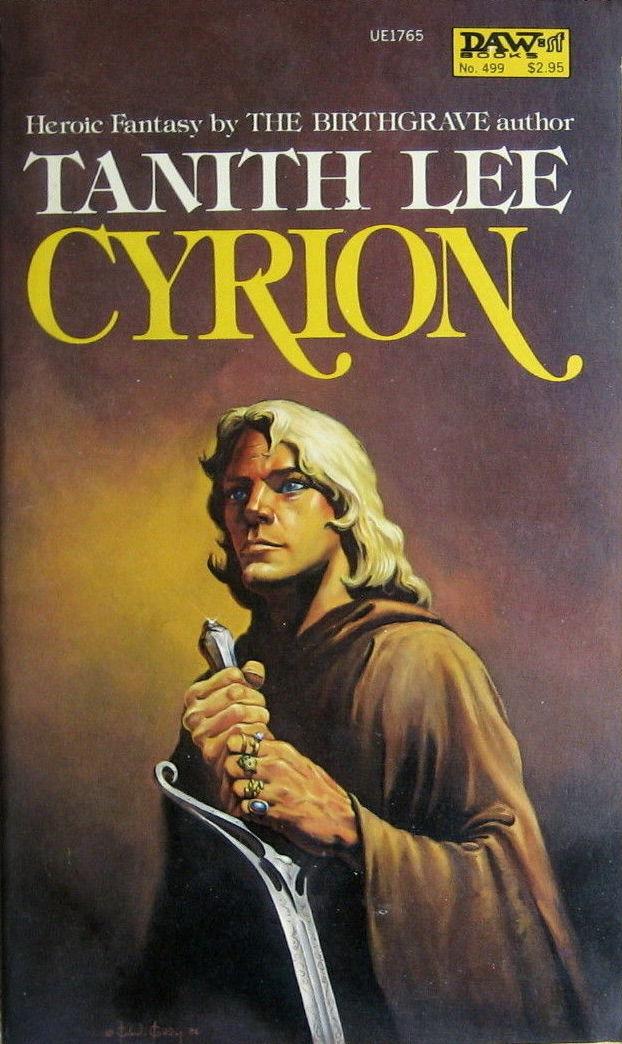
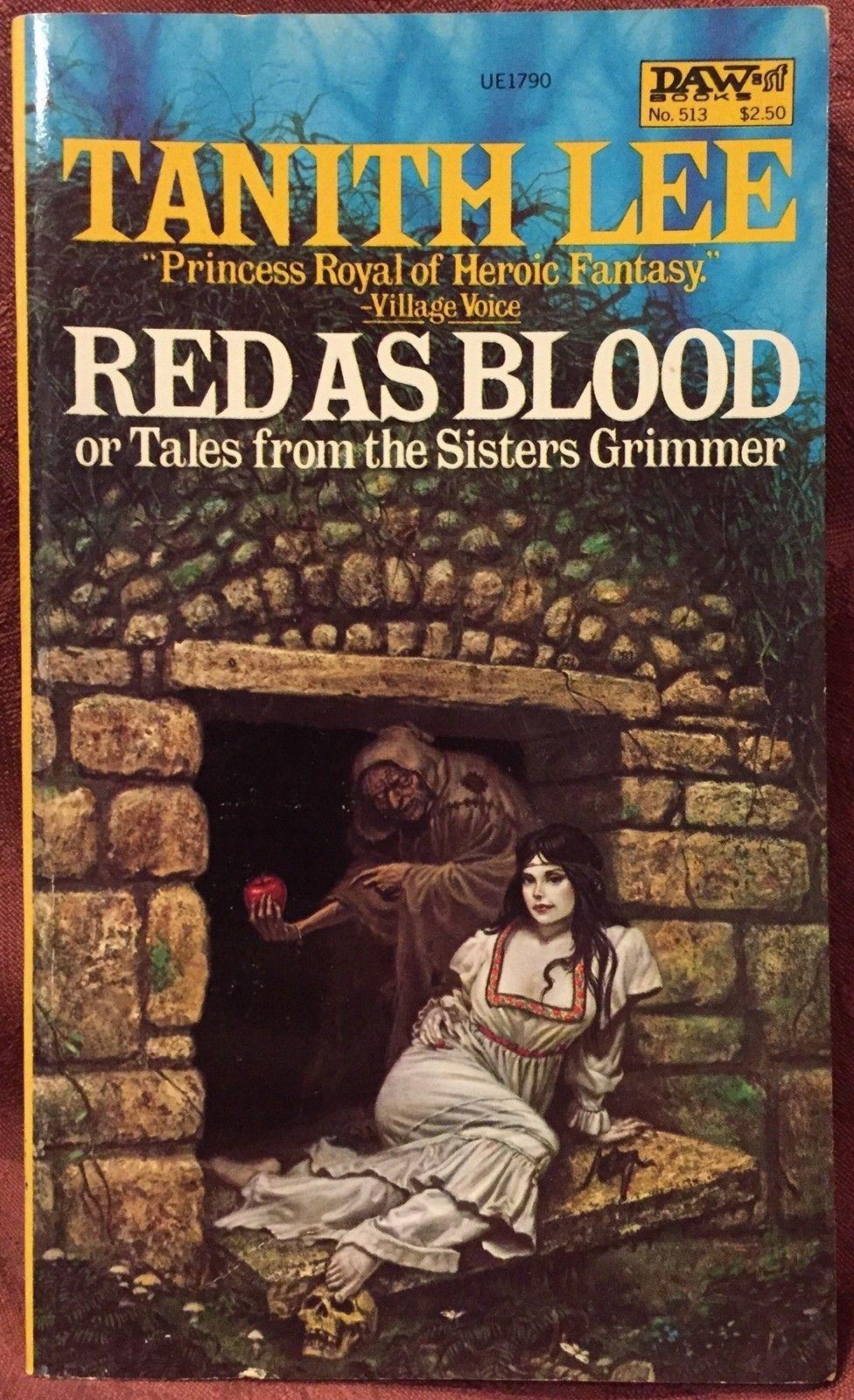
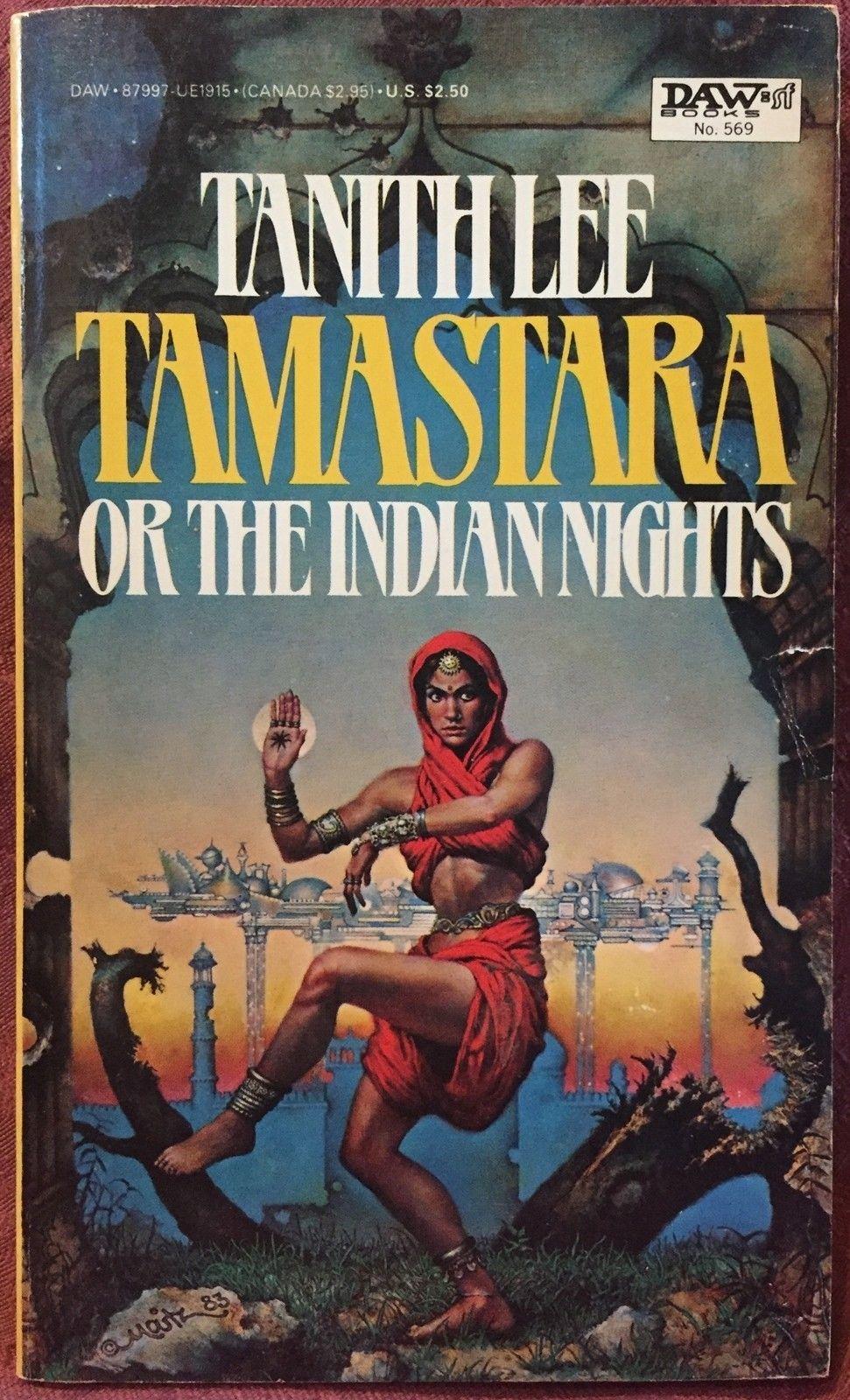
To start with, I’d like to showcase the pairing of Lee with one of my favorite cover artists. Sanjulian painted the covers for the 1988 DAW editions of all three novels of The Wars of Vis: The Storm Lord, Anackire, and The White Serpent, a series which the publisher labeled a “best-selling epic of war torn-empires, alien gods, and a Witch race with the power to reshape a world…” Over her long career Lee has been blessed with some of the best cover artists in the business — including Michael Whelan, Carl Lundgren, Paul Lehr, Don Maitz, and many others — but she rarely did better than these three.

Read More Read More

Vintage Treasures: The Fox Woman by A. Merritt

Vintage Treasures: The Fox Woman by A. Merritt

The Fox Woman-small The Fox Woman Avon-small

A. Merritt is something of a cautionary tale for authors today.

He was the bestselling American fantasy writer for a generation. His career spanned three decades, from 1917 to the mid-1940s, and his novels — including The Moon Pool (1919), The Ship of Ishtar (1924), The Face in the Abyss (1931), and Creep, Shadow! (1934) — remained in print for more than seven decades after his death. Yet he is virtually forgotten today.

This isn’t a case of an uncaring public ignoring a forgotten genius. Merritt certainly still has his fans, but his day is past. Personally, I find his novels largely unreadable. His short stories, however, are another matter.

Read More Read More

Explore the Best of Early SF With Science Fiction From the Great Years

Explore the Best of Early SF With Science Fiction From the Great Years

Armageddon 2419 AD-small The Mightiest Machine-small The Moon Is Hell-small Alien Planet-small

In the early 1950s, after the end of World War II and the beginning of the Space Race, science fiction experienced an almost unprecedented boom. Some 31 new SF magazines began publishing in that decade alone. Hungry to meet the demands of a new audience, publishers mined the pulps of the 1930s and 1940s for titles they could inexpensively reprint in paperback. Countless SF and fantasy writers enjoyed their very first mass market editions as a result — including Isaac Asimov, Robert A. Heinlein, John W. Campbell, Lester del Rey, Jack Vance, Theodore Sturgeon, A.E. van Vogt, and many others. Avon, Ace, Berkely and others built their fledgling enterprises into mighty publishing houses repackaging classic SF and fantasy for a new generation.

By the early 1960s, the boom in SF was essentially over. Nearly 80% of the magazines on the market folded. Publishers drastically cut back on SF titles, and the entire industry re-trenched. By the early 1970s, a new generation of young SF readers was starting to show up in bookstores, clutching their dollar bills and looking for great adventure tales, and Frederick Pohl convinced his publishers at Ace that the time was ripe to repackage the great SF of the early 20th Century one more time.

Read More Read More

The Omnibus Volumes of P.N. Elrod: The Vampire Files

The Omnibus Volumes of P.N. Elrod: The Vampire Files

The Vampire Files Volume One The Vampire Files Volume Two-small The Vampire Files Volume Three

To tell you the truth, I wasn’t initially interested in P.N. Elrod’s The Vampire Files. A few things happened to change that.

First, I started to hear about Jack Fleming, the investigative journalist in Prohibition-era Chicago who becomes a vampire and private investigator, and whose first case was to solve his own murder. Folks used adjectives like “surprising” and “old fashioned fun” to describe his adventures. That sounded pretty good. By then, the series had gotten pretty far along, and I wondered idly if I should pick one up. But it seemed a little late to jump on board, and I was never really sure what volume to start with. Plus some of the earlier books became harder to find, and it all seemed like just a bit too much effort.

Then Ace Books released the first omnibus volume in 2003, containing the first three Vampire Files novels. And, well, you know what a sucker I am for omnibus collections. All those hard-to-find paperbacks, in one handsome and economical package? It’s too much to resist.

Read More Read More

Vintage Treasures: A Touch of Strange by Theodore Sturgeon

Vintage Treasures: A Touch of Strange by Theodore Sturgeon

A Touch of Strange 1959-small A Touch of Strange 1965-small A Touch of Strange 1970-small

I’ve really been enjoying this gradual survey I’ve been doing of Theodore Sturgeon’s paperbacks. It hasn’t been a particularly deliberate undertaking… the truth is that, as I come across his books, I’ve been talking about them. This week I stumbled on a copy of the 1965 Berkley edition of A Touch of Strange (above middle), and here we are.

Part of the reason I enjoy them is that I find it fascinating that a writer could have made a decent living in this business selling almost exclusively short stories. Sturgeon did write five novels (six, if you want to count his 1961 Voyage to the Bottom of the Sea novelization), but he’s far more well known for more than two dozen short fiction collections. And it was upon them that he largely built his considerable reputation.

Another reason is that I genuinely find it delightful to catalog the different editions, and note all the variations. A Touch of Strange was reprinted five times, by three different publishers, between 1958 and 1978, before it vanished from bookstores forever. Each of those editions is unique, not just in cover art and design, but also in how it was packaged and presented — and, in some cases, in content as well.

Read More Read More

Fletcher Vredenburgh’s Simakpalooza!

Fletcher Vredenburgh’s Simakpalooza!

SimakpaloozaI don’t have time to read many other blogs. I barely have time to read this one, what with all the time I spend reading, and writing, and telling my wife how awesome Mad Max: Fury Road is. Seriously honey, sooo awesome. I wish I got to ride  in the desert, and take a giant chain elevator to work every day. Is there a word for when you envy the baddass folks who live in an apocalyptic dystopia? There should be such a word. And I bet that word would be awesome.

Anyway, I appreciate those moments when I get to read blogs written by other folks. Especially when they’re folks like Fletcher Vredenburgh, and especially especially when they look at one of my favorite writers, as Fletcher did this week with his Simakpalooza! (Is there a word for when you envy a writer who makes up a word? There should be such a word.) Here’s a sample:

I’m not sure what the first story I read by Clifford Simak was, but the first I remember is “Desertion.” It’s part of the book he’s probably most famous for, City. The novel is a mournful farewell to humanity and Earth and stars robot butlers and talking dogs… There’s a tremendous sense of wonder in the tale as the nature of what’s going on is revealed. I think of it as the story that showed me the true potential of sci-fi…

Sadly, Clifford Simak seems to have slipped into the ranks of the unjustly forgotten sci-fi writers of the past. Growing up, he was just part of the general fabric of sci-fi [for me], and most fellow sci-fi fans I knew had read at least something by him…

It’s been a long time since I’ve read anything by Simak. John O’Neill’s post about The Goblin Reservation and the comments reminded me how much I loved his work. There’s a warmth and comfortableness to his stories that I love.

Fletcher created an impressive tapestry of images from 17 Simak paperbacks to accompany his article (a tiny snippet is at right). Read the whole thing here.