Browsed by
Category: Rich Horton

Rich Horton Reviews Arctic Rising
Rich Horton Reviews Arctic Rising

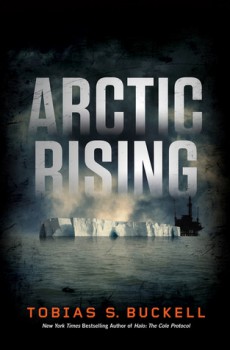
arctuic-rising-tobias-buckellArctic Rising
Tobias S. Buckell
Tor ( $24.99, hc, February 2012, 304 pages)
Reviewed by Rich Horton

Tobias S. Buckell began his novelistic career with a very nice linked trio of books that fit fairly readily with what has been called “New Space Opera” – adventure stories set in space (or at least on distant planets), the main difference between “New” and “Old” Space Opera being a greater concern in the newer stuff for non-white characters, and perhaps a lesser belief in the primacy of humanity’s position in the Universe. His career hiccuped a bit in recent years, partly simply because he was changing course to a different sort of book, but more seriously because of some health issues. But his new novel, Arctic Rising, is now out, and it’s another cracker – as full of action and neat Sfnal ideas as his first three books, but set on Earth in the near future, and taking as its subject a central contemporary concern, global warming.

The protagonist of Arctic Rising, Anika Duncan, is an airship pilot for the United Nations Polar Guard. As the story opens she and her partner notice a radiation signature on a ship entering arctic waters, but when they investigate, the ship shoots them out of the sky, seemingly a rather disproportionate response. Her partner dies, and Anika is eager to find justice for him, but soon realizes that the investigation has hit a brick wall. When she makes noise, things get worse quickly, in classic thriller fashion: Anika’s home is bombed, she’s beaten up and only barely escapes being killed. She ends up on the run with a sort of “prostitute with a heart of gold” – that is, a brothel operator who has taken a shine to her. The one clue she has leads her to a ship run by the radical Green organization Gaia, who have a plan to stop global warming. But it turns out their tech can be used in multiple ways …
Read More Read More

Tangent Online Recommended Reading List 2011

Tangent Online Recommended Reading List 2011

Art for Jamie McEwan's "An Uprising of One," by Jim and Ruth Keegan (from Black Gate 15).

Over at Tangent Online long-time editor and founder Dave Truesdale has posted his annual Recommended Reading list of the best short fiction of the year, compiled from selections made by eighteen Tangent reviewers.

Tangent Online reviews virtually every science fiction and fantasy short story published annually, combing the big print magazines (including Fantasy & Science Fiction, Asimov’s, and Analog), semi-professional outlets (such as Cemetery Dance, Interzone, Black Static, Weird Tales, Postscripts, On Spec, Bull Spec, Redstone SF, Albedo One, and Murky Depths), the leading online periodicals (Lightspeed, Beneath Ceaseless Skies, Clarkesworld, Tor.com, Strange Horizons, and Subterranean magazine) and the best anthologies published this year (Eclipse 4, Life on Mars, Like Water for Quarks, Triangulation: Last Contact, and Welcome to the Greenhouse). Just like Rich Horton, but requiring more caffeinated beverages.

This year’s list includes a total of four stories from Black Gate 15 — including two with their coveted three-star rating, their highest ranking:

  • “An Uprising of One” by Jamie McEwen (Two Stars)
  • “Into the Gathering Dark” by Darrell Schweitzer (Two Stars)
  • “Roundelay” by Paula R. Stiles (Three Stars)
  • “Purging Cocytus” by Michael Livingston (Three Stars)

Congratulations to Jamie, Darrell, Paul and Michael! The complete table of contents of Black Gate 15 is here, and you can still buy print copies through our online store for $18.95 (or as part of a bundle of two back issues for just $25). The PDF version is just $8.95.

The Kindle version, with enhanced content and color graphics, is also available through Amazon.com for just $9.99.

The complete 2011 Tangent Online Recommended Reading List  list can be found here. Last year’s list is here.

Tangent Online reviews Matthew David Surridge’s “The Word of Azrael”

Tangent Online reviews Matthew David Surridge’s “The Word of Azrael”

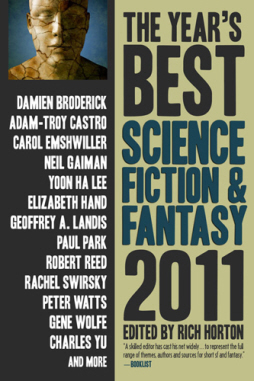
yearsbest2011Reviewer Nader Elhefnawy at Tangent Online offers a detailed review of the latest volume of Rich Horton’s The Year’s Best Science Fiction and Fantasy 2011, including Matthew David Surridge’s story from Black Gate 14, “The Word of Azrael.”

In Matthew David Surridge’s “The Word of Azrael” (which first appeared in the Winter issue of Black Gate magazine, an excerpt of which can be read on the magazine’s web site), warrior Isrohim Vey encounters the Angel of Death on the battlefield. Having seen the Angel’s smile once, he spends the rest of his life pursuing another glimpse of it – a colorful, wide-ranging, action- and adventure-filled epic journey in the tradition of Conan the Cimmerian and Elric of Melnibone. The resulting piece is one of the strongest heroic fantasies I have seen in years.

Fine praise indeed, for a terrific story that’s been one of the most acclaimed pieces we’ve published in recent years.

You can read the excerpt from “The Word of Azrael” here, and the complete Black Gate 14 Table of Contents is here.

And you can read more about Rich’s excellent The Year’s Best Science Fiction and Fantasy 2011 here.

The Year’s Best SF & Fantasy 2011, edited by Rich Horton

The Year’s Best SF & Fantasy 2011, edited by Rich Horton

yearsbest2011The third volume of Rich Horton’s Year’s Best Science Fiction and Fantasy (Prime Books), my favorite annual Year’s Best collection, shipped in early June, and my copy finally arrived last week. Imagine my surprise to find this on the dedication page:

For two editors who got me started on the route to putting together these books: Dave Truesdale and John O’Neill.

You don’t have to imagine how honored I feel, because I can tell you that right now: pretty damn honored. I’ve been publishing Rich’s excellent articles and reviews since the early days of the SF Site, shortly after he was introduced to me by, yes, Dave Truesdale, who was publishing his short fiction reviews at Tangent. Thanks, Rich. And thanks, Dave.  Owe you one.

As for the book, it’s excellent as always. This year it features thirty stories that showcase the very best in contemporary SF and fantasy, from the finest writers in the field: Gene Wolfe, Robert Reed, Paul Park, Carol Emshwiller, and many others. In fact, this year’s volume is even more awesome than usual, as it features “The Word of Azrael” from BG 14, by our very own Matthew David Surridge, as well as “Braiding the Ghosts” (from Clockwork Phoenix 3) by our website editor C.S.E. Cooney.

C.S.E. had a particularly good year last year, in fact: two additional tales made Rich’s Recommended Reading list, including “Household Spirits” (from Strange Horizons; read the complete story here) and her novella The Big Bah-Ha (from Drollerie Press), alongside Robert J. Howe’s novella from BG 14, “The Natural History of Calamity.” We covered the 2009 edition of Year’s Best SF & Fantasy here.

Congratulations to all the contributors, and to Rich on another superb volume. If you’re looking for one book this year to point you to the cream of the crop in modern SF & fantasy, this is the one.

If, October 1957: A Retro-Review

If, October 1957: A Retro-Review

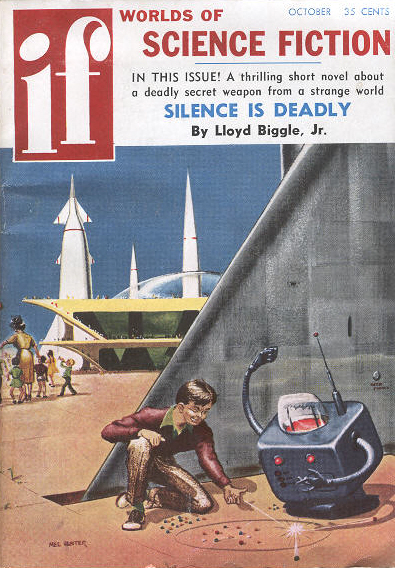
if-oct-57This is the fourth installment in Rich Horton’s retro-reviews of science fiction and fantasy digest magazines from the mid-20th Century. The first three were the February 1966 Analog, the December 1965 Galaxy, and the January 1966 issue of The Magazine of Fantasy & Science Fiction.

Click the images for larger versions.

Back to the ’50s for this one. If is a magazine I remember with affection, even though I never saw a precisely new copy — the last issue, except for an abortive one issue 1986 revival, appeared in December 1974, just a couple of months after I started buying magazines, but my source (Alton Drugs in Naperville, IL) didn’t carry it. But its evident sense of playfulness, at least in the Pohl years, has always appealed to me.

At any rate, this issue appeared at a portentous time – its issue date is October 1957, the same month that Sputnik I was launched. So this magazine is from the very cusp of the Space Age.

Indeed, I have a few magazines on hand from roughly the same time (1957, or up to January 1958 – which certainly went to press before the news of Sputnik), and I propose to cover them in the next few old magazine reviews.

The title is one odd aspect. Is it If: Worlds of Science Fiction? Or is it Worlds of If? Apparently the original title was officially If: Worlds of Science Fiction, but it wobbled early on, at least as to its display. In 1972 the then publishers, UPD, officially changed it to Worlds of If. (All this from Phil Stephenson-Payne’s wonderful Galactic Central site.)

At any rate this issue appears fairly unambiguously to be If: Worlds of Science Fiction. The editor (and publisher, and indeed founder) was James L. Quinn. (Confusing because a later publisher was named Guinn.) (And I should note that though Quinn was publisher from the start, the first editor was Paul Fairman.)

Read More Read More

Rich Horton Reviews Blood of Ambrose and This Crooked Way

Rich Horton Reviews Blood of Ambrose and This Crooked Way

World Fantasy Award Nominee

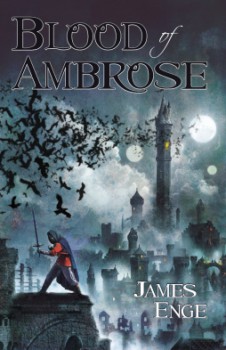
Blood of Ambrose
James Enge
Pyr (416 pp, $15.98, April 2009)

This Crooked Way
James Enge
Pyr (414 pp, $16.00, October 2009)
Reviewed by Rich Horton

A few years ago Black Gate featured the first published story from James Enge, “Turn Up This Crooked Way” (in BG 8). I admit I regard first stories with skepticism – but despite limited expectations I was entirely delighted, and at the end of the year it made my “Virtual Best of the Year” list. Enge continued to place stories in the pages of Black Gate, all featuring the main character from “Turn Up This Crooked Way,” a rather dour magician named Morlock Ambrosius. Morlock’s reputation is bad, but, perhaps predictably, he is actually on the side of good. There were some hints of a tortured history for him in those initial stories, but little real details about his past.

Now we have two novels from Enge, each also about Morlock. The first, Blood of Ambrose, is more conventionally a novel – though quite episodic in structure – and while Morlock is a major character, he shares the stage with another protagonist. But we are vouchsafed some revelations about Morlock’s back story. As for the second book, This Crooked Way, it is straightforwardly a fix-up of several of the Black Gate stories, as well as some new episodes and linking material. For all that, it does feature an overarching narrative arc, so it ends up working effectively enough as a novel.

Read More Read More

Analog, February 1966: a Retro-Review

Analog, February 1966: a Retro-Review

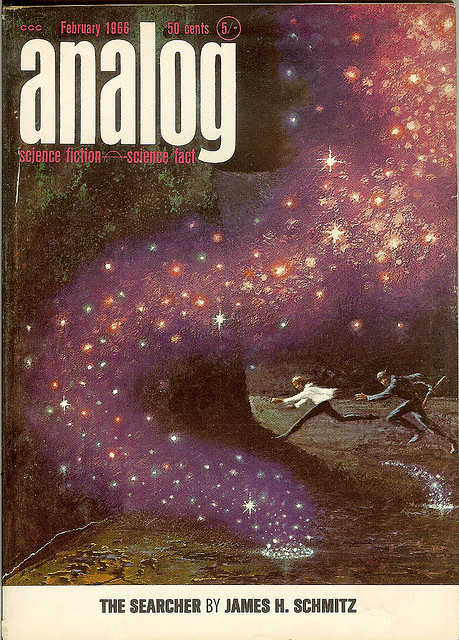
analog-feb-66And now the third of three consecutive months of SF magazines I recently bought, each a different specimen of the canonical “Big Three” of that time. The first, the December 1965 Galaxy, is here, and the January 1966 issue of The Magazine of Fantasy & Science Fiction is here.

Todd Mason complained last time about this designation of Analog, Galaxy, and F&SF as the “canonical Big Three” SF magazines of the ’60s. He noted, correctly, that Galaxy‘s sister magazine If was winning Hugos as best magazine, and that Amazing and Fantastic were tremendous magazines under Cele Goldsmith Lalli (though by 1966 the magazines had been sold and Lalli was no longer editing them — and their quality suffered immensely).

Fair enough comments — but there is little doubt that Analog, Galaxy, and F&SF were regarded then — even by those who voted for If for the Hugo! — as the most prestigious SF magazines in the US. They paid better. Analog and Galaxy published more fiction per issue, though F&SF was as slim as If and Amazing/Fantastic. They were regarded as more “serious” — each in different ways, mind you. (And I think that very lack of seriousness was a big part of If‘s appeal.) Anyway …

This issue of Analog comes very late in John W. Campbell’s long tenure. The magazine is all but universally regarded as having declined in quality by this point, relative to Campbell’s best years. But this issue is really quite a good one.

Read More Read More

The Magazine of Fantasy & Science Fiction, January 1966: A Retro-Review

The Magazine of Fantasy & Science Fiction, January 1966: A Retro-Review

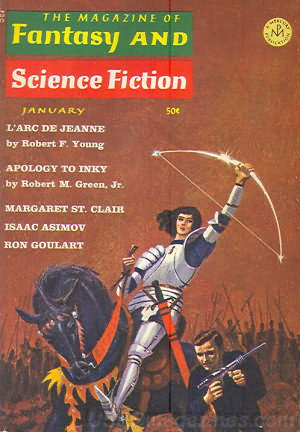
fsf-jan661Here’s the second of three consecutive months of SF magazines I recently bought, each a different specimen of the canonical “Big Three” of that time. The first, the December 1965 issue of Galaxy, is here.

Edward Ferman was the Editor of F&SF at this time, as he had been for a while. (I have heard that even while his father Joseph was listed as Editor, Edward was actually doing the job.)

The cover is by Jack Gaughan, illustrating “L’Arc de Jeanne,” by Robert F. Young. Of course there was no interior artwork, excerpt for Gahan Wilson’s cartoon. There were also no ads except for the Classifieds in the F&SF Marketplace, and except for one or two inhouse ads. This issue did feature the Statement of Management and Circulation. Average Paid Circulation, 53,831. Average Mail Circulation, 16,644.

The features include Wilson’s Cartoon, a very brief “Science Springboard” by Theodore L. Thomas, about smog, and Isaac Asimov’s Science column, this time called “The Proton Reckoner,” about counting things, lots of things, like the protons in the universe.

And there is a book review column by Judith Merril. She writes from London, in September of 1965, and her subject is how much better things are in England: the drinking, people’s looks, the rock and roll, and the SF — the New Wave SF (though Merril does not here use that term). She focuses on three major fairly young writers: J. G. Ballard, Brian W. Aldiss, and John Brunner.

Read More Read More

Galaxy, December 1965: A Retro-Review

Galaxy, December 1965: A Retro-Review

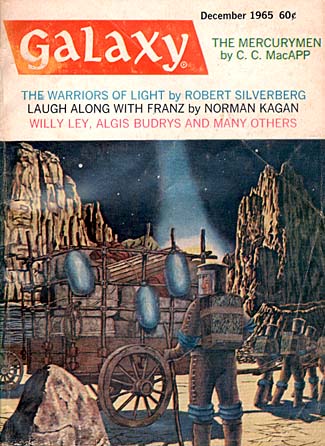
galaxy-dec-1965I picked up a few magazines at an antique store near Columbia, MO, last week, including three consecutive issues — of different magazines — from the end of 1965/beginning of 1966: the December 1965 Galaxy, the January 1966 F&SF (reviewed here), and the February 1966 Analog. The first one I got to was the Galaxy.

This is from more or less the center of Frederik Pohl’s editorial tenure. Galaxy in this period was bimonthly, with two sister magazines — Worlds of Tomorrow, also bimonthly, and Worlds of If, which was monthly. (I admit I had not known that — I thought it was also bimonthly, and I’m surprised that Galaxy, the “senior” magazine, was not the monthly one.) Galaxy was generously sized, at 196 pages (including covers), with about as much fiction as Analog and Asimov’s feature these days. By contrast Worlds of Tomorrow had 164 pages per issue, and If only 132. The latter two were 50 cents, but Galaxy was 60 cents. (I find this mixture of format, frequency, and pricing in three magazines from the same stable rather intriguing.)

The cover of the December 1965 Galaxy is by Pederson, illustrating “The Mercurymen”, by C. C. MacApp. (Galaxy typically only credited last names for artists — apparently this particular artist was named John Pederson, Jr. — I’m not very familiar with his work, and not too impressed with this particular example!) Interiors were by Gray Morrow, Giunta, Jack Gaughan, and Wood. (The artists whose first names I know are, not surprisingly perhaps, the better ones, though I am told that John Giunta and Wally Wood were well known for work in comics.) There are a fair number of ads — more than often in SF magazines — though somewhat low rent ones: Rosicruans, hypnotism, the Puzzle Lovers Club, the Book Find Club, book plates (from Galaxy), and the Duraclean Company.

Read More Read More

Rich Horton Reviews The Bell at Sealey Head

Rich Horton Reviews The Bell at Sealey Head

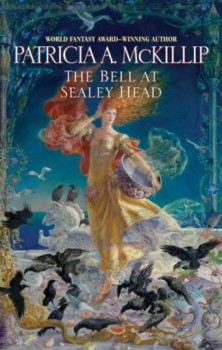
bell-at-sealey-headThe Bell at Sealey Head
Patricia A. McKillip
Ace (288 pp, $14.00, September 2009)
Reviewed by Rich Horton

I think of Patricia McKillip a little like I think of Van Morrison. Which is really not a terribly useful comparison, because I don’t mean it to apply to their respective styles… rather, I mean to say that McKillip is one of those writers who reliably issues a novel every year or two, always enjoyable work. In the same way I look for a new Van Morrison album every year or two, and they are always satisfying.

Now it can also be said the McKillip’s novels, as with Morrison’s latter period works, are fairly small scale affairs, and while they show a certain range and a willingness to try different things, they aren’t groundbreaking masterpieces, either. (But as McKillip had the Riddle Master books early in her career, and the utterly gorgeous Winter Rose somewhat later, so Morrison has Astral Weeks and Veedon Fleece. Though here the comparison rather breaks down, because fine as The Riddle Master of Hed is, it’s no Astral Weeks. Which is hardly an insult – Astral Weeks being arguably the greatest album ever to come out of the pop/rock idiom.)

Read More Read More