A Review of The Isle of Glass, by Judith Tarr
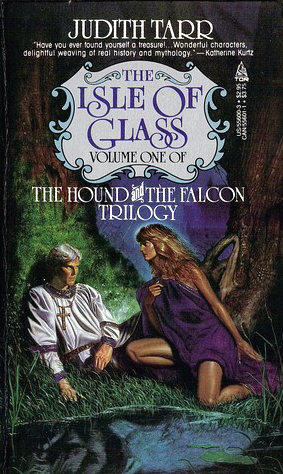 The Isle of Glass, by Judith Tarr
The Hound and the Falcon Trilogy, Volume 1
St. Martins Press (276 pages, hardcover, February 1985)
Isle of Glass is the sort of book that will work excellently for some people and not for others, based both on the knowledge needed and the subject matter.
It’s fairly short, but dense and somewhat challenging. For instance, I think I have a fairly decent vocabulary, but I encountered a few words, like “crozier” or “thurifer,” that I didn’t know.
(According to my dictionary, both words are church terms. A crozier is an abbot’s staff; a thurifer is someone who carries a censer.)
The story centers around Alfred of St. Ruan’s Abbey, a monk who doesn’t seem to age. He was found in the snow, on the solstice, being warmed and protected by three white owls. Between his origin, his age, his inhuman beauty, and his ability to work magic, it’s quite clear to anyone who knows Alf that he is one of the Fair Folk, and the fact torments him.
Although Isle of Glass is technically an alternate history – this world contains at least one extra country, and the real countries seem to have somewhat alternate names – it’s still set in a version of medieval Europe, and not a sanitized or tolerant one. It’s widely accepted that sorcery is evil and elves have no souls.
Alf buries himself in the small world of the monastery so he doesn’t have to think about such things – he’s only somewhat successful – but his isolation is broken by the advent of an injured knight named Alun. Alun is a member of Alf’s species, the first he’s ever met, and he was trying to prevent a war before he was captured and brutalized.
 The River of Shadows (Book III of the Chathrand Voyage Series)
 Curse of the Necrarch
 In this double episode finale, we get to the end of one of the best seasons. It started out a little rocky, but had some of the series’ best episodes, I think. The finale happened while I was a on a plane to Arizona for vacation, so I wasn’t able to review it until I got back this week. (Gotta love DVR!)
 Flesh and Fire
 There’s a school of thought that views the Middle Ages as a dark gulf between the Classical Age and the rebirth of reason known as the Renaissance. The Middle Ages were, to paraphrase science fiction author David Brin, an unhappy time of small-mindedness and fear, marked by the squabbles of petty nobles, ignorance, superstition, and religious persecution.
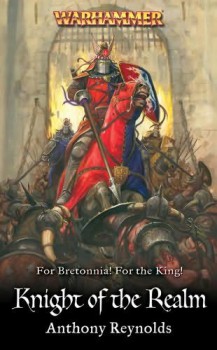 Knight of the Realm