Browsed by
Category: Movies and TV

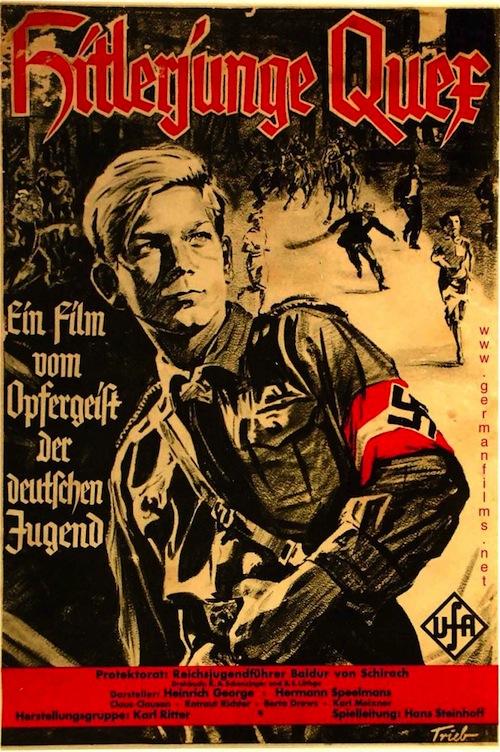
Nazi Film Review: Hitlerjunge Quex
Nazi Film Review: Hitlerjunge Quex

hitlerjunge-quex

When the Nazi Party took over in 1933, Germany was already a leading nation for film production. From the late 1910s through the early 1930s, its silent films and early talkies were seen all across Europe and were popular in the United States as well. But the year saw a major change in the nation’s film industry as well as its political makeup. Like with every other industry, movie making had to subordinate itself to the goals of National Socialism.

The Nazi party’s first targets were Communists and Socialists, who had fought against them for control of the streets. Many lives were lost on both sides during this era of riots, and one of the more famous of those was a member of the Hitler Youth named Heini Völker, who was killed while distributing Nazi flyers in a Communist neighborhood. There had already been a popular book about the boy published in 1932 titled Hitlerjunge Quex. (“Quex” means “quicksilver”, a nickname Heini got for being such an eager worker). This was turned into a film in the first year Hitler was in power.
Read More Read More

The Public Life of Sherlock Holmes: Jeremy Brett’s Adventures Begin

The Public Life of Sherlock Holmes: Jeremy Brett’s Adventures Begin

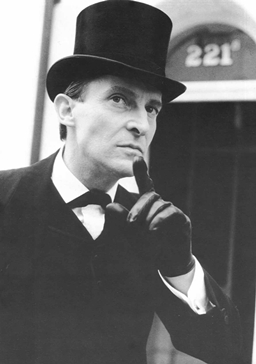
Brettstrand1Last week I posted part one of our look at Granada’s The Adventures of Sherlock Holmes, starring Jeremy Brett.

The Adventures were divided into two parts; seven episodes in the first; six in the latter. A Scandal in Bohemia aired on April 24, 1984. Can it be thirty-one years since Jeremy Brett first graced television sets as the great detective? Scandal was actually the third story to be filmed.

Producer Michael Cox wanted Brett and his Watson, David Burke, to become comfortable with their roles before filming one of the most famous tales in the Canon, so he didn’t start taping with this one.

Watson enters their Baker Street lodgings, having been gone on a trip. He sees the empty syringe case and fears his flat mate has turned to cocaine. Shortly after our first vision of Holmes, Brett gives the “My mind rebels at stagnation” speech. It is completely understated but still paints a portrait of Holmes’ need for work (compare it to the over-the-top reading of Matthew Frewer).

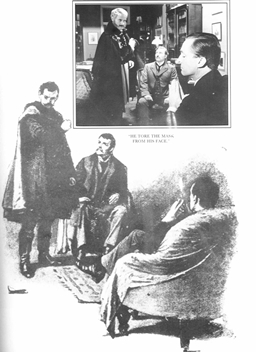
The script is remarkably faithful to the story and is filled with original dialogue from Doyle. The influence of Sidney Paget is blatantly obvious. The King of Bohemia’s unmasking is a replica of the original drawing, and Brett’s ‘drunken groom’ disguise is nearly identical to Paget’s drawing. We even get the famous “Good Night Mr. Holmes” scene.

David Burke is as far from Nigel Bruce as one can imagine. He is thoughtful, intelligent, amusing without being a buffoon and utterly dependable. There is a valid film reason for Bruce’s un-Canonical portrayal as comic relief, but Burke reinvents Watson as his original self: the way Doyle wrote him.

Read More Read More

Belated Movie Reviews #4: The Road Warrior

Belated Movie Reviews #4: The Road Warrior

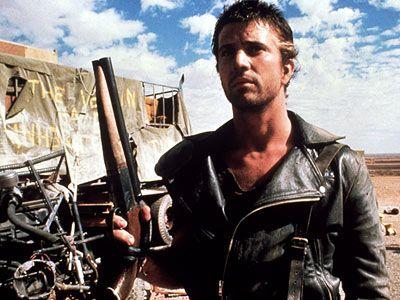
The Road WarriorAmong the genre of world-gone-mad movies, The Road Warrior (TRW) is pretty much the standard by which all others are measured — for good reason! Easily the best of the Mad Max trilogy, it doesn’t suffer from the technical issues and slow plot of Mad Max, nor the excesses of Beyond Thunderdome. TRW is a movie lathed down to a simple gleaming core: good guys inside the refinery, bad guys outside. And, for a bit of a spark, Max is also on the outside and like the bad guys, he wants in to get that fuel.

Whereas MdMx drops the viewer straight into a world going to hell, TRW includes a bit of a voiceover that gives all the introduction that you need — and really, it is mostly the background of the world. An interesting thing about TRW is that you don’t even have to see Mad Max for it to make sense, and even though that intro touches on Max’s history it almost doesn’t have to. Max Rockatansky is defined almost entirely by his actions.

Did I say action? I meant ACTION! Max vs. Wez! Max rescuing the scout! Max retrieving the rig! Max making his getaway in the last V8! The Big Chase!

A thing they do in this movie, and do well, is that although Maxis the MC, the movie is really about Papagallo vs. The Humungus, and Max is just drawn in and plays his cards close to the vest, and [spoiler alert] he never actually picks sides. He just says he’ll drive the tanker, not that their plan or goal way of life is any better than anyone those of the people outside.

Read More Read More

The Public Life of Sherlock Holmes: Adventures With Jeremy Brett

The Public Life of Sherlock Holmes: Adventures With Jeremy Brett

Brett46For several decades, Basil Rathbone, star of fourteen Holmes films in the thirties and forties, was generally the most recognizable and popular screen Holmes. And of course today, Benedict Cumberbatch and Robert Downey Jr are internationally recognized for their turns as the master detective.

But in between Rathbone and Cumberbatch, one actor (with apologies to Peter Cushing) stood above all other portrayers of Sherlock Holmes. And that was Jeremy Brett.

This is number one of a three part series looking at the first part (The Adventures) of the Granada television series, which ran in full from 1984 to 1994. To many fans, Brett is simply THE Holmes. So…

In 1980, Michael Cox was a producer at Granada, one of the Independent Television (ITV) contractors in England. At the same time in America, Charlton Heston was starring as Sherlock Holmes in the stage play, The Crucifer of Blood. His Watson was a handsome Englishman named Jeremy Brett.

The following year, Cox proposed an authentic Sherlock Holmes series; one that was as true to the original tales as could commercially be done in the television format. His idea was received positively, but Cox was told that an essential element of the deal would be a pre-sale agreement with American television. This would secure “up-front” money, which would be invested into the series. WGBH in Boston, host of the popular PBS series, Mystery!, was an ideal candidate for the partnership.

Read More Read More

Watch Stan Lee Give Tips on How to Give a Great Cameo Performance, in the Stan Lee Cameo School

Watch Stan Lee Give Tips on How to Give a Great Cameo Performance, in the Stan Lee Cameo School

I was watching movies on YouTube last night when an Audi ad popped up featuring Stan Lee. [I’d like to take a minute to point out that sentence would have been completely nonsensical 15 years ago. Ah, what a world we live in.]

It turned it to be well worth watching. Directed by Kevin Smith, “The Stan Lee Cameo School” is a hilarious two-minute short featuring featuring Lou Ferrigno, Tara Reid, Michael Rooker, Jason Mewes and Kevin Smith. I won’t ruin any more for you — check it out.

Audi has a long tradition of appealing to science fiction fans — check out their Star Trek ads. (And Volkswagen reunited William Shatner and Leonard Nimoy for an ad late last year.) All this talk of Audis does make me miss mine, however… tragically, it was destroyed in a head-on collision in 2011.

Blade Runner: Edmond Hamilton’s Tears in the Rain?

Blade Runner: Edmond Hamilton’s Tears in the Rain?

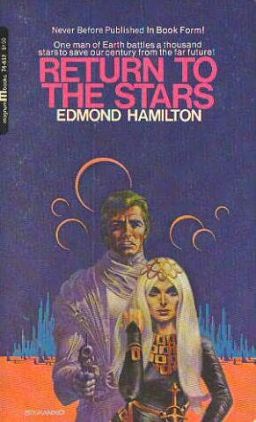
HamiltonReturnToTheStars
“I’ve… seen things you people wouldn’t believe…”

Get this:

I heard the sunrise music that the crystal peaks make above Throon when Canopus comes to warm them. I feasted with the star-kings in the Hall of Stars. And at the end, I led the fleets of the Empire against our enemies, the men from the League of Dark Worlds. I saw the ships die like swarming fireflies off the shores of the Hercules Cluster. I’ve shot the Orion Nebula. I’ve been into the Cloud, where the drowned suns burn in a haze of darkness. I’ve killed men, Doctor. And in that last battle, I —

Oddly familiar? Actually, that’s Gordon’s monologue to his shrink in Edmond Hamilton’s Return to the Stars.

How about this one?

I’ve… seen things you people wouldn’t believe… Attack ships on fire off the shoulder of Orion. I watched c-beams glitter in the dark near the Tannhäuser Gate. All those… moments… will be lost in time, like [small cough] tears… in… rain. Time… to die…

Of course, that’s Roy Batty’s dying monologue in Blade Runner. Hauer is supposed to have improved on the original script, which had…

I have known adventures, seen places you people will never see, I’ve been Offworld and back… frontiers! I’ve stood on the back deck of a blinker bound for the Plutition Camps with sweat in my eyes watching the stars fight on the shoulder of Orion… I’ve felt wind in my hair, riding test boats off the black galaxies and seen an attack fleet burn like a match and disappear. I’ve seen it, felt it…!

Read More Read More

See the BBC Trailer for Jonathan Strange & Mr Norrell

See the BBC Trailer for Jonathan Strange & Mr Norrell

Susanna Clarke’s debut novel Jonathan Strange & Mr Norrell (2004) won both the Hugo Award and World Fantasy Award, and became a New York Times bestseller. The BBC announced they were adapting the book as a seven-part series staring Eddie Marsan (Ray Donovan, Filth) as Mr Norrell, and Bertie Carvel (Restless, Matilda) as Jonathan Strange late last year.

The series is set at the beginning of the 19th-century, in an England where public belief in magic has begun to die off. The reclusive Mr Norrell stuns the city of York when he causes the statues of York Cathedral to speak and move. With a little persuasion and help from his man of business Childermass (Enzo Cilenti), he goes to London to help the government in the war against Napoleon. It is there Norrell summons a fairy (Marc Warren) to bring Lady Pole (Alice Englert) back from the dead, a decision that has dark consequences…

The series begins broadcasting on BBC One on May 1st. It will air in Canada on Space, and in the United States on BBC America.

Adventures In Near-Future Sci-Fi: Black Mirror

Adventures In Near-Future Sci-Fi: Black Mirror

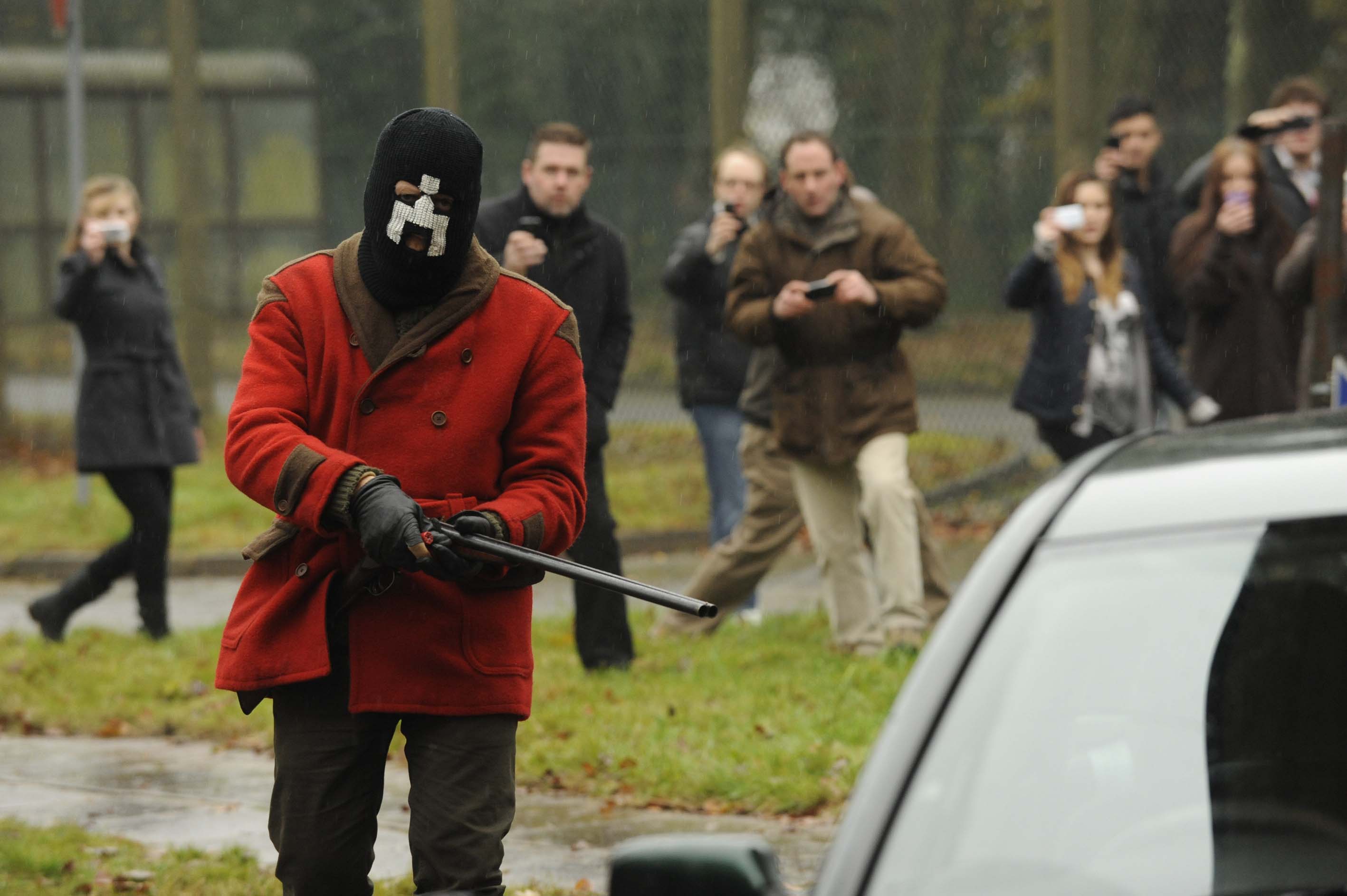
Black Mirror White BearI don’t watch television. Or not, let’s say, broadcast television. Since the first X-Files video tape showed up, I have, instead, binge-watched episodic TV in irregular, spasmodic doses via VHS, DVD, and Netflix. I watch with my wife, and we’re not (to the shows) faithful: if a particular series bores us, we move on. Even Breaking Bad, after three seasons, felt like a joke gone on too long.

But Black Mirror. Holy cats!

It’s the best sci-fi you’ve never heard of.

A British show made for Channel Four, Black Mirror is the brainchild of one Charlie Brooker — whom you haven’t heard of, either. The series aired in the UK from 2011 through 2013. Based on that time span, you’d think it was a fabulous success spanning dozens of episodes. Only half true. Black Mirror consists of six shows total (plus a 2014 “Christmas Special,” which I have yet to see), and each is self-contained, a hermetic “What If?” often compared to Rod Serling’s Twilight Zone. The reference is not especially apt, but like Velcro and old chewing gum, it’s a label that seems to have stuck.

Read More Read More

The Public Life of Sherlock Holmes: Richard Diamond, Private Eye

The Public Life of Sherlock Holmes: Richard Diamond, Private Eye

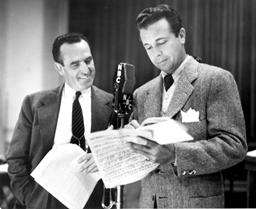
Diamond_PowellA topic that I’ve long intended to visit is that of old time radio shows. Of course, it’s no surprise that Sherlock Holmes has been a popular subject for radio dramas. Arthur Wontner (who I’m sure you read about here) and William Gillette (again, here…) reprised their film roles for radio.

Richard Gordon, John Stanley and Richard Hobbs had long runs as Holmes. And of course, the most popular film Holmes, Basil Rathbone, had a long-running serial with his Watson, Nigel Bruce.

More recently, Clive Merrison starred in the entire Canon (and more) for BBC Radio. Also, Jim French’s Imagination Theater features new Holmes radio dramas (along with several other characters). I’ll certainly be writing about those two.

In the forties and fifties, detectives, newspaper reporters and even insurance investigators were popular heroes for radio dramas. Sam Spade, Philip Marlowe, The Fat Man (ostensibly created by Dashiell Hammett) and Johnny Dollar were some of the radio stars of the day. One of the most fun was Richard Diamond, Private Detective.

Read More Read More

The Fantasy and Science Fiction Films of Thomas Edison

The Fantasy and Science Fiction Films of Thomas Edison

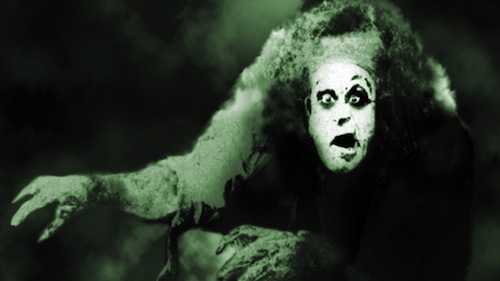
The original Frankenstein's monster from the 1910 Edison film.
The original Frankenstein’s monster from the 1910 Edison film.

In the annals of early silent film, the name Thomas Edison stands out prominently. The American inventor racked up a series of firsts–building the first film studio in the U.S., registering the first copyright for a film in the U.S., making the first sound film in the U.S. (and arguably the world), and many other innovations.

Edison Studios was launched in 1894 and ran until 1918, when an antitrust lawsuit led Edison to sell the company. In that time, the studio’s host of directors made almost 1300 films. The vast majority were shorts, with the earliest efforts being “actualities” such as The Sneeze (1894) and the historically interesting Sioux Ghost Dance (1894). For the first few years of film, simply seeing people moving on screen was enough, but soon audiences wanted stories. Edison Studios churned out dozens of shorts a month, most of them rather forgettable comedies or dramas as well as a few Westerns such as the very first in the genre, The Great Train Robbery (1903).

A few, however, broke new ground in fantasy, science fiction, and horror. The most notable are The Night Before Christmas (1905), Alice’s Adventures in Wonderland (1910), A Christmas Carol (1910), Frankenstein (1910), A Trip to Mars (1910), and the powerful The Land Beyond the Sunset (1912). Click the links to watch the movies. None are longer than 13 minutes. Spoilers are coming.

Read More Read More