Browsed by
Category: Movies and TV

Fantasia Diary 2015, Day 14: The Visit and The Demolisher
Fantasia Diary 2015, Day 14: The Visit and The Demolisher

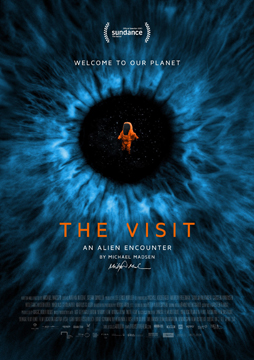
The VisitNo-one’s a perfect critic, and I’ll readily confess to being less perfect than most. At any rate, sometimes a film’s best appreciated with a certain level of knowledge. Maybe you know too much about the film’s subject, and you see nothing new. Or you know too little, and you find yourself lost. In the latter case, at least, you can wonder whether your lack of knowledge is representative of a general audience, if not of whatever audience the artist has in mind. No critic’s going to be able to hit the sweet spot of knowing just enough, not every time out. Nobody’s perfect.

Monday, July 27, I saw two movies, both in the De Sève Theatre. The first was a documentary called The Visit, examining what would happen if aliens landed on Earth — what the response would be from human governments and scientific organisations. Then I watched a suspense movie called The Demolisher, about a woman stalked by a mentally-disintegrating police officer. And I found myself wrong-footed in the first case by knowing too much and in the second by knowing too little.

Before The Visit a short film screened: “Testimony of the Unspeakable” (in the original French, “Témoignage de l’indicible”). The director, Simon Pernollet, spoke briefly beforehand setting up the film, a story told by one of his friends about his childhood in Mexico and strange things that happened around his family’s home. We hear a voice telling several anecdotes about unexplained happenings; the stories have the feel of real experiences, in the way they seem to build up an atmosphere more than a connected set of incidents. Meanwhile, the camera moves around an empty house at night, catching shadows, creating an atmosphere and sense of place. At six minutes long, the film manages to subsist on the spooky magical-realist feeling it evokes without feeling as though it’s outstaying its welcome.
Read More Read More

A Brief Guide to Space Race Documentaries, Part II

A Brief Guide to Space Race Documentaries, Part II

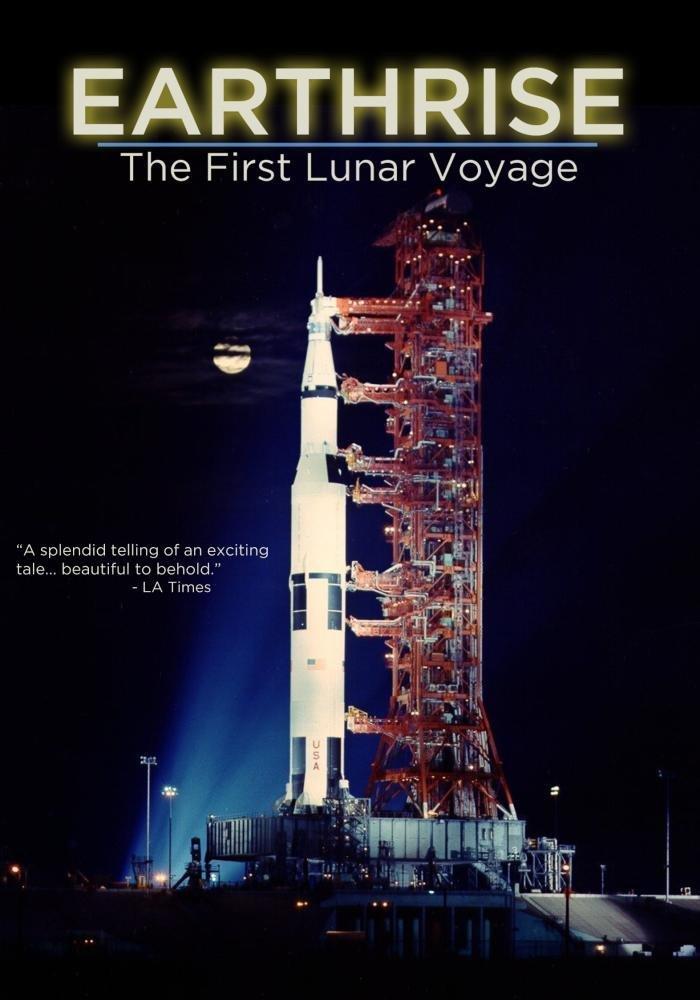
Earthrise The First Lunar Voyage-smallI’ve written two articles at this site about movies and documentaries that deal primarily with the Space Race years, which I define as 1957 (Sputnik) to 1969 (first Moon landing):

A Brief Guide to Space Race Movies
A Brief Guide to Space Race Documentaries

I thought I’d exhausted the supply of space race documentaries worth mentioning, but alas, I recently ran across two more.

Both are worth noting for the simple fact that they solve two problems I often see with this type of documentary. One is the tendency to cram too much into too little time, which means it’s hard to go into any kind of depth in one specific area. The other is the tendency to rely on footage that’s rather familiar.

Which comes with the territory, I guess, at least to an extent. If you’re going to do a documentary on Apollo 11 you can hardly leave out the footage of Neil Armstrong’s first step on the Moon. Ditto for many of the events that made up the ill-fated Apollo 13 mission.

But one can’t help but suspect that there’s a vast amount of footage from this era that we don’t see much of. The following two documentaries seem to support that theory.

Earthrise: The First Lunar Voyage (2014)

It’s safe to say that the best known space missions of all time — whether American or otherwise — are Apollo 11 and Apollo 13.

Read More Read More

Fantasia Diary 2015, Day 13: Monty Python: The Meaning of Live and He Never Died

Fantasia Diary 2015, Day 13: Monty Python: The Meaning of Live and He Never Died

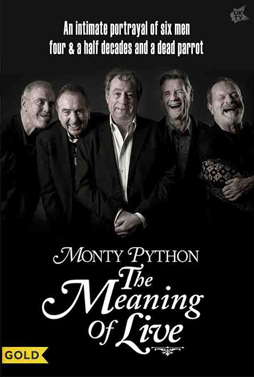
The Meaning of LiveThere’s what you expect from a movie, and then there’s what you get. Sometimes a good movie can be a little disappointing, because it gives you only more-or-less what you’d been expecting. And sometimes a movie can surprise you with just how good it is. So if I say that on Sunday, July 26, I had a good day at the Fantasia Festival, it actually means I had two very different experiences in the big Hall Theatre. First was a documentary, Monty Python: The Meaning of Live. And then a supernatural thriller starring Henry Rollins, He Never Died. Both were good. The second was surprisingly good.

The main surprise to me about the Python documentary was how relatively small the crowd was. I reluctantly decided to skip the Korean action movie Tazza: The Hidden Card because I wanted to be sure of getting into the media line for The Meaning of Live, and it turns out I needn’t have worried. Demand was not what I’d expected. When the film started (preceded by a trailer for a Shaw Brothers’ movie called The Bloody Parrot, for reasons that need no explanation) the theatre seemed to be maybe two-thirds or three-quarters full; not a bad crowd, by any stretch, but not the full house I’d been expecting.

I mention this because it led me to wonder how much Python, once beloved of any number of subcultures, had lost popularity over the last couple of decades. That’s the way things happen sometimes: a slow fade, a gradual dulling of the shine. Was the audience for the documentary a little older than the Fantasia standard? Maybe. Was Python’s appeal in part a generational thing? Well, if that question had a meaningful answer, likely the documentary would provide it. In the end, it did and it didn’t because, of course, the answer’s both yes and no.

Read More Read More

Fantasia Diary 2015, Day 12: Nowhere Girl and Princess Jellyfish

Fantasia Diary 2015, Day 12: Nowhere Girl and Princess Jellyfish

Nowhere GirlSaturday, July 25, was an odd day. At 4 in the afternoon I was meeting my girlfriend and some other friends to watch Princess Jellyfish, a live-action adaptation of a manga that had already been adapted into an anime series. But because I had to queue for it with members of the media, I’d actually be waiting in a different line than the people I’d be seeing the movie with. So I decided I’d go to the Fantasia screening room first, and watch another film: Mamoru Oshii’s Nowhere Girl.

Oshii’s best known as a director of anime films such as Ghost in the Shell and the recent Garm Wars. This was his first live-action feature, from a script by Kei Yamamura based on a short film by Kentaro Yamagishi; Yamagishi’s 2012 film ran 20 minutes, and Oshii’s only runs 85. For most of that time we follow Ai, apparently an exceptionally talented student at an arts school for girls. Orders from unseen authorities have given her more privileges than the other students, and she’s building a strange sculpture project in the school auditorium. She’s excluded and bullied by the other students, and has a tense relationship with one of her teachers. The school nurse is more sympathetic, but is pushing medication on Ai despite Ai’s doubts. It’s hinted that Ai might be suffering from hallucinations. Mysterious scars and injuries appear on her for no obvious reason. And what do the quakes striking the school have to do with her?

Mysteries run through Nowhere Girl (original title: Tokyo Mukokuseki Shojo). Ai’s schoolmates say she’s suffering from “PT … something. Some mental illness.” She’s clearly capable of violence. Formerly considered a genius, something seems to have wrecked her talent — unless she can work through whatever’s blocking her. Then an unexpected climax is filled with gunplay, and everything becomes clear in the last minutes. It’s a Twilight Zone–esque structure, a puzzle revealed by the hoary old twist ending.

Read More Read More

Fantasia Diary 2015, Days 10 and 11: On the White Planet and The Blue Hour

Fantasia Diary 2015, Days 10 and 11: On the White Planet and The Blue Hour

On the White PlanetThursday, July 23, was the first day of the Fantasia Festival I chose not to see any movies. Wandering down to the screening room was a very real temptation, but I desperately needed to do laundry and other household chores — as well as to write about the films I was seeing. In fact as I made my plans it seemed that I was entering a relatively light stretch of the schedule, before what looked like a killer weekend.
On Friday the 24th I returned to the De Sève Theatre for two films. The first was an animated Korean science-fantasy called On the White Planet. The second was The Blue Hour, a gay romance from Thailand with elements of horror. Both were interesting to watch and ponder, though I can’t say I found either perfectly satisfying.

On the White Planet, or Chang-baek-han eol-gul-deul, was written and directed by Hur Bum-wook, and comes from the same animation school as Park Hye-mi’s Crimson Whale. It’s an extremely bleak but startlingly beautiful movie. It takes place on another planet (or some other time period of this planet) where there is no colour — everything’s white. Except for the sky and the lead character, Choi Min-je. Min-je’s flesh marks him out as an outcast, in what seems a very direct metaphor. Isolated at the start of the movie, he falls in with a gang, and things go from bad to worse. Murder and rape and all sorts of pain follow, and eventually the movie becomes a sort of extended chase as Min-je seeks sanctuary with two fellow escapees from the gang, and then goes on to try to find a way off the white planet.

Read More Read More

Fantasia Diary 2015, Day 9: Raiders!: The Story of the Greatest Fan Film Ever Made, 100 Yen Love, The Royal Tailor

Fantasia Diary 2015, Day 9: Raiders!: The Story of the Greatest Fan Film Ever Made, 100 Yen Love, The Royal Tailor

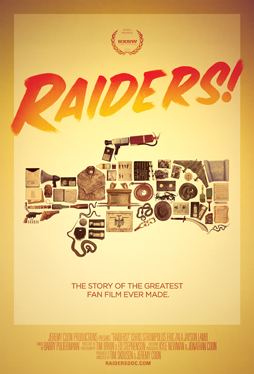
Raiders!On Wednesday, July 22, I saw three movies at the Fantasia Festival — which made it an average day, to the extent I had an average day at Fantasia. It began at 1 PM, with a documentary called Raiders!: The Story of the Greatest Fan Film Ever Made. After that was a Japanese comedy-drama called 100 Yen Love. Then I made a difficult decision to pass on both the New Zealand horror-suspense film Observance and the American science-fiction film Synchronicity in favour of the Korean historical epic The Royal Tailor. I figured I could watch a later showing of Synchronicity, while Observance was available in the screening room. But this looked like my only chance to catch Tailor on the big screen, and I had an idea it was the sort of film that would take full advantage of the Hall Theatre’s scale.
The day’s earlier films were at the smaller De Sève Theatre, and at 1 I was ready for Raiders! — the saga of some kids in the 1980s who tried to make a shot-for-shot remake of Raiders of the Lost Ark. It was preceded by a short film called “Villain,” an excellent partially-animated subversive take on superheroes. Directed and starring Ivan Bergerman from a script by Jolene Bergerman, it’s essentially a monologue by a villain called Munition Man. We see him and his equipment (vintage jet pack and gas mask) as he tells his story and talks about the defeat of his friend the Harquebus by the heroic Captain Valour. Except Captain Valour isn’t that heroic, to hear Munition Man tell it.

On the one hand, there’s nothing especially new in the movie’s bleak take on super-heroes and violence, but on the other it’s cleverly done and its general approach to heroism is dramatically effective — you legitimately wonder whether a villain can be a hero. The animated sequences show what would be effects-intensive sequences in an affordable way, but more importantly use the visual approach to deepen the theme: Golden Age designs and bright Silver Age colours contrast with a 1980s-esque cynicism. There seemed to me to be a Mignola-esque feel to the art, or perhaps a better comparison might be to Tony Harris’s Starman work — there’s the same love of super-heroes mixed with a knowing take on the genre, invention co-existing with a deep knowledge of hero history. More importantly, though, the film tells a story, using the background of a super-hero universe to build a character and set up that character’s crucial dramatic choice. It’s one of the better short films I’ve seen at Fantasia.

Read More Read More

Fantasia Diary 2015, Day 8: Buddha’s Palm, Ojuju, The Reflecting Skin, and Haruko’s Paranormal Laboratory

Fantasia Diary 2015, Day 8: Buddha’s Palm, Ojuju, The Reflecting Skin, and Haruko’s Paranormal Laboratory

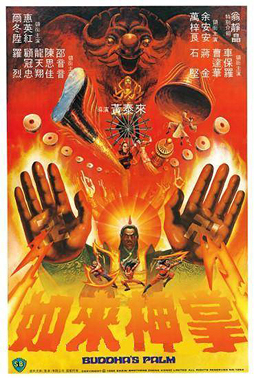
Buddha's PalmI was at Concordia’s De Sève Theatre early on Tuesday, July 21, for a showing of a 35mm print of the Shaw Brothers’ wuxia fantasy Buddha’s Palm. After that, I had a decision to make. At 5:30 the Nigerian zombie movie Ojuju played directly against a re-release of the British-Canadian horror-suspense movie The Reflecting Skin. Which would I see? And then after that, the first live-action film by director Mamoru Oshii, Nowhere Girl, was directly opposite a quirky romantic fantasy comedy, Haruko’s Paranormal Laboratory. Again: which to see?

I’d have enough time after Buddha’s Palm to see one movie in the Fantasia screening room, and I decided I’d watch Ojuju there. The Reflecting Skin wasn’t available in the screening room, and anyway part of the draw of it was the chance to see a high-quality (2K) restoration of the movie for its twenty-fifth anniversary. As for the second decision, at the start of the day I assumed I’d go see Nowhere Girl. But sitting waiting for Buddha’s Palm, I changed my mind. Haruko seemed more overtly fantastic. And Nowhere Girl was in the screening room, so I’d have the chance to see it there — if I could find the time over the next few days among all the other movies I hoped to see.

The screening of Buddha’s Palm was introduced by King-Wei Chu, one of the festival’s Directors of Asian Programming. He noted the rarity of 35mm prints of this film, and said “As long as I’m alive, Fantasia will play 35 millimeter,” adding: “The doctors say six months.” As he went on to explain, in 1982, when Buddha’s Palm was made, the popularity of kung-fu films was declining in the face of a craze for Star Wars-esque science fiction, “so [the Shaw Brothers] decided to introduce special effects.” He noted that the movie predated Tsui Hark and Zu Warriors From The Magic Mountain (Shu Shan – Xin Shu shan jian ke), itself an important fantasy wuxia film. That said, we got to see a trailer for another Shaw Brothers film, The Kid With the Golden Arm (Jin bei tong), and then the main feature began.

Read More Read More

The Public Life of Sherlock Holmes: Ronald Howard – A Younger Holmes

The Public Life of Sherlock Holmes: Ronald Howard – A Younger Holmes

RonHoward_GunSheldon Reynolds, an American producer, went to England looking for an actor to cast as Holmes in a new television series. Alan Wheatley had appeared in six televised plays (filmed live) for the BBC in 1951. Reynolds had much broader horizons. He found Ronald Howard, son of the famous English actor Leslie Howard. It was the senior Howard who insisted that Humphrey Bogart get to reprise his role of Duke Mantee when the successful play was turned into a film. It was Bogart’s first success on screen and helped launch his career. Howard was killed during World War II when the Nazis shot down his commercial plane over the Bay of Biscay.

Ronald Howard sold his house and took his family to France in early 1954. The entire series was to be shot there to save on costs. Reynolds had used this approach before, filming the American series Foreign Intrigue, in Stockholm for reasons of economy.  This time he would be an American producer, with a British Sherlock Holmes, shooting a television show in France.

Read More Read More

Fantasia Diary 2015, Day 6: The Arti: The Adventure Begins, Director’s Commentary: Terror of Frankenstein, (T)ERROR, and I Am Thor

Fantasia Diary 2015, Day 6: The Arti: The Adventure Begins, Director’s Commentary: Terror of Frankenstein, (T)ERROR, and I Am Thor

The Arti Some days at the Fantasia Festival I find a common theme among the movies I see. And some days I don’t. Sometimes the day’s movies are simply a wonderfully strange mix of things each wonderfully strange in themselves. Bearing that in mind, let’s jump into what I saw on Sunday, July 19.
I started at the Hall Theatre with the Chinese puppet wuxia film The Arti. After that, I had lunch and went to the De Sève Theatre to watch Director’s Commentary: Terror of Frankenstein, which took a real movie from the 1970s and gave it a new audio track in the form of a fictional “director’s commentary” that slowly revealed the “truth” of what had happened behind the scenes of the film. After that I stuck around to watch (T)ERROR, a documentary about FBI informants in the United States. Then went back to the Hall to watch a completely different documentary, I Am Thor, about Canadian bodybuilder and veteran rock’n’roller Jon Mikl Thor. It made for a full but wildly varied day.

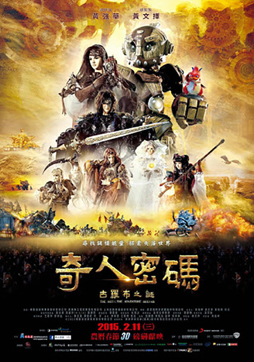
The Arti: The Adventure Begins is a fantasy adventure set in the time of the Han dynasty (I can’t find voice credits, or a version of the original title transliterated into Roman; this source gives it as 奇人密碼, or “eccentric person secret.” Here’s the film’s web site, if you’re interested). Years ago, an inventor created a wooden robot, Arti-C, powered by a mysterious force called The Origin. As the film opens, he’s dead and Arti-C’s energy’s running down — but the inventor’s son and daughter, Mo and Tong, are trying to fix him. They travel to a legendary city on the Silk Road, where they sign Arti-C up for a martial arts tournament, join forces with a thief and an idealistic prince, and find themselves involved with a war against the mysterious desert-dwelling Lop people and their strange magic.

Read More Read More

The New Dungeons & Dragons Movie Will Be Set in The Forgotten Realms

The New Dungeons & Dragons Movie Will Be Set in The Forgotten Realms

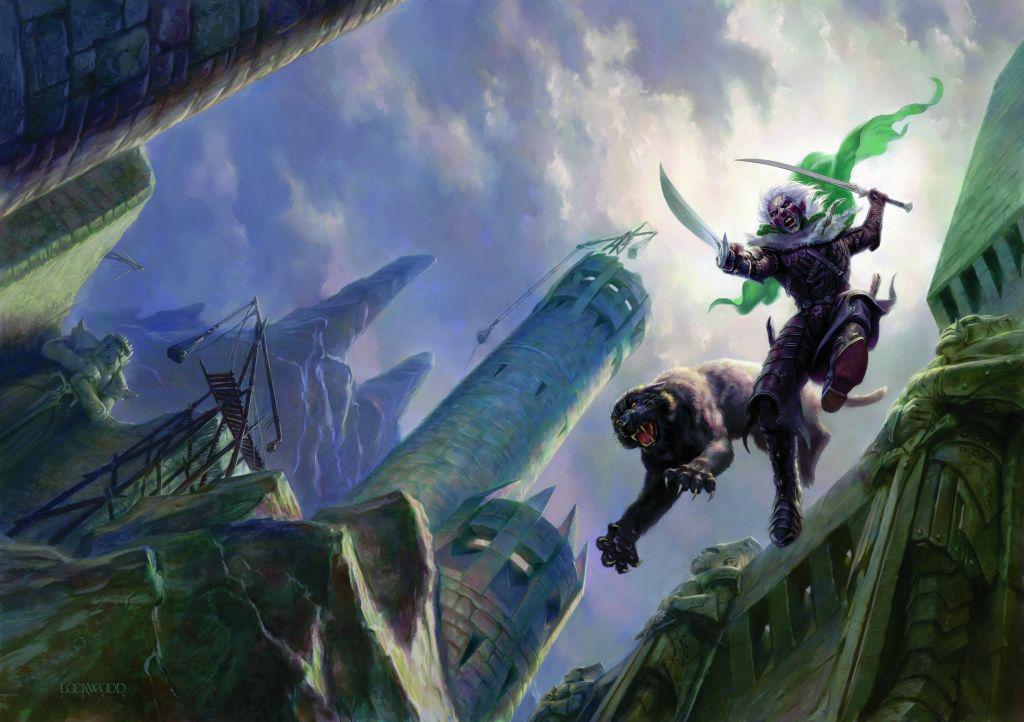
Drizzt Do’Urden-smallWe’re learning more about the new Dungeons & Dragons movie announced by Warner Bros. this week.

The first D&D movie, produced by New Line Cinema in 2000, was an epic failure (and its sequel was even worse), but this film will be produced by the studio behind The Lord of the Rings and the Harry Potter franchises, which has been on the hunt for a premium fantasy property for some time. An ongoing lawsuit over ownership of the D&D film rights prevented the project from going ahead, but Variety reports that dispute has finally been resolved.

A movie based on the widely popular game Dungeons & Dragons is in the works at Warner Bros., the studio announced Monday, 10 months after a trial over who owned the rights to the fantasy game ended.

After months of negotiation, Warner Bros., Hasbro’s Allspark Pictures and Sweetpea Entertainment said they had come to an undisclosed arrangement, ending the 2-year-old lawsuit, and are moving forward with the feature film franchise. David Leslie Johnson (The Conjuring 2) has already written the screenplay set in the D&D fantasy world of [The] Forgotten Realms. Hasbro’s Brian Goldner and Stephen Davis, Sweetpea Entertainment’s Courtney Solomon and Allan Zeman, and Roy Lee (The Lego Movie) are producing the high-priority project.

“This is far and away the most well-known brand in fantasy, which is the genre that drives the most passionate film followings,” said Greg Silverman, Warner Bros. president of creative development and worldwide production. “D&D has endless creative possibilities, giving our filmmakers immense opportunities to delight and thrill both fans and moviegoers new to the property…”

The Forgotten Realms, created by Ed Greenwood in 1987, is home to the drow ranger Drizzt Do’Urden, the mighty wizard Elminster, and countless other famous D&D characters. It has been featured in over 200 novels and countless adventure modules and supplements.

Read the complete article at Variety.