Fantasia 2016, Days 12 through 14: Afterlife, Life-in-Death, and Madness (We Go On, Aloys, and Therapy)
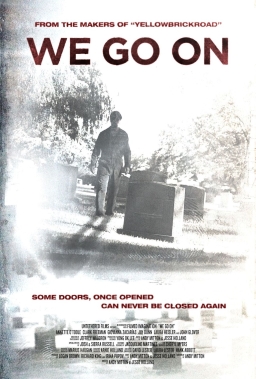 I had errands keeping me away from the Fantasia film festival on Monday, July 25. Now, interruptions are a sad fact of life, but sometimes it’s easy to get back into the swing of things; and as it happened the next day I made it back to the De Sève theatre to watch an American horror film called We Go On, which served to get me back into the Fantasia spirit. Then the day after that I saw two more movies at the De Sève, an odd Swiss romance called Aloys followed by a French horror film called Therapy. The latter had been directed by 16-year-old Nathan Ambrosioni — his second feature film. Together the movies made an odd meditation on life, death, and horror.
We Go On was written and directed by Andy Mitton and Jesse Holland (the IMDB credits Holland with “story,” while Mitton gets credit as “writer” as well as for screenplay and story). Miles Grissom (Clark Freeman) is an adult man in Los Angeles suffering from a crippling fear of death. He therefore offers $30,000 to anyone who can prove that there’s life after death — reincarnation, ghosts, anything. Deluged with people who claim to have proof, Miles and his cynical mother (Annette O’Toole) begin a quest to investigate the most promising responses. Things do not go as Miles might have expected.
Nor do things go as the audience might have expected either, and in this case I mean that in the best way. We Go On is thoroughly unpredictable, with an unusual structure and a story that moves between horror and character-based drama. Miles and his mother almost alternate as leads, and one can make a strong argument that the crucial choice shaping how the climax plays out is hers.
More than that, when Miles first gets responses to his offer, he’s able to eliminate most out of hand except for three or possibly four. He then investigates those few contacts one by one; as you might expect he has no luck at first. Also as you might expect his early investigations end up returning to become relevant to the movie later on. But how they become relevant is interesting. In one case it’s plot-related, but another is more thematic, putting forward ideas about fear and the supernatural that inflect the rest of the movie.
 Impossible to predict some things. Notably: you can’t know how you’ll react to a work of art until you’ve experienced it. Looking at the movies Fantasia offered on Sunday night, July 24, I thought I’d try If Cats Disappeared from the World (Sekai kara neko ga kietanara), which promised a tale about a terminally ill man who makes a surreal Faustian bargain. After that, I decided I should watch Superpowerless, as it was a genre piece about an aging superhero who’d lost his powers. In truth, I had my doubts about both movies; Cats looked it might suffer from excess of romanticism and forced whimsy, while Superpowerless seemed like some kind of mumblecore satire treading ground comics had worked over decades past. In the event, I was wrong to doubt. If Cats Disappeared from the World would be likely the best movie I saw at Fantasia, and probably my favourite. Superpowerless, meanwhile, turned out to be the festival’s most pleasant surprise, the film which most greatly exceeded all my expectations.
  I’d marked four screenings on the Fantasia schedule to attend on Sunday, July 24. The first two were both at the small De Sève Theatre: a presentation of the 1983 Shaw Brothers film Holy Flame of the Martial World (Wu lin sheng huo jin), followed by a short film showcase. The showcase, Fragments of Asia 2016, promised half-a-dozen pieces from across Asia, both animated and live-action. Afterward I’d have time for food, and then two more movies would follow. Before all that, though, came one of the films I’d immediately highlighted when I first saw what was playing at this year’s Fantasia.
 The evening of Saturday, July 23, was going to be busy for me, with three shows at the De Sève Theatre. First, a showcase of short films called Born of Woman, which the Fantasia program told me would feature nine films by women directors “centred largely around themes of the body and interpersonal malaise.” Then after that two science-fiction features. The first would be Realive, about a man from our time (or close to it) who dies and is cryonically revived in 2083. The second would be Tank 432, about a squad of soldiers seeking shelter from a surreal battle within a battered tank. It looked like a promising night, and it got off to a good start in the late afternoon with the Born of Woman showcase.