Gary Con II Report
 On Saturday I drove to Lake Geneva, Wisconsin, for the second annual Gary Con, a friendly gathering in honor of Gary Gygax, the co-creator of Dungeons and Dragons and the father of role-playing games.
You can read the Tribute to Gary Gygax, written by the staff at Black Gate magazine and Paizo publisher Erik Mona after Gary’s death in 2008, if you’re not familiar with his work.
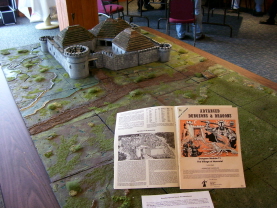
Lake Geneva is the birthplace of D&D and, consequently, the entire RPG industry. It was here that TSR, the company Gary co-founded in 1973, was headquartered for over two decades, and where many of the creative minds who helped it grow from a fledgling hobby company to the most influential game publisher of the last 30 years still live today – people like Tim Kask, founding editor of Dragon magazine, Gamma World author James Ward, RPGA founder Frank Mentzer, Snit’s Revenge creator Tom Wham, and many others.
The stated goal of the con is to “harken back to the early days of gaming conventions where role-playing was in its infancy and the players shared a strong sense of camaraderie,” and in that respect Gary Con was an unqualified success.
Players gathered around dozens of tables enjoying highlights from TSR’s early catalog, including first edition AD&D, Metamorphosis Alpha, Dawn Patrol, Boot Hill, Dungeon, Chainmail, and more modern games that strive to capture that sense of old-school adventure, such as Hackmaster, Castles and Crusades, and even Gygax’s fondly remembered post-TSR effort, Dangerous Journeys.
Best of all, I saw many renowned game designers and early TSR employees mingling with the crowd, or acting as dungeon masters for classic Gygax modules such as Steading of the Hill Giant Chief, The Temple of Hommlet, and Castle Greyhawk.
 One of the things I most enjoy about
  There are a lot of things to commend this book to an experienced gamer. The rules are fairly simple yet cover a lot of ground. I like how the abilities are not really tied into specific stats that are sometimes hard to justify - this system is much more fluid. It also is not conducive to rules lawyering and if there is one thing I hate, it is rules-lawyering, so this is a positive for me. I can see where the OCD crowd who wants a rule for everything could be irritated with it, but I game by the principle that story precedes rules, and this rule set is made for that mindset.
 Risus: The Anything RPG
 If a single positive resulted from the work of that woefully misinformed but correctly acronymed organization BADD (Bothered about Dungeons & Dragons), a group that waged a crusade to stop children from jumping into the Bags of Holding that they learned to construct from an $11.99 hardcover rulebook purchased at a hobby store, it was the computer RPG
 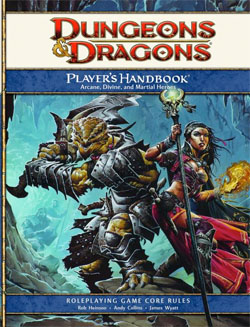 Fourth Edition Dungeons and Dragons has been with us for about a year now; long enough for the gaming community to get a pretty good taste of it. I’ve been hearing various reports from gamer friends about the system, and opinions of it have fallen across a roughly tripartite spectrum, from favorable to neutral to negative. Among these views, though, there is agreement that this isn’t the same old Dungeons and Dragons. Fans of Fourth Edition sometimes call it a “transformation,” or point out, “This time around they didn’t have any sacred cows. They were ready to change anything.” Critics have generally agreed that “It might be a game some people like, but it’s no longer D&D.”
 The death of Gary Gygax, co-creator of Dungeons & Dragons, marks the passing of an era. Gygax changed the face of fantasy like no other since J.R.R. Tolkien or Robert E. Howard. D&D brought people together, forged lasting friendships, and introduced a whole new generation to classic fantasy — in the process firing imaginations, heavily influencing the fledgling computer and video game markets, and laying the foundation for the billion-dollar online RPG industry. Just as importantly Gygax invited — indeed, demanded — that his readers become creators themselves, and the young fans he inspired eventually became some of today’s bestselling authors, including Raymond E. Feist, Margaret Weis and Tracy Hickman, R. A. Salvatore, Ed Greenwood, and dozens of others.