Browsed by
Category: Essays

Abbotsford: The House We’d All Like to Have
Abbotsford: The House We’d All Like to Have

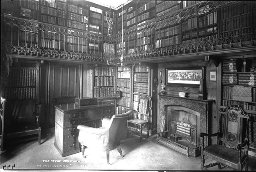
The study at Sir Walter Scott's Abbotsford House in Scotland. Postcard by James Valentine & Co published 1878. Photograph probably by James Valentine, who died in 1879. From the online collection of the University of St Andrews
…it takes a while to realize that it reminds me of my study.

(This week, I’m at World Fantasy Convention in Brighton, England. If you see me, please say hello – it’s my first convention in years!)

I feel so at home in this place, it takes a while to realize that it reminds me of my study.

320px-Abbotsford08
…is like my study, except it’s an entire house…

Weapons and armor roost on the walls, occult tomes jostle with classics and history books for shelf space, and History’s shrapnel — locks of hair, an ancient book, or a scrap of stone or pottery — remind us of a real and concrete past.

Yes, it’s like my study, except it’s an entire house…

Abbotsford House on the Tweed near Melrose, is the absolute archetype of a Fantasy writer’s perfect mansion, except that it was built by the grandfather of historical novelists, Sir Walter Scott, way back in the 19th century.

Sir Walter Scott is Scotland’s Robert E Howard. His Targe and Tartan yarns put Scotland on the 19th-century tourist map. If his text is past its sell-by date, his stories live on on the screen, big and small.

He was so famous in his day that both Blucher and Wellington were glad to meet up when he visited the field of Waterloo. When he fell ill, the government lent him a Royal Navy frigate so he could tour the Mediterranean. (Oh, and, Hail to the Chief? Guess who wrote the original verses?)
Read More Read More

Adventure On Film: Planet Of the Apes

Adventure On Film: Planet Of the Apes

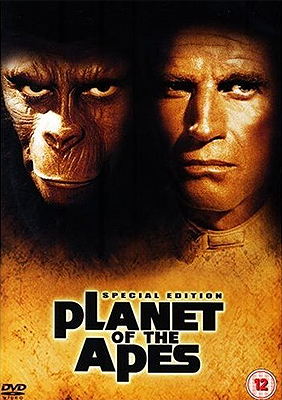
original.0I missed nearly all the seminal pop culture of my youth. When in eighth grade Andy H. asked me which I liked better, AC/DC or Pink Floyd, I honestly couldn’t answer the question. I was also much too tongue-tied to ask Andy if he’d ever heard of Doctor Who, which I’m quite sure he had not.

Anyway. One of the major events that I missed was Planet Of the Apes. True, Planet is from 1968, and I was only born in ’67, but even so, kids at my school through at least my sixth grade year sported Planet Of the Apes lunch boxes, thermoses, backpacks, and t-shirts. Planet Of the Apes (whatever it was) was cool.

My hipper-than-I friends informed me that Planet regularly played in re-runs on TV, and of course there was the short-lived spin-off series made specifically for the telly (1974). How was it that I had missed all this? Simple: I was building dams in the tributary streams of the Olentangy River, using whatever was handy: stone knives and bearskins, that sort of thing. I knew better than to explain.

Now that I’m older than Methuselah, or at least rapidly catching him up, I figured it’s time to see precisely what I’d missed.

And you know what?

If it weren’t for the execrable presence of Charlton Heston, it’s not half bad.

Read More Read More

The Weird of Oz Wishes You a Happily Horrifying Hallowe’en

The Weird of Oz Wishes You a Happily Horrifying Hallowe’en

Don’t fear the Reaper. — Blue Oyster Cult

Fall 2013 062
Visitors to our house on Hallowe’en are greeted by a presence.

Oh, I’ve loved being spooked, terrified, creeped out since I was knee-high to a werewolf and not much bigger than Bigfoot’s foot.

Okay, sometimes I chickened out; it got too much for me.

I have a vague recollection of my Grandpa Yontz, who died when I was very young, taking me into one of those spookhouses somewhere along the side of the road. We got a few feet into the dark, narrow entry hall. Up ahead to our right, glowing heads hung suspended in air (recalling it decades later, and now being something of a scholar of spookhouses, I can exactly identify the effect: polystyrene mannequin heads, the kind used to display wigs, strung up on fishing line beneath an ultraviolet light). Even then, I knew they weren’t real, but that’s as far as I got. I just couldn’t bring myself to plunge further into that black unknown. I ignored my grandpa’s reassurances, pulled my hand away from his, and darted back for the entrance.

Within a year or two, a real horror visited us: my grandpa was snatched away in a traffic accident on a narrow road coming back from a camping trip on the Mogollon Rim. In the face of reality, pretend horrors aren’t so scary after all, and I never again turned away from a spookhouse or a scary movie.

Read More Read More

Scale: What Pre-Modern Battles Really Looked Like

Scale: What Pre-Modern Battles Really Looked Like

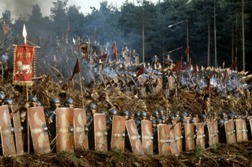
Gladiator
More men please!

That battle scene from Gladiator?

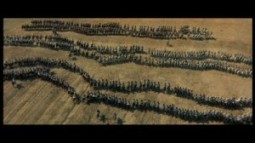
More men, please! Where you see a line of Romans, imagine five. Ancient armies numbered in the tens of thousands.

Sure, a thousand be-weaponed extras on-screen makes your mind go “1…2…3… Lots.” But real battles were several orders of magnitude larger.

Waterloo French Cavalry
More cavalry please!

Remember the Rod Steiger Waterloo? More cavalry, please! That should be 9,000 sabres. When you measure it out, they should fill the space between the two farmsteads. The only reason the Allied Infantry didn’t turn tail and run was because Wellington had positioned them behind a ridge so that they couldn’t see the tsunami of horseflesh about to wash around their squares.

Take an earlier battle on the same scale; Chalons — Huns and “allies” versus some Romans and lots of Romanized barbarians who hated each other. Jordanes says Chalons left 150,000 men dead on the field. That has to be a wild overestimate. However, suppose he’s out by a factor of ten and the body count reflects 10% of the men fighting… that takes us back to one hundred and fifty thousand warriors jostling and yelling, say about 75,000 a side.

Read More Read More

Passive vs Active Heroes

Passive vs Active Heroes

Ask any established actor, and s/he will always say something along the lines of, “it’s much more fun to play a villain than a hero.” It’s no wonder: villains tend to get the best lines (“No, Mr. Bond, I expect you to die!”), certainly their share of the trophy companions, have a higher standard of living, enjoy life more, and many go to their eventual demise laughing.

There’s another difference, though, that strikes at the very core of the hero/villain dynamic. The villains get to be pro-active. That means that traditional heroes are always re-acting.

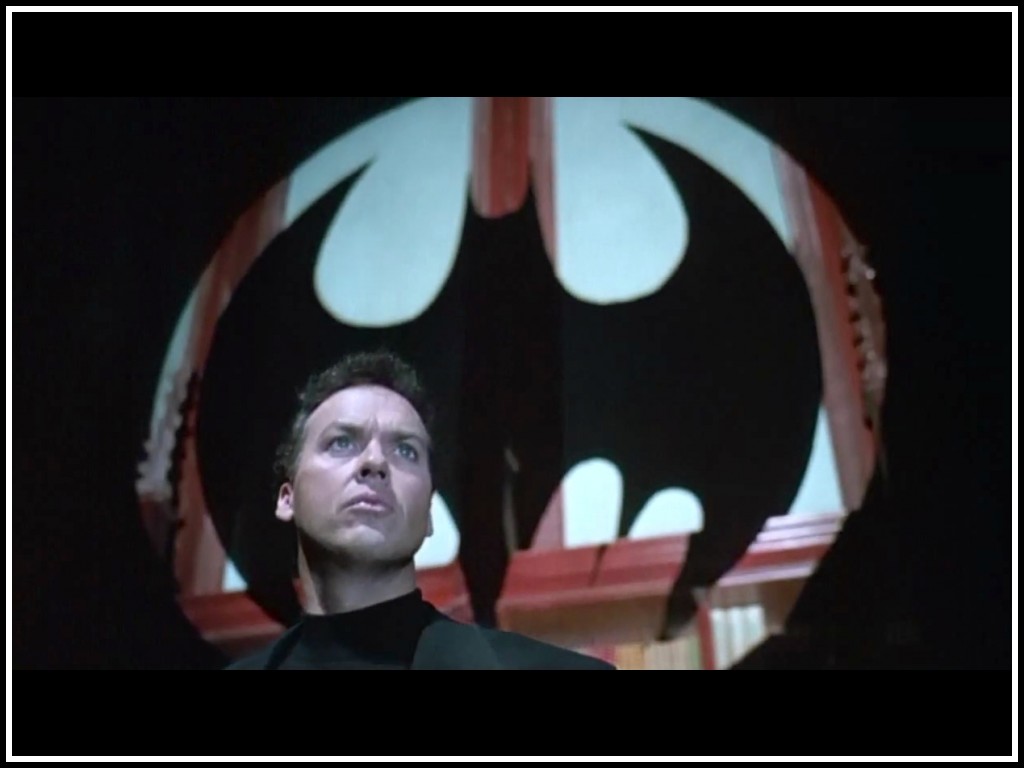
It’s in the nature of heroes to simply sit around and wait to be needed. The most vivid example of that is in Batman Returns, when Bruce Wayne (Michael Keaton) is shown sitting alone in the dark until the bat signal calls to his alter ego. Superman can’t act until Lex Luthor unveils his nefarious plan. Philip Marlowe has to wait for a client to walk in the door.

Just chillin' wit my batz waiting for yur signal.
Just chillin’ wit my batz waiting for yur signal.

And this goes against one of the great Rules of Writing, which is to never let your hero be passive. But it’s in the very nature of heroes to be passive, to wait until the villain makes a move, to respond to a threat. After all, how do you act like a hero pro-actively?

Well…ask Conan.

Read More Read More

The Cold Edge of Forever, II: City

The Cold Edge of Forever, II: City

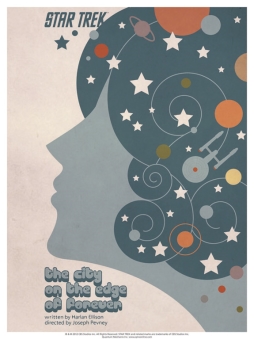
The City on the Edge of Forever, by Juan OrtizThis is the second part of my attempt to write about Star Trek, and specifically the episode “The City on the Edge of Forever.” For reasons which I hope will soon make sense I started off yesterday by writing about the 1954 short story “The Cold Equations.” What I’m about to try to do is tie that into a discussion of the Trek episode, and then go on to look at that episode in the context of the show overall. I am going to assume in what follows that you’re familiar with the episode (the plot synopsis is here; if it helps, it’s the one with the Guardian of Forever, where Kirk and Spock travel back to 1930), and that you know things like who Captain Kirk is, and who Mister Spock is, and so on and so forth. This I think is a fair assumption. Everybody knows these characters. Which is a part of why I want to talk about the episode, and its context. So before anything else, I want first to talk about the exercise of unknowing them. (And as an aside, the poster at right is by artist Juan Ortiz, who did an image for every episode of the original series. Worth taking a look at, and the whole run has been collected in a single book.)
Lately I’ve been watching the first season of Star Trek week by week, on a TV network that airs old shows from the 50s through 70s. Seeing the series in that context means seeing it as part of the fabric of its time. Some series, I`ve found, become very different: the original Twilight Zone, always a good show, becomes downright mind-bending. Watching Trek in that way I find myself caught up in the craft of the writing, direction, and (yes) acting; and I seem to forget everything I know about what happens outside of the show I’m seeing.

Read More Read More

An Open Letter to Amy Farrah-Fowler, Ph. D.

An Open Letter to Amy Farrah-Fowler, Ph. D.

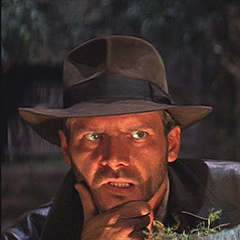
Puzzled Indiana JonesDear Dr. Farrah-Fowler,

Regarding your erroneous conclusion that Indiana Jones played no role in the outcome of Raiders of the Lost Ark, I can only express disappointment that your usual disciplined reason failed you in this instance.

Let us explore your thesis and remove Indiana Jones entirely from the equation. The year is 1936 and the Nazis are exploring a sand-covered ruin of a largish ancient Egyptian city (Tannis, a major religious center, was comparable to Thebes) in search of the Ark of the Covenant. Without the headpiece to the staff of Ra, brute manpower would not have been equal to the task before them in the short time available to the Nazis. The only similar ancient city destroyed by catastrophe and quickly preserved in such a manner is that of Pompeii. As you are no doubt aware, Pompeii has been excavated and explored off and on since 1748, and intensively between 1924-1961, yet we still have not progressed much outside the main streets or into second floors and basements. The Nazis, in theory, would have until the outbreak of war in September 1939 at the very latest to carry out their dig, a span of 3 years. Unless you posit the British Army would have been willing to let a detachment of Afrika Korps poke around Egypt within spitting distance of the Nile in wartime. If you believe that, I have a piece of the True Cross made out of Georgia Sweetgum you may be interested in buying.

I think we can dispense with the idea that the Nazis would have found the Ark without the headpiece to the Staff of Ra.

Read More Read More

The Cold Edge of Forever, I: Equations

The Cold Edge of Forever, I: Equations

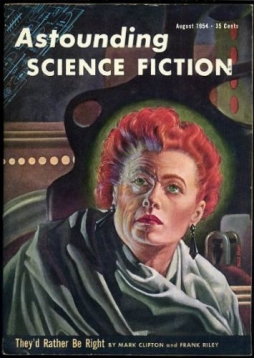
Astounding Science Fiction, August 1954I want to write about Star Trek. Specifically, about the episode “The City on the Edge of Forever.” But I’m not going to do that right now. I’ll get there, but I’m going to start off by writing about a well-known prose sf story that to me parallels “City” in some interesting ways. Then, in my next post, I’ll go on to write about the Trek episode and make a fuller comparison (edit to add: time having passed, you can find the post here). First up, though: “The Cold Equations.”
“The Cold Equations” was written in 1954 by Tom Godwin for editor John W. Campbell and published in Astounding. Some, including writers Kurt Busiek and Lawrence Watt-Evans, have stated that the story was largely borrowed from an EC Comics short story by Al Feldstein with art by Wally Wood, “A Weighty Decision,” itself perhaps copied from an E.C. Tubb story (“Precedent”). At any rate, Godwin’s tale is well-known, having been adapted for the screen and frequently anthologised; I read it in The Road to Science Fiction 3: From Heinlein to Here.

A man, Barton, piloting a small spaceship carrying medicine to an isolated colony, discovers an eighteen-year-old stowaway, Marilyn, who wanted to see her brother on the colony world. But Marilyn, from Earth, doesn’t understand the way things work out on the frontier of space: the ship had exactly as much fuel as it needed to get to the planet — before Marilyn’s unexpected weight was added. With Marilyn, it won’t be able to land safely. For the people on the colony world to live, she has to be ejected from the ship. Barton frantically tries to find some way out, some way to keep her alive, but cannot; and so, willingly, she goes into the airlock, and dies out in the void of space. Physics and mass and momentum cannot be argued with, the story tells us; the cold equations must balance.

Read More Read More

The Horror: Oz Meets the Scarecrow

The Horror: Oz Meets the Scarecrow

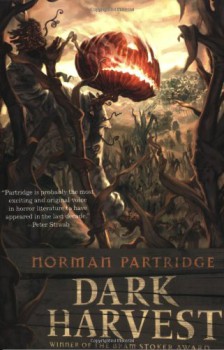
dark harvestAs Stephen King once observed, horror has a short shelf life. What scares us today will lose its impact tomorrow. The shock of the new will wear off, the fear of the unknown dispelled by our having come to know it.
Mary Shelley’s Frankenstein may be a literary classic, and it is still required reading in high school and college classes the world over. But when was the last time anyone was actually scared by Frankenstein’s Monster, I wonder? Or by Dracula, or any of the other classic monsters that now grace the sides of cereal boxes?

Familiar, tried-and-true monsters suffer from overexposure just as surely as vampires exposed to too much sunlight. After the umpteenth new Hollywood film, movie of the week, and YA book series, they “jump the shark,” so to speak. They lose their ability to produce chills and instead become the butt of parody or — worse — a love interest.

Until, that is, they come creeping back in an altered guise, rendered frightening and unfamiliar again by the latest horror maverick. Oh, they keep coming back, these perennial terrors. After all, there is a reason they are iconic: they have so aptly embodied so many human fears throughout the ages. We will likely be spooked — genuinely frightened — by a vampire again, hard as that is to imagine now, somewhere down the road.

In this macabre dance, venerable monsters take turns in the blacklight; their popularity waxes and wanes and waxes again, like the cycles of the moon.

Read More Read More

Low Adventure: Clasp-knives and Fortunetelling in Carmen

Low Adventure: Clasp-knives and Fortunetelling in Carmen

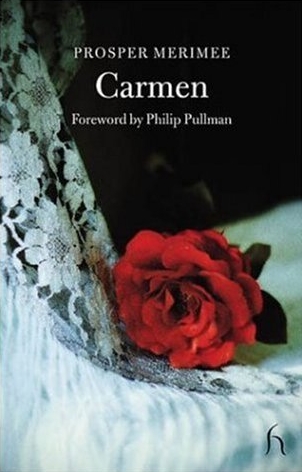
Prosper Mérimée Carmen-smallWhy does it have to be the days of “high adventure?”

Low adventure can be extraordinarily riveting, as I recently found when I revisited Prosper Mérimée’s Carmen, the novella that inspired the Bizet opera. I’d read it once before, after seeing the (definitive, to my taste) Rosi film of the opera in the early 80s. Thanks to that film, I was so enchanted with the light and color of Andalusia that on my first trip to Europe I spent the better part of it there, on the coasts, in the alleys of Gibraltar, and especially in the stony mountains of Spain’s Sierra Nevadas. Thanks to a stay at an Andalusian cortijo (estate-farm) I was able to see some of the more remote areas on horseback, dragging a dutiful, saddlesore (need I say “ex”?) girlfriend behind who would have much rather been sunning on the beaches of Marbella or examining the wonders of the Alhambra.

Spain is a country of regions. The differences you might notice between northern Italians and southern are trebled in the expanses of Spain, divided as it is by mountains and joined by indirect routes reaching back into the dust of antiquity. There’s something of Robert E. Howard’s Zamora in Andalusia. Rome, the Caliphate, Catholicism, and for the history-minded traveller with a good guidebook, traces of the Phoenicians, Carthaginians, and Napoleon can still be found. Each province has its flavor, industrious Bilbao, pretentiously bustling Madrid, historic Toledo, artistic Barcelona, leaving a distinct impression. The Andalusians are famous for just living life. Every meeting is an excuse for a party, every parting as one between old friends. Visiting Spain revised my personal definitions of “courtesy” and “hospitality.”

I see I’ve imitated Mérimée in framing these notes, elaborating the circumstances of my acquaintance with Carmen and Don Jose and the search into their origins. So enough about me.

Read More Read More