Leaks and Peeks
So a lot of people are on the edge of their seats because Apple is introducing a new iPhone model next week, and some people have fuzzy pictures supposedly leaked from China that purportedly show that the new model will have a matte black case. I can hardly contain my excitement. I’m cynical enough to think that Apple itself might be leaking the sneak peeks as a way to generate buzz about what sounds to me as just some feature improvements so people will want to stand in line for two weeks at the wireless store until the new model is available and they can belong to the technical elite for a couple of days or so.
All of which reminds me of a recent short story by Bruce Sterling, “Black Swan” in the March-April 2009 (Issue 221) of Interzone. The protagonist is an Italian blogger-journalist (sounds a little like Sterling himself in some respects) who gets insider tips on new technologies from a mysterious source who is so secretive he can’t be Googled. There’s a lot of techno-speak and the plot hinges on the notion that the 1980s (when, perhaps not coincidentally, Sterling and his fellow cyberpunks first started making names for themselves) was a critical historical point from which multiple realities branched. The story also features Nicholas Sarkozy (yes, the president of France) and his actress-singer wife (yes, that wife).
Fun stuff and much more interesting than the gloss on the iPhone.
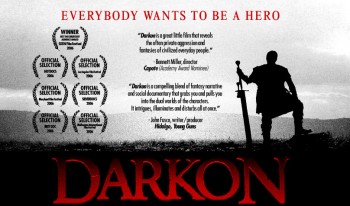 As a follow-up to
 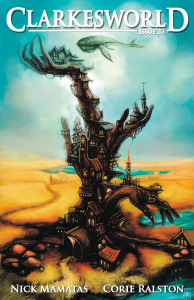 Issue 33 of Clarkesworld Magazine features a
  I’m looking forward to China Miéville’s new novel, The City and the City. In the meantime, here’s an
  I’ve only ever heard the terms ‘escapism’ and ‘escapist’ used as pejoratives and, quite often, used to describe things that I enjoy. We all know what these terms mean, and especially what they are implicitly communicating: the notion that escapist entertainment is a crutch, a way of running away from reality. But also, and I think that this is more important, that it has no redeeming value as art or as educational material.

 Risus: The Anything RPG
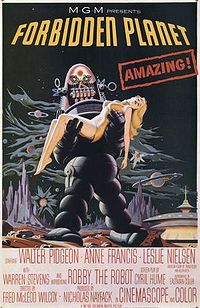 Given all the discussion of late about reboots, I wonder why no one has ever thought to revisit this classic. Forbidden Planet was my Star Wars when I was in fifth grade. In the New York metro area, Channel 9 had a feature called “Million Dollar Movie” that used to play a particular movie ever day throughout the week in the early evening. Forbidden Planet was a regular staple, and whenever it was in rotation, I was there in front of the TV (which, to give you an idea of how old I am, displayed only black and white).