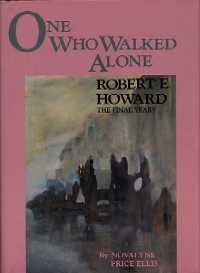
 It’s hard to add much about RE Howard to what’s been said here, but I’ll try.
Howard is easy to compliment on his prose style, his ringing battles so evocative that the blood almost sticks to your hands as you turn the pages. His characters were primal archetypes, quick to take to and want more from. His worldbuilding allowed you to smell the exotic spices in the market street air and hear the shadowy footpads in the alleys — his masterwork Hyborea teemed with life and detail. His sense of rhythm in the telling of Conan’s latest exploit or explosive westerns leavened with physical humor prove him a master yarn-spinner.
But there’s more to him than just technique.
I get writing from amateurs every now and then that about lives up to Howard, even if it’s just aping his style. The stories just seem strangely lifeless for all the careful detail, cacophonous action, and pulpish word-choice. I usually tell these writers to “tell me one of your truths.”
Howard put what he knew to be true in his stories. He was an opinionated man, read Novalyne Price Ellis’s memoir One Who Walked Alone for plenty of examples. He knew the power of entropy, he’d seen it growing up in Texas as the oil men came and went. Cross Plains experienced it in the bust of the Great Depression. Howard’s stories are filled with the frailty of civilization, yet even when all that is dross falls away and the hollow gongs go silent there’s still the rough code of someone like Conan to protect a defenseless woman or Solomon Kane’s relentless resolve to avenge a murder even unto the lawless coasts of the New World. The whole world may have fallen or been left behind, but these characters will still see justice prevail.
Howard was a great reader of history and spoke endlessly of corruption. The rotten old order gives way to the new, not always easily, then the new eventually goes sclerotic and itself is preyed on by another generation of barbarians. The same truth applied to Rome applied to Howard’s Aquilonia and fallen Stygia.
Yes, by all means give R.E. Howard his hard-earned props as a technical master. But he also wrote from his brain, his heart, and his guts about what was important about life, as he saw it. Conan’s broadsword spoke many of Howard’s truths.
 Last week,
 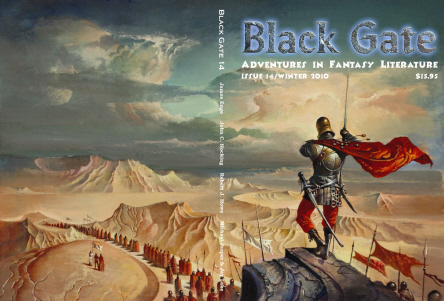 Black Gate 14 is a landmark issue — and at 384 pages, it’s also the largest in our history.
 This past week I saw both
  might be struck by the special effects of the latter (I particularly like the scene where Tom Waits as the devil unfurls his umbrella and casually steps off a cliff, at which point little white clouds appear to support each of his steps so he doesn’t plummet to the ground), except now it (and maybe everything else) pales in comparison to Avatar, which is as visually stunning as all the hype suggests, assuming all you expect from going to a movie is a cool light show. Not that there’s anything wrong with that. But, for my money, the better movie, even with its flaws is The Imaginarium of Doctor Parnassus. Why?
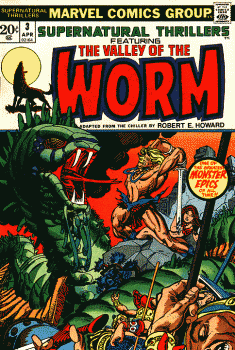 “One of the greatest monster epics of all time!”