Browsed by
Category: Blog Entry

The IX by Andrew P. Weston
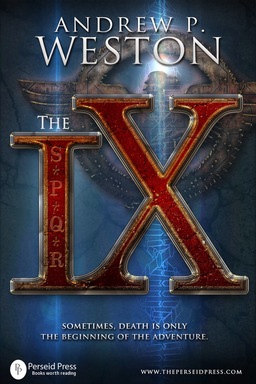
The IX by Andrew P. Weston

oie_235511s7P3HzLYAre you old enough to remember the Kirk Douglas Saturday Night Live sketch from 1980 that asked the important question: “What if Spartacus had a Piper Cub?” Well I am, and it was the first thing that popped into my head when I received a review copy of Andrew P. Weston’s new novel, The IX, from the fine people at Perseid Press. I don’t read or review much sci-fi, but they suspected, quite correctly it turns out, that this would be right up my alley.

No, modern aviation doesn’t save the famous Roman IX Legion from destruction. Instead, the IX — and a host of other soldiers from across the ages — get a chance to play with advanced weapons to stave off a massed army of energy-devouring monsters on a star far across the galaxy from Earth.

The Ardenese, a highly advanced race, rule dozens of worlds, crossing the stars in ships that rip holes in space…until they encounter an enemy they come to know only as the Horde.

First discovered on a colony world, the energy-devouring Horde manage to secrete themselves aboard Ardenese starships. One by one the colonies fall, until all that remains is the homeworld and the capital city, Rhomane.

Even protected by barriers and nearly impregnable walls, the Ardenese know they are doomed. In the end, and it is surely near, they will all die, subject to the hideous ravages of the Horde. To ensure the survival of their race, the handful of survivors turn their fates over to the Architect, a massive AI computer.
Read More Read More

Wanderings on Writing by Jane Lindskold: Enter to Win a Signed Copy!

Wanderings on Writing by Jane Lindskold: Enter to Win a Signed Copy!

It’s been a while since I’ve posted, but I am back! In the months since you last heard from me I started up a ebook and paperback formatting company, and we’ve formatted some very cool stuff. The coolest, I will post about here on the site (note, this is not all I will post about and I do not benefit commercially from these postings. This is all stuff I want to shout from the rooftops because of its coolness.)

First up is: Wanderings on Writing by Jane Lindskold, which is a compilation of essays about writing, plotting, storycrafting, characterization and much, much more. She is giving away a signed copy here –> a Rafflecopter giveaway.

Wanderings On Writing-small

Read More Read More

February 2015 Nightmare Magazine Now on Sale

February 2015 Nightmare Magazine Now on Sale

Nightmare Issue 29-smallThe February 2015 issue of Nightmare Magazine is now available. (Truthfully, issue 30 will be on sale any day now too, but I’ll get to that later.)

Nightmare is the sister publication of the highly-regarded science fiction and fantasy magazine Lightspeed. It’s an online magazine of horror and dark fantasy, with a broad focus — editor John Joseph Adams promises you’ll find all kinds of horror within, from zombie stories and haunted house tales to visceral psychological horror.

This issue has two pieces of original fiction:

“The Garden” by Karen Munro
“Descent” by and Carmen Maria Machado

As well as two reprints:

“Fishfly Season” by Halli Villegas
“Cult by Brian Evenson

There’s also the latest installment of their column on horror, “The H Word,” plus author spotlights, a showcase on the cover artist, and an interview with award-winning author Chuck Palahniuk.

Read More Read More

The Public Life of Sherlock Holmes: The Lords of Dus

The Public Life of Sherlock Holmes: The Lords of Dus

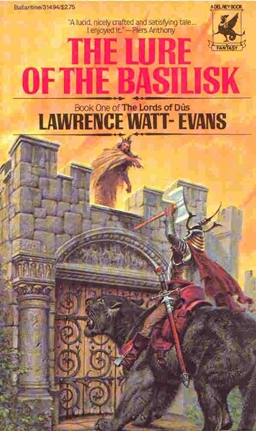
Dus_BasiliskThe eighties was full of epic fantasy series’ by the likes of David Eddings, Raymond Feist, Stephen R. Donaldson, Terry Brooks and Katherine Kurtz, to name a few. While many remain giants in the history of the genre, Lawrence Watt-Evans wrote a largely forgotten series: The Lords of Dus.

Watt-Evans has written quite a bit of fantasy, science fiction and horror and is probably best known for his Ethshar series. Ethshar was created as a role-playing game world and he ended up writing many novels and short stories using the setting.

Watt-Evans had flunked out of Princeton’s architectural school and had to wait a year before he could re-apply. He had heard (the possibly apocryphal story) that Larry Niven started his career by deciding to write for one year and if he sold something, continue on: if he didn’t, he’d give it up. Watt-Evans decided to do the same and wrote a slew of short stories, selling one.

He did go back to school, but he wrote a novel (The Cyborg and the Sorcerer) on a summer break and after two years of college, gave it up to make a living with the typewriter (as a writer, not a typewriter salesman).

Influenced by Robert E. Howard, Michael Moorcock and Lin Carter’s anthologies (Flashing Swords, anyone?), he was ready to spin a fantasy saga featuring a non-human (but less effete than a Melnibonian) hero. Thus, the race of overmen.

He wanted to write a ‘quest’ series, so he needed somebody to tell Garth what to do. He borrowed from Robert Chambers and came up with The King in Yellow (yes, people were influenced by Chambers before HBO’s True Detective). So, we had a sort of Elric meets the Labors of Hercules.

Read More Read More

The Son of Satan: A Gem from the Marvel of the 70s

The Son of Satan: A Gem from the Marvel of the 70s

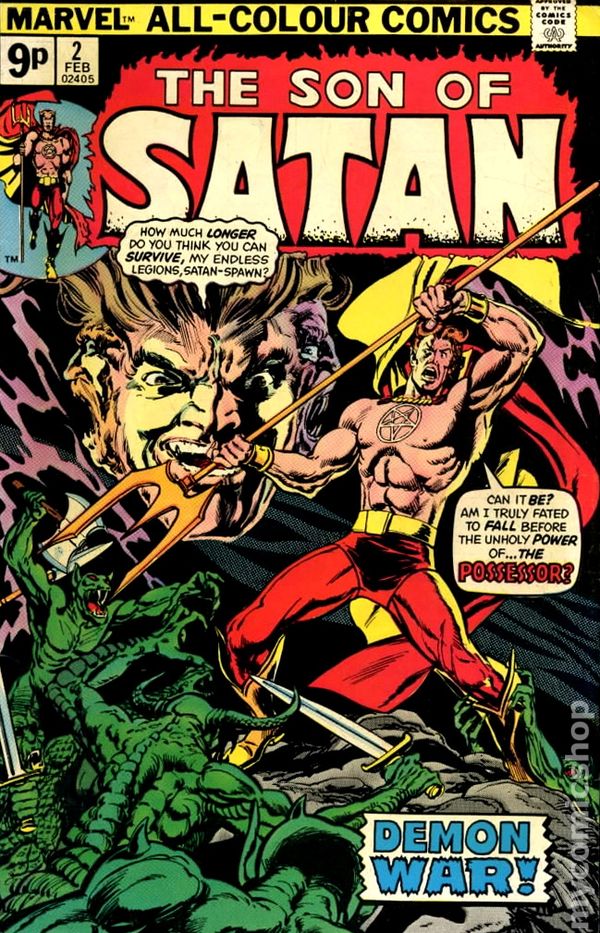
Son of Satan 2
So many demons to fight.

While interviewing Associate Editor Jake Thomas of Marvel Comics for my last blog post (see Middle Child) , we also talked a bit about horror in comics and where it fits, what fans are looking for, etc. It turns out that until recently, I hadn’t gone all the way to thinking about comics as a horror medium, partly because I’d never found them scary.

Marvel Spotlight 22
Human side versus devil side plus sister thrown in for family angst, and a guy on a flaming motorcycle. Freud! Help!

The old saw is that, other than superheroes, comics chased movies and TV, so that when westerns were popular, the comic industry produced cowboy books, and when SF movies were popular, they made SF comics, etc. And the 70s of course was the era of The Exorcist, The Shining, Jaws, and so on.

Some of the grotesqueries of the 1950s drove the creation of the Comics Code, but I guess I’d looked at the post-Code books like Tomb-of-Dracula and Man-Thing and Werewolf by Night as monster books, rather than horror.

There’s only so much you can do within the code, which was part of the reason why Marvel experimented with magazine-sized black and whites in the 1970s, which, by today’s standards (ex.: Severed or Wytches, from Image) look like a tea party… the little kid play, not the political movement.

However, despite being not scary, there was a rich subtlety in some of Marvel’s spooky books, an unreliability of perception, that drew me in, as a pre-teen and teen, and probably helped form some of my tastes.

In the summer of 1981, my mother gave me four comics, one of which was Doctor Strange #43. Doctor Strange was soooo wierd, but good, knock-off Chthulhu good.

And I hunted down Doctor Strange everywhere I could find him, which led me to the Defenders, another oddball child of the 1970s.

Read More Read More

Future Treasures: Year’s Best Weird Fiction Volume Two, edited by Kathe Koja

Future Treasures: Year’s Best Weird Fiction Volume Two, edited by Kathe Koja

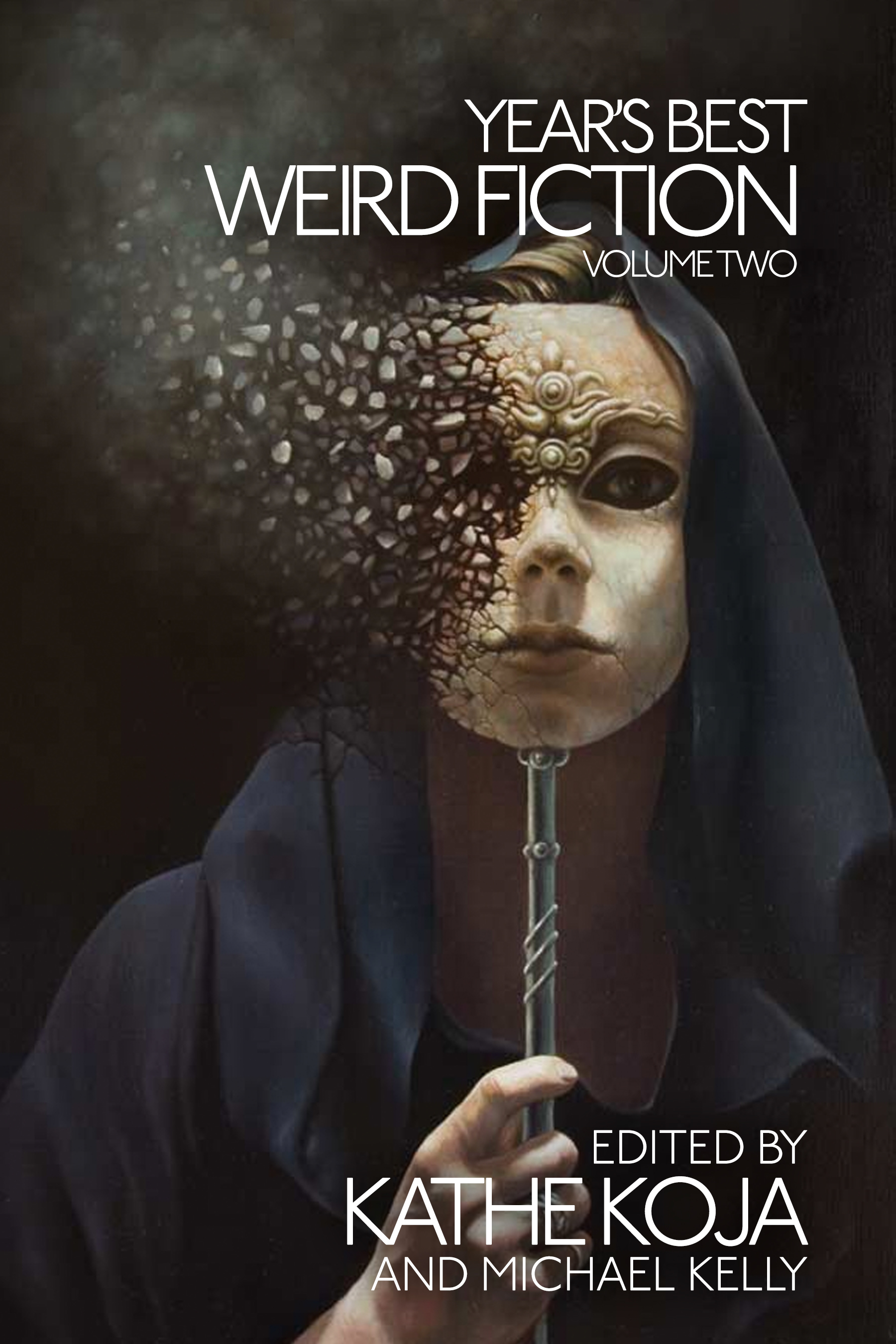
Year's Best Weird Fiction Volume 2-smallThe first volume of Year’s Best Weird Fiction looks like it has been an unqualified success.

In his review, James McGlothlin wrote:

We are long overdue to have a year’s best anthology dedicated specifically to the weird… The craft of fine writing is quite exemplar here… Barron has successfully compiled an excellent anthology.

Now Undertow Books has revealed the cover and the complete Table of Contents for Year’s Best Weird Fiction Volume Two, to be published later this year. Here’s the TOC:

“The Atlas of Hell” by Nathan Ballingrud (Fearful Symmetries)
“Wendigo Nights” by Siobhan Carroll (Fearful Symmetries)
“Headache” by Julio Cortázar. Translation by Michael Cisco (Tor.com, September 2014)
“Loving Armageddon” by Amanda C. Davis (Crossed Genres #19, July 2014)
“The Earth and Everything Under” by K.M. Ferebee (Shimmer #19, May 2014)
“Nanny Anne and the Christmas Story” by Karen Joy Fowler (Subterranean Magazine, Winter 2014)

Read More Read More

When I Win the Lottery; Or, I Should Be So Lucky

When I Win the Lottery; Or, I Should Be So Lucky

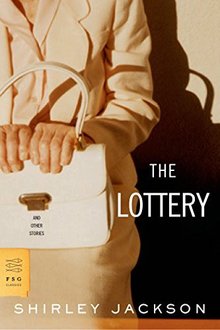
Jackson LotteryThe phrase “when I win the lottery” seems to be used in two distinct ways. The first and, I hope, the most common usage, has the same “ain’t gonna happen” meaning as “when pigs fly,” and connotes a certain sense of realism on the part of the speaker. The second, and I think sadder, usage stands for a certain lack of foresight. It’s been said, for example, that a sizable percentage of people include winning the lottery as an element in their retirement plans.

In our house the phrase also stands for any unlikely event beyond our control that we would nevertheless welcome. Like “when they finally come up with a retina chip that will fix my right eye,” or, “when the Dhulyn and Parno novels are optioned for TV.”

The lottery as a phenomenon is now so pervasive that it’s almost impossible not to think about lotteries and winning/losing them. The concept has formed the basis of a wide variety of movie and TV plots – mostly on the negative aspects of winning, but I think that’s meant to comfort those of us who, well, lost.

How are lotteries treated in Fantasy and SF writing? I don’t mean games of chance as such, though that gives us magnificent stories like “Gonna Roll the Bones” from Fritz Leiber. Nor do I mean criminal activities like numbers running, or even straightforward betting, whether on or off track or line. No, I mean actual lotteries. You get your ticket, and you wait your chance.

Read More Read More

Geek Parenting: D6 Thoughts for Tabletop Gamer Parents

Geek Parenting: D6 Thoughts for Tabletop Gamer Parents

2kg of Halo Megablocs. It's hundreds of pounds worth of plastic, but we'll only get a few quid for it because the sets are all jumbled.
2kg of Halo Megablocs… hundreds of pounds worth of plastic, but we’ll only get a few quid for it because the sets are all jumbled.

At the moment, Kurtzhau and I are trying to flog off 2kg of Halo Megablocs. It’s hundreds of pounds worth of plastic, but we’ll only get a few quid for it because the sets are all jumbled. Worse, he only got 18 months play out of the lot, less out of recent acquisitions. He’s 11 now and Bolt Action and Warhammer 40K have swept away all his toys.

So, this set me thinking about things I wished I known when I started parenting.

1. Your old games are rubbish

Seriously, your old edition of AD&D is unplayable — too many subsystems, too much obscurantism for anybody growing up a digital native. This is also true of those older boardgames that tried to emulate some aspects of role playing, but without the verbal problem solving and character stuff that make RPG worthwhile. In terms of making interesting decisions, Talisman, for example, is not really much better than Snakes and Ladders.

Read More Read More

British Museum uses CT Scans to Unwrap Mummies

British Museum uses CT Scans to Unwrap Mummies

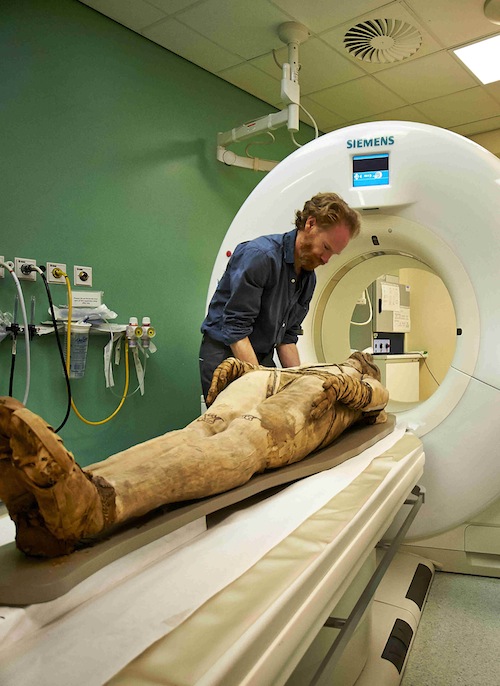
A mummy undergoing a CT scan at the Royal Brompton Hospital. © Trustees of the British Museum

A remarkable exhibition at the British Museum is revealing the secrets hidden inside mummy wrappings.

Ancient Lives, New Discoveries showcases eight mummies from the Nile valley, Africa’s greatest center of ancient civilization. Seven were found in Egypt and an eighth was uncovered in Sudan. They have all been analyzed with the latest model CT scanner at a London hospital to reveal information about the people without their having to go through damaging analysis.

Read More Read More

Ancient Worlds: Claiming the Lost from the Underworld

Ancient Worlds: Claiming the Lost from the Underworld

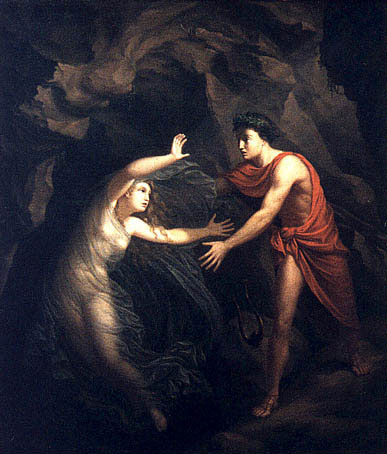
Kratzenstein's Orpheus and Eurydice
Kratzenstein’s Orpheus and Eurydice

We live in an age of reboots. I for one think this is an excellent thing. Most of the great of history has fallen into the category of reboots, retellings, recapitulations and reimaginings.

Without the concept of fanfic there is no Aeneid, and while many a college Sophmore may rejoice at that idea, world literature would be the poorer for it. That is, as well, what Ovid is doing with the Metamorphoses. He’s compiling and retelling, weaving several hundred different strands together into one long rope of story. And that work is still bearing fruit today.

One of the better and most wideley known tales that Ovid retells is the myth or Orpheus. This one is so commonly read that I’ll just sketch down the bones here: Orpehus was the greatest musician who ever lived. He was married to a young woman named Eurydice, but she died very soon after the wedding. Heartbroken, he made his way down to the Underworld, and with the power of his music, convinced Hades and Persephone to let Eurydice come back to the light. They agreed, the only time in all of history they have done so, because they were so moved by his music. But there was a condition: Eurydice would follow him up to the surface, and he couldn’t look back once.

Read More Read More