Browsed by
Author: Matthew David Surridge

The Book Fair

The Book Fair

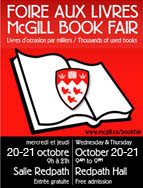
Book Fair flyerThe McGill book fair is the largest English-language used book sale in Montreal. It’s been held for decades, every October, on the second Wednesday and Thursday after Thanksgiving (which in Canada is on the second Monday in October). Every year an eclectic mix of thousands of books are sold, helping to raise money for scholarships.

I’ve been coming to the sale for about a dozen years. I’ve found novels by Lord Dunsany, a biography of C.S. Lewis, a book about Hypatia of Alexandria, a Dennis Wheatley omnibus, Fighting Fantasy Gamebooks, Paul Park’s Celestis, a volume combining Bede’s Ecclesiastical History with The Anglo Saxon Chronicle, collections of poetry by John Clare and Francois Villon and Elizabeth Barrett Browning and Robert Southey and Don Marquis, a graphic novel by Posy Simmonds — and all of these (along with books by Neal Stephenson, Tad Williams, and T.H. White) in just one year, 2008, when I bought a total of 65 books for $161.

Read More Read More

The Time is Out of Joint: The Silver Skull, A Review

The Time is Out of Joint: The Silver Skull, A Review

silver-skull2The Silver Skull is the first book in a new series by Mark Chadbourn, Swords of Albion, following the adventures of Will Swyfte, spy for Queen Elizabeth the First of England, as he fights a secret war against the faerie-folk of the Unseelie Court. That’s a brilliant hook for an ongoing series of adventure novels. And in fact Chadbourn’s new book is best described as modern-day pulp, with all the strengths and weaknesses that implies.

It’s a swashbuckling tale of adventure, filled with sword-fights, melodrama, action set-pieces, heroes, and villains. But its characters are flat and uninteresting. And, ultimately, its depiction of its setting is gravely disappointing.

Let’s look first at what the book does well. The plotting is strong and sure, and builds nicely through a series of action sequences. Tension is manipulated skillfully, and the staging of events is imaginative and clearly described. Chadbourn moves his story through a number of interesting places in the Elizabethan world, filling those places with cloak-and-dagger suspense, mysterious riddles, ancient Indiana-Jones-style deathtraps, and the like.

Read More Read More

Wormy: The Dragon‘s Dragon

Wormy: The Dragon‘s Dragon

WormyIt begins with an imp, some dwarves, a stolen set of bowling balls, and a cigar-smoking dragon in a flat newsboy cap. It gets stranger from there, sprawling through an epic of long-jawed mudsuckers, oddly literate stonedrakes, bad puns, bounty hunters, and some of the most spectacular color comics pages you can imagine.

I’m talking about Wormy, a comic by David Trampier which ran in the back of Dragon magazine, one to four pages per month, from 1977 to 1988. Trampier, whose artwork helped define the feel of First Edition Dungeons & Dragons, created a lush, memorable tale, one that deserves to be better known today. You can see a large chunk of it here, though most of the comic seems to be offline.

What was it about? As I said, it began with Wormy, a green dragon with a cigar, who’d stolen some bowling balls from a group of dwarves. The dwarves show up to try and get them back, which leads to complications involving a group of brutal but occasionally cunning card-playing ogres (Wormy steals their poker pot when they’re not looking), a minotaur, a talking bear in a Robin Hood hat, a whole community of trolls, and a Brooklyn-accented imp. Then somewhere in there one of the balls gets broken, and a demon comes spilling out. So when we cut to a wizard named Gremorly, “somewhere at the end of this weird world,” plotting to steal the dwarven treasure, we’re not that surprised.

Read More Read More

War, Peace, and Fantasy

War, Peace, and Fantasy

War and PeaceIn one of my first posts here, I mentioned that I was hoping to figure out what it is, exactly, that I like about fantasy fiction; what it is I get from fantasy that I get nowhere else.

I found myself thinking about that question a fair bit over the past couple of weeks. I was reading a 1500-page novel about a world-shaking clash of armies, a prose epic whose subjects ranged from the politics of high society to battles shaped by cavalry charges, and which presented a struggle against a would-be world conqueror viewed by some as divinely gifted and by others as a Satanic force of utter chaos.

It wasn’t a fantasy, though. It was War and Peace.

I found myself fascinated by how much Tolstoy’s great novel (Tolstoy claimed the book wasn’t a novel, in a formal sense, but the term fits better than any other) looks like an epic fantasy — even while feeling like nothing of the sort. Why is that? Why is something that seems so close to fantasy in form so different in actuality?

Obviously it’s a different kind of book. Obviously Tolstoy was aiming at something — many things — quite different from an epic fantasist. But what sort of things? How do they determine the feel of the novel?

Read More Read More

Reconsiderations: The Book of The Dun Cow and The Book of Sorrows

Reconsiderations: The Book of The Dun Cow and The Book of Sorrows

The Book of the Dun CowOne of the characteristics of a great book is that you can go back to it at different times in your life and get different things out of it. But then sometimes the reverse happens: you read a book before you’re ready. If you’re lucky, though, the book hangs around in the back of your mind, and eventually you pick it up again and find out what you weren’t able to grasp the first time around.

When I was in elementary school, someone gave me a copy of The Book of the Dun Cow, by Walter Wangerin, Jr. I read it, but I didn’t particularly appreciate it. Many years later, I bought another copy, and was much more impressed. I also understood why I didn’t care for it as a child. Not long ago, I found a copy of the sequel The Book of Sorrows. Reading the books together I was impressed again.

The books are an animal fantasy, set when “the earth was still fixed in the absolute center of the universe. It had not yet been cracked loose from that holy place, to be sent whirling — wild, helpless, and ignorant — among the blind stars. And the sun still traveled around the moored earth, so that days and nights belonged to the earth and to the creatures thereon, not to a ball of silent fire. The clouds were still considered to flow at a very great height, halfway between the moon and the waters below; and God still chose to walk among the clouds, striding, like a man who strides through his garden in the sweet evening.”

Humans have not yet been made, and the world is inhabited by animals, who talk and think. And they have a purpose, which is to act as Keepers against Wyrm, the evil that dwells in the heart of the earth and wants to ruin all creation. It is the connection between the animals — their community — that keeps Wyrm from rising. The two books describe two particularly vicious assaults by Wyrm against his keepers, and what happens to the animals as a result.

Read More Read More

Worlds Within Worlds: The First Heroic Fantasy (Part IV)

Worlds Within Worlds: The First Heroic Fantasy (Part IV)

This is the fourth in a series of posts investigating the question of who wrote the first otherworld fantasy (you can find the first part here, the second here, and the third here). By ‘otherworld fantasy’ I mean a story set entirely in another world, with no framing device to connect it to reality. Traditionally, the credit for inventing otherworld fantasy has been given to William Morris. I have another figure in mind.

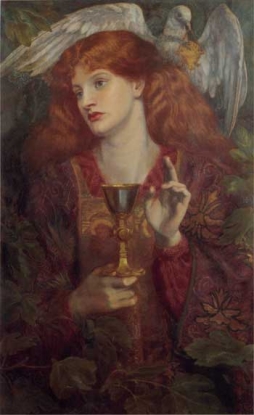
You can see her there on the right.

In 1837, Sara Coleridge, the daughter of poet Samuel Taylor Coleridge, published a book called Phantasmion, which was received, and reviewed, as a fairy tale novel. And, at first glance, it certainly seems similar to the German and French fairy tales that were popular at around that time. But I don’t think it reads like a fairy tale, certainly not once it gets going.

It reads very like a high fantasy. In fact, like an otherworld fantasy.

Read More Read More

Worlds Within Worlds: The First Heroic Fantasy (Part III)

Worlds Within Worlds: The First Heroic Fantasy (Part III)

William MorrisThis is the third in a series of posts looking at the question of who wrote the first otherworld fantasy: that is, the first fantasy to be set entirely in its own fictional world, with no connection to conventional reality at all. It’s an innovation traditionally ascribed to William Morris, but I think I’ve found an earlier writer who deserves that honor.

In the first post, I considered how to identify a fictional otherworld. I suggested four characteristics, of which a story’s fictional world needed to have at least three to be a true otherworld: its own logic (which might involve, say, the existence of magic), characters who we identified as residents of another world than our own, a coherent history, and a coherent fictional geography. In the second post, I considered ways in which older fantasies were linked to reality — by being set in the past, or in a place beyond contemporary knowledge, or being established as a dream, or as a story within a story, or as a myth. I concluded by discussing what I felt was significant about the idea of otherworld fantasy.

Before going on to present my suggestion for the writer of the first otherworld fantasy, though, I’d like to take a closer look at some past fantasies I thought came very close to presenting self-contained otherworlds. These are works which I don’t think are true otherworld fantasies, but which other people might choose to see as such.

Read More Read More

Worlds Within Worlds: The First Heroic Fantasy (Part II)

Worlds Within Worlds: The First Heroic Fantasy (Part II)

William MorrisThis is the second post in a series trying to answer what looks like a simple question: who wrote the first fantasy set entirely in another world? As I found in my first post, to answer that question you first have to decide how to define a fantasy otherworld. I came up with a list of four characteristics: whether the world has a distinct logic to it, such as the use of magic; whether the people in the world are meant to be perceived as residents of this world; whether the world has its own history; and whether it has its own geography. It seems to me most otherworlds have all four characteristics, with a few interesting cases getting by with three. Any less than three, and you don’t have an otherworld.

Now, traditionally, William Morris has been considered to be the first writer to have set a story entirely in a fantastic otherworld; that is, to write a story in which the real world as we know it never appeared. His was the name suggested by Lin Carter and L. Sprague de Camp, it was accepted by John Clute and John Grant in their 1997 Encyclopedia of Fantasy, and it’s found a place in the repository of all human knowledge, Wikipedia. I, however, am disagreeing; I’ve found an a writer from a few decades before Morris who wrote something that seems to me to be an otherworld fantasy.

Before naming that writer, though, I’d like to tackle a related question. And that is: why did it take so long for somebody to come up with the idea?

Consider: Morris’ The Wood Beyond the World was published in 1894. Even if the first otherworld fantasy was in fact a few decades earlier, then people were still telling tales for thousands of years before coming up with the idea of an independent world (it would be interesting to see when the term ‘world’ began being used in criticism, as in ‘the world of Dickens’ or ‘Shakespeare’s green world’). Why the long delay?

Read More Read More

Worlds Within Worlds: The First Heroic Fantasy (Part I)

Worlds Within Worlds: The First Heroic Fantasy (Part I)

William MorrisWho was the first person to write high fantasy?

It seems like a simple enough question. By “high fantasy” I mean a story set in a world that is not this one. John Clute, in The Encyclopedia of Fantasy, defines high fantasies as stories “set in otherworlds, specifically secondary worlds, and which deal with matters affecting the destiny of those worlds.” In this definition, ‘Secondary worlds’ is Tolkien’s useful term for a fictional, self-consistent world with its own geography and history.

There’s a bit of ambiguity here, though. A secondary world is not necessarily a wholly other world. Tolkien intended his world of Arda to represent this world in a mythic, pre-historic time. Similarly, Robert E. Howard’s stories of Conan and Kull were meant to take place before the dawn of recorded history, and even most (if not all) of Clark Ashton Smith’s stories are given a precise relation to reality. In fact, Smith locates his stories almost everywhere in the existing universe that a fantasy could conceivably be placed: in the past (Hyperborea, Poseidonis), in the far future (Zothique), on other worlds known (Mars) or unknown (Xiccarph).

These choices of settings justify the fantasy. They explain how the fantasy can be imagined to exist, and make suspension of disbelief easier by linking the fantasy to reality. They frame the fantasy, if you like, in a connection to the real. That’s interesting, but it makes you wonder who the first person was that discarded the frame, and stepped wholly outside of reality. Or, to reframe my original question: who was the first person to come up with the idea of setting a story entirely in a world that is not our own? Who told the first story that had no link to the real world?

Read More Read More

The High House and the False: James Stoddard’s Evenmere

The High House and the False: James Stoddard’s Evenmere

The High HouseIn 1998, American writer James Stoddard published his debut novel, The High House, and two years later followed it with a sequel, The False House. They’re two of the more remarkable fantasies I know.

The High House is Evenmere, a fantastic old rambling edifice that was the boyhood home of Anderson Carter. His father was Master of Evenmere, but the machinations of Anderson’s step-mother, Lady Murmer, led to him being sent away from the High House. Years later, he returns — just as evil forces are emerging to threaten the house, and by extension, all of creation.

For Evenmere, we learn, is not simply a house among houses. In a way, it is the world, and a stranger world than we know. Its doors open onto an endless series of hallways, home to whole nations. The clocks and lamps of Evenmere are the clocks and lamps that keep the universe in motion; for them to run down, or go out, is the ruination of all things, and it is the responsibility of the Master to ensure this does not happen. But the elder Anderson has disappeared, and the sinister Society of Anarchists is stirring …

Read More Read More