Katherine Blake (or Dorothy Heydt) and The Interior Life
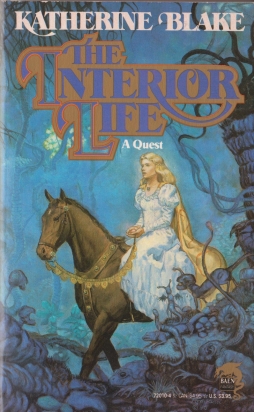 I’ve mentioned a few times before that I have a fascination with 80s fantasy, and suspect a number of now-overlooked genre books from those years are worth closer examination. I want to put forward another example of what I mean: The Interior Life, written by Dorothy Heydt under the name Katherine Blake. Published in 1990, it’s a novel that does interesting things in mixing a fantasy world with the experiences of a modern-day housewife.
The book starts with Sue, whose three kids have just started the school year. Sue’s doing some daily chores and remembers how she told herself fairy tales when she was a child, creating and inhabiting fictional characters: “all the people I used to be.” After which, she starts seeing the lives of people in the quasi-medieval world of Demoura. More precisely, she sees things from the perspective of Lady Amalia, a noblewoman with magical gifts, Marianella, her maid, and occasionally others such as Kieran, an innkeeper’s son who joins Amalia’s service. Demoura’s menaced by a Darkness creeping westward across the land, blighting all in its path; the characters of the Demouran story live a fairly conventional high fantasy tale of an evil wounding the land, of the struggle to overthrow the dark and bring healing. But those characters also, as the story goes on, provide inspiration for Sue.
You could in theory read the book as moving back and forth between two separate worlds. Heydt, in the comments to this perceptive review of the book by Jo Walton, has said that she thinks of the fantasy aspects as entirely Sue’s creation; in fact, without being explicit, a number of things about the set-up imply this. It’s subtly done. Notably, the life-and-death drama of the fantasy becomes the venue for Sue’s development as a person. She wants nothing more than to tend her family — raise her kids and cook and keep house and help her husband advance in his career. However old-fashioned this sounds, the novel makes it clear she’s happy with this life, and the point of the book is not that she finds new goals, but that she becomes better at what she does and happier in the course of doing so. Two or three interesting points come out of this. First, the blending of the ‘real’ and ‘fantasy’ worlds is worth considering, well-done and unusual. Second, the book points out a generic similarity in fantasy stories about a protagonist developing skills and learning to master their world. Three, and this is perhaps more marked from a twenty-first century perspective than a 1990 perspective, it raises some interesting questions about what is contemporary and what is archaic. Sue’s life and aspirations feel dated in ways that the fantasy of Demoura does not.
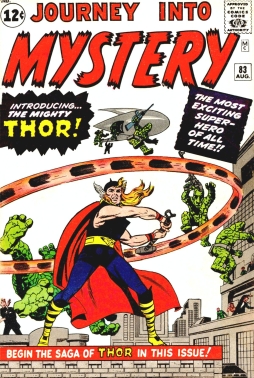 Journey Into Mystery first appeared in 1952, one of a number of anthology titles from publisher Martin Goodman’s line of comic books. Over the years, the title featured a lot of short horror, fantasy, and science fiction tales, many of them collaborations between editor/scripter Stan Lee and artists like Steve Ditko and Jack Kirby. Until 1962. At that point Goodman’s comics were beginning to change direction, following a revival of interest in the super-hero genre. A team book, The Fantastic Four, had taken off. A solo book had followed, The Incredible Hulk. Heroes would now be his company’s main product, and the line would soon come to be known as Marvel Comics. The horror anthology books would be taken over by recurring super-hero characters, and Journey Into Mystery would be the first of the bunch. So with issue 83, in August 1962, in a story credited to Stan Lee and artist Jack Kirby, it introduced its new lead: the mighty Thor, Norse god of thunder.
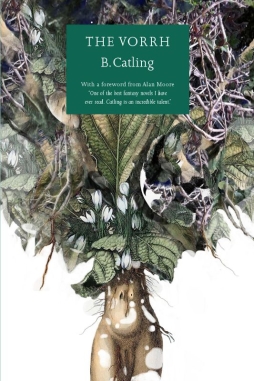 Raymond Roussel was a French surrealist writer who died in 1933, aged 56; one of his most famous works, Impressions of Africa, was a self-published novel (later turned into a play) depicting a fantastical African land based on no actual place, which contained a forest called the Vorrh. Late last year, the English sculptor and poet Brian Catling published his second novel, a story based on Roussel’s work: The Vorrh, first of a projected trilogy, described on its back cover as an epic fantasy. It’s a powerful book, precise and unexpected in its use of language and its plot construction, a dizzying and straight-faced blend of history and the unreal.
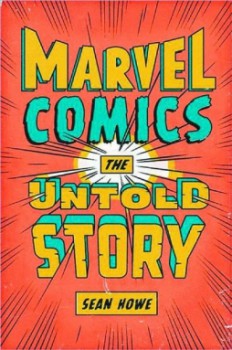 Early on in Sean Howe’s book-length history Marvel Comics: The Untold Story, the reader’s imagination is spurred by a throwaway anecdote: in 1937, New York magazine publisher Martin Goodman and his wife planned to return from a trip to Europe aboard the Hindenburg — on what would turn out to be the final tragic flight of the German dirigible, which ended with a terrifying aerial explosion and fire that led to the deaths of 36 people. Goodman, as it happened, was too late to get tickets and took a plane instead. You can’t help but wonder, though. What if he’d died then, before he’d expanded his magazine line to include comics? Before he’d hired his nephew Stanley to work in the office and do fill-in bits of writing? What if Marvel Comics, the subject of Howe’s book, had been stillborn? What would have been different in the development of comics, of popular culture, of the North American imagination? Maybe everything. Maybe nothing.
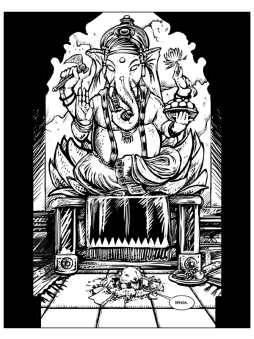 The Hugo Award for Best Graphic Story was first given out in 2009. The category was a nice idea, especially given the increased prominence of comics in the media landscape, but I have to admit that up to this year, I’ve been underwhelmed by the choice of winners. Or, more precisely, winner, singular: Phil and Kaja Foglio’s webcomic Girl Genius took the award three times straight. I don’t dislike the comic, but from what I’ve read, I’d be hard-pressed to identify anything in it that makes it worth a major award ahead of any number of series — Hellboy or Mouse Guard or Wednesday Comics or RASL or All-Star Superman or you name it. After their third win, though, the Foglios announced they would decline to accept a nomination for the next year, in the interest of helping to establish the validity of the award. So the 2012 Hugo went to another title:
  I’ve been thinking a fair bit lately about how I read what I read, and how I enjoy it. Or, what’s in it that I enjoy. It seems to me that much of the pleasure in my reading comes about from bad habits. Which is to say, habits that I can’t help but think ought to be bad, but which nevertheless feel central to the act of reading. Maybe that feeling’s an illusion; maybe it’s the secret why bad habits become habits. At any rate, I thought I’d be self-indulgent this week and throw out what I’ve come up with, as I’d love to hear if any of it resonates with anyone else’s experience of reading.
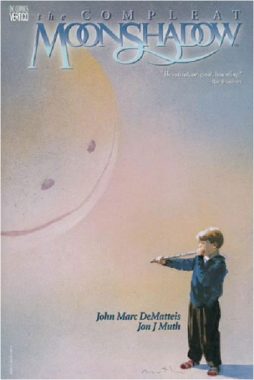 There was a time in the 1980s when it looked like Marvel and DC Comics might slowly evolve into something like mainstream book publishers: publishers who gave creators fair deals respecting copyright, and who lived off of the publication of new titles rather than the exploitation of intellectual property from decades previous. That hasn’t really happened, so far as I can see. Both companies dabbled in various kinds of creator ownership, but both appear mostly to have retreated to the relative safety of work-for-hire deals in recent years. Vertigo, a DC imprint featuring better deals for creators, seems to have become more strict in their contracts, and the
 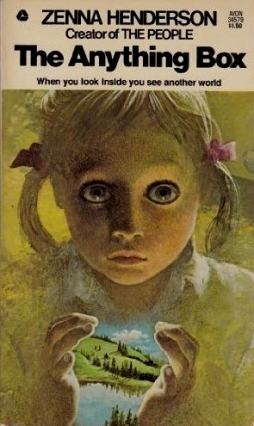 As so often happens, I was at a book fair the other week when, again as so often happens, I stumbled on a book by a writer I’d heard of at some point and about whose work I was vaguely curious. In this case, the writer was Zenna Henderson and the book was a collection of sf and fantasy short stories called The Anything Box. Which, upon reading, I found to be quite intriguing.
 Typically in these blog posts, I write about some work of fantasy, science fiction, or horror; of fantastika. I’m not sure whether the book I want to write about this time round can be described as any of those things. It’s not always, in fact, easy to distinguish what is fantastic and what is not. Does the distinction lie in what the writer has in mind, or in how the reader interprets the text? If a man who believes himself to be a magician writes about magic, is that fantasy or mimetic fiction? The author describes the world as the author understands it. The reader, reading, then sees the world as the author does: so writing is perhaps inherently magical, a possession. All words are magic words. All stories are true.